JAMA Network publishes new analysis showing 56% drop in insulin out‑of‑pocket costs for Medicare beneficiaries –
Insulin affordability improved nationwide; beneficiaries paying more than $35 per month dropped from 52% to 25%, alongside OOP costs dropping nearly 60%
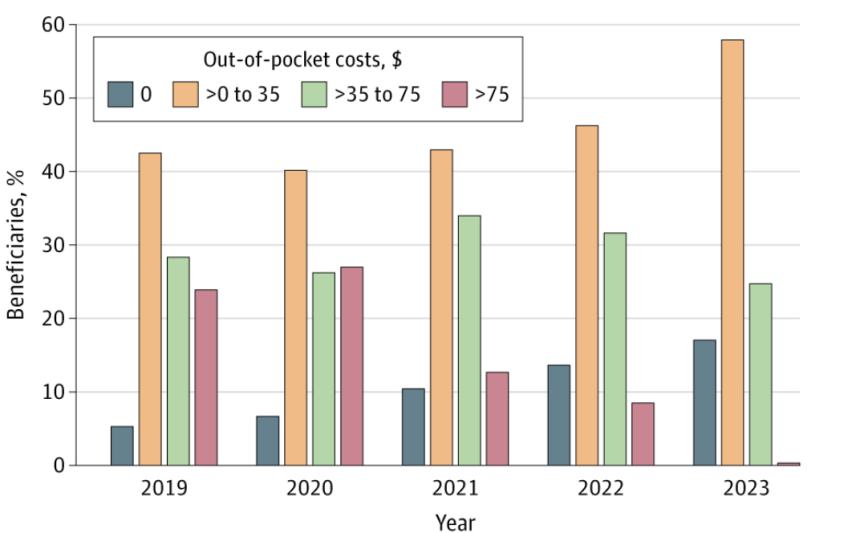
JAMA Network published a study yesterday, “Trends in Insulin Out-of-Pocket Costs Among US Medicare Beneficiaries,” by Dr. Michael Fang (Johns Hopkins University), Dr. Elizabeth Selvin, and Dr. Mariana Socal, et al. Using 100% Medicare Part D claims between 2019 and 2023, the study found that the share of beneficiaries paying less than $35 for a 30‑day supply rose from 48% to 75%. Correspondingly, the mean monthly out‑of‑pocket (OOP) costs fell from $50.87 to $21.98, reflecting a 55.8% relative reduction. Moreover, virtually no one in 2023 paid over $75 per month for insulin out of pocket, compared to nearly a quarter in 2019 – suggesting that those with extremely high out-of-pocket cost burden benefited most from the new price cap. The decline accelerated after the Part D Senior Savings Model was launched in 2020, which Lilly, Sanofi, and Novo Nordisk signed. In 2023, the Inflation Reduction Act capped OOP for monthly insulin costs in Medicare at $35.
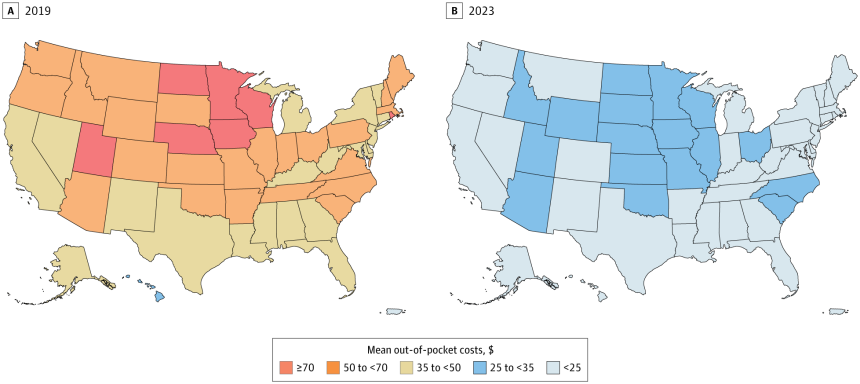
The mean out-of-pocket cost was over $25 per month in 17 states in 2023
The range of insulin costs was relatively broad, with $10.36/month representing the lowest mean OOP in Washington, DC, and the highest going up only to $31.09/month in Minnesota. In all, there were 17 states with prices above $25/month.
A quarter of Medicare beneficiaries still pay over $35 per month
We note that one-quarter of beneficiaries still paid more than $35/month in 2023, with almost all of them having at least one non‑prorated claim for quantities not aligned with 30, 60, or 90‑day intervals. While this seems like an easy thing to fix, non‑standard refill lengths, like a 45‑day supply (which don’t align with 30‑day intervals), resulted in OOP costs that exceeded $35 per month. State‑level variation persisted in 2023, with the highest costs in rural Midwest states. See the figure below for a comparison of mean insulin OOPs nationwide from 2019 to 2023. We look forward to seeing more recent data to better understand the impact of the pandemic on this crisis for some people who still may not be able to afford insulin.
Dr. Michael Fang discusses the next steps for research and policy
In our conversation, Dr. Fang said that prorating the IRA cap across all quantities is a crucial – albeit slow – next step for the Centers for Medicare & Medicaid Services (CMS). The CMS allows plans to charge non-30-day quantities at any price, as long as it is below $35 for a full month. This can lead patients to pay more per day for smaller supplies (e.g., $35 for a 15-day insulin supply). Dr. Fang advocated for a policy in which CMS mandates plans to prorate, but changing and implementing CMS policy is a long process.
He said that future research could evaluate whether reducing the out-of-pocket costs of insulin translates to improved long-term outcomes, such as glycemic management and complications.
-- by Kayla Mathieu, Kat Moon, Jeremy Alkire, and Kelly Close