Medtronic receives FDA approval for Simplera Sync –
The decision follows EU’s lead for this sensor last year; exciting upcoming option for 780G users
Good Friday brought good news for Medtronic, as the FDA approved Medtronic’s Simplera Sync this afternoon – it’s excellent news for all Medtronic users on the path to better glycemic health to have yet another strong sensor choice! It’s also good for all health systems, since continuous insulin therapy has long been associated with fewer long-term micro- and macrovascular complications. For those on pump therapy using AID, the quality of the sensor is especially important. This includes approximately 40% of people with T1D and fewer than 5% of those with T2D who are on insulin.
Medtronic said that a limited launch of Simplera Sync will begin in fall 2025. MiniMed 780G users can use the system with the Guardian 4 sensor before this launch.
Table of Contents
Product details: Disposable all-in-one sensor features smaller form factor and simplified insertion process
What’s the big deal with this one compared to Guardian 4? Well, it’s all about the accuracy. Not surprisingly, that is a big issue for people with type 1 diabetes, and we believe they will be happy with this new sensor if they are already on a Medtronic pump or if that is the pump they choose. Simplera Sync – we love the name – is more accurate than other Medtronic sensors (MARD of 10.2% vs. Guardian 4’s 10.6% MARD in adults), and that will make it far more appealing to current and future users.
Although Simplera Sync and Guardian 4 both offer seven-day wear time, Simplera Sync features several meaningful quality-of-life improvements. Simplera Sync is Medtronic’s first disposable, all-in-one sensor and is half the size of Guardian 4, which has a disposable sensor and rechargeable transmitter. Simplera Sync offers a simplified two-step insertion process, and users do not need to apply overtape. Calibrations are not required in SmartGuard mode; however, users still need to calibrate the sensor in manual mode and to enter SmartGuard.
Simplera Sync launched in Europe last year – 30 countries and counting
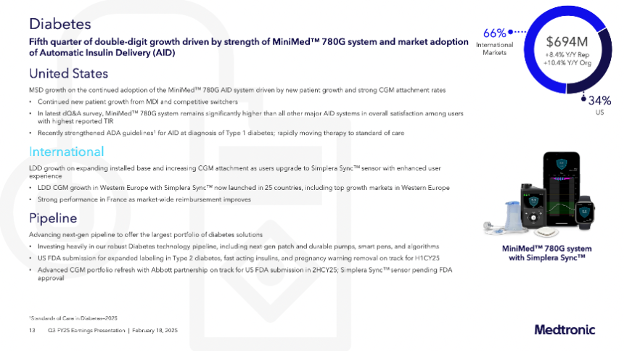
This approval has been in the works for some time, as Medtronic originally submitted Simplera Sync to the FDA in 1Q24. Simplera Sync already received CE Mark in January 2024, which is typical – the EU often moves faster than the US on medical device approvals. Medtronic subsequently initiated a limited launch in five European countries later in 1Q24, followed by a full commercial launch in 2Q24. As of Medtronic’s last quarterly report in February, Simplera Sync was already launched in 25 countries in the EU, up from 16 countries a quarter earlier. Presumably, the pace at which they’re going would imply at least 30 countries, if not more. Although we wish the US weren’t at the tail end of this launch, we’re very excited to see where the approval will take this product.
Approval could catalyze greater MiniMed 780G adoption – both new users as well as switchers
We expect this approval in the US to drive more people to pump therapy, as some clinicians still use Medtronic or nothing, and this is a big win for them. While the approval could also cause some pump users to switch to Medtronic (there are many loyalists to their diabetes division in the clinical world), that might take a while, as payers allow traditional durable pump switches only every four years or so. As a sidenote, although people on Insulet can switch at virtually any time, it’s our sense that typically, once they have chosen “no sets,” they aren’t as likely to switch to other pumps, though it’s not unheard of.
Pipeline: Medtronic will submit FreeStyle Libre-based CGM to FDA in 2H25
Close Concerns’ Questions
- To what extent will Simplera Sync drive a higher number of competitive conversions for Medtronic vs. switchers? Are there any especially high-profile users waiting in the wings?
- How does Medtronic expect Simplera Sync to catalyze growth among MDI users in the US given the phenomenal growth overseas – and how would Medtronic characterize the difference overseas versus within the US?
--by Andrew Goyette and Kelly Close