Medtronic 3Q23 (F2Q24) – Diabetes revenue of $610 million (+10% YOY, +6% sequentially), led by 20% OUS growth; US new patients grew 60% YOY, highest in three years –
Executive Highlights
- Medtronic reported its 3Q23 quarterly update on a call led by CEO Mr. Geoff Martha and CFO Ms. Karen Parkhill. The call reiterated the company’s diabetes turnaround story, with continued signs of upside for the diabetes franchise front and center. See the webcast, press announcement, slide deck, financial schedules.
- Medtronic Diabetes saw 3Q23 global sales of $610 million, rising 10% and beating guidance of “4.5% growth.” OUS sales grew 20% to $393 million while US sales fell 5% to $217 million. US pump sales grew in the low 30s; given that this was the first full quarter that the MiniMed 780G was on the market, we see this as a sign that this market is growing massively!
- In the US, Mr. Martha said that the number of unique 780G prescribers increased “over 20%” sequentially and are “exceeding launch goals” so far. Mr. Martha shared that Medtronic continues to see “very high CGM attachment rates,” which he said is “meaningfully above” the company’s historical rates prior to the 780G launch. Medtronic launched the 780G in Korea in 3Q23, and the company and Japan is scheduled for 4Q23.
- “We don’t see any meaningful change in our diabetes growth outlook through 2030;” Mr. Martha and Ms. Dallara comment on potential impact of GLP-1s. During Q&A, Ms. Dallara said that the SELECT results might suggest that wider GLP-1 adoption could lead to a slowdown towards insulin dependency among people with prediabetes, but she said that Medtronic believes any impact of this potential phenomenon would be offset by the overall low pump penetration among people with type 2 diabetes.
- Pipeline:
- Simplera: Following CE-Mark in September, the standalone CGM is launching in a number of European countries with expanded rollout slated for the next quarter. The US pivotal study for MiniMed 780G with Simplera has completed enrollment and the system has been submitted for CE-Marking. The study should finish by April 2024 and submitted to the FDA by July 2024.
- Indications: Per ClinicalTrials.gov, the 780G preschooler study (NCT05574062) has completed enrollment (n=101 children aged two to six) and the primary completion is slated for May 2024. The type 2 pivotal (NCT05238142) has begun recruiting and has a 2024 completion target.
- Let’s round it up! Now that Medtronic has reported, we bring you our preliminary insulin pump and CGM market estimates for 3Q23 – this reflects an exploding CGM market that is propelling continuous insulin delivery, contributing to a fast-moving AID landscape:
- CGM: $2.6 billion (+26% YOY, +9% Q/Q)
- Pumps: $1.06 billion (+14% YOY, +8% Q/Q)
- AID: $3.66 billion (+21% YOY, +8% Q/Q)
Medtronic reported its 3Q23 (F2Q24) financial results on a call today (webcast, press announcement, slide deck, financial schedules) led by CEO Mr. Geoff Martha and CFO Ms. Karen Parkhill. Diabetes Operating Unit President and EVP Ms. Que Dallara joined today’s call for Q&A. As a reminder, Medtronic’s fiscal calendar ends at the end of April, so today’s call presented Medtronic’s second fiscal 2024 update. Medtronic expects to report its 4Q23 (F3Q24) financial results on February 20, 2024.
Table of Contents
-
Financial Highlights
- 1. Worldwide Diabetes revenue of $610 million, up 10% (+7% operationally); momentous OUS growth (+20%) offset by US decline (-5%)
- 2. Fiscal FY24 guidance raised to 4.75% from 4.5% for full business; “return to growth” in Diabetes revenue in US in back half of the fiscal year
- 3. Mr. Martha and Ms. Dallara riff on potential impact of GLP-1s, highlighting the SELECT trial
-
Device and Pipeline Highlights
- 1. About 16,000 unique prescribers of MiniMed 780G, up “over 20%” from 2Q23; US new patient growth up >60% from 3Q22
- 2. Simplera/“Instinct” with MiniMed 780G submitted for CE-Mark, US pivotal completes enrollment, with FDA submission in 1H24
- 3. Expanded indications for MiniMed 780G to preschoolers and T2D continues to progress
- 4. Medtronic “on track” to bring patch pump to US, amidst patent infringement lawsuit
- 5. Next-gen spinal cord stimulator Inceptiv launched in Europe
- Analyst Q&A
- Close Concerns’ Questions
Financial Highlights
1. Worldwide Diabetes revenue of $610 million, up 10% (+7% operationally); momentous OUS growth (+20%) offset by US decline (-5%)
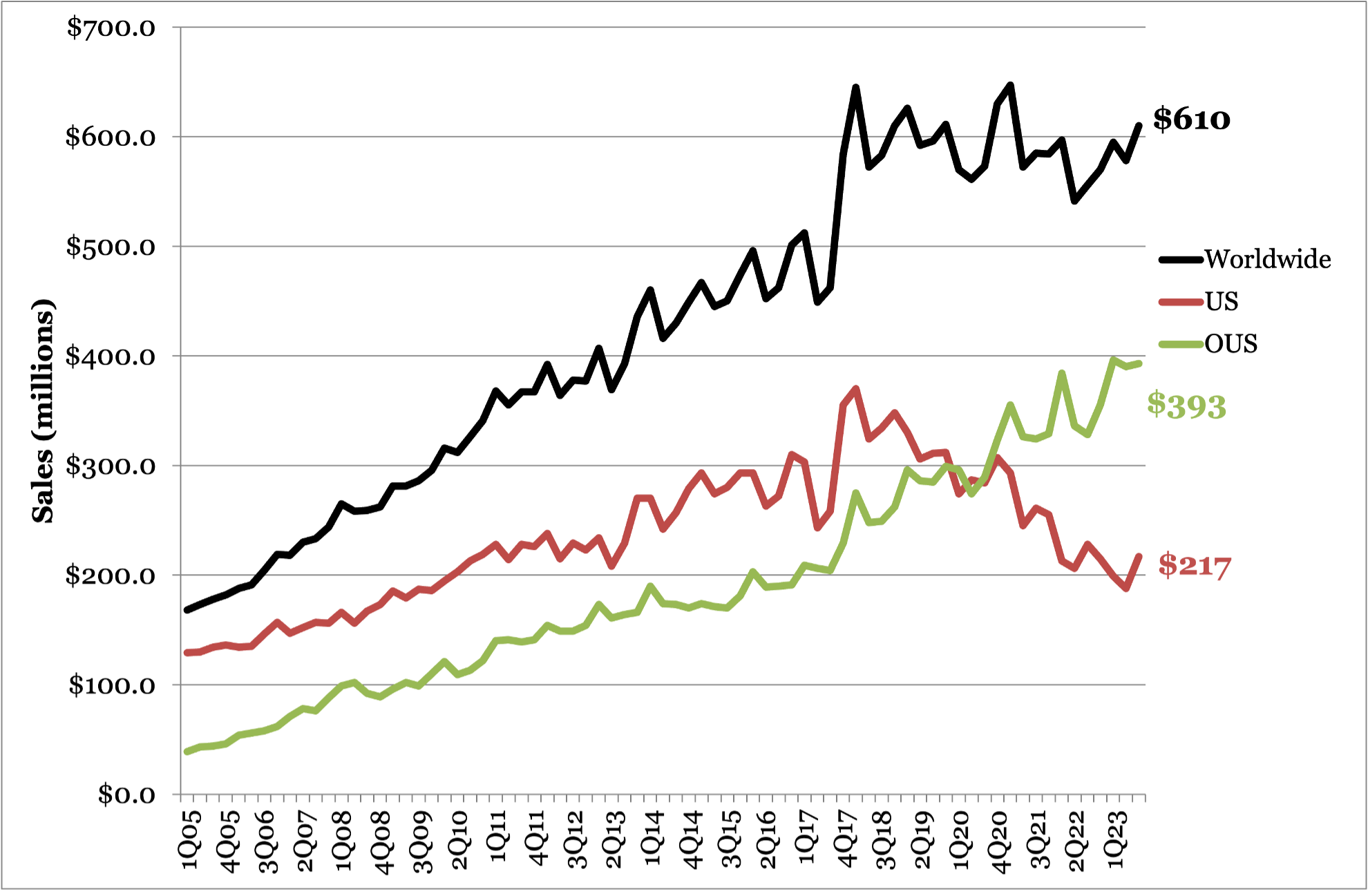
Medtronic Diabetes reported total worldwide sales of $610 million (+10%), the highest in ten quarters (expecting a COVID-19 anomaly in 1Q20). and beating guidance of 4.5% growth. Sequentially, global sales grew 6% from $578 million in 2Q23. Revenue is expected to increase throughout the second half of the fiscal year, as management characterized Medtronic as “driving its turnaround story.”
- Outside the US, Medtronic reported $393 million in sales, growing 20% as reported. Sales in Medtronic’s “non-US developed markets” totaled $310 million (+22%; +15% operationally) and sales in “emerging markets” totaled $84 million (+14%; +15% operationally). Attributed to “mid-teens growth in Western Europe,” this is consistent with past quarters; specifics on markets were not shared. Mr. Martha cited MiniMed 780G adoption as well as increased CGM attachment rates.
- US revenue fell 5%, the result of “installed base attrition,” but expects increased US revenue throughout the year. Although US revenue declined for the tenth straight quarter, 3Q23 marked the first full quarter in which MiniMed 780G was on the market following FDA approval in April and launch in mid-May. Medtronic saw “low 30s” sequential growth in US pump sales in 3Q23 – a favorable indicator of the popularity of AID.
- Sales from insulin pumps and consumables (e.g., infusion sets) still represent the majority of Medtronic’s 3Q23 revenue. For 3Q23, we attributed 66% of Medtronic’s global Diabetes sales to pumps and consumables, compared to 65% in 2Q23, stemming from continued market launches of MiniMed 780G. The remaining 34% of sales were attributed to CGM, and Mr. Martha reported “very high CGM attachment rates in the 780G install base” in OUS markets.
2. Fiscal FY24 guidance raised to 4.75% from 4.5% for full business; “return to growth” in Diabetes revenue in US in back half of the fiscal year
In 3Q23 (F2Q24), Medtronic Diabetes revenue performance aligned with guidance. In 1Q23, Ms. Parkhill said that Diabetes revenue would start fiscal 2024 below 4%, the corporate average, but would ramp up due to the US launch of the 780G. Indeed, 3Q23 diabetes revenue of $610 million, representing 10% growth, seems to affirm this forecast. Ms. Parkhill also said that Medtronic is expecting a “return to growth” in the US in the back half of the fiscal year due to “continued adoption of the 780G and associated CGM and consumables sales.”
- Medtronic raised fiscal year 2024 guidance to 4.75% for the full company, up slightly from the 4.5% guidance issued in 2Q23 (F1Q24). This guidance excludes the impact of foreign currency, and revenue from the company’s “Other” segment. Like 2Q23, According to Ms. Parkhill. the increase is due to the full business’ revenue outperformance in 3Q23 as well as “continued strength in underlying fundamentals” in the company’s supply chain and markets.
- For 4Q23 (F3Q24), Medtronic forecasts revenue guidance of 4-4.5% for the full company. Ms. Parkhill attributed this slightly lower guidance for 4Q23 compared to fiscal year 2024 guidance to an unfavorable impact from foreign currency exchange rates on revenue in 4Q23 of up to $50 million.
3. Mr. Martha and Ms. Dallara riff on potential impact of GLP-1s, highlighting the SELECT trial
Following the readout of the SELECT trial at AHA 2023 this month, GLP-1s were a hot topic on today’s call, with extensive commentary in both Mr. Martha’s prepared remarks and Q&A. In his prepared remarks, Mr. Martha said that GLP-1s are “clearly an exciting class,” stating that the SELECT results suggest GLP-1s have “the potential for a large market.” Unsurprisingly however, Mr. Martha downplayed investor concerns for possible negative impact of GLP-1 adoption on Medtronic’s long-term growth potential in diabetes as well as bariatric surgery.
- In his prepared remarks, Mr. Martha said that only 10% of Medtronic’s installed base are people with type 2 diabetes on insulin therapy. He said that Medtronic expects growth among people with type 2 diabetes in the future due to low pump penetration rates within this population. As well, Mr. Martha said that internal modeling with “aggressive” GLP-1 assumptions has not suggested “any meaningful change” in the company’s growth potential for its Diabetes business through 2030. During Q&A, Ms. Dallara said that the SELECT results might suggest that wider GLP-1 adoption could lead to a slowdown towards insulin dependency among people with prediabetes, but she said that Medtronic believes any impact of this potential phenomenon would be offset by the overall low pump penetration among people with type 2 diabetes – we were especially grateful to hear Ms. Dallara mention how GLP-1s can delay insulin initiation and believe that this is another meaningful impact of these therapies. She said that the company remains optimistic for continued growth due to the sizes of these populations. In the US, Ms. Dallara estimated that there are three to four million people on basal insulin, 25 million people with type 2 diabetes not on insulin, and over 100 million people with prediabetes.
- Medtronic also commented on the potential impact of GLP-1s on its bariatric surgery business. In his prepared remarks, Mr. Martha said that Medtronic expects temporary, yet “modest,” impact on its bariatric surgery market; however, he emphasized that the company does not anticipate a prolonged impact due to long-term adherence difficulties with GLP-1s and smaller weight loss effects for people with more severe obesity in SELECT. Specifically, he said that Medtronic expects the current headwinds on bariatric surgery procedures in the US to stabilize “over the next several quarters” and return to growth by calendar year 2025.
Device and Pipeline Highlights
1. About 16,000 unique prescribers of MiniMed 780G, up “over 20%” from 2Q23; US new patient growth up >60% from 3Q22
Medtronic’s MiniMed 780G remained a large focus of today’s call, following the system’s FDA approval in April 2023. Despite 3Q23 being only the first full quarter of the 780G launch in the US, Mr. Martha said that Medtronic is “exceeding [its] launch goals” so far. As well, Mr. Martha shared that Medtronic continues to see “very high CGM attachment rates,” which he said is “meaningfully above” the company’s historical rates, prior to the 780G launch. Therefore, Mr. Martha said that Medtronic remains confident that the company’s CGM and consumables sales will ramp in the US and that the company’s Diabetes business will drive even more growth moving forward.
- In the US, Mr. Martha said that the number of unique 780G prescribers increased “over 20%” sequentially. While Mr. Martha did not disclose a specific number of prescribers, we estimate that there are now ~16,000 unique prescribers of the 780G, up from ~13,000 in 2Q23 and 10,000 at ADA 2023. Additionally, in the company’s slide presentation (Slide 13), we learned that new patients grew by over 60% compared to 3Q22, with new user starts surpassing three-year highs in the US. Medtronic attributed this strong patient growth to increasing conversions from MDI as well as competitive conversions.
- Internationally, 780G also continues to grow at a strong rate. While there was little commentary regarding the 780G’s performance internationally on today’s call, we did learn from the company’s slide presentation (Slide 13) that “mid-teens growth” was observed in Western Europe. In 2Q23 and at ADA 2023, Ms. Dallara shared that Medtronic was winning ~40% of new starts in the top six Western European markets with direct competition. We’re excited to see how this dynamic continues to play out and are curious to know whether this share of new starts was maintained in 3Q23. Additionally, Medtronic launched the 780G in Korea in 3Q23, and the company anticipates launching the system in Japan in 4Q23.
2. Simplera/“Instinct” with MiniMed 780G submitted for CE-Mark, US pivotal completes enrollment, with FDA submission in 1H24
On the CGM side, the Instinct trial of next-gen CGM, Simplera, continues progressing towards goal of FDA clearance by the end of fiscal FY24 (i.e., by April 2024), following CE-Mark of the standalone CGM in September. Recall that Simplera has been submitted for FDA clearance since February 2023 and is in a phased launch in Europe. Medtronic has access for the standalone CGM in 30+ Europe, Middle Eastern, and African markets, and the expanded rollout of the system expected in F2H24 (i.e. through April 2024). Simplera is one generation ahead of the recently FDA-cleared Guardian 4 sensor, preserving the same form factor and seven-day wear duration of Guardian Sensor 3 but eliminating calibrations. This next gen-sensor is significantly smaller than the Guardian sensors and will be Medtronic’s first fully disposable CGM. Overall, Simplera will help Medtronic on the competitive front with Abbott and Dexcom, and importantly, the new sensor will likely be perceived as less of a negative for the company, relatively speaking.
- The US pivotal study for MiniMed 780G with Simplera has completed enrollment (NCT05714059) and the system has been submitted for CE-Marking. Recall that Medtronic shared IDE receival for this trial during its 3Q22 update a year ago. The study is slated to finish by the end of FY 2024 and Medtronic plans to submit the system to the FDA by July 2024. The four-month study, titled, “Safety and Effectiveness of the MiniMed 780G System with DS5 CGM,” has enrolled 250 adults and children with type 1 diabetes. The study will also utilize Medtronic’s Extended Infusion Set. The combination of: (i) Medtronic’s latest pump and algorithm; (ii) fully-disposable, smaller, and no calibration CGM; and (iii) seven-day infusion set will undoubtedly be a very compelling AID offering when available – we can’t wait to hear more from those in the trial afterwards. Additionally, we learned in a separate correspondence that Simplera will be branded as “Instinct” when used as a component in an AID system.
3. Expanded indications for MiniMed 780G to preschoolers and T2D continues to progress
Although Medtronic continues to focus on the US launch of the 780G, the company also continues to advance its pipeline work. On today’s call, Mr. Martha expressed excitement regarding pipeline developments in Medtronic’s diabetes business. Notably, Medtronic continues to advance clinical work to support expanded indications for MiniMed 780G, specifically for type 2 diabetes and preschoolers.
- Type 2 Diabetes: Although Medtronic’s type 2 diabetes pivotal with the 780G (NCT05238142) was unmentioned on today’s call, management said in Q&A that it believes there is substantial upside for growth in AID for people with type 2 diabetes on insulin therapy and characterized this population as “under-penetrated.” Recall that the trial has begun recruiting and expects enrollment of ≥500 people with type 2 diabetes. Per ClinicalTrials.gov, the study remains on track to complete in 2024.
- Preschoolers: Medtronic also intends to submit an expanded indication for the 780G for preschoolers, although no updates were shared on this work on today’s call. Recall that although the 770G is indicated for use in preschoolers (≥2 years old), the 780G was only approved for people with type 1 diabetes older than seven years of age; however, in a separate conversation with Medtronic, we learned that the company will submit data from the LENNY trial, which is currently ongoing in Europe, to obtain an indication from the FDA for this age group. Per ClinicalTrials.gov, the study (NCT05574062) has completed enrollment (n=101 children aged two-six) and the primary completed is slated for May 2024.
4. Medtronic “on track” to bring patch pump to US, amidst patent infringement lawsuit
Management briefly mentioned Medtronic’s impending acquisition of South Korea-based EOFlow, the developer of EOPatch. On today’s call, management said that the company was “on track” to bring the patch pump to the US market. Recall that the deal, valued at $738 million, is slated to close in 2H23. While not mentioned on today’s call, Insulet recently filed a patent infringement lawsuit in the US against EOFlow for its tubeless insulin patch pump EOPatch. As a reminder, EOPatch is a fully disposable patch pump with 3.5-day wear time, which EOFlow submitted for 510(k) clearance with the FDA in December 2022. Insulet CEO Dr. Hollingshead on Insulet’s 3Q23 call said that the court granted the preliminary injunction request, which prevents EOFlow from “manufacturing, marketing, or selling to any new customer, any product that was designed, developed, or manufactured, using or relying on Insulet’s trade secret.”
- At Medtronic’s ADA 2023 Investor Day, Ms. Dallara shared that Medtronic has no intention of changing the form factor of EOPatch. Ms. Dallara characterized EOFlow’s high-caliber manufacturing as one of the reasons Medtronic was initially interested in the company. Ms. Dallara also explained that due to the fact that EOFlow is already on the market in both Europe, via a partnership with A.Menarini, and South Korea, Medtronic sees few challenges in the path to bring the pump to the market with Medtronic’s CGM and algorithm.
5. Next-gen spinal cord stimulator Inceptiv launched in Europe
Although painful diabetic neuropathy (PDN) was not a large focus on today’s call, we’re covering this area in more detail in light of recent regulatory approvals that have been very exciting to many PWDC (patients with diabetes complications). Recall that Medtronic’s next-gen spinal cord stimulator, Inceptiv, received CE-Mark in August. Today, Medtronic shared that the system is launched in Europe and the company has completed its first European implants. Inceptiv adds to Medtronic’s portfolio of spinal cord stimulators, which includes Intellis and Vanta – both of which are indicated to treat PDN. Notably, Inceptiv is differentiated from Intellis and Vanta as it is a “closed-loop” system, which can detect and adjust the strength of impulses automatically. In 3Q22, Inceptiv was also submitted to the FDA for approval, although it is unclear whether Inceptiv will have an indication for PDN upon approval or if Medtronic intends to submit for this indication following approval. Beyond Medtronic’s Intellis and Vanta, Nevro’s HFX, Abbott’s Proclaim XR, and Boston Scientific’s WaveWriter Alpha spinal cord stimulators have received FDA approval to treat PDN, so we’ll be interested to see if Inceptiv enters this market in the future to address this significant unmet need.
Analyst Q&A
Q (Travis Steed, Bank of America): Geoff, I did want to follow-up on your thoughts on GLP-1s. Curious if there's any color you'd add on the SELECT trial with the cardiovascular endpoints and diabetes prevention that maybe you didn't mention in the prepared remarks.
Mr. Geoff Martha, CEO: First of all, I want to make it clear that we see that it's an exciting class of drugs with a large opportunity, and I'm sure just like you, I talk to many patients that are benefiting from these drugs, from a weight perspective, from a mental health perspective. It's pretty amazing. That being said, we've done a lot of work, and outside of the near-term temporary impact on bariatric surgery market, we don't see these drugs impacting our growth outlook, even in the long-term. On the bariatric piece, as we mentioned, it is a small part of our revenue, low single-digits, and the rate of decline is stabilized there. I think we see that coming back here in the coming year even. So, we did do a lot of work here and it was, like I said, science-based and looking at epidemiology and really digging into SELECT.
And what we do have on the call here, our Chief Medical Officer Dr. Laura Mauri, and I thought I'd call her in here, bring in a relief pitcher here on that question, to talk a little bit more about SELECT and kind of what we're seeing out of that. So, Laura, can you chime in here?
Dr. Laura Mauri, SVP and Chief Scientific, Medical, and Regulatory Officer: The SELECT trial results that were presented at AHA gave us a lot more detail beyond the top-line that we heard about back in August to really look at the endpoints, and look at drug adherence, understand the details of the trial results. As you know, these were patients with obesity with a history of cardiovascular disease. And as Geoff said, this is a very important advance for this patient population, but the results didn't change our overall impression that there will be a negligible effect on the growth of cardiovascular procedure volumes, and that's based on a couple of things that we saw in the detailed results.
First, the number needed to treat was much higher, and that means it's setting a higher bar for treatment compared with other things that are used in guidelines. Then we saw that there was a lack of effect on cardiovascular death and that's something that if it had been present would have spurred more adoption and the lack of that is important, because it will not spur the wide adoption and coverage that we might have been looking at if that had been positive. Then the only effect on the composite endpoint was non-fatal MI, not stroke or cardiovascular death as I mentioned. And as you know, the discontinuation rates were nearly one-third of patients due to the nausea and GI side effects. And clearly, we know from practice that rates of adherence are even lower and that results in lower treatment effects. And then there were a couple of interesting findings in the trial. As Geoff mentioned earlier, the higher BMI population didn't seem to have as much benefit and there was no significant treatment effect in the North American subgroup, which is certainly something that I think we'll want to understand better going forward.
So, using range of assumptions, we updated our models across the major cardiovascular procedures and the inputs to that were looking at US procedure volume across different procedure areas, using data on the prevalence of obesity for each of these procedure populations, and then a range of penetration and adherence assumptions all the way up to and including what we've seen over time with statins, which as you know are really well-tolerated and just freely available and part of guidelines for the past 30 years. Then we also input the risk reductions seen in each of the endpoints from the SELECT trial or literature based on weight loss to look at treatment effects. The bottom-line is that the reduction to TAM growth over the next 10 to 30 years is really negligible on the cardiovascular procedure outlook.
I think it's really important to also note what this analysis doesn't include, and that's that there will probably be offsets in the markets that are really under-penetrated or new like PFA or Ardian, because of the growth, the rapid growth in those areas. And then there's, in fact, potential upside for patients in procedure growth because of the potentially longer survival or lower BMI that makes a greater funnel of patients eligible for cardiovascular procedures.
Ms. Que Dallara, EVP and President, Diabetes Operating Unit: Like Laura mentioned, we spent quite a bit of time studying this and I think there's some evidence from SELECT that would say there may be a slowdown in the pre-diabetic population towards insulin dependency and maybe some in type 2 will come off insulin, but we believe that is very small and more than offset by the fact that there is low penetration of type 2 using AID. And the fact that when you look at the funnel of 3 to 4 million who require basal insulin, with 25 million non-insulin type 2s as well as the over 100 million pre-diabetic population, it doesn't change our point of view on the long-term size of the market as well as the growth rates. And as Geoff mentioned at the beginning, the majority of our business more than 90% is in type 1 diabetes, so we remain pretty optimistic about the growth and market profile in diabetes.
Q (Robbie Marcus, JPMorgan): Geoff, you talked about how most of the headwinds are largely mitigated. I look at the guidance implied in the second half of the year, which is a point of growth or so below the first half. Maybe you can just talk about how we should think about the lower growth in the second half versus the first half and the reasons for that. And then part B. If I look to fiscal year 2025, the street has you pretty close to your long-range plan of 5%+ on the top and 8%+ on the bottom. Is that the right way to think about next year? Are there any headwinds or tailwinds we should be thinking about here, like potential dilution from the monitoring business?
Mr. Geoff Martha, CEO: In terms of the headwinds being mitigated, what I'd say is the markets are pretty stable, especially relative to what we've seen over the last couple of years with procedures. The staffing issues that were hurting the procedural growth are more or less under control. Pricing has been stable. We can talk China later, we're working through the China VBP, but that's largely behind us. Still a little bit more to go but largely behind us.
And then our own internal changes to our global operations and supply chain. That was a big one for us and has been a big one, and we're seeing our teams perform much better and now we're turning that into a strategic long-term strength, and our supply is in a much better situation. So, then of course our pipeline is coming in, and I'm sure we'll get into that in the call here with a lot of new approvals, plus the prior approvals of where we're starting to launch. They're having meaningful uptake, so that's where the optimism is. In terms of how to think about the back half versus the first half, and then getting into FY 2025, I'll turn that over to Karen.
Ms. Karen Parkhill, CFO and Executive Vice President: On the back half, Robbie, our comparisons do get a little tougher as you know, but we've got a really strong innovation pipeline that we talked about, and that's driving a growth acceleration from the first half to the second half. We've got our Diabetes business returning to growth in the second half. We talked about our extensive pipeline. EV-ICD, PFA, Hugo, Evolut FX and now the Ardian approval. And so, we're confident in this growth acceleration, and we're confident that that's going to continue beyond the back half of next year.
We think about FY 2025. You know it's still early. We have two quarters left in this fiscal year and we're laser-focused on delivering the rest of this year. We're also at the beginning of our planning process, so we're not ready to give specifics, but I do know that all of you are working on your calendar-year models for our competitors, so happy to give you some perspective based on what we know today and what we're thinking about. I'll start with revenue because we've been focused on consistently delivering that mid-single-digit revenue growth and you've seen us do that for four quarters now. Our new full year guide for this fiscal year is 4.75%, and as I mentioned we've got the strength of those numerous product approvals in big markets that are launching around the world to help drive our back half growth, and obviously, we're confident that strength will continue into next year and beyond. On margins and down the P&L, there are some puts and takes. We've got inflation stabilizing a bit but it's still higher than historical but again, it's stabilizing. Currency is dynamic, and as you know, the US dollar has been strong, so we're likely facing a headwind from FX but we'll see how that shakes out.
Global tax reform will likely be a headwind but as always, we're focused on driving offsets everywhere that we can. Geoff talked about it. We've made progress on cost of goods sold and cost-out, starting with centralizing our global ops team. We have work to do but those teams now have tangible programs in place to drive that work, and we'll continue to drive pricing as an important lever.
We've built a new muscle on pricing, and our focus is to keep it strong. We've been working hard on controlling expenses and that includes maintaining discipline on our largest driver of our expense which is our head count. So, I hope that gives you some color on just the puts and takes, but to summarize, I'll remind you what hasn't changed, and that's our long-range commitment of driving durable mid-single-digit top growth, of driving leverage down the P&L, of driving a strong free cash conversion and a growing dividend, which all combined ultimately delivers double-digit total shareholder return.
What has changed though is our progress toward that commitment. You've already seen us at mid-single-digit top-line. We've talked about the strong pipeline that gives us confidence in its durability and obviously, we've talked about the programs we have in place, whether it's in head count management, COGS costs down, pricing discipline, and they're all levers to help us offset the headwinds and over time, establish that same durability on the bottom-line.
Q (Matt O’Brien, Piper Sandler): You're a 30-plus-billion-dollar-revenue company, but you have talked about more tuck-in acquisitions historically. Just given your size, given the strength in terms of new product flow, I'm just wondering if now is the time to be more aggressive from an M&A perspective, just given the pullback that we've seen at some of the public company side of things, to be able to do a bigger deal to really solidify your growth algorithm going forward. Are you more amenable to doing bigger deals now just given strong balance sheet and the operating model together, etc.?
Mr. Geoff Martha, CEO: And yeah, clearly, I think you're seeing asset prices come down, and it's a tough operating environment. I think they're going to continue to come down in the mid cap space in particular and below. But we definitely have the capabilities as you pointed out to do bigger deals. All that being said our focus still is on tuck-ins, and we've got a lot of big organic programs between just Ardian, the robot, PFA, Diabetes – I mean, the list goes on. There's a lot of big organic pipeline going up against these high-growth markets that we're really focused on and then I would augment that with the appropriate tuck-ins, so I'm not going to, I don't think we're really focused on, and we're not going to say we're focused on any kind of bigger deals at this point.
Q (Rich Newitter, Truist): We saw more broadly in MedTech a little bit of seasonality or a weaker, I think, third quarter for a number of your competitors play out. Just wonder if you could comment on the trend throughout the quarter. Was August unseasonably kind of weaker than what you would have thought? And what's been the normal pickup? Is it stronger-than-expected into the 4Q, especially if you could talk about the exit trend from September into October?
Ms. Karen Parkhill, CFO and Executive Vice President: I would say we saw strength throughout the second quarter no matter what month you looked at, and I think that's driven in part by just the strength of our product offering. When we look at the first few weeks of this quarter and how that's been trending, it's been trending well. We're tracking to the expectations that we set in our guidance at this stage.
Close Concerns’ Questions
- How is the Extended Infusion Set business going? Is it possible to know, approximately what percentage of MiniMed 780G users are using the company’s Extended Infusion Set in geographies where it is launched?
- To what degree are Medtronic’s “win back” customers switching from Insulet or Tandem or Beta Bionics or something else? To what degree did Insulet and Tandem win former Medtronic users that didn’t wait for the approval of the 780G?
- Was Simplera’s FDA submission for class II iCGM approval or standard CGM approval through a class III PMA submission?
- What is the feedback from HCPs in busier-than-ever clinics on how easy it is to track PWD on the 780G compared to Tandem’s Control IQ compared to Insulet’s Omnipod 5?
- What does pricing look in Europe compared to other geographic markets?
- What is the average TIR, TAR, and TBR for people on the 780G vs. the 770G vs. the 670G? What has Medtronic most learned and noticed and how does this compare to management teams at Abbott, Dexcom, Insulet, and Tandem?
--by Emily Herndon, Andrew Goyette, Katie Lingen, and Kelly Close