Madrigal 1Q26 – Rezdiffra revenue totals $311 million (up over 2x), with 42,000+ patients on treatment for MASH; siRNA added to pipeline –
Executive Highlights
- Madrigal reported its 1Q26 results this morning in a call led by CEO Mr. Bill Sibold, CMO Dr. David Soergel, and CFO Ms. Mardi Dier – see the webcast, press release, and slides.
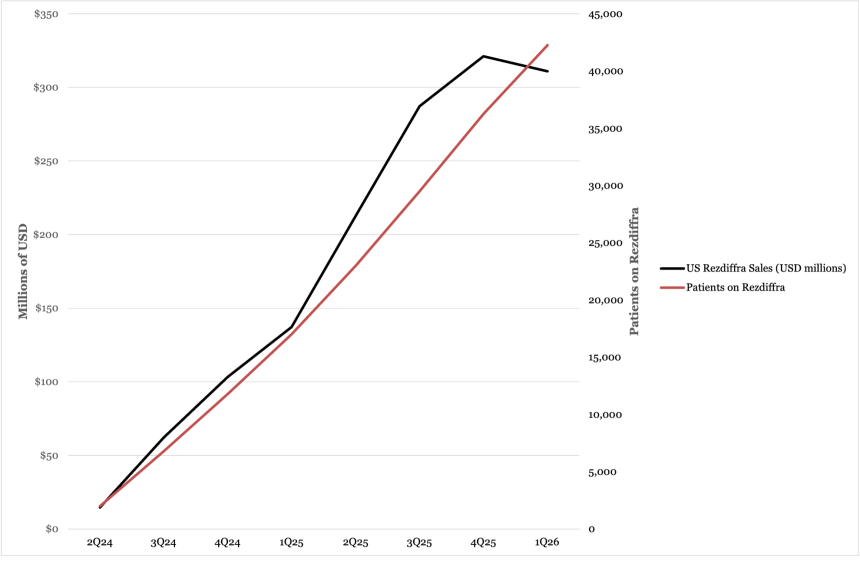
- In its second year on the market, Madrigal’s Rezdiffra (resmetirom), a once-daily oral thyroid hormone receptor-β agonist for metabolic dysfunction-associated steatohepatitis (MASH), totaled $311 million in 1Q26, up more than 2x from 1Q25 and down 3% sequentially. Rezdiffra has now generated more than $1.1 billion in trailing 12‑month sales, achieving blockbuster status in the MASH landscape, which management characterized as “early, underdiagnosed, and underpenetrated.”
- Rezdiffra exited 1Q26 with more than 42,250 active patients, up 2.5x from 1Q25 and up 17% from 4Q25,reflecting strong treatment persistence and expanding prescriber confidence. Management noted that momentum has continued into 2Q26, with April marking the strongest month since the launch of new‑to‑brand prescriptions.
- Madrigal will be presenting eight abstracts later this month at EASL 2026 in Barcelona. Presentations include a secondary analysis from the MAESTRO‑NASH/NAFLD‑1 program showing reductions in Lp(a) and LDL‑c with Rezdiffra, independent of statin use. Madrigal will also present results from two real‑world studies featuring patients treated for up to one year, providing validation of the consistency seen in the pivotal MAESTRO program.
Table of Contents
-
Top Highlights
- 1. Rezdiffra (resmetirom) sales total $311 million in its second year on the market, up over 2x from 1Q25 and down 3% sequentially
- 2. Strengthening MASH pipeline with siRNA asset added just yesterday, in addition to six other pre-clinical siRNA candidates acquired earlier this year
- 3. Phase 1 trial for oral GLP-1 RA MGL-2086, a potential combination treatment for Rezdiffra, expected in “the coming weeks”
- 4. Rezdiffra reaches more than 42,250 patients, as Madrigal accelerates engagement with the field of endocrinology
- 5. EASL 2026 data to broaden Rezdiffra’s clinical footprint; unmet need for F4c population underscores expansion potential ahead of trial outcomes in 2027
- Analyst Q&A
- Close Concerns’ Questions
Top Highlights
1. Rezdiffra (resmetirom) sales total $311 million in its second year on the market, up over 2x from 1Q25 and down 3% sequentially
In its second year on the market, Madrigal’s Rezdiffra (resmetirom), a once-daily oral thyroid hormone receptor-β agonist for metabolic dysfunction-associated steatohepatitis (MASH), totaled $311 million in 1Q26, up more than 2x from 1Q25 and down 3% sequentially. Rezdiffra has now generated more than $1.1 billion in trailing 12‑month sales, achieving blockbuster status in the MASH landscape, which management characterized as “early, underdiagnosed, and underpenetrated.”
- Rezdiffra is currently approved for stage F2/F3 MASH, defined as moderate to severe fibrosis. Management repeatedly underscored that F2/F3 represents a core commercial opportunity, and it also represents where Rezdiffra has shown consistent efficacy across patient subtypes, with the company receiving feedback that the therapy “continues to exceed expectations in the real world.” Despite rapid uptake, penetration remains just under 10% of the 460,000 diagnosed F2/F3 patients under specialist care, highlighting how early the market still is.
- Madrigal ended 1Q26 with $818 million in cash and equivalents, compared with $987 million in 4Q25.Management attributed the 17% sequential decline to upfront business‑development payments and API purchases to support future risk manufacturing. Management emphasized that the company remains well‑resourced to support the ongoing commercial rollout of Rezdiffra and to advance more than 10 pipeline programs. Operating expenses increased meaningfully year‑over‑year as Madrigal continued to invest in launches, including endocrinology field‑force expansion that began in 4Q25 and direct-to-consumer marketing efforts for Rezdiffra.
- While not mentioned on today’s call, Rezdiffra received European Commission approval for F2/F3 MASH in August 2025 and began its first commercial rollout in Germany in September 2025. Germany led the European launch despite MFN‑related pricing uncertainty, and early commercialization required substantial system rewiring, including provider education and expanded use of non‑invasive tests.
 '
Source: Madrigal, Close Concerns’ Knowledgebase
2. Strengthening MASH pipeline with siRNA asset added just yesterday, in addition to six other pre-clinical siRNA candidates acquired earlier this year
Madrigal continues to strengthen its pipeline with ARO-PNPLA3, a clinical-stage siRNA asset targeting a mutation in the PNPLA3 gene that predisposes a significant proportion of people with MASH to advanced liver fibrosis and eventually progression to cirrhosis. Just yesterday, Madrigal announced an exclusive global license agreement with Arrowhead Pharmaceuticals to add ARO-PNPLA3 to its pipeline as a precision treatment for those at high risk of MASH.
- According to Madrigal, PNPLA3 represents a well-established genetic driver of MASH, associated with increased liver fat, inflammation, fibrosis, cirrhosis, and hepatocellular carcinoma. Madrigal plans to advance ARO-PNPLA3 by pairing it with Rezdiffra to explore whether reducing MASH drivers at the genetic level could complement Rezdiffra’s therapeutic effects on the liver.
- ARO-PNPLA3 has demonstrated promising efficacy as a precision treatment in a phase 1 trial (n=55), which included patients with MASLD who were either homozygous or heterozygous carriers of the PNPLA3 variant. In the trial, a single dose of the highest treatment dose led to a 46% reduction in liver fat (measured by MRI-PDFF) at Week 12 in PNPLA3 homozygous patients. Results showed a rapid onset of the treatment effect, with reductions observed as early as six weeks and sustained through at least 24 weeks. On the other hand, no effect on liver fat content was observed in PNPLA3 heterozygous patients at any dose. On safety, ARO-PNPLA3 did not show clinically meaningful adverse events. These results were supported by a second phase 1 trial (n=9) in Japan. Following these results, Madrigal plans to discuss the phase 2 combination trial with Rezdiffra with the FDA.
Aside from ARO-PNPLA3, Madrigal added six other pre-clinical siRNA candidates for MASH in February 2026. These candidates come from an exclusive global licensing agreement with China-based Suzhou Ribo Life Science and its subsidiary, Sweden-based Ribocure Pharmaceuticals. In today’s call, management said these six siRNA targets are progressing at “various stages of preclinical development.”
3. Phase 1 trial for oral GLP-1 RA MGL-2086, a potential combination treatment for Rezdiffra, expected in “the coming weeks”
Madrigal continues to advance MGL-2086, an oral GLP-1 RA and derivative of Lilly’s orforglipron, as a potential combination treatment with Rezdiffra. As a reminder, Madrigal acquired this treatment from CSPC Pharmaceutical Group in July 2025. The combination of MGL-2086 and Rezdiffra aims to optimize the efficacy and tolerability of both treatments in MASH, balancing weight loss from a GLP-1 RA with fibrosis and lipid reduction from Rezdiffra. The rationale for a combination therapy stems from results of the phase 3 MAESTRO‑NASH trial (n=1,759), in which even a 5% weight loss enhanced the antifibrotic benefit of Rezdiffra. Previously, in 4Q25, management emphasized that combination treatment aims to deliver “the right amount” of weight loss rather than maximal weight loss.
During Q&A, management said the phase 1 single‑ascending‑dose study is expected to start in “the coming weeks.” This timeline aligns with what was previously announced in 4Q25, when management said the IND was complete and that the phase 1 trial was expected to begin in 2Q26.
4. Rezdiffra reaches more than 42,250 patients, as Madrigal accelerates engagement with the field of endocrinology
Rezdiffra exited 1Q26 with more than 42,250 active patients, up 2.5x from 1Q25 and up 17% from 4Q25, reflecting strong real‑world persistence and expanding prescriber confidence. Management emphasized that the quarter was shaped by the typical first-quarter dynamics seen across chronic therapies, including benefit‑plan changes, insurance reverifications, and a step‑up in gross‑to‑net tied to the company’s first‑line commercial contracting.
- Patient mix remains stable with an approximate split of Rezdiffra treatment between F2 and F3. Additionally,more than 25% of Rezdiffra patients are on a GLP‑1 RA, while more than 50% have prior use with a GLP‑1 RA. Leadership reiterated that GLP‑1 RAs are background therapies rather than a competitive threat. The company emphasized that Novo Nordisk’s launch of Wegovy (semaglutide) for MASH has not slowed Rezdiffra uptake, and the company continues to post record prescription weeks and months.
- During Q&A, management stated that the prescriber base now exceeds 10,000 clinicians and described hepatologists as “out of the gates faster.” However, gastroenterologists dominate by volume, given their 10:1 numerical advantage. Endocrinologists remain a smaller but rapidly growing segment, and the company emphasized that the field team is focused on familiarity with MASH evaluation and treatment. Management expects endocrinology to become an increasingly interdisciplinary specialty, given the high overlap between MASH and metabolic disease.
5. EASL 2026 data to broaden Rezdiffra’s clinical footprint; unmet need for F4c population underscores expansion potential ahead of trial outcomes in 2027
Madrigal continues to emphasize that compensated MASH cirrhosis (F4c) represents one of the highest risk segments in liver disease, with an estimated ~245,000 addressable US patients and a 42× higher risk of liver‑related mortality compared to earlier‑stage fibrosis. There are currently no approved therapies for this population, and therefore, Rezdiffra is positioned to be the first treatment in this market if positive outcomes are observed. Madrigal continues to highlight the strength of the two‑year open‑label extension from the MAESTRO‑NAFLD‑1 trial (n=1,000), in which a meaningful proportion of F4c patients improved into lower‑risk categories, a signal the company views as supportive of the upcoming MAESTRO‑NASH OUTCOMES trial (n=700), with data expected in 2027.
- Madrigal will be presenting eight abstracts later this month at EASL 2026 in Barcelona. Presentations include a secondary analysis from the MAESTRO‑NASH/NAFLD‑1 program showing reductions in Lp(a) and LDL‑c with Rezdiffra, independent of statin use. The company will also present two real‑world evidence studies featuring results from patients treated for up to one year, providing validation of the consistency seen in the pivotal MAESTRO program. These presentations follow survey data presented at Digestive Disease Week 2026 earlier this week, showing that nearly 70% of Rezdiffra prescribers report improved patient quality of life and nearly 70% expect to increase their use of the therapy over the next six months.
Analyst Q&A
On Rezdiffra
Q (Prakhar Agrawal, Cantor Fitzgerald): Just on Rezdiffra, what are you seeing on the 2Q trends so far and the expectations for patient adds for the rest of the year? And as a follow up, now that Wegovy has been on the market for MASH for a few quarters, what are you seeing on the impact to Rezdiffra in the market, if any? Thank you.
A (Mr. Bill Sibold, CEO): Look, as we take a look at the Q2 trends, I mean, stepping to, first of all, did great. So I'll get to that in a second. Context over 42,250 patients on drug as we exit Q1 2.5 times growth over last year at this time, really impressive. And in the context that we are at the very beginning of the market, we fully expect this to be a mega-blockbuster, $1.1 billion in the last four quarters. We're in a really great space. So, to put in perspective, how are things going in the second quarter? We're off to a strong start. We're carrying that momentum. We're steadily adding patients.
Maybe it's best to put it in the context of Wegovy that you mentioned as well. You know, Wegovy's had now three quarters of launch that we've been out there. It's being used, but certainly not to the detriment of Rezdiffra. We continue to steadily add patients through it. You have to think Wegovy and GLP-1s are really becoming a background therapy. In fact, most of the doctors that we talked to say they're already on a GLP-1 when they come into the office. So they're coming into the office on a GLP-1 and they have F2/F3 MASH. So, you know, our profile looks really, really strong there. So it's out there. We're seeing them, but we're not seeing any real difference.
And maybe as as a final proof point, last quarter I talked about us having our best NBRx week in the last quarter. And as we exit April, it's been our best NBRx month since launch. So, we're really excited about the rest of the year. We'll be steadily adding patients, just as we said from the launch.
Q (Ash Verma, UBS): Congrats on the quarter and thanks for taking the question. So maybe just can you talk about the breadth of prescribing right now and how do you think that could evolve? Is it fair to assume that the bulk of the prescribing right now is coming from gastroenterologist? And when do you start to get traction from hepatology, which is kind of like a smaller patient audience? And then endos, when does that become a big source? And then on the 1Q new patient ad dynamic. So it seems like of the 6,000 new patients that you added, which is lower than some of the recent quarters, we saw this dynamic in the first quarter of last year as well, and you had 5,000 and then kind of doubled from there. So, is it primarily the New Year insurance deductible reset that's driving that? And how does the rest of the year shake out on a new patient adds benefit?
A (Mr. Sibold): So the Q1 adds again, it falls into our steadily adding patients and it is a Q1 effect. That's really it. I mean, when you think about the Q1 effect, the Q1 effect applies to virtually 100% of your patients on therapy. And remember, what we are presenting is the number of patients that are on drug on the last day of the quarter. Right? So you have patients that are coming in the top and then the patients that are on drug. So it is acute. That's the Q1 effect that you have since everyone is exposed to it.
So as I said in the last question, we expect to steadily add patients throughout the rest of the year. Q2 is off to a strong start. Maybe the discussion then about breadth of prescriber. We have over 10,000 prescribers now, which is plenty of breadth for us, though we continue to add new prescribers every day. When you think about just the numbers of physicians, gastroenterologists outnumber hepatologists 10 to 1. So you're going to see the majority of prescriptions that are flowing through them. Hepatologists, they were out of the gates a little faster. They treated the disease longer, probably a little bit better prepared. In fact, we know they were better prepared. You know, we had to wire the system practice by practice with the others.
Endocrinology, they're just coming on board. It was really the fourth quarter that we started our efforts there. And, you know, you have to think about endocrinologists as being where gastroenterologists were about 2.5 years ago. Right. So it's something that they've been seeing some mass, but they haven't really thought about it. Now they're starting to look more actively, and you know, we're wiring the system for each of those endocrinologists as well. So we see them as in the future being a really productive specialty for us. As I said, they see all these patients with background GLP-1s yet they're still seeing F2/F3 MASH. So we think that in the future that becomes a valuable specialty for us as well.
Q (Srikripa Devarakonda, Truist Securities): I had a question about patient mix. I think you just mentioned, you know, that GLPs are likely going to be backbone therapy. But you'd also previously talked about how 25% of Rezdiffra patients are on a combo. Can you talk about how that has evolved over the last few quarters and also some of the Q1 tracks? Not all but that we've done say that the preferred Rezdiffra for F2 would be helpful to understand the F2/F3 split that you are seeing in the real world.
A (Mr. Sibold): Yeah, thanks for the question. And you're right, we still continue to see, you know, 25 plus percent of patients that are on Rezdiffra also on a GLP-1 and over 50% have been previously exposed. So, you know, we expect that trend to continue. We expect that most patients that are going to come in in the future will have had experience with the GLP-1. So, you know, those dynamics seem to be in place.
Now, your second question was F2/F3 split. It's about 50/50 still. You know, and I know, I know some people have thought, well, wouldn't prescribers want to clear the F3s first? And I think it has to do with you have a patient sitting in front of you that's 1 to 2 steps away from cirrhosis. Are you going to wait to treat in F2 not knowing how fast they're going to progress to F3 or to cirrhosis? And no, you're not going to wait. You're going to make the call on that patient where you think their risk factors are and initiate therapy. So we still see and that's been pretty consistent since the start of launch, about a 50/50 split between F2/F3.
Q (Ritu Baral,TD Cowen): Do you think that you could be that it could be worthwhile to spend more on disease awareness now that competitive diagnostic awareness programs may be slowing with the maturity of the GLP-1 launches in MASH. And you know how you think about maybe stepping up SG&A to support top line growth versus clinical development versus your approach to profitability? And then if you have some client questions coming in on how you think about estimates for the full year, which still sit at 1.48, I think, but this change in gross to net.
A (Mr. Sibold): I think the proof is in the market sizing that we've seen in just two years, the market grew almost 50% from 315,000 addressable patients to 460,000 addressable patients. And we think that and remember, diagnosis went from 1.5 million to 1.9 million. What you're seeing there is that there are more patients that are being diagnosed and most importantly, they're getting into the specialist offices that we're calling on, so that there's a potential for them to get a Rezdiffra prescription.
So I think our efforts and, you know, this is where, you know, we believe novos help that as well by creating more awareness of the disease. So I think that we've already seen the proof point that by having a product, by having more than one company, the market's growing. Now, specifically on diagnostics, you know, what we're also seeing is more and more interest by practices, purchasing NITs and being able to do point of care diagnosis and that's another good trend that we expect to continue over time. So I think that will also facilitate staging of patients and then the ability to treat. And then most importantly, to see how the patients are doing over time. So maybe what I'll do now is turn it over to Mardy to answer the rest of the questions.
A (Ms. Mardi Dier, CFO): So clearly, we want to support this, what we think is going to be a mega blockbuster brand through the efforts of our sales force and our commercial efforts, including marketing campaign and DTC. And we talked about that and we talked about SG&A for the rest of the year, you're going to see an increase in Q2 and then steady for the rest of the year. But absolutely, we want to be in front of the growth and support the brand as best we can.
And then that leads to a question about gross to net for the year as well. So how did that look so gross to net? As we said, we believe we have some favorability going into the rest of the year. We now have better clarity after we got through Q2. Remember, this is a new brand, so we get clarity every quarter. This was a, you know, a Q1 quarter that we look at what the various components are. And I would say the team did an excellent job managing gross to net for the quarter and set us up for the rest of the year. So we believe will be in the mid to high 30s for the rest of the year. And I would say for Q1 we're even a little bit more favorable to that, but we're in good shape on the gross to net side.
So that leads us to now SG&A and gross to net where we think for the full year. So the full year, yes, we are good with that consensus that you mentioned for the full year. That sounds good. And we're also looking good for Q2 with the same analogy. So we seem to be right on track and feel good about the rest of the year. And then the last point that you brought up was about profitability. As we look at it, profitability we believe is inevitable. We're going to be a profitable company, and that's why we're preparing for profitability now. If we look at 2026 specifically, we're not going to be profitable in 2026. And you know, specifically in Q2 with the PNPLA3 acquisition, you know, we will not be profitable in Q2 either.
Could there be other quarters where we tip into profitability perhaps? So it's really going to depend on our one time spend. But beyond 2026 and without specifics, you know, profitability is inevitable, and we're planning for that.
Q (Yasmeen Rahimi. Piper Sandler): But let me we transition to MAESTRO outcome. I mean we're almost halfway through the year. Would love to understand at what point do you really get visibility on how the events are tracking fine-tuning guidance and sort of also helping understand expectations. I know you take blinded looks at the event rate you've been consistent saying they're tracking. Would love to kind of get sort of color on how you're thinking about what we could learn more around MAESTRO outcome in the upcoming between now and sort of year end to kind of prep us for a very important pipeline expansion opportunity.
A (Dr. David Soergel, CMO): I mean, obviously a critical a critical study for us. And as we said, we're seeing events track in range of our expectations and we continue to project the trial to deliver in 2027. With these, you know, smaller size trials, precision is sometimes difficult. And we want to give you a good estimate of when to expect that. And so when we have that precision, we'll provide you an update. But right now, we're still seeing 2027 events are tracking and we're excited to see the results.
Q (Ellie Merle, Barclays): You alluded to this with patients coming in already on GLP-1, but can you elaborate on what you're seeing in terms of combination use with GLP-1 specifically, maybe the latest in terms of the proportion of Rezdiffra patients also on GLP-1? And then I guess what is payer coverage for combination looked like since Wegovy got the formal label for MASH.
A (Mr. Sibold): We're still seeing around 25% of patients that are concomitantly on GLP-1 with Rezdiffra. And we think that's going to increase. That's our belief is that it's just inevitable. I mean, it's just, you know, really so many patients that are on GLP-1. Regarding access, we have great access. I have to say. I mean, since day one of launch, we have had I would call it even exceptional access. And as we moved into 2026 with the contracting that we did, we maintained that great access. I think it's like everything else it's a subtlety.
You can use a GLP-1 in combination with Rezdiffra if the GLP-1 is prescribed for one of the other indications that a GLP-1 is indicated in. Now what we haven't seen and don't have good data on is just if there's any that have a double MASH prescription. We don't think payers would allow that, but they're certainly allowing a GLP-1 to be used for another indication and then Rezdiffra being used for MASH. And I think, you know, from what we're hearing more and more from prescribers is that having the combination makes sense in a lot of ways. And certainly we believe that based upon us going out and getting an oral GLP-1 last year, we think that it is a combination that could make sense.
If you recall, if we saw greater than 5% weight loss in patients that were not on a GLP-1 in our MAESTRO NASH trial, that it led to a improved effect on fibrosis for Rezdiffra. So we're going to pharmacologically induce that, so to speak, with the GLP-1. That's the hope and that's the study that as Dave said or we've said previously, we have that Phase 1 study of our oral GLP-1 kicking off in the next weeks.
Q (Akash Tewari, Jefferies): So MAESTRO outcome baseline poster show around 150K mean platelet count in the population. Well, this is lower than the around 180K seen in Dosimetry Phase 2. It still seems to be higher than the F4c the earlier data you were showing, which was, I think, around 120K. So in the earlier data you saw around 2 percentage to 3 percentage of annualized driven, but given this outcome, that baseline population platelet count is above that, that earlier data. Do you expect to see some difference in the even rate there based on this platelet count difference, I mean platelet count difference?
A (Dr. Soergel): So, you know, you're highlighting a really important point, which is in these F4c trials, you have to ensure that you enroll the right patient population within the F4c population. F4c is not a, you know, monolithic disease, right? So patients who just transition, for example, from F3 to F4 might take them a while to progress to de-compensation, whereas patients who have CSPH clinically significant portal hypertension are right on the cusp of having a decompensation event. And those are the patients that are more likely to drive events in the near term.
So as you're highlighting, one way that you measure clinically significant portal hypertension is including platelet counts along with liver stiffness measurements using the BOVINO criteria. And as we've talked about before both in our open label extension study and in MAESTRO outcomes, we've allowed patients with low platelet counts so greater than or equal to 70,000-K to enroll in the study. So there are patients with quite low platelet counts and that's not uniform across all Phase 3 F4c protocols.
So we believe that that our outcomes trial is enriched exactly the right way. So using a variety of criteria to enrich the population to make sure that we see the outcomes as we are, and yet have an opportunity to bring these patients back from the brink of being on the cusp of decompensation and bring them into a less urgent stage of their disease. So, I think on that basis, if you look across the open label extension period, the open label extension study and MAESTRO outcomes, the populations are broadly comparable. There are going to be some differences just because the sample sizes are very different. But the inclusion criteria are very similar. And we are seeing, you know, rates of CSPH in both studies that give us confidence.
Q (Jon Wolleben, Citizens): You made a comment about, I think, a path to a peak sales. And I'm wondering if you could talk a little bit about what that path looks like in terms of timing, how long you get there, and how big you think Rezdiffra could be down the road?
A (Mr. Sibold): I think that in our belief, this is going to be a mega blockbuster. How do we get there? We continue to do what we're doing. We have the diagnosis rates increasing. We have more patients get on drug. We steadily add patients and we build our path to peak sales. I think it's pretty straightforward. We just continue to do the hard work we're doing. There's plenty of patients. The market's growing. Penetration rate is low. Diagnosis rate at the moment is low. All of these things are increasing. So there's literally years and years and years ahead of this market expanding.
And, you know, as I said earlier, as more companies come in, it actually helps us, because it drives market expansion. You know, our initial focus was always on that 315,000. Just who was sitting in those prescribers' offices at the moment. Fortunately, now we even have more potential with the advent of other companies coming in and driving diagnosis, etcetera. So keep doing what we're doing, you know, steadily add, and we'll find our path to peak.
On siRNA program
Q (Thomas Smith, Leerink Partners): Your pipelines expanded substantially here over the last 12 months. Multiple siRNA programs, the oral GLP you two inhibitor sounds like a lot of optionality, but can you just provide some updated thoughts on the clinical strategy and positioning across these doublet or triplet combos? Maybe the criteria you're going to use to advance these programs beyond proof of concept? And then can you also comment on your appetite for additional deals in BD following the string of recent deals?
A (Mr. Sibold): It goes back to this opportunity that we have. We're at the very beginning of the treatment of a disease that's had no therapies and is a incredibly high unmet need, number one, cause of liver transplants for women in America. And number two, for men. We have the foundational therapy and we expect that this market is really set up for decades of growth. We're at the front end with a foundational therapy that is really effective, and we're seeing that in the real world. Feedback has just been, you know, truly impressive from what we're hearing from prescribers that are using the product and from patients as well.
So when you've got this opportunity with the product that's already a blockbuster to think about long term leadership, you take that opportunity based on the success of Rezdiffra and the future dynamics of the market and the fact that so many people have decided to step out of the market. Pfizer steps out, JNJ step up, BMS steps out etcetera, etcetera based on failure with some of them. I mean, Pfizer actually just they just can't bring it. They couldn't bring it forward. So, it was better in our hands. So what we've done is we've gone out and looked for mechanisms of action that we think make sense in combination with Rezdiffra. Those mechanisms may not have been strong enough. Good enough to compete as a monotherapy.
But if we can put them together with Rezdiffra and get even more efficacy across the whole population or a sub population, that is a step to long term leadership, either as a fixed dose combination. If it's an oral or as a regimen where you've got a once a day pill and then every three to six month siRNA just like the deal that we did with Arrowhead, which we think is fantastic. We've also been able to do this in an incredibly capital efficient manner for under $300 million. We have assembled a leading pipeline. You just don't see that. I haven't seen that in any other therapeutic area. And we because of our leadership position, I think, have been able to access opportunities that others it probably wouldn't make sense for.
So that's how we're thinking about it and yes, we've done a really good amount of BD in the last 10 months now I guess it is. What's our appetite going forward? Look, we're still constantly looking at everything out there that is potential in MASH and where we see an opportunity that could make sense with the mechanism that we like and we don't have we would look at that opportunity and bring it in. But again, think about how we've done it already, which is extremely efficiently, and we will keep that disciplined going forward. So maybe with that, I'll just pass it over to Dave to comment on any specifics.
A (Dr. Soergel): I think, you know, one way to think about it as Bill was highlighting is we have the foundational therapy, right? So we have Rezdiffra, to look for combination partners with to improve efficacy and improve outcomes for patients. So that's the idea. And our approach has been we look for validated targets with complementary biology and we're modality agnostic. So that's how we built the pipeline. We have small molecules. We have siRNAs, anything that could potentially work more effectively with Rezdiffra, that's great.
Now, you know, it's important to start off with, you know, Rezdiffra also sets a high bar. Rezdiffra works very well across all subpopulations, as we've seen from MAESTRO NASH. So, you know, our bar for bringing products forward when we conduct Phase 2 studies is that they have to be meaningfully, you know, that could deliver a meaning potential meaningful benefit to patients at the end of Phase 2. But our decisions will all be data driven. And we've talked about a couple of different examples where we talk about, for example, PNPLA3, where there's a very specific patient population that we're targeting. So patients who are homozygous for i148M PNPLA3 mutations. Again, highly prevalent mutation, highly burdensome in terms of clinical outcome.
But we believe that with Rezdiffra as the foundation adding PNPLA3 may provide an even greater benefit for those patients. And as Bill is just highlighting for GLP-1, it's a different strategy, right? So that's to produce modest but important weight loss for patient patients that can drive risk difference anti-fibrotic effect. So what we're looking for in early clinical development and these sort of initial combination studies are, you know, primarily will be, you know, biomarkers like changes in MRI-PDFS but also other biomarkers of fibrosis and other blood based and imaging biomarkers to help us make decisions about what to move forward into Phase 3.
Q (Michael DiFiore, Evercore ISI): Two for me, first on PNPLA3 that was previously partnered and later returned to Arrowhead. And without asking you to speak for JNJ, could you walk us through what Madrigal saw in the asset that made it attractive today and what diligence gave you confidence in the program?
A (Dr. Soergel): I mean, you touched on it before, Bill. I mean, I think, you know, starting with the fact that we have Rezdiffra, you know, we think in our hands adding a PNPLA3 targeted agent could deliver even better efficacy to the patients who are homozygous. So again, coming back to the strategy for validated targets, complementary biology to Rezdiffra and being modality agnostic. So why did this asset sort of fit into this so well? Clearly, it's a validated genetic target. PNPLA3 is a validated genetic target clearly linked to more rapid and progression of disease of MASH and emergence of liver related events in patients who are homozygous versus those who are wild type.
And I think second, it's a proven modality so siRNA as we've seen you know with other products getting to the siRNA products, getting to the market, it's a safe modality that you can deliver once every three to six even up to 12 months. So a highly attractive modality with great tolerability. And then last, there are clinical data, right? So we had, you know, we had Phase 1 data in patients where we could see reductions of liver fat. So we had a proof of concept in Phase 1. And as we've seen, you know, with the MAESTRO NASH data, with Rezdiffra, if you can reduce more liver fat, we can see more efficacy with resmetirom. So again, the complementarity of these two mechanisms was particularly compelling as well.
So I think for all those reasons, you know, we bring in a clinical stage asset advance our pipeline and have a potential offering for patients who really need a therapy.
Close Concerns’ Questions
- What level of improvement in MAESTRO‑NASH OUTCOMES would meaningfully support an F4c label expansion?
- What factors are limiting penetration beyond the current ~10% of diagnosed F2/F3 patients under specialist care?
- How are patients using GLP‑1 RAs as background therapy performing on persistence and fibrosis outcomes in real‑world use?
--by Kayla Mathieu, Esther Min, Monica Oxenreiter, and Kelly Close