Merakris received NIH Direct-to-Phase II SBIR Grant for diabetic foot ulcer treatment, MTX-001
North Carolina-based Merakris Therapeutics announced today that it was awarded an NIH Direct-to-Phase II SBIR Grant to advance the development of its injectable MTX-001 for diabetic foot ulcers (DFUs). This award from the National Institute of Diabetes and Digestive and Kidney Diseases (NIDDK) provides Merakris with up to $2.2 million in non-dilutive funding to support a two-year project assessing MTX-001 for DFUs, complementing the company’s FDA Fast Track-designated venous leg ulcer (VLU) program.
Merakris Therapeutics products & pipeline
Founded in 2016, Merakris focuses on cell-free regenerative therapies. Merakris current pipeline includes MTX-001, MTX-001 liquid line expansions, and topical gel formulation. Currently, products include the Dermacyte Matrix for wound care and the Opticyte Matrix for ocular care. Notably, Merakris anticipates being at the forefront of the cellular regenerative market, which is expected to reach $40 billion by 2027.
MTX-001 dual-action mechanism
MTX-001 is designed to address the key biological drivers of chronic wound persistence by reducing inflammation and protease activity while stimulating endogenous cells involved in cutaneous tissue repair and re-epithelialization. Additional effects include increasing keratinocyte migration, fibroblast proliferation, and collagen deposition (see below).
In addition, MTX-001 uses cell-free amniotic fluid to stimulate healing and repair. Promising pre-clinical and clinical studies have shown that amniotic fluid has anti-inflammatory, anti-microbial, and regenerative properties, making it a promising treatment for wounds and ulcers.
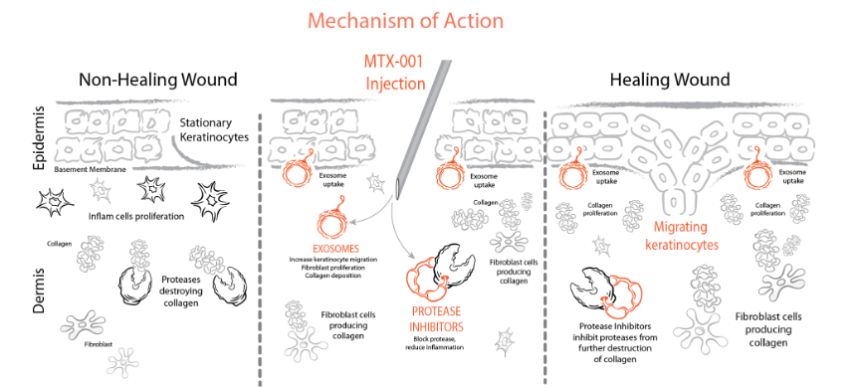
Source: Merakris Therapeutics
Phase 2 trial of MTX-001 for venous leg ulcers shows significant reduction in ulcer size
In April 2026, Merakris reported interim results from its phase 2 trial (n=95) of MTX-001 for venous leg ulcers. A subgroup analysis (n=9) of participants who completed 12 weeks of therapy showed a promising statistically significant ulcer size reduction by Week 8 and Week 12. Mr. Chris Broderick, CEO of Merakris Therapeutics, stated that the company plans for MTX-001 to advance into late-stage development by 2027.
Close Concerns’ Questions
- What timeline might we expect for in-human trials of MTX-001 for diabetic foot ulcers?
- How does ulcer size reduction seen in MTX-001 thus far compare to that seen with Integra LifeSciences’ Dermal Regeneration Matrix?
-- by Allison Platt, Kayla Mathieu, Monica Oxenreiter, and Kelly Close