Novo Nordisk launches Awiqli (once-weekly insulin icodec) in India, aimed at those without affordability challenges –
Approved for use in adults with T1D and T2D; 1 mL (700 unit) and 3 mL (2,100 unit) pens available at $27 (₹2,611) and $82 (₹7,833), respectively, over 10x higher than once-daily basal insulins
Novo Nordisk launched today its once-weekly insulin icodec, Awiqli, in India. Awiqli will be available as a 1 mL (700 unit) pen priced at $27.37 (₹2,611) and a 3 mL (2,100-unit) pen priced at $81.10 (₹7,833) – representing a once-weekly dose (assuming 70 units) price of $2.74 (₹261). Novo Nordisk expects Awiqli to be available in Indian markets as soon as next week!
India is the eighth country or “region” to gain access to Awiqli following established launches in the US (approved in 2026), Canada (2024), Japan (2024), China (2024), Australia (2024), and Switzerland (2024), with launches pending across the EU (2024). Awiqli is the first once-weekly insulin to launch in India. While we are curious to see differences in adherence between Awiqli and once-“daily” basal insulins, to say nothing of insulins like NPH, which are still used widely in the world, we note that use of Awiqli in India will presumably be limited to those with significant resources.
Table of Contents
- Insulin initiation delayed by an average of seven to nine years in India
- Novo Nordisk not expected to compete against its own Tresiba or Sanofi’s Lantus and domestic drugmakers including Biocon, Eris Lifesciences, and Lupin
- India becomes the eight market as Awiqli’s global rollout continues
- Close Concerns’ Questions
Insulin initiation delayed by an average of seven to nine years in India
While it’s been long established that India has more people with diabetes and prediabetes in the world than virtually any other country besides China, as recently as a just a bit over a decade ago (2014), it was estimated by WHO that ~75 million people had diabetes and just 25 million had pre-diabetes. In fact, in Novo Nordisk’s announcement, the company highlighted that, according to a study in the Lancet from 2023, more than 100 million people in India live with diabetes, while another 136 million have prediabetes. We were struck by the variability of T2D and pre-T2D from region to region throughout India[1]. Insulin initiation is said to be typically delayed by an average of seven to nine years in the country, reflecting, according to various sources, cost concerns (there is no reimbursement for any medical expenses except for the economically vulnerable) as the biggest barrier, as well as fear of injections, and anticipated pain cited as additional barriers. The country’s first once-weekly insulin could address the some of these by reducing the number of injections to 52 per year at least while patients need basal insulin only. While we would not expect most people with diabetes to pay the premium for once-weekly insulin, we are interested to see how it affects adherence, since there may be less perceived stigma surrounding insulin for those taking it just once weekly. We note extreme need for progress and innovation on this front given the very high numbers of people not only with diagnosed diabetes, but also those for whom diagnosed diabetes is a major risk (those with family history and other major risk factors).
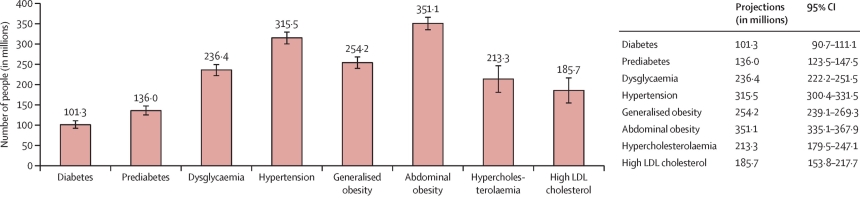
Source: “Figure 4, Projections for Metabolic Disease Prevalence in India” from “Metabolic non-communicable disease health report of India: the ICMR-INDIAB national cross-sectional study (ICMR-INDIAB-17)” by Dr. Viswanathan Mohan, MDa for the ICMR-INDIAB Collaborative Study Group
Novo Nordisk not expected to compete against its own Tresiba or Sanofi’s Lantus and domestic drugmakers including Biocon, Eris Lifesciences, and Lupin
In India, while Awiqli enters a crowded and price-sensitive basal insulin market, which already includes its own Tresiba, as well as Sanofi’s first-to-market Lantus (insulin glargine, which has been available in India for over two decades) and multiple lower-cost glargine biosimilars from domestic manufacturers such as Biocon, Lupin, Cipla, and Wockhardt. On Tata 1mg, one of India’s leading online pharmacies, a 3 mL 100IU/mL Lantus cartridge costs roughly ₹650 ($6.80). Biocon’s BASalog, generic insulin glargine, is listed at ₹620 ($6.49) and ₹575 ($6.02) for an injectable cartridge and vial, respectively, making Awiqli far more expensive and presumably limited to those who are not price sensitive.
With Novo Nordisk reporting a price of approximately $82 (₹7,833) for a 3 mL Awiqli pen, patients can still access once-daily insulin glargine via BASalog at a roughly 13-14-fold lower cost. Additional post-launch analyses will presumably assess relative “cost-effectiveness” in India relative to daily basal insulin analogues – it is our sense that in India there are major adherence issues related to daily insulin, not say nothing of insulins like NPH that require more than one daily injection. Such studies could build on health economic evaluations from Canada and Japan, which suggest insulin icodec could be cost-effective compared to once-daily basal insulin in some settings in which adherence represents a major barrier.
Of interest, globally, India is actually expected to have one of the lowest list prices Awiqli. By comparison, the submitted US price is $78 for a 1.5 mL pen and $156 for a 3 mL pen. In the Netherlands, by contrast, a 1.5 mL pen costs as much as $187 (€163). In Canada, Awiqli pens are available for roughly $100 for a 1.5 mL pen and roughly double for the larger size.
India becomes the eight market as Awiqli’s global rollout continues
Novo Nordisk launched Awiqli in India just a few years after its first commercial launches, making India a relatively early region to gain access to once-weekly insulin icodec after the US, multiple countries in Europe, Canada, Japan, China, Australia, and Switzerland. While India represents the world’s largest diabetes markets by population, with more than 100 million people living with diabetes, and said to be nearly half of this population on insulin, this launch also represents another milestone in Novo Nordisk’s effort to establish once-weekly basal insulin globally.
As Awiqli becomes available in an increasing number of markets, we are eager to see evolution in how early commercial uptake reflects the enthusiasm generated during clinical development; to date, in many regions, once-weekly insulin will ultimately occupy a more selective niche within diabetes care given the significantly higher cost at launch. Happily, ultimately, we know the prices globally will fall, as biosimilars enter.
Close Concerns’ Questions
- What has Novo Nordisk learned from Awiqli’s initial commercial launches and Awiqli’s uptake regarding clinician adoption, patient interest, dosing, and adherence?
- Are there certain patient populations who have emerged as the strongest early adopters such as “busy” or frail or elderly PWD?
- What has been learned about cost-effectiveness for Awiqli in various regions and what is expected in India, where reimbursement does not exist?
- Does Novo Nordisk plan to encourage transition from once-daily basal insulin to a weekly regimen for specific patients or to focus on those not yet on insulin that could benefit from it or some range?
- How do pricing strategies differ for Awiqli from region to region?
- How much was invested in R&D for Awiqli and what has been recouped?
- In what countries is Awiqli priced the “closest” to “next generation” basal insulins like Tresiba and “first generation” basal insulins like Lantus?
-- by Daniel Lee, Elizabeth Rose, Riya Chatterjee, Monica Oxenreiter, and Kelly Close
[1] From the article: “The state-wise weighted prevalence of diabetes ranged from 4·8% (154 of 3421 individuals; in Uttar Pradesh) to 26·4% (886 of 3744 individuals; in Goa) and that of prediabetes from 6·8% (236 of 4053 individuals) to 31·3% (1240 of 3925 individuals). Diabetes prevalence (figure 1A) was highest in the southern and northern regions of India, with urban areas having high prevalence throughout. The central and northeastern regions had lower prevalence. Conversely, prevalence of prediabetes (figure 1B) was highest in the central and northern regions of India and lowest in Punjab, Jharkhand, and some parts of the northeastern region. The prevalence of prediabetes was not significantly different between urban and rural areas.”