Cleveland Clinic Diabetes Day 2026 Highlights –
Executive Highlights
- The Cleveland Clinic Diabetes Day 2026 came together for a packed day of learning today in Cleveland, Ohio. The amphitheater was full throughout the day, with sessions ranging from lively debates on whether incretin-based therapies or SGLT-2 inhibitors should be the first first-line agents to shifting focus on the quality of weight loss. See the website, agenda, and our preview. Virtually all speakers work at Cleveland Clinic – if this is not the case, we note this. What a triumph for Cleveland Clinic to have such an outstanding day of learning for so many stakeholders.
- Dr. Steven Nissen (Cleveland Clinic) said that tirzepatide is part of a broader shift in cardiovascular medicine, in which incretin-based therapies are increasingly functioning as multi-system disease-modifying agents that extend far beyond glycemic management. Dr. Nissen said that dual GIP/GLP-1 agonists may fundamentally alter obesity-driven disease biology in the heart, kidneys, vasculature, and inflammatory pathways. Throughout the session, he repeatedly returned to the concept of ectopic fat deposition, describing obesity as a systemic disease in which fat accumulates throughout all systems, ultimately driving organ dysfunction and mortality. As weight-loss therapies become more common, Dr. Nissen suggested that clinicians may finally be able to intervene in the underlying biologic processes to prevent them from occurring, instead of managing downstream complications.
- On optimal first-line therapy for T2D, widely-admired pharmacy expert Dr. Diana Isaacs delivered a (“the”!) winning argument for multi-agonists as a first-line therapy over GLP-1 RAs, supported by Dr. Adi Mehta, a noted endocrinologist who has now practiced over 50 years, and SGLT-2 inhibitors, supported by Dr. Marwan Hamaty, who has now practiced over 20 years. Citing the SURPASS program, pharmacy expert Dr. Isaacs demonstrated that tirzepatide delivered superior weight and A1c reductions as a dual agonist. Of course, GLP-1 RAs and SGLT-2 inhibitors were not without merit. Dr. Mehta pointed to the cardiovascular benefits of GLP-1 RAs – as opposed to the noninferior MACE reduction of tirzepatide vs. dulaglutide in the SURPASS-CVOT – while Dr. Hamaty highlighted the affordability advantages of SGLT-2 inhibitors, given the recent generic entry of dapagliflozin.
- On the future of therapies for diabetes, Dr. Paloma Rodriguez Alvarez presented on epigenetic therapies for diabetes, which she described as giving us “an entirely new vocabulary for treating diabetes that goes beyond managing glucose and addressing the root biology of the disease.” Notably, she covered menin inhibitors, HDAC3 inhibitors, and EZH2 inhibitors as the three “most promising” among the candidates.
- On potential complications of diabetes, we were very glad to hear Dr. Willy Marcos Valencia explore the connections between dementia and T2D – underscoring that in people diagnosed with Alzheimer’s disease, 80% were categorized as having either T2D or prediabetes. However, Dr. Valencia cautioned that a link of causation between the two remains to be discovered. In the meantime, clinicians should assess and determine targets for their patients, implement feasible treatment strategies, and monitor response.
- On weight management and body composition, Dr. Marcio Griebeler argued that the era of “quantity” weight loss is over. Modern incretins now confer unprecedented reductions; however, a third of the weight loss comes from lean mass. He highlighted emerging combination approaches, like semaglutide and bimagrumab in the BELIEVE trial, that help achieve greater fat loss with minimal muscle decline. These innovations can preserve strength, mobility, and metabolic health while delivering significant weight reduction.
- In tech, Dr. Oscar Morey Vargas advocated for CGM use in inpatient settings. Although accuracy is more variable in the hospital setting, inpatient use of CGM outperforms intermittent point-of-care testing, with studies demonstrating fewer recurrent hypoglycemia events, higher TIR, and strong alignment with evolving guidelines. He emphasized that true success requires structured workflows and clear validation protocols. Separately, Dr. Vinni Makin made the case for both A1c and TIR for T2D clinical care, arguing that both glycemic markers complement one another in personalizing patient care.
Table of Contents
- 1. Dr. Steven Nissen highlights growing evidence for tirzepatide across heart failure, cardiovascular disease, and all-cause mortality
- 2. STRIDE demonstrates improved walking capacity and limb outcomes with semaglutide in peripheral artery disease
- 3. Guidance on once-weekly insulin: Patient selection, titration, and risk mitigation
- 4. First‑line therapy for T2D: Multi‑agonists vs. GLP‑1 RAs, vs. SGLT‑2 inhibitors go head‑to‑head
- 5. From quantity to quality: Advancements in increasing fat mass loss and preserving lean mass
- 6. “The war of the sugars”: A1c or TIR as the better marker for glycemic management
- 7. Inpatient use of CGM: Evidence shows clinical benefit over point-of-care testing
- 8. Dr. Stacey Ehrenberg discusses the potential for CGM and AID to transform diabetes management during pregnancy
- 9. Epigenetic opportunities for disease-modifying therapy in diabetes
- 10. Dementia and diabetes: T2D and prediabetes increase the risk of Alzheimer’s disease
1. Dr. Steven Nissen highlights growing evidence for tirzepatide across heart failure, cardiovascular disease, and all-cause mortality
Dr. Steven Nissen (Cleveland Clinic) said that tirzepatide is part of a broader shift in cardiovascular medicine, in which incretin-based therapies are increasingly functioning as multi-system disease-modifying agents that extend far beyond glycemic management. Drawing on data from SUMMIT, SURPASS-CVOT, and newer cardiorenal analyses, Dr. Nissen said that dual GIP/GLP-1 agonists may fundamentally alter obesity-driven disease biology in the heart, kidneys, vasculature, and inflammatory pathways. Throughout the session, he repeatedly returned to the concept of ectopic fat deposition, describing obesity as a systemic disease in which fat accumulates throughout all systems, ultimately driving organ dysfunction and mortality. As weight-loss therapies become more common, Dr. Nissen suggested that clinicians may finally be able to intervene in the underlying biologic processes to prevent them from occurring, instead of managing downstream complications.
- In SUMMIT (n=731), tirzepatide significantly reduced cardiovascular death and worsening heart failure events in individuals with obesity-related heart failure with preserved ejection fraction (HFpEF), while also producing meaningful improvements in quality of life. Dr. Nissen noted the trial’s 38% reduction in the composite endpoint of cardiovascular death or worsening heart failure events compared to placebo, emphasizing that the findings finally provide clinicians with a stronger therapeutic framework for treating obesity-associated HFpEF. Importantly, the benefits extended beyond cardiovascular outcomes alone. Kansas City Cardiomyopathy Questionnaire clinical summary scores improved substantially with tirzepatide, with a between-group difference of ~7 points at 52 weeks, a magnitude Dr. Nissen described as very clinically meaningful.
- Analyses further reinforced tirzepatide’s broad cardiometabolic effects. MRI substudy data from SUMMIT (n=106) demonstrated significant reductions in left ventricular mass and pericardiac adipose tissue alongside weight loss. Dr. Nissen said that obesity-related fat deposition throughout the myocardium and surrounding cardiac structures likely contributes directly to cardiac dysfunction, particularly in HFpEF. Tirzepatide also produced meaningful reductions in systolic blood pressure and lowered CRP by ~40%, supporting the idea that incretin-based therapies demonstrate substantial anti-inflammatory and hemodynamic effects in addition to glucose lowering.
- Dr. Nissen then turned to SURPASS-CVOT (n=13,299), which he described as the first major active-comparator cardiovascular outcomes trial evaluating one incretin-based therapy directly against another. The study compared tirzepatide versus dulaglutide in adults with T2D, elevated cardiovascular risk, A1c levels 7.0%-10.5%, and BMI ≥25 kg/m². While the trial did not achieve superiority for the primary MACE endpoint, Dr. Nissen said that the interpretation is fundamentally different in an active-control study where dulaglutide itself already has established cardiovascular benefit from the REWIND study. Against this context, he repeatedly highlighted the striking mortality findings, with tirzepatide reducing all-cause mortality by 16%. Dr. Nissen stressed that therapies producing substantial weight loss may improve both cardiovascular death rates and obesity-associated mortality pathways, including inflammatory and cancer-related causes of death.
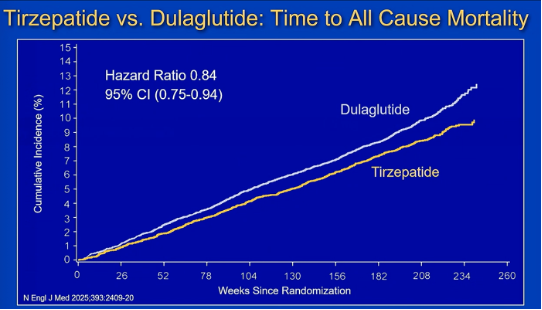
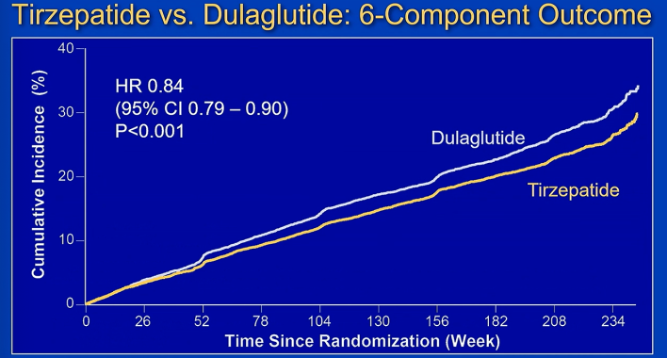
- Additional post hoc and secondary analyses further strengthened tirzepatide’s cardiorenal profile. A recently published secondary analysis demonstrated lower incidence of six-component cardiorenal outcomes with tirzepatide compared to dulaglutide, including: (i) all-cause mortality; (ii) myocardial infarction; (iii) stroke; (iv) coronary revascularization; (v) heart failure; and (vi) renal outcomes. Dr. Nissen pointed out that the benefit persisted even after removing renal and heart failure components from the composite endpoint, suggesting the effect extended beyond kidney protection alone. Subgroup analyses across sex, age, geography, BMI, and baseline A1c remained consistently favorable toward tirzepatide. Dr. Nissen argued that these findings collectively suggest dual GIP/GLP-1 agonism may provide stronger cardiometabolic protection than GLP-1 mono-agonists alone.
- Looking ahead, Dr. Nissen described anticipated findings from the ongoing SURMOUNT-MMO study as “the last frontier” for incretin-based cardiovascular prevention. The ongoing study has enrolled ~15,000 participants with overweight or obesity, including many without diabetes or established cardiovascular disease, to determine whether tirzepatide can reduce first cardiovascular events in primary prevention populations. Secondary endpoints include kidney function decline, incident T2D, and quality-of-life outcomes. From Dr. Nissen’s perspective, demonstrating benefit before overt cardiovascular disease develops could fundamentally reshape preventive cardiometabolic care. He closed by emphasizing that clinicians now have an opportunity to intervene earlier in obesity-related disease progression, rather than waiting until irreversible cardiovascular complications occur.
2. STRIDE demonstrates improved walking capacity and limb outcomes with semaglutide in peripheral artery disease
Dr. Robert Zimmerman (Cleveland Clinic) discussed the growing role of GLP-1 RAs in peripheral artery disease (PAD), positioning semaglutide as a potential new therapeutic option for individuals with PAD and T2D. Focusing on the phase 3b STRIDE trial, Dr. Zimmerman described PAD as one of the most under-recognized and under-treated vascular complications of diabetes, particularly among individuals with T2D who often develop more distal, below-the-knee disease associated with impaired mobility, reduced quality of life, and elevated cardiovascular risk. As there are limited therapeutic options, he framed the STRIDE trial as an important step toward expanding the role of incretin-based therapies into vascular disease modification.
- In the phase 3b STRIDE trial (n=792), 1 mg of semaglutide significantly improved walking performance and quality of life in individuals with symptomatic PAD, T2D, and intermittent claudication. Using a treadmill protocol over 57 weeks, semaglutide improved maximum walking distance by 13% relative to placebo, corresponding to an estimated treatment difference of about 40 meters (approximately 130 feet). Improvements were also observed in pain-free walking distance and patient-reported outcomes, including VascuQoL-6 and SF-36 physical functioning scores, with Dr. Zimmerman emphasizing that the magnitude of benefit exceeded thresholds typically considered clinically meaningful in PAD studies.
- Beyond symptom improvement, exploratory analyses suggested semaglutide may also reduce the progression of limb-related disease. The composite endpoint of rescue therapy initiation, major adverse limb events (MALE), or all-cause death was reduced by over 50% with semaglutide. Dr. Zimmerman also shared pooled analyses across STRIDE, FLOW, and SOUL involving nearly 14,000 participants, where semaglutide reduced adjudicated MALE by 30%, critical limb ischemia hospitalization by 28%, and combined MALE/MACE outcomes by 17%. Collectively, he suggested these findings reinforce the idea that GLP-1 RAs may influence the biology of vascular disease itself, in addition to improving glycemic outcomes or body weight.
3. Guidance on once-weekly insulin: Patient selection, titration, and risk mitigation
In this afternoon session, Dr. Ravali Veeramachaneni (Cleveland Clinic) delivered an overview of once-weekly basal insulin, including who to treat and how to use it. Dr. Veeramachaneni said that current basal insulins can have limitations for some people with diabetes, such as adherence challenges for some, what is considered a high injection burden for others, and wide glucose variability that for some stems from challenges in taking doses on time or at all. One study even found that over 20% of patients miss a one basal insulin dose per week. From what we understand, once-weekly insulin has promise to address some of these barriers for some patients. Currently, Novo Nordisk’s Awiqli (insulin icodec) has been FDA-approved for T2D, with launch expected in 2H26, while Lilly’s efsitora alfa is currently under regulatory review. Hengrui Pharma’s candidate SHR3167 and Gan&Lee’s candidate GZR4 are also in phase 2 and phase 3 development, respectively.
- Dr. Veeramachaneni explained that on a molecular level, insulin icodec uses amino acid substitutions and a fatty diacid, reducing insulin receptor affinity and extending the half-life to eight days. By contrast, efsitora alfa combines a single-chain insulin with a fragment of an antibody (IgG2 Fc), resulting in a half-life of 17 days. Efsitora alfa has a flatter seven-day profile, while insulin icodec has a more pronounced peak in action.
- In the ONWARDS and QWINT programs, Novo Nordisk’s insulin icodec and Lilly’s efsitora alfa demonstrated noninferior A1c reduction to once-daily basal insulin without increasing hypoglycemia risk in most trials. Moreover, insulin icodec was superior in insulin-naïve people with T2D (ONWARDS-1, 3, 5) and in basal insulin-treated people with T2D (ONWARDS-2).
- Hypoglycemia risk was generally consistent with once-daily insulin, but was higher in people on basal/bonus, which is expected because bolus insulin generally increases the risk of hypoglycemia.
- Dr. Veeramachaneni shared multiple valuable clinical considerations for once-weekly insulin use. First, she said that ideal candidates for insulin icodec include adults with T2D who are on or now starting basal insulin. Those with T1D, high hypoglycemic risk, hospitalized patients, or pregnant women are less ideal candidates, she said.
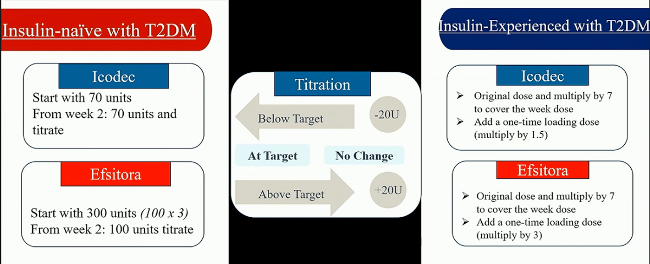
- Dosing and titration schemes differ by insulin and patients’ history of prior insulin use. See the figure below for instructions. Dr. Veeramachaneni also encouraged using CGM to guide titration, as shown to be beneficial in the ONWARDS-9 program. Lilly is also exploring the use of autoinjectors for efsitora alfa, which could simplify administration and prevent accidental extra dosing. When switching back to daily insulin, prescribers can divide the weekly dose by seven. It is crucial to monitor for hypoglycemia, as residual once-weekly insulin may overlap with once-daily basal insulin.
- While limited, early real-world data are encouraging. One paper “Early Real-World Implementation of Once-Weekly Insulin Icodec in Type 2 Diabetes” featured 10 men, 50% insulin-naïve, and 70% on CGMs. The cohort achieved A1c improvement from baseline through Week 12, with no hypoglycemia or weight gain reported (we will be back with the improvement and the baseline).
- For people with T1D, Dr. Veeramachaneni advised against using insulin icodec until further clinical trial results become available. That makes sense for those in the US, since the approval is for people with T2D only. Even though insulin icodec conferred noninferior A1c reduction as insulin degludec in the ONWARDS 6 trial, hypoglycemia rates were significantly higher. Post-hoc analysis found that exercise-related hypoglycemia did not increase with insulin icodec, CGMs were more useful at detecting hypoglycemia, and those with lower glycemic variability had less hypoglycemia risk. However, more research is needed – excitingly, the ONWARDS-11 trial in people with T1D is currently underway, with Cleveland Clinic as one of the investigation sites.
- Very interestingly, Dr. Veeramachaneni said that insulin icodec may be used in select cases. For example, insulin icodec may benefit the following groups, she said: (i) people who often miss insulin doses and are frequently hospitalized for DKA; (ii) older adults who may find lots of difficulty with multiple daily injections; or (iii) those with high-dose insulin pump therapy.
- Looking forward, Dr. Veeramachaneni expressed optimism for Novo Nordisk’s IcoSema, which combines insulin icodec with semaglutide in a fixed dose – it is approved in the EU and Japan and not in the US. IcoSema could simplify T2D treatment for some, as it targets both glycemic and weight reduction. It especially shows promise in people with complex insulin regimens. In the COMBINE-3 trial, IcoSema conferred noninferior A1c reduction when compared to basal-bolus insulin therapy. Time in Range was comparable. Moreover, the IcoSema group lost more weight and had fewer hypoglycemia events. Finally, once-weekly insulin could be considered “greener diabetology” by reducing medical waste (see “Pharmacokinetic Properties of a Once-Weekly Fixed-Ratio Combination of Insulin Icodec and Semaglutide Compared with Separate Administration of Each Component in Individuals with T2D”)..
4. First‑line therapy for T2D: Multi‑agonists vs. GLP‑1 RAs, vs. SGLT‑2 inhibitors go head‑to‑head
In this lively debate, Cleveland Clinic faculty, including Drs. Diana Isaacs, Adi Mehta, and Marwan Hamaty, advocated for multi-agonists, GLP-1 RAs, and SGLT-2 inhibitors as first-line therapies. In the end, multi-agonists reigned supreme for audience members as the most convincing option for first-line therapy.
- Dr. Isaacs argued for multi-agonists as the best first-line therapy. In dual agonists like tirzepatide, GLP-1 RAs mimic endogenous GLP-1 secreted by distal ileal L cells[1], while GIP RAs mirror the effect of endogenous GIP secreted by duodenal K cells[2]. Together, GLP-1/GIP RA activates both early‑meal and late‑meal signals, which leads to stronger effects on weight and glycemic management as compared to using GLP‑1 RA alone. She highlighted this in practice with data from the SURPASS program, where tirzepatide consistently showed greater A1c reduction against active comparator semaglutide. Dr. Isaacs also presented a network meta-analysis (n= 23,622) of tirzepatide versus semaglutide in T2D. In the analysis, tirzepatide 15 mg delivered the greatest A1c reduction of 2.0% versus 1.6% reduction on semaglutide and the most weight loss (9.6 kg versus 5.0 kg). Dr. Isaacs emphasized that tirzepatide was well tolerated in the SURMOUNT-5 trial (n=751), where discontinuation rates due to GI adverse events were 3% for tirzepatide compared with 6% for semaglutide.
- On cardiorenal outcomes, she highlighted a recently published post hoc analysis of the SURPASS-CVOT (n=13,299), where tirzepatide produced a 16% relative risk reduction (HR=0.84) of the primary cardiorenal endpoint versus dulaglutide.
- Dr. Isaacs closed by noting that next‑generation multi‑agonists continue to amplify these benefits. In the TRANSCEND-T2D-1 trial (n=537), retatrutide (a GLP‑1/GIP/glucagon triple agonist) conferred A1c reductions of 1.7-2.0% at 40 Weeks and up to 16.8% (36.6 lbs) weight loss with no plateau, reinforcing her argument that multi‑agonists offer the most powerful path to achieving and maintaining glycemic and weight goals.
- Dr. Hamaty argued that SGLT‑2 inhibitors should remain a first‑line option because they offer simplicity, applicability for more than 90% of patients with T2D, and rapid cardiorenal benefit. He emphasized the importance of diversity in choice for first‑line therapy and spotlighted the practical advantages of SGLT-2 inhibitors like empagliflozin and dapagliflozin: (i) once‑daily morning dosing; (ii) no need for up‑titration for cardiac or renal indications; (iii) consistent safety across eGFR subgroups; and (iv) the ability to continue therapy even as kidney function worsens. He noted that SGLT‑2 inhibitors are well tolerated, with urinary and yeast infections being the only side effects occurring in more than 5% of patients, and that combination formulations with metformin improve convenience and early glycemic management.
- On cardiorenal outcomes, he presented to the EMPA-KIDNEY trial (n=6,609), where empagliflozin reduced the composite kidney endpoint by 28% (HR 0.72) and lowered progression to ESKD or severe eGFR decline by ~30%, reinforcing the class’s strong kidney‑protective profile. He also highlighted their proven benefits in heart failure with reduced and preserved ejection fraction, and said that SGLT‑2 inhibitors reduce CV death and HF hospitalization regardless of diabetes status.
- On cost, Dr. Hamaty stressed that SGLT‑2 inhibitors have become increasingly cost‑effective, with dapagliflozin now generic and empagliflozin soon to follow – creating a dramatic price contrast with GLP‑1 RAs. Economic models show SGLT‑2 inhibitors deliver intermediate‑to‑high value in heart failure and CKD, whereas GLP‑1 RAs are not cost‑effective at current prices.
- Dr. Mehta argued that GLP‑1 RAs are the most logical first‑line therapy because they address the full spectrum of treatment goals in T2D: (i) improving glucose management; (ii) lowering atherogenic lipids; (iii) reducing inflammation; (iv) stabilizing plaque; and (v) slowing the development of heart failure, kidney disease, and MASH. He also emphasized the high cardiometabolic burden in T2D, noting that ~40% of deaths are due to ischemic heart disease and ~15% to heart failure, with patients facing a 2-4‑fold higher risk of HF and roughly double the risk of MI compared to people without diabetes. Dr. Mehta highlighted evidence that GLP‑1 RAs reduce coronary plaque burden and promote plaque stabilization, and pointed to a large comparative‑effectiveness study (n=296,676) of adults with T2D showing that sustained GLP‑1 RA use was the most protective against MACE, with the greatest benefit in those with ASCVD, HF, older age, or kidney impairment.
- On cardiorenal outcomes, Dr. Mehta noted that semaglutide reduced kidney events by 24% in the FLOW trial, a figure comparable to the strong renal protection seen with SGLT‑2 inhibitors in CREDENCE, DAPA‑CKD, and EMPA‑KIDNEY trials. He also cited treatment‑pattern data, which demonstrated that GLP‑1 RAs delay the need for therapy intensification longer than SGLT‑2 inhibitors or other therapy classes. Furthermore, Dr. Mehta referenced the STEER study (n=10,625), where semaglutide was associated with a 57% greater reduction in MACE among adherent adults with obesity and established cardiovascular disease (without diabetes) and a 29% reduction across the full cohort compared with tirzepatide. These results reinforce the early, BMI‑independent cardiovascular advantages of GLP‑1 RAs. In conclusion, Dr. Mehta argued that the cardiovascular, renal, cerebrovascular, and hepatic benefits of GLP‑1 RAs occur early and largely independent of weight loss, supporting their reconceptualization as first‑line cardiovascular‑modifying agents in T2D.
- On multi-agonists, Dr. Mehta underscored that despite its greater A1c and weight-loss effects, SURPASS‑CVOT showed noninferiority, but not superiority, to dulaglutide for MACE. Thereby, the study reinforces his view that early cardiovascular benefit is a defining strength of GLP‑1 RAs.
5. From quantity to quality: Advancements in increasing fat mass loss and preserving lean mass
Dr. Marcio Griebeler (Cleveland Clinic) challenged the audience to look beyond the scale – arguing that although modern incretin therapies are delivering unprecedented weight loss, the field must now confront optimizing body composition. He described the development of semaglutide as an inflection point that broke the historical ceiling of weight-loss therapies. Semaglutide conferred a mean 17% weight loss in the STEP‑1 trial (n=1,961). 92% of patients achieved ≥5% loss, and 35% of patients achieved≥20%. Dual agonists further pushed the boundary in the SURMOUNT‑1 trial (n=2,539), in which tirzepatide achieved 22% weight loss on average, and 40% of participants lost≥25%. Results once considered statistical outliers are now becoming the average.
- Dr. Griebeler emphasized that “scale weight” alone is no longer a sufficient metric of success. To support his argument, he cited a review which showed that interventions, including semaglutide, tirzepatide, retatrutide, and even bariatric surgery, impose a substantial loss of lean mass, with 24-39% of total weight lost coming from lean body mass (see below).
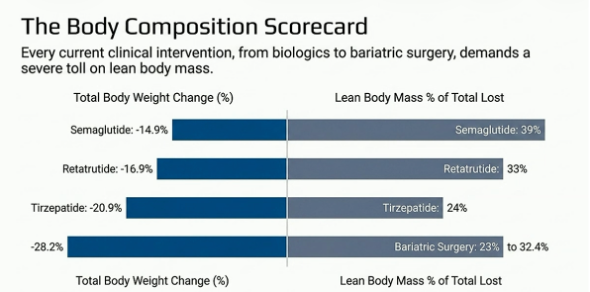
- Next, Dr. Griebeler revisited the long‑standing quarter FFM rule, which states that around 1/4 of weight lost consists of lean mass. Modern incretins, however, often exceed this threshold. He pointed to one example, where a patient on tirzepatide may gain lean‑mass percentage yet still lose 6 kg (13 lbs) of muscle – a change with real implications for strength, mobility, and metabolic health.
- Looking ahead, Dr. Griebeler discussed the BELIEVE trial (n=507), which he described as a paradigm shift toward “quality weight loss.” In this phase 2 study, combination therapy with semaglutide and bimagrumab, an activin‑receptor blocker that acts to prevent muscle breakdown, delivered 18 kg (~39 lbs) total weight loss with only 1 kg (3lbs) lean‑mass loss. This result confers a 92% fat‑loss index, the highest ever reported in an obesity trial, compared to 71% with semaglutide alone. Visceral fat fell by 44% versus 30% with semaglutide alone. Lean mass was largely preserved, demonstrating that it is now possible to achieve significant weight reduction without the penalty of substantial muscle loss. Nearly 80% of participants completed the primary treatment period, with discontinuations driven mainly by mild‑to‑moderate GI symptoms and muscle spasms inherent to adding a second agent.
- Dr. Griebeler also highlighted the 72‑week BELIEVE extension trial, where the separation between fat loss and muscle preservation became even more striking: semaglutide alone produced 28% fat loss but continued to show muscle loss (-7%). Meanwhile, combination therapy achieved the greatest fat reduction (-46%) with minimal additional muscle loss (-3%), reinforcing its potential as the first regimen capable of delivering truly “high‑quality” weight loss.
- To close, Dr. Griebeler highlighted enobosarm, a selective androgen receptor modulator, as the first agent shown to preserve lean mass when combined with a GLP‑1 RA. This therapy supports the emergence of a new therapeutic category focused on muscle protection.
6. “The war of the sugars”: A1c or TIR as the better marker for glycemic management
In this engaging talk, Dr. Vinni Makin (Cleveland Clinic) argued the case for both A1c and TIR in clinical care for PWD. Due to the substantial prevalence of diabetes, we need a “great” marker of glycemic management. Yet, HCPs have long debated whether that marker should be a three-month average (A1c) or a real-time snapshot (TIR) of glycemia.
- To distinguish between the two, Dr. Makin compared both markers in terms of standardization, cost, interfering factors, and a wealth of other diabetes-related categories (see below).
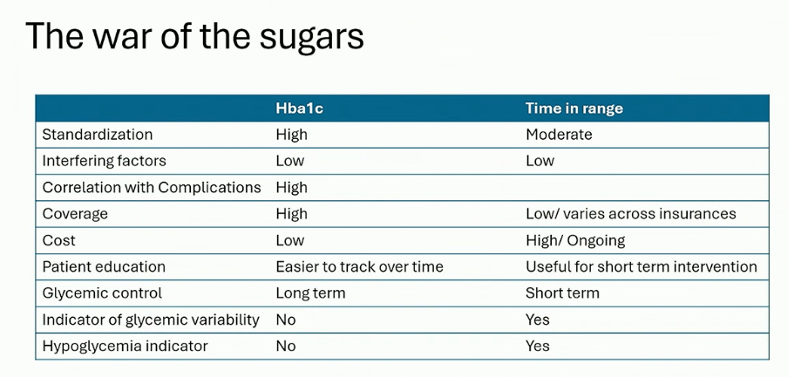
- While doing so, Dr. Makin delineated the pros and cons of each.
- A1c is exceptionally standardized, traceable to the DCCT reference assay, and completed by personnel who must complete proficiency training three times per year. On the other hand, CGM findings can vary by device. Moreover, A1c is useful in its ability to predict the risk of micro- and macrovascular complications.
- For CGMs, evidence is still emerging. In a retrospective real-world study (n=808), a 10% increase in time in tight range (TITR) and TIR was associated with a 24% and 17% decline in any microvascular complication, respectively.
- Dr. Makin concluded that the answer is both. A1c is a more affordable, stronger marker to assess long-term glycemic control and a patient’s sense of accomplishment over time. TIR is suitable for short-term medication adjustments, warnings on hypoglycemia, and a reduction in the mental load of diabetes and patient lifestyle education. Dr. Makin argued that A1c and TIR together confer a better picture of a patient’s glycemic management, as well as support the reduction of complications.
7. Inpatient use of CGM: Evidence shows clinical benefit over point-of-care testing
In this packed session, Dr. Oscar Morey Vargas (Cleveland Clinic) delivered a comprehensive and forward-looking examination of inpatient diabetes technology. He opened by underscoring the persistent complexity of inpatient glycemic management, including unpredictable nutrition, rapid medication changes, and workflow disruptions, which all contribute to wide glucose variability that intermittent point‑of‑care (POC) testing struggles to capture. Against this backdrop, CGM offers a fundamentally different level of visibility, providing continuous 24‑hour glucose profiles, trend data, and real‑time alerts that expose both asymptomatic and nocturnal hypoglycemia that may otherwise go undetected.
- Dr. Morey Vargas said that while outpatient CGM accuracy is now excellent, with modern systems achieving mean absolute relative difference (MARD) values <10%, inpatient performance is more variable. Across non‑ICU studies, accuracy typically ranges from 9%-16%, while studies in the ICU report MARD values from 11%-18%. He highlighted several situations where CGM accuracy can drop, but said that most inpatient studies still show CGM readings that are within clinically acceptable ranges. He pointed to a postoperative cardiac surgery cohort as an example, where the Dexcom G6 delivered over 99% of values in clinically safe zones even though MARD was 21%.
- The clinical evidence he presented consistently favored CGM-guided management over POC alone. In one study of patients with T1D and T2D (n=185), recurrent events fell from 2.9 to 1.8 per patient with CGM, and Time below Range dropped from 5.5% to 1.9%, both statistically significant improvements. The DIATEC trial (n=166) in adults with T2D showed that CGM-guided insulin titration increased TIR from 63% to 78% when compared with POC testing. In addition, the TIGHT study (n=110), which compared CGM-guided intensive management to standard care, found smaller differences, with TIR of 63% vs. 57%.
- On clinical practice guidelines, Dr. Morey Vargas highlighted the Endocrine Society Clinical Practice Guidelines, which now suggest using real-time CGM with confirmatory POC testing for insulin-treated adults at high risk of hypoglycemia. In addition, the 2026 ADA Standards of Care recommends continuing personal CGM and insulin pump use, including AID systems, when clinically appropriate and supported by institutional protocols.
- On implementation, Dr. Morey Vargas said that CGM alone does not improve outcomes, with success requiring structured workflows as well. He highlighted the importance of eligibility criteria, sensor warm‑up and validation procedures, alarm management, confirmatory testing thresholds, imaging and perioperative guidance, and EHR integration. Real‑world experience also shows strong acceptance. In one implementation study, 63% of patients agreed or strongly agreed that they liked CGM-based monitoring, and 80% of nurses preferred CGM to routine finger sticks, with 74% reporting more effective glucose management and improved coordination with mealtime insulin.
- Dr. Morey Vargas described AID systems as the next major frontier in inpatient diabetes care. Hospitals are increasingly allowing patients to continue using personal AID systems when hospitalized, and some are beginning to initiate AID during hospitalization either to optimize outpatient transition or, more ambitiously, to improve inpatient glycemic management itself. He noted that AID offers adaptability and may reduce staff workload, but successful adoption requires robust infrastructure, staff competency, and clear transition plans.
8. Dr. Stacey Ehrenberg discusses the potential for CGM and AID to transform diabetes management during pregnancy
Dr. Stacey Ehrenberg (Cleveland Clinic) opened today’s sessions with a review of the benefits of diabetes technology use during pregnancy. She reminded the audience that rates of all forms of diabetes are increasing, reaching nearly 10% for GDM in the US (~14% globally), 1-2% for T2D, and 0.2-0.5% for T1D. Given the inverse relationship between glycemic management and pregnancy complications, she emphasized the importance of adopting strategies that improve glycemia, including “up-and-coming” technologies such as CGM and AID.
- The use of CGM before and during pregnancy is important, as it supports behavioral modifications and provides multiple metrics that healthcare providers can use for insulin titration and clinical decision-making. Currently, three CGMs are cleared by the FDA for use during pregnancy – Dexcom G7 and FreeStyle Libre 2 Plus and 3 Plus – though Dr. Ehrenberg noted that others “can surely be used off-label”… She reminded the audience that CGM-based glycemic targets differ during pregnancy compared to traditional diabetes management. Citing the recently published international consensus statement on CGM and AID use in pregnancy, she highlighted the “70-80-90 Rule”: >70% Time in Pregnancy Range (TIRp; 63-140 mg/dL) in T1D, >80% TIRp in T2D, and >90% TIRp in GDM. In GDM, expert opinion also recommends <5% Time >140 mg/dL.[3] Dr. Ehrenberg reviewed several studies supporting CGM use across these populations.
- In T1D, the CONCEPTT trial showed that CGM improved A1c, TIRp, and glycemic variability without increasing hypoglycemia. Alongside maternal and neonatal benefits, the study “solidified the need to use CGM for pregnant patients with T1D.”
- In T2D, evidence remains more observational. Existing studies have shown reductions in composite neonatal outcomes and NICU admissions with CGM use and increasing TIRp. While more research is needed, data to date has not shown harm associated with CGM use in this population.
- In GDM, the field is “at the tip of the iceberg”… The GLAM study found that lower TIRp and higher Time >140 mg/dL could predict GDM development, while another RCT showed that unblinded CGM use in GDM increased TIRp to target, with mean levels reaching 93%. Dr. Ehrenberg noted that while more data is needed, current evidence supports broader uptake, which is already being driven by increased social media awareness among pregnant women. Looking ahead, she shared that Cleveland Clinic is participating in a multicenter trial evaluating CGM as a potential diagnostic tool for GDM.
- Excitingly, Tandem t:slim X2 and Mobi with Control-IQ became the first commercially available AID systems in the US to receive FDA clearance for use during pregnancy just last week. Clearance was based on the CIRCUIT trial, which demonstrated higher TIRp, lower mean glucose and TBR, and improvements in several maternal complications. Alongside the AIDAPT trial[4] (CamAPS FX) and the CRISTAL trial[5] (MiniMed 780G), the data suggest that “AID is probably the right way to go” during pregnancy. Dr. Ehrenberg noted that the lowest glucose targets available in most systems – 100 mg/dL or 110 mg/dL – remain above the pregnancy fasting glucose target of <95 mg/dL. Still, because many patients enter her clinic with much higher fasting glucose levels, she still considers reducing fasting glucose to about 110 mg/dL as a meaningful improvement. She added that the relatively recently launched Sequel twiist system offers glucose targets <95 mg/dL, though supporting data are not yet as robust.
- More broadly, Dr. Ehrenberg described connectivity as a “game changer” in pregnancy care. Because insulin needs change rapidly throughout gestation and clinicians often adjust therapy weekly or even twice weekly, CGM connectivity has made frequent insulin titration substantially easier.
- Looking ahead, Dr. Ehrenberg identified three ongoing research focuses for technology in pregnancy that could further shape the field: (i) determining the CGM data that will predict pregnancy outcomes; (ii) identifying optimal CGM timing and metrics to diagnose GDM; and (iii) collecting more data on using AID for T1D and T2D in pregnancy.
9. Epigenetic opportunities for disease-modifying therapy in diabetes
In this engaging presentation, Dr. Paloma Rodriguez Alvarez (Cleveland Clinic) explored epigenetic therapies for diabetes. She explained that epigenetics is a “system of clinical tabs on the genome itself,” dictating which genes are transcriptionally active or repressed in a specific cell type. Likening the DNA to the alphabet, Dr. Alvarez said, “epigenetics gives us an entirely new vocabulary for treating diabetes that goes beyond managing glucose and addressing the root biology of the disease.” Dr. Alvarez highlighted three of the most promising” disease-modifying therapies that she believes have the potential to shift diabetes treatment within the next decade.
- Menin inhibitors “restore what is declining.” As background, the MEN-1 gene encodes a protein that recruits HDAC3 to suppress PBK, a kinase that is essential to ß-cell proliferation induced by a high-fat diet. Accordingly, menin suppresses ß-cell proliferation, as well as GLP-1 receptor transcription levels. An menin inhibitor can therefore act by “essentially mimicking two therapeutic effects in one drug,” including a GLP-1 RA and therapy to increase insulin production.
- Excitingly, icovamenib (an oral covalent menin inhibitor) is currently being investigated in phase 1/2 trials for diabetes by Biomea Fusion. In the 52-week phase 2 COVALENT-111 trial (n=163), 12 weeks of therapy conferred an A1c reduction of 1.2 percentage points (p=0.01) sustained through Week 52 among participants with severe insulin-deficient T2D (SIDD; n=22) – characterized by insulin deficiency and rapid disease progression. Icovamenib also conferred statistically significant A1c reduction by 1.3 percentage points (p=0.05) among participants who were on GLP-1 receptor agonists but did not achieve glycemic targets at baseline (n=11). Icovamenib use demonstrated a favorable safety and tolerability profile, with no treatment-related serious adverse events or discontinuations from adverse events.
- The complete 52-week results from the phase 2 COVALENT-111 trial (n=414) and topline results from the phase 2 COVALENT-112 trial (n=190) of icovamenib in T2D and T1D, respectively, are expected in 2H26. Furthermore, Biomea has a Type-C meeting planned with the FDA in 2H26 to discuss approaches for a phase 2b trial, advancing icovamenib into later-stage clinical development. The company plans to initiate a phase 2 trial of icovamenib in people with T2D on GLP-1 RA therapy in 2H26.
- Excitingly, icovamenib (an oral covalent menin inhibitor) is currently being investigated in phase 1/2 trials for diabetes by Biomea Fusion. In the 52-week phase 2 COVALENT-111 trial (n=163), 12 weeks of therapy conferred an A1c reduction of 1.2 percentage points (p=0.01) sustained through Week 52 among participants with severe insulin-deficient T2D (SIDD; n=22) – characterized by insulin deficiency and rapid disease progression. Icovamenib also conferred statistically significant A1c reduction by 1.3 percentage points (p=0.05) among participants who were on GLP-1 receptor agonists but did not achieve glycemic targets at baseline (n=11). Icovamenib use demonstrated a favorable safety and tolerability profile, with no treatment-related serious adverse events or discontinuations from adverse events.
- HDAC3 inhibitors “protect what survives.” As background, HDAC3 is an “eraser protein” that can remove protective chemical (acetyl) marks from genes critical to ß-cell survival. As a consequence, inhibiting HDAC3 can block cytokine-induced ß-cell death while simultaneously reducing T-cell recruitment to islets. Among the three therapeutic classes she presented this morning, Dr. Alvarez described the HDAC3 inhibitor as “mechanistically distinct” by addressing the autoimmune component of T1D. In theory, HDAC3-selective inhibitors can protect ß-cells from immune and metabolic damage.
- EZH2 inhibitors “reprogram what remains.” EZH2 is a histone methyltransferase that can repress gene expression by adding a chemical mark (a methyl group) to the genome. This process, termed DNA methylation, has been well characterized as a critical component of the epigenetic barrier to ß-cell differentiation. In promising preclinical research from 2022 and 2023, EZH2 inhibition was shown to reprogram pancreatic progenitor and ductal cells towards insulin-producing ß-like cells. Unlike the other agents covered during her address, Dr. Alvarez emphasized that this therapy class is not a “theoretical agent.” Instead, tazemetostat (a selective EZH2 inhibitor) received accelerated approval by the FDA in June 2020 for the treatment of epithelioid sarcoma and refractory follicular lymphoma. However, the therapy was withdrawn from all trials and markets due to safety concerns, including multiple cases of secondary hematologic malignancies[6], in March 2026. Nevertheless, the therapy has not been investigated as a disease-modifying therapy in diabetes. “We are not talking about stem cells,” Dr. Alvarez concluded, “we are talking about our own cells that are able to be differentiated into ß-cell producing cells.”
10. Dementia and diabetes: T2D and prediabetes increase the risk of Alzheimer’s disease
In this interesting morning session, Dr. Willy Marcos Valencia (Cleveland Clinic) discussed the connections between dementia and T2D. As background, Alzheimer’s disease is a progressive, neurodegenerative disorder caused by the accumulation of ß-amyloid plaques and tau tangles. Notably, T2D confers a 56-65% greater risk of developing Alzheimer’s disease in one’s lifetime. In people diagnosed with Alzheimer’s disease, 80% were categorized as having either T2D or prediabetes.
- Beginning on a positive note, Dr. Valencia highlighted that cardiovascular-related deaths in T2D have declined over recent years. However, as patients live longer, deaths linked to dementia continue to rise (see below). In adults aged 65 or older, nearly 6% of deaths were attributed to Alzheimer’s disease. This figure increases to over 9% in adults aged 85 or older. Dr. Valencia argued that such a trend establishes dementia as a leading, rapidly growing contributor to mortality in diabetes (see below).
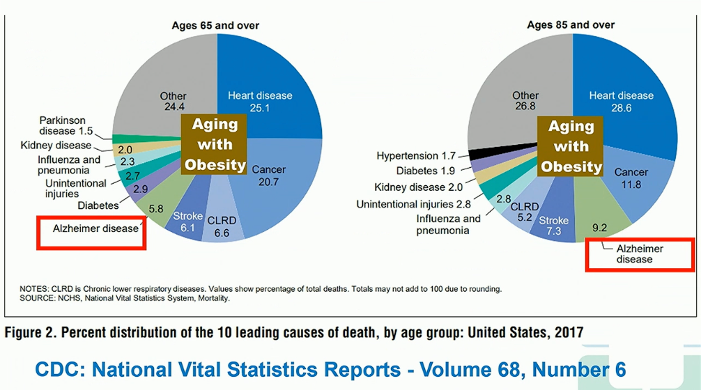
- The connection between vascular dementia – the second most common type of dementia, behind Alzheimer’s disease – was first drawn by epidemiological studies in the 1990s. In a prospective cohort study from 1997, adults with diabetes had a 66% higher risk of developing all-cause dementia. Alzheimer’s disease was significantly elevated, particularly in men (RR=2.27). Similarly, in the Rotterdam Study (n=6,370) published in 1999, diabetes increased the risk for al dementia and (RR=1.9) and Alzheimer’s Dementia (RR=1.9) in elderly patients. Notably, patients treated with insulin in this study were at the highest risk of all-cause dementia (RR=4.3).
- Decades later, in a meta-analysis conducted in 2024, the presence of diabetes increased the overall risk of dementia by 59%. A longer diabetes duration and hypoglycemic event incidence correlated with even greater risks of dementia. Further, both of these findings were corroborated by a prospective cohort study from 2024.
- Still, Dr. Valencia emphasized that the underlying driver of elevated risk remains unclear. Specifically, he explained that it is not currently possible to distinguish whether multiple hypoglycemic events have damaged the brain or if dementia is a contributor to hypoglycemic incidence.
Research at the intersection between T2D and dementia remains ongoing, Dr. Valencia added. Both liraglutide and semaglutide have been investigated in phase 2/3 studies for mild-to-moderate Alzheimer’s disease, but did not demonstrate a disease-modifying potential. For liraglutide, the phase 2b ELAD trial (n=204) demonstrated no significant change to its primary endpoints. Similarly, the phase 3 EVOKE program (n=3,808) failed to meet its primary endpoints. Further RCTs on GLP-1 RAs are still required to determine the disease-modifying effects of the therapy class for people with mild-to-moderate dementia. Previously, meta-analyses have supported GLP-1 RAs in lowering dementia risk.
- Without an effective therapy, Dr. Valencia urged his audience to follow eight critical steps during clinical assessment, including: (i) treat the individual; (ii) determine targets; (iii) assess the patient; (iv) identify barriers; (v) implement feasible treatment strategies; (vi) monitor response; (vii) aim for treatment simplification; and (viii) reassess. Lastly, he emphasized the need to maximize risk reduction in patients, including the use of GLP-1 RAs to decrease cerebrovascular dementia risk.
-- by Kayla Mathieu, Elizabeth Rose, Jeremy Alkire, Riya Chatterjee, Kat Moon, Monica Oxenreiter, and Kelly Close
[1] Distal ileal L cells are specialized enteroendocrine cells crucial to regulating metabolism through GLP-1, PYY, and GLP-2 secretion that are concentrated in the lower small intestine.
[2] Duodenal K cells, a type of specialized enteroendocrine cell found in the mucosa of the duodenum, are a primary source of GIP.
[3]Beyond CGM-derived metrics, it is recommended to have A1c <6.5% before pregnancy, <6% during pregnancy (unless a patient is at risk of hypoglycemia, in which <7% is acceptable), and fasting glucose <95 mg/dL (<140 mg/dL within one hour postprandial).
[4]The trial demonstrated greater TIRp, lower mean glucose, and similar rates of hypoglycemia with CamAPS FX compared to standard care.
[5]The trial results “weren’t as astonishing as AIDAPT” – partly due to the participants’ impressive baseline glycemic management – but still showed slightly greater TIRp and lower TBR with MiniMed 780G compared to standard care.
[6] Hematologic malignancies are cancers affecting blood, bone marrow, and the lymphatic system which originate from the uncontrolled growth of abnormal blood cells.