2IQP trial demonstrates additive benefits of Control-IQ+ system in GLP-1 RA users with insulin-treated T2D –
AID initiation increased TIR by 15% and lowered A1c by 0.8% among GLP-1 RA users, outperforming the CGM-only comparison group
Diabetes Care published results from Tandem’s 2IQP trial, “Additive Benefits of Control-IQ+ AID to GLP-1 Receptor Agonist Use in Adults with Type 2 Diabetes,” led by Dr. Timothy Graham (Utah Diabetes & Endocrine Treatment) and Dr. Roy Beck (Jaeb Center for Health Research) et al. These findings build on the broader results of the overall RCT, previously published in NEJM. The study evaluated adults with insulin-treated T2D (n=319), including a subgroup using GLP-1 RAs at baseline (n=143). Participants were randomized to Tandem’s Control-IQ+ AID system or maintenance of their existing insulin regimen (MDI or insulin pump) with CGM.
Among GLP-1 RA users, Control-IQ+ provided clear additive benefits, improving glycemic outcomes beyond those achieved with CGM alone. AID initiation also lowered total insulin needs and maintained a favorable safety profile, as measured by Time below Range (TBR). The authors noted that these findings support the adjunct use of AID with GLP-1 RAs in adults with insulin-treated T2D to further improve glycemic outcomes.
Table of Contents
- Study design and background: Nearly half of participants were on stable GLP-1 RA therapy with baseline A1c of 8.0%
- AID produced meaningful improvements in glycemic outcomes alongside GLP-1 RA use
- Clinical implications: Findings support Control-IQ+ use as an additional option for insulin-treated T2D already using GLP-1 RAs
- Close Concerns’ Questions
Study design and background: Nearly half of participants were on stable GLP-1 RA therapy with baseline A1c of 8.0%
The 2IQP trial enrolled adults with insulin-treated T2D (n=319), of whom 45% (n=143) were already using a GLP-1 RA at the time of study initiation. GLP-RA use reflected real-world practice, with most using semaglutide (55%), followed by dulaglutide (29%) and tirzepatide (10%). All doses were stable for over three months and held constant throughout the 13-week trial.
GLP-1 RA users had a baseline mean A1c of 8.0% and baseline Time in Range (TIR) of 53%, with persistent hyperglycemia despite incretin therapy. Mean total daily insulin use at baseline was ~96 units/day.
Participants were randomized 2:1 to t:slim X2 with Control-IQ+ or continuation of their existing insulin regimen with CGM. The trial was run over 13 weeks, with primary outcomes being A1c change and secondary outcomes including CGM metrics, insulin needs, and weight change.
AID produced meaningful improvements in glycemic outcomes alongside GLP-1 RA use
Among participants using GLP-1 RAs, those randomized to the Control-IQ+ algorithm experienced significant glycemic improvements exceeding those achieved by the group continuing their baseline insulin regimen with CGM. Key outcomes included:
- A1c reduction of 0.8% (from 8.0% to 7.2%) with AID versus 0.3% (from 7.9% to 7.6%) with CGM alone; and
- A 15-percentage point improvement in TIR (from 51% to 66%) with Control-IQ+ versus a ~1-percentage point improvement (from 55% to 56%) in the CGM-only arm.
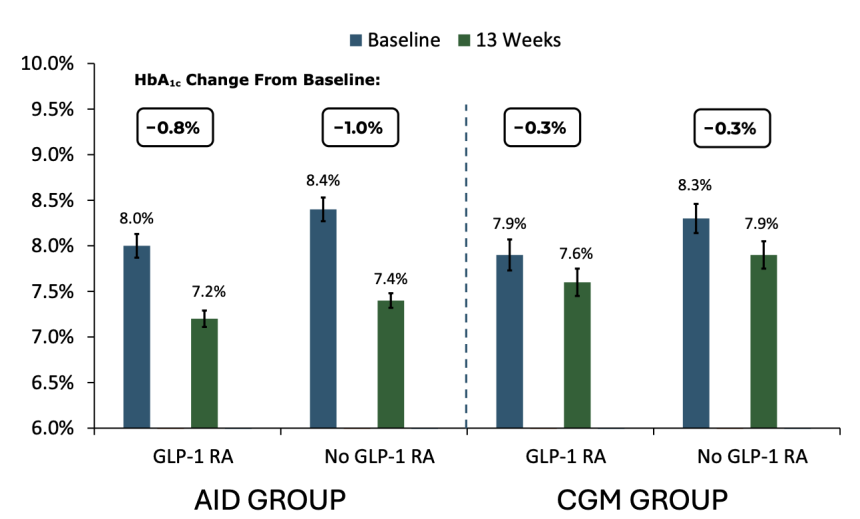
Source: Diabetes Care
Notably, these improvements occurred without increasing hypoglycemia and were accompanied by lower insulin requirements. Specifically, those using GLP-1 RAs and Control-IQ+ required approximately eight fewer units of insulin daily, reflecting improved insulin sensitivity and more efficient titration. GLP-1 RA non-users on Control-IQ+ gained ~1.9 kg over 13 weeks, whereas GLP-1 RA users on the AID system gained no weight, suggesting a possible weight-stabilizing effect when AID use is combined with incretin therapy. Similar additive benefits were observed among participants using both a GLP-1 RA and an SGLT-2 inhibitor, indicating that AID use maintains its effectiveness even in individuals using multiple therapies in addition to insulin.
Clinical implications: Findings support Control-IQ+ use as an additional option for insulin-treated T2D already using GLP-1 RAs
The trial demonstrated that Control-IQ+ provides incremental glycemic benefit for people with insulin-treated T2D who are already using GLP-1 RAs. The authors commented that the glycemic improvements seen with AID underscore the complementary mechanisms between incretin therapy and algorithm-guided insulin delivery. GLP-1 RAs reduce postprandial glycemic excursions and improve insulin sensitivity, while AID systems provide flexible, automated adjustments. The observed reduction in insulin used by those in the AID cohort reinforces this additive effect.
Improvements in A1c, significant TIR gains, and favorable weight and hypoglycemia profiles collectively position the Control-IQ+ system as a potential strategy for therapeutic intensification. Since Control-IQ+ has already received FDA clearance for adults with T2D, these findings may help support broader clinical adoption, particularly among those already using GLP-1 RAs. We imagine it could also drive patient interest in GLP-1 RA initiation among those already using Control-IQ+. As interest grows in treatment strategies combining pharmacologic and technological approaches, this study reinforces the value of integrating AID into treatment pathways for T2D.
Close Concerns’ Questions
- What changes to daily insulin use might occur when Control-IQ+ and GLP-1 RAs are used together over longer periods and in the real world?
- What is the long-term durability of these glycemic improvements? How might Control-IQ+ support the maintenance of these improvements in the face of GLP-1 RA discontinuation?
--by Riya Chatterjee, Jeremy Alkire, Monica Oxenreiter, and Kelly Close