Senseonics 4Q25 – Revenue of $14.3 million drives 72% growth as Eversense 365 enters AID ecosystem and the company takes over commercialization efforts from Ascensia –
Executive Highlights
- Senseonics reported its 4Q25 and full-year 2025 financial results (press release, webcast) on a call led by CEO Dr. Tim Goodnow, CFO Mr. Rick Sullivan, and Chief Commercial Officer Mr. Brian Hansen.
- Senseonics reported 4Q25 revenue of $14.3 million, up a striking 72% from 4Q24 and up 77% sequentially, driven by strong new patient starts following the US launch of Eversense 365 and increasing traction through its direct-to-consumer (DTC) campaigns. US revenue totaled $12.1 million in 4Q25, nearly doubling year-over-year (+98%) and up 89% sequentially, while OUS revenue totaled $2.2 million, up 5% year-over-year and 30% sequentially. Full-year 2025 revenue totaled $35.2 million, up 56% from 2024 and meeting guidance ($34-$38 million).
- Management noted that 4Q25 revenue was still recognized under the Ascensia collaboration agreement; going forward, Senseonics will recognize 100% of US revenue following the commercial transition.
- Senseonics’ installed userbase more than doubled in 2025 and annual US prescribers grew approximately 80%, positioning the company for continued revenue acceleration in 2026 as Eversense 365’s full commercial ownership take effect. Notably, by year-end 2025, approximately 70% of new patients had T2D, reflecting strong Medicare traction and direct-to-consumer (DTC)-driven awareness.
- On the pipeline front:
- Eversense 365 received CE Mark in January 2026, enabling rollout in Germany, Italy, Spain, and Sweden beginning in 2Q26 under Senseonics’ European salesforce. Management expects Europe to contribute approximately 20% of full-year 2026 revenue, with uptake supported by the transition from Ascensia and elimination of the prior revenue-sharing structure.
- Eversense 365 compatibility with Sequel’s twiist AID system launched in the US, with first patients already initiated on the combined system. Management described the early response as encouraging, and views pump integration as a meaningful incremental growth driver for 2026. Additional pump partnerships remain under discussion and would represent upside to current guidance. We will be curious to see Sequel at ATTD – last year, they had the first booth that one saw on the exhibit hall floor, and they are certainly gaining attention in discussing the problem of occlusions, the bane of existence for many who use traditional pumps.
- Gemini pivotal trials are expected to complete by the end of 2026, with launch anticipated in 2027, followed by Freedom in 2028. In the Q&A, management reiterated that Gemini is expected to remain iCGM compliant, with equivalent performance across flash and nearfield modes.
Senseonics Annual Revenue (2016 – 2025)
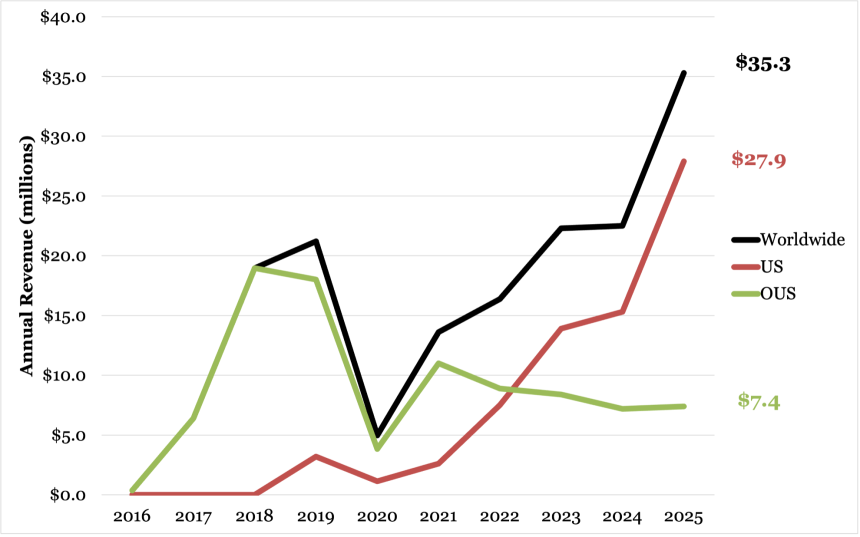
Source: Close Concerns Knowledgebase
Table of Contents
- Financial Highlights
-
Eversense Highlights
- 1. Eversense 365 receives CE Mark, with initial launch in select European countries upcoming
- 2. Userbase more than doubles from 2024; focus on DTC strategy expands
- 3. Eversense 365 compatibility with Sequel twiist launches in the US, with first patients started
- 4. Senseonics assumes full commercial responsibility for Eversense in the US
- 5. Pipeline updates: Gemini pivotal trials expected completion by end of 2026, anticipated 2027 launch; Freedom follows in 2028
- Analyst Q&A
- Close Concerns’ Questions
Financial Highlights
1. 4Q25 revenue totals $14.3 million, (+72%); full-year 2025 revenue totals $35.2 million (+56%)
4Q25 revenue totaled $14.3 million, up 72% from 4Q24 and 77% sequentially. Management attributed this strong growth to strong new patient starts following the US launch of the company’s one-year implantable CGM Eversense 365. US revenue in 4Q25 totaled $12.1 million, nearly double that of 4Q24 (+98%) and sequentially (+89%). OUS revenue in 4Q25 totaled $2.2 million, up 5% from 4Q24 and 30% sequentially. Mr. Sullivan noted that Senseonics continued to recognize revenue through Senseonics’ collaboration with Ascensia in 4Q25; moving forward, 100% of US revenue will be recognized.
Senseonics Quarterly Revenue (1Q16 – 4Q25)
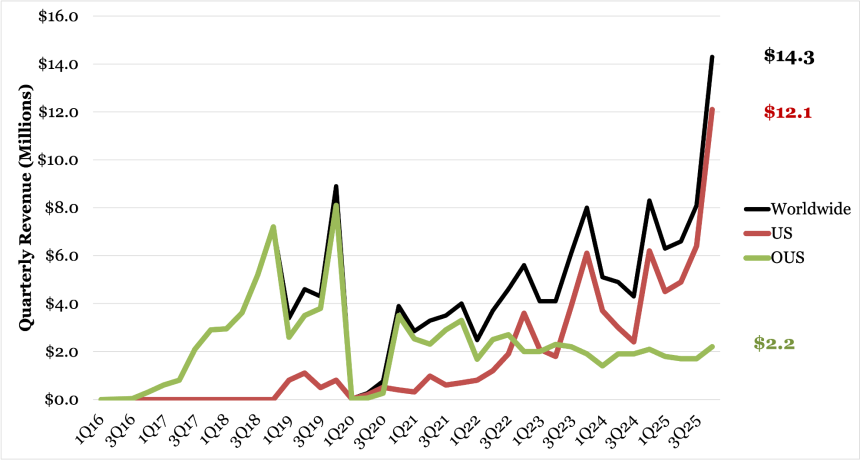
Source: Close Concerns Knowledgebase
- Full-year 2025 revenue totaled $35.2 million, up 56% from 2024 and meeting guidance. As background, Senseonics had previously predicted global net revenue in 2025 ranging from $34 to $38 million, and over $35 million is certainly well within the ballpark! Mr. Hansen also highlighted that Senseonics’ installed userbase more than doubled and annual US prescribers grew 80% (more on this below), positioning the company for even “higher-quality” growth in 2026 due to Eversense 365’s more favorable margin structure. Mr. Hansen said investment in “direct consumer spend” had a big impact on the top line in 2025. It sounds like the company will continue to invest meaningfully in that channel this year. Continued Mr. Hansen, “It was clear with the company’s revamped DTC campaign and enhanced spend that we could drive significant lead volume and leads, drive awareness, patient interest, prescriptions, and ultimately new insertions translating into top line revenue.”
2. Cash, cash equivalents, and investments of $94.3 million; annual net loss of $69 million
Senseonics reported $94.3 million in cash, cash equivalents, and investments at the end of 4Q25, up 26% from 4Q24. Senseonics reported outstanding debt of $35.3 million at the end of 4Q25, consistent with debt reported at the end of 2024.
- Senseonics recorded a net loss of $20.8 million in 4Q25, higher than the $15.5 million net loss reported in 4Q24. The increase in net loss in the quarter was primarily attributed to increased sales commissions and other costs related to taking over the commercialization and distribution of Eversense from Ascensia. Net loss for 2025 was $69.1 million, about $10 million less compared to the net loss in 2024, driven primarily by improved margins from Eversense 365. With expected cash utilization of over $110 million in 2026 (see above) and a similar net loss, we imagine Senseonics has about a year of cash reserves.
- 4Q25 gross profit was $7.7 million, an increase of nearly $4 million from 4Q24. Mr. Hansen attributed this increase to a full year of sales of Eversense 365 with more of the company’s business going through its consignment sales channel, where it recognizes 100% of the revenue. Furthermore, 4Q24 was impacted by one-time charges related to the transition from Eversense E3 to Eversense 365.
- In terms of operating expenses, R&D investment in 4Q25 was $8.8 million, down slightly from 4Q24 due to the completion of the Eversense 365 system clinical trials and development efforts. R&D expenses for 2025 dropped by $9.5 million from 2024 to just under $32 million. Sales and general and administrative (SG&A) expenses were nearly $20 million in 4Q25, more than doubling from 4Q24, primarily driven by higher sales, marketing, and personnel costs as well as promotional expenses stemming from DTC investments and sales commission expenses as its consignment program expands. SG&A expenses for 2025 were $52 million, up $18 million from 2024 stemming from taking on more operational spending and stemming from costs related to the Ascensia transition.
3. Management guides for 2026 revenue of $58-$62 million, up 65%-76%
Senseonics issued full-year 2026 revenue guidance of $58-$62 million, which would translate to an increase of 65%-76%. Mr. Hansen explained that Senseonics expects to recognize ~40% of full-year revenue in the first half of the calendar year due to diabetes technology seasonality. Assuming 40% revenue full-year revenue is reported in 1H26, this would translate to revenue of approximately $23-$25 million, up 87% at the midpoint from 1H25. While sales in Europe are expected to contribute ~20% of full-year revenue, consistent with contributions in 2025, we could see this increase meaningfully over time, due to factors such as great care of the environment in and around many parts of the EU, plus due to more opportunities related to AID (that should help every geography but that we feel may resonate more in the EU).
- Senseonics’ 2025 revenue guidance also assumes (i) refinement of plans for the commercial transition from Ascensia and the roll-out of Eversense 365 outside the US; (ii) continued spending on DTC marketing to generate leads; and (iii) the utilization of the patient assistance programs for Eversense 365 to support uptake.
- Mr. Sullivan announced 2026 projected gross margin of 50%. He explained that margin performance to date and the planned launch of Eversense 365 in Europe should enable full year 2026 gross profit margin to exceed 50%, beginning slightly lower in 1Q26 and increasing sequentially throughout the year.
- Reaching a discussion finally of the likely “bottom line” for Senseonics, management attributed much of Eversense’s growth in the US to the company’s DTC campaigns and said that Senseonics plans to make similar investments this year (~$12 million to $15 million), at similar levels throughout the year and building into 2H26. Senseonics expects this will help the company target “higher-quality” opportunities, achieve a higher close rate, all at a lower cost per potential patient served. Due to the integration of the commercial organization and supporting transition service agreements from Ascensia, Mr. Hansen expects operating expenses will increase by ~$70 million, consistent with Ascensia's prior commercial spend. Total operating expenses are expected to be $150-$160 million in 2026, with increases primarily in SG&A and to a smaller degree in R&D for the Gemini pivotal trial (see more below). He estimated that cash utilization will be $110-$120 million in 2026, largely as a result increasing SG&A due to moving both the sales and marketing teams “in-house”. Mr. Hansen noted that Senseonics expanded its debt facility with Hercules Capital to up to $100 million in 2025, providing access for up to an additional $65 million of non-dilutive capital to help fund increased operating expenses for the integrated business.
Eversense Highlights
1. Eversense 365 receives CE Mark, with initial launch in select European countries upcoming
Management announced that Eversense 365 received CE Mark in January, enabling launch in Germany, Italy, Spain, and Sweden in the coming months under Senseonics’ dedicated European salesforce. Dr. Goodnow emphasized that patients and providers in Europe have been waiting for a one-year implantable CGM option, and the company anticipates uptake will look similar to the initial US launch over one year ago. In Q&A, management said the rollout is expected to begin in mid-2Q26 and the company continues to work out the transfer of contracts currently held by Ascensia, with certain transitions potentially extending through late summer or early fall.
- The European transition of Eversense commercialization from Ascensia remains in its final stages, with the transition service agreement continuing to support OUS markets where Senseonics’ in-country infrastructure is still being built. This regulatory milestone was framed as a foundational step for growth, with management noting that the strategic restructuring was completed in the US in 2025.
2. Userbase more than doubles from 2024; focus on DTC strategy expands
Senseonics more than doubled its US patient base from 2024 to 2025, with new patient starts increasing 103% year-over-year, driven largely by expanded direct-to-consumer (DTC) marketing efforts and growing awareness of Eversense 365. Mr. Hansen described DTC as a “big growth driver” and indicated the company plans to invest approximately $12-15 million in 2026, similar to 2025 levels but deployed more evenly throughout the year. Management expects this shift in DTC strategy to improve lead quality, conversion rates, and cost efficiency.
- Provider adoption continues to expand as well, with active prescribers growing more than 80% from 4Q24. Furthermore, the Eon Care inserter network expanded to approximately 60 providers performing nearly one-quarter of US insertions, with plans to grow up to ~100 providers by year-end 2026 to further support capacity and growth. Management indicated that Eon could perform ~30-35% of overall insertions and noted there is no structural barrier to expanding beyond 100 providers if volume supports it.
- Management also highlighted favorable reorder dynamics entering 4Q25.Since the US commercial launch of Eversense 365 occurred in 4Q24, many early adopters are now initiating their sensor reorders beginning this quarter. As a result, the company reported meaningful sequential growth throughout 2025, including leads, conversions, new patient starts, and first-time prescribers. Dr. Goodnow said this momentum is expected to continue into 2026, supported by ongoing DTC investment, pump integration with Sequel’s twiist, and expansion into new European markets.
- Dr. Goodnow noted that by the end of 2025, approximately 70% of new patients had T2D. Management expects that mix could shift back toward people with T1D as momentum from Eversense’s integration with twiist continues. The majority of new patients were switchers from transcutaneous CGM systems, with ~15-20% new to CGM.
3. Eversense 365 compatibility with Sequel twiist launches in the US, with first patients started
The integration of Eversense 365 with Sequel’s twiist AID system has officially launched in the US, with patients now using the combined system. Dr. Goodnow framed the partnership as a major milestone, allowing twiist users to pair with a one-year implantable CGM and eliminate sensor changes every 10 to 15 days, while maintaining automated insulin delivery function.
- Mr. Hansen noted that despite only a few weeks of general availability, early commercial response has exceeded his expectations. Management views twiist compatibility as meaningful growth driver for 2026, particularly among individuals with T1D. The company reiterated that this is intended to be the first of multiple potential pump integrations, though it declined to indicate expectations or timelines for future launches.
4. Senseonics assumes full commercial responsibility for Eversense in the US
Management reiterated that transitioning commercial operations from Ascensia Diabetes Care back to Senseonics was the most consequential strategic decision of 2025. Nearly 100% of Ascensia’s US CGM commercial team transitioned to Senseonics under Mr. Hansen’s leadership. Mr. Sullivan noted that 4Q25 revenue was still recognized under the Ascensia collaboration agreement.
- However, Senseonics expects to recognize 100% of revenues going forward. Leadership said a few key advantages of the transition include clearer insight into DTC performance and tighter integration between commercial execution and corporate objectives. In Q&A, management characterized the US transition as “seamless” and operationally straightforward, emphasizing that the entire sales organization transitioned with “zero customer impact.”
5. Pipeline updates: Gemini pivotal trials expected completion by end of 2026, anticipated 2027 launch; Freedom follows in 2028
Senseonics reaffirmed development timelines for its next-generation CGM systems, positioning the pipeline as a long-term innovation driver beyond Eversense 365.
- Gemini pivotal trials are expected to complete by the end of 2026, with launch anticipated in 2027. Senseonics announced today that it has received approval from the FDA for an investigational device exemption (IDE) for Gemini. Gemini incorporates a one-year battery into the sensor itself, enabling transmitter-free operation. In Q&A, management clarified that Gemini’s flash and nearfield modes are expected to demonstrate equivalent performance, with no anticipated accuracy differences, and the device is expected to remain iCGM compliant.
- Freedom is expected to follow with a launch in 2028 and will incorporate direct wireless communication between the implanted sensor and the patient’s smartphone, eliminating the need for a separate transmitter. Dr. Goodnow expressed confidence that decisions and execution in 2025 have formed a strong foundation for growth in 2026 and beyond.
Analyst Q&A
On patient and prescriber growth
Q (Anthony Petrone, Mizuho Group) I'll start with some of the trends you're seeing early in the year. You're coming off 2025, 103% new patient starts for the year, and hitting a new high in the fourth quarter. I know there's a little bit of seasonality on policy resets here as you start the year, but could you provide anything in terms of US new starts at the beginning of the year?
Mr. Sullivan: We continue to do very nice on new patient starts. Eversense 365 product continues to perform just as we expect. We are now into the more routine cycle of getting the reinsertions. So new patient growth continues as we've expected it to. As we planned it, January typically is our softest month with the patient resets. We've seen a surprising amount of encouraging interest with the Sequel product and new patient starts associated with that. So that's very encouraging to see. And we continue, you know, we continue to make progress as you know, with the market for the Eversense 365 in Europe. We're looking for that that region to really take off as well here later in 2026.
Q (Josh Jennings, Cowen) With the active prescriber base growing 80% last year and with Senseonics now in control of the commercial effort and the sales team, how do you expect that prescriber base to grow? I mean, you guys are on track. Your guidance when Senseonics controlled commercial efforts was to double your patient base in 2025 and 2026, on the heels of the Eversense 365 launch. Could you do better than that? Could you see an acceleration in the prescriber base and new patient starts from this doubling, which is already an impressive number?
Dr. Goodnow It’s a significant push in 2025. We did accelerate DTC under the expectation. I think we validated that perspective that this is really about awareness. As we spent the DTC, we made more and more patients who then in turn worked with their providers and made more and more providers aware of the opportunity with Eversense the excitement around 365.
For us to continue to sustain that level of growth, we are going to spend a significant amount in DTC, but about the same that we spent last year, just loaded at the back half of the year. The ramp is commensurate with that investment. We expect that ramp to slow down a little bit with the normalization of that spend over the year, but still supporting that doubling of growth or that approximately 70% of revenue growth across the whole company.
Q (Matt Miksic, Barclays): On the type of new folks signing up new users, what are some of the major reasons they are choosing Eversense?
Dr. Goodnow: From an investment perspective, much of our DTC and quite frankly, the facile nature of the buy and bill really makes this attractive product for people that are on Medicare. So, we have transitioned to probably 70% Type 2 patients coming out of 2025. I expect that proportion will actually change back more towards Type 1 now here with the pump partner. But we continue to see the majority of our patients are switchers that are either coming from one of the two transcutaneous sensors, with about 15% or 20% are brand new to the space. The new pump rollout has been very encouraging.
Q (Ben Haynor, Lake Street Capital Markets): Are you seeing any changes to the behavior of new prescribers with the 365 day version?
Dr. Goodnow: I wouldn't say there's been a change in behavior. Certainly industry level, the recognition and now the feedback, it's much more common to see feedback from users that have gone on to their second sensor. The retention rates are encouraging. People love the product, and when they use it for as long as a year, it becomes part of their life. I would say from that perspective, a convert is very, very attractive to us. But from a new patient perspective I don't think we've seen any real behavior differences from as we've seen before nor from the prescriber side.
Q (Ben Haynor, Lake Street Capital Markets): Can you remind us where the expectations for retention are being exceeded?
Dr. Goodnow: We haven't updated those as yet as we're still honestly pretty early into the one-year renewal cycle. But our history had been from first to second sensor. It was in the 70s for the second sensor, and 80% to the third sensor. By the time people were on the third sensor, it was 90% retention or sometimes even higher, as is evidenced in our European market. I would anticipate the largest drop off from the first to second sensors, but still some pretty attractive break.
On 2026 guidance
Q (Anthony Petrone, Mizuho Group) I had a question on that top line guidance of $58 million to $62 million. You have US clearance and the launch of the twiist integration. to what extent in that range do you have some contribution for Europe and twiist, and could you recap how the economics are split between Sequel and Senseonics for the twiist integration?
Dr. Goodnow: From an economics perspective it's two companies that work together from a marketing and awareness perspective. But the economics are unique to each company. We sell the sensor, we recognize the associated economics, they sell a pump. Through the integration that the iCGM enables, the patient enjoys that combination. There's really no difference economically on a brand new patient start on MDI versus somebody who's on a Sequel pump.
Mr. Hansen: And then for Europe, you know, the past couple of years, we've seen fairly consistent revenue in Europe, and we are really expecting growth with the Eversense 365 launch in 2Q26. That, along with the elimination of that revenue share to Ascensia, causes us to expect Europe to be about 20% of our revenue in 2026.
Q (Marie Thibault, BTIG): On the operating spend level that you discussed of $150 million to $160 million this year, I understand that the bulk of that is picking up where Ascensia left off, but can you get longer term? Are you expecting a multiyear investment here, or should we expect continued step ups in the out years? I’d just like to understand now that everything's under Senseonics.
Mr. Sullivan: From the commercial spend perspective, it'll certainly continue to grow as our revenue grows, but not at the magnitude that it is in 2026. And so that will be more efficient. But as we launch new products, we'll expand the number of territories, increase number of providers from the Eon Care, etc. But again, it'll decrease as a percentage of revenue going forward. And then this year, we do have a Gemini clinical trial, which is about $5 million of an increase in our R&D line. We'll see a similar amount next year for the Freedom trial, but then R&D should go down for further out years.
Q (John Block, Stifel): I'll just try to get a little bit more granular on the revenue. You provided some details on the cadence. Are there any more details you can give, even 1Q26 with some of the moving parts with Ascensia? When I look at Street, around $10 million and those moving parts and here we are in early March, is that sort of a good figure to call it? Set ourselves and then think about the other commentary you provided for 2H26 versus 1H26?
Mr. Sullivan: From a revenue perspective, we know we have a seasonality in Q1 with the deductibles resetting and higher utilization of our patient assistance programs. What impacts that ASP through that channel? The second half of the year is typically where we have some of our renewals from the past couple of years with the Eversense 365 launch. The revenue is certainly back half loaded and I do expect it to be similar to 2025, thinking about 40% in the first half, 60% in the second half approximately. And we will see a certainly a step down in Q1 because of that seasonality from where we were in Q4.
On the commercialization transfer from Ascensia
Q (Josh Jennings, Cowen) I was just wanted to check in on the takeover of the commercial organization in United States from Ascensia. It seems like it has been seamless in terms of sales reps converting over under the Senseonics roof. Is it as seamless as it sounds, and have there been any friction points?
Mr. Hansen: It was a straightforward as we expected. They changed business cars. They got a new computer. They had to do a few things. We even pulled their cars over with them. So, quite frankly, it went that simply and we have a full boat and they all stayed. We're very fortunate. OUS, we had a little bit more work to do as we go through the transition here the first half of the year. We're hiring new folks to replace our BGM reps that were supporting both products, so there's a few moving parts to it differently than the US.
But so far, the US, I mean, we had our kickoff meeting in January, late January in D.C. and everybody was there and excited and focused. As I said in my comments, that one's gone very well, knock on wood.
Q (Josh Jennings, Cowen) And do you mind reviewing where maybe some deficiencies were with Ascensia at the helm of the commercial effort? Was it investment levels in DTC? Was it aggressiveness in pursuing new prescribers? And can you review how you guys are filling any voids that were in play prior to taking over the commercial effort in the US?
Mr. Hansen: The strategic execution around the commercial activities really did hand over 1 to 1, even in Europe where we had some opportunities in the operational part of the organization. For example, there were some quality duplications that happened, you know, some strategy elements that that happen. In those cases, we did do some rationalization, but obviously there was just a little bit of upstream marketing around product development that existed in the prior Senseonics organization that's now been folded in to the new Senseonics commercial team.
And you know, Brian, Rick, and Ken just did an exemplary job of leading this transition to be able to get every sales rep to go over and be part of Ascensia at 5 p.m. on Friday and show up at 8 a.m. on Monday as a Senseonics employee. So an absolutely zero, knock on wood, customer impact through that transition. It’s just been managed and executed with a great ability.
On DTC campaigns
Q (Matt Miksic, Barclays): On the investment DTC, it is proved to be pretty successful last year and within the spend this year. Is it becoming sort of a reliable and important budget item, and any color you can give us on the size or the direction of DTC spend would be great.
Mr. Hansen: It was again, as Tim said, more in that last six months and we really put quite a bit in that September, October, November timeframe. That's when you want to put a bunch in as the fourth quarter so strong. But we also really stressed our team by doing that and now to level that spending a bit more, not quite half in the first half of the year and then saving a little bit to push into that really important third and fourth quarters is how we're looking at it. We also learned a lot last year of what works and what doesn't work, what segments we are getting better returns versus others. I think we're going to do a much better job this year taking our same spend but maximizing it.
Our team is right sized for that as well right now. We're expecting to spend the same but get better results as we spread it out across the year. $12 million to $15 million is what we said in our prepared remarks.
Q (Matt Miksic, Barclays): What are the challenges or the friction around getting more implanters up and running, getting more education out there? Is DTC a part of that? What do you see as the primary constraints right now in terms of growth, in terms of your ability to address new patient interest, and the new clinician interest? What are the things you're trying to address to speed things and make the most of the opportunity out?
Mr. Hansen: Number one, Matt, it continues to be around awareness, and that's where DTC really helped. That drove it from the consumer level. We would certainly augment that with a strong internal team to take the inbound interest. We're going to continue to do that. We have 45 regions right now that are focused in the primary areas and they are working hard to not only expand their reach, but also to go deeper within the clinics. We think there’s an opportunity as well to make sure that instead of having one or two doctors in a clinic be heavy prescribers, try and turn that into three or four or five prescribers. Number one is certainly about awareness.
Number two, from insertion, you're absolutely right. We're going to continue to focus on it. That said, recall that our Eon program is a major initiative for us. We ended the year just about 60 nurses that were contracted with us to do the insertions. And we are absolutely on target, two months into 2026, to end the year at 100 nurses. And we anticipate we'll be doing 30% to 35% of all of our insertions in that time period. So we expect a lot of organic growth through that initiative as well.
We saw a lot of changes in reimbursement last year going from $180 million to $365 million. And certainly, the first three or four months of the year we had some things to work through. We've revamped that team. We've seen quite a few good results from that, and getting a clearer picture of reimbursement make it easier for the physician and the patient to know exactly how this is all going to work. And as Tim said on the insertion and reimbursement piece, we've come a long way over the last 12 months, and we really believe we'll benefit from that here in 2026. We're becoming easier to work with and the volume has certainly helped with that.
Dr. Goodnow: You recall there was a little bit of a hurdle in early 2025 with the physician fee schedule. They first came out with G-codes and then transitioned to the standard fee G-codes. Well, we don't have that this year, right? They've published the results for 2026 that started right away. So you know, we've been into the economics and implementation of those right from the very beginning of this year.
Q (Ben Haynor, Lake Street Capital Markets): On the DTC marketing, what sort of lessons are you learning there, for instance, areas where you have more users. Do you see a greater impact from advertising or does greater awareness in a given area translate to cheaper user acquisition? How should we think about some of the dynamics of the DTC marketing?
Mr. Hansen: The first and foremost is we tend to really focus where we have qualified inserters. And so we've played with that geography boundary we can geofence our spend. It's very interesting when you start moving it 75, 100, 125 miles, how you start to reduce the effectiveness of it when you get too far away from inserter. To Marie's question earlier of getting more insertion areas and coverage really helps us then maximize our DTC efforts going forward, then you get into the different channels, you get into the different markets that you try to or a little more into. It's typically success breeds success there. We watch that very closely, when we see areas that we get a better return, the lower cost per workable lead, all the things that we follow very well.
We continue to pour more in until we see it diminish at that point. We certainly test a whole bunch of different ads and methods that we go through and the team is constantly changing those almost on a week or two week basis in different markets at times as well. The sophistication is very, very interesting. What we found last year, we did fairly well, especially with the robust Medicare reimbursement we had. We really started to lean into some of those areas and again, where we had proper coverage for insertions. I can go on and on to the different levers we pull, but you really do start to lean into those areas. You're doing very well and continue to invest more and more in those until you see it start to slow down a little bit. That's some of the learnings we really got from last year and will continue this year. But I think we've got a more focused effort as we go into 2026.
On Senseonics’ Eon Care insertion network
Q (Marie Thibault, BTIG): I wanted to ask a follow up here on the Eon Care insertion network. You mentioned moving from 60 to 100 this year. What’s the gating factor on expanding that more quickly? I know they're doing about a quarter of volumes. It seems like you could move to a third or better of volume. What challenges, if any, are there in kind of expanding that network and moving more quickly on that opportunity?
Mr. Hansen: There really isn’t. It's really about volume and having enough work for them. There's really no downside to going to 125, 150 if the volume justifies it. We can keep them busy and we can identify folks in the areas where we need them. That 100 mark seems like a sweet spot getting, an increase in the percentage of insertions that they do is good for everybody, our economics, as well as the quality of the work. It frees up the physicians in the prescriber only areas where they really don't want to do it. So that's a goal, but it could exceed that. There's nothing that stops us from doing more. We just need to have the volume to keep them busy and justify putting those in places and getting accredited and certified and trained. But it's a good question. There really is no barrier.
On partnerships
Q (Jon Block, Stifel): Tim or Brian, anything around the timing of additional partnerships coming on board? Do you expect that in 2026? Does the guidance arguably take into account any thoughts for additional pump partnerships this year?
Dr. Goodnow: We do continue to work with additional pump opportunities. We're not yet announcing any of those or going public with us, but we do have quite a bit of interest. Obviously, getting the first one out, as you know, creates a little bit of dynamic of there's only one pump company right now that has access to the Eversense and they've seen an encouraging conversion as a result of that. So we certainly expect that's going to work on our favor, but we have not as of yet modeled the additional pump companies in. We would look for that to be upside. But still not announcing timing on the next one yet.
On the European Eversense 365 launch
Q (Sean Lee, H.C. Wainwright): First quarter European market, what's the expected timeline for the rollout there? Are you seeing any hurdles from the transition, especially if some of these are affected by local purchase agreements?
Dr. Goodnow: The timing is consistent as we've guided since the beginning of the year. That being, we expect the transition to occur in the second quarter. That is gated by the transitions that we're going through right now. Many of these markets are tender market, so they're contracted with Ascensia and we are transitioning those to Senseonics. We're in that process right now. We did receive the approval, the CE mark. We have the authorization to go and we do anticipate, you know, mid-second quarter will be rolling out the product into those markets.
Some of the tenders will go frankly go through the summer, even into early fall, depending on the contract that we have. But, say, May through September, October time period will transition.
On Gemini development
Q (Sean Lee, H.C. Wainwright): My second question is on the Gemini study and how the potential approval would go for that. I was just wondering, is the FDA requiring a second mark for the Flash mode for the Gemini, becauseit has both two different functionalities versus the Eversense 365? How does the inclusion of the dual modality impact the complexity of the trial?
Dr. Goodnow: The FDA will expect that in the flash mode or in the nearfield mode with the transmitter, it will give you the same result. So, the expectation is it's the same chemistry, the same sensor our expectation and their expectation should be ICGM compliant and as you recall our market is around 8% that supports that and we don't have any reason to expect that that would change. But technologically, there should be no reason why you get a different result in Flash or with Nearfield.
Close Concerns’ Questions
- Beyond Germany, Italy, Spain, and Sweden, which additional European markets are under active evaluation for 2026–2027 launch, and what criteria (reimbursement, regulatory timing, distributor readiness) will determine which are selected next?
- In the initial European rollout, what patient mix does management expect between T1D and T2D, and between competitive CGM switchers versus new-to-CGM patients on MDI?
- How are Senseonics and Sequel working to co-promote AID?
- Based on current revenue guidance and expected 2026 cash utilization, how long does management believe existing cash provides runway, and what might trigger a need for additional capital?
- When will Eversense 365 pursue clearance for patients under 18 years? Does Senseonics have any plans to pursue an indication for this population?
-- by Jeremy Alkire, Riya Chatterjee, Elizabeth Rose, and Kelly Close