Diabetes Care publishes study assessing glycemic outcomes with Control-IQ and Omnipod 5 in youth with low bolus frequency –
Control-IQ yields 8% higher TIR (55%) than Omnipod 5 (47%), driven by greater time in automated mode and automated boluses
Diabetes Care published a study on Thursday, “Effect of Low Bolus Frequency on Automated Insulin Delivery System Performance in Youth With Type 1 Diabetes,” by Dr. Prerana Chatty (Children’s Hospital of Philadelphia) and Dr. Brynn Marks et al. The study compared glycemic outcomes in youth using Omnipod 5 (n=75) and Tandem’s Control-IQ algorithm (n=127) at the Children’s Hospital of Philadelphia who had low bolus frequency (n=202). It aimed to evaluate AID performance in children who struggle to bolus consistently despite education on its importance. Although user-initiated bolus frequency was the same across systems (2.2 boluses/day), Control-IQ users achieved significantly higher TIR (+8%), leading authors to conclude that algorithm-specific responses to bolus frequency should be considered when selecting an AID system.
Study design: Youth averaging ≤3.0 user-initiated boluses/day; Control-IQ sees greater time in automated mode
The study included youth ≤22 years with T1D using Control-IQ or Omnipod 5 with Dexcom G6, averaging ≤3.0 user-initiated boluses/day, and providing at least two weeks of AID data. Key baseline differences included: (i) longer T1D duration in Control-IQ users (8.8 vs. 7.9 years; p=0.001), higher total daily insulin (59.6 vs. 45.5 units/day; p=0.001); (ii) higher CGM active time (92% vs. 80%; p=0.001); and (iii) greater time in automated mode (81% vs. 62%; p=0.001). The number of user-initiated boluses were similar (2.2 vs. 2.1/day), but Control-IQ users ultimately received 8.6 total boluses/day due to automated corrections, leading to over six more boluses per day, on average, than Omnipod 5.
Researchers next propensity score-matched 98 youth. After matching, differences in T1D duration, CGM active time, and total daily insulin were no longer significant.
Results: Control-IQ yields higher TIR despite similar user-initiated bolusing
Adjusted TIR was 8% higher in Control-IQ users (55% vs. 47%; p<0.05), though overall glycemic management across both systems remained suboptimal in this population that was not regularly bolusing. Just 10% of Control-IQ users and 4% of Omnipod 5 users achieved ≥70% TIR. All participants who achieved ≥70% TIR did so while meeting the <4% Time below Range (TBR) goal.
Much of the higher TIR with Control-IQ use was driven by lower time at >250 mg/dL (22% vs. 29%; p=0.001). Time spent at 54-69 mg/dL and <54 mg was slightly higher with Control-IQ (see figure below), though both cohorts met goals of <4% TBR and <1% Time <54 mg/dL. Mean GMI was also found to be 0.6% lower with Control-IQ use (7.6% vs. 8.2%; p=0.001).
Figure 1: Glycemic outcomes with Control-IQ and Omnipod 5 after propensity-matching
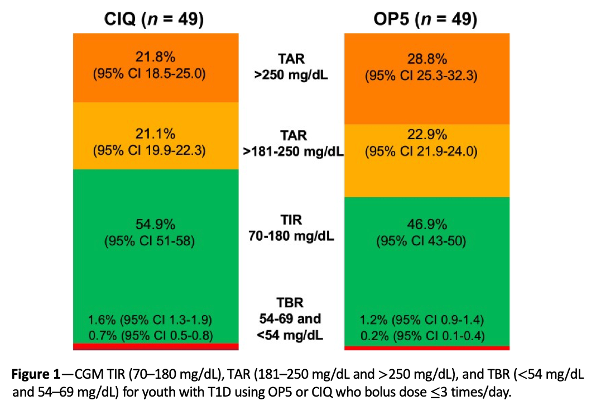
Source: Diabetes Care, “Effect of Low Bolus Frequency on Automated Insulin Delivery System Performance in Youth With Type 1 Diabetes,” Dr. Prerana Chatty (December 11, 2025)
The authors posited that differences in algorithm design and higher time in automated mode among Control-IQ users likely drove the outcomes. They recommended discussing these algorithm-specific effects of bolus frequency with families when selecting an AID system.
Close Concerns’ Questions
- Were there any differences in user settings (basal rates, correction factors, insulin-to-carbohydrate ratios, and glucose targets) between the two systems, and if so, how might these have affected the results?
- When each system was used with its recommended or “optimal settings,” did outcomes differ meaningfully between groups?
- To what extent might user behaviors such as physical activity or average meal size influenced glycemic outcomes?
--by Jeremy Alkire, Elizabeth Rose, Monica Oxenreiter, and Kelly Close