Ascletis announces advancement of once-monthly GLP‑1R/GIPR/GCGR triple agonist ASC37 as next clinical candidate for obesity –
Achieved a half-life 7-fold longer than the standard liquid formulation of Lilly’s retatrutide in non-human primate studies
Hong Kong-based biotech company Ascletis announced today that it is advancing its once‑monthly GLP‑1R/GIPR/GCGR triple agonist, ASC37, as its next clinical candidate, with an IND filing planned for 2Q26. Built using the company’s AI‑assisted structure‑based drug discovery (AISBDD) and ultra‑long‑acting platform (ULAP) technologies, ASC37 shows higher in vitro potency than Lilly’s once-weekly retatrutide across all three receptors and is engineered for a substantially longer half‑life. The company plans to initiate phase 1 in 2H26.
Beyond monotherapy, the company is also exploring combinations with ASC36, its once‑monthly amylin receptor agonist, to target obesity, diabetes, and MASH. See our updated competitive landscape for more in the incretin-based therapy pipeline.
In preclinical studies, ASC37 demonstrated more potent activity than retatrutide
In head-to-head preclinical studies for non-human primates, ASC37’s proprietary subcutaneous depot achieved a ~17‑day observed half‑life, roughly seven times longer than retatrutide’s standard liquid formulation. This supports once-monthly dosing with ≤1 mL injection volume and potential manufacturing advantages in scalability. In addition, the company reported that ASC37 had in vitroactivity that was about five-, four-, and four-fold higher in potency than retatrutide for GLP-1 R, GIPR, and GCGR agonism, respectively.
Ascletis’s pipeline includes oral and injectable GLP-1 RAs in phase 2
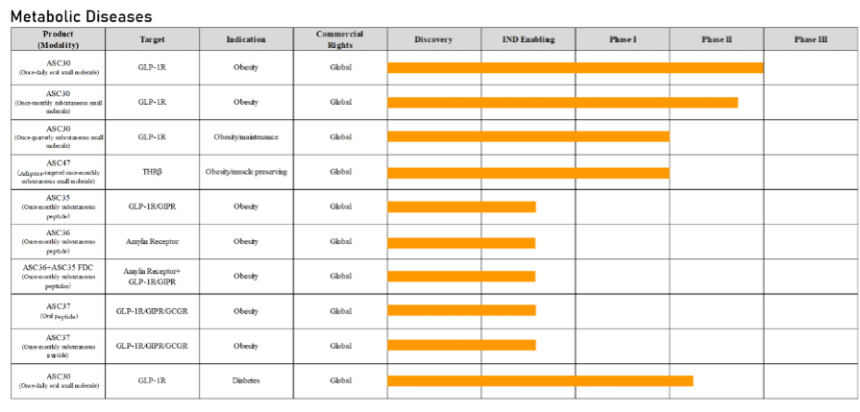
ASC37 is the latest addition to Ascletis’s pipeline (see above), developed using the company’s AISBDD and ULAP engine, which optimize slow release of pharmaceutical ingredients. Specifically, AISBDD is an AI‑assisted structure‑based drug discovery platform, and ULAP is its ultra‑long‑acting peptide platform that tunes slow‑release constants in subcutaneous depots to enable precise, once‑monthly release.
The company’s broader pipeline of ultra‑long‑acting peptides includes ASC35 (GLP-1R/GIPR dual peptide agonist) and ASC36 (once‑monthly amylin receptor agonist), both of which are undergoing IND-enabling studies.
Separately, the company’s pipeline also includes ASC30, a once‑daily oral GLP‑1 RA. In April 2025, Ascletis announced topline results from phase 1b trials, where ASC30 demonstrated up to 9.3% weight loss and is also being advanced as a once‑monthly subcutaneous candidate for obesity.
Close Concerns’ Questions
- To what extent might ASC37’s higher in vitro potency across GLP‑1R/GIPR/GCGR agonism translate into efficacy or tolerability compared to retatrutide?
- What are the key factors contributing to the scalability advantages of the ≤1 mL injection volumes, and how might these influence the cost of the therapy?
- What magnitude of weight loss and metabolic benefit does Ascletis expect from combining ASC37 with ASC36, and how will the company prioritize monotherapy vs. combination development?
-- by Kayla Mathieu, Kat Moon, Monica Oxenreiter, and Kelly Close