ACC 2026 Day #1 Highlights –
Executive Highlights
- This year’s American College of Cardiology (ACC) Scientific Sessions began strongly today in New Orleans, LA. Ernest N. Morial Convention Center, just a twenty-minute walk away from the lively French Quarter, pulsated with excitement for new data, emerging therapies, and clinical pearls. We continue to be impressed by the scientific rigor of this meeting, as many talks – posters and late-breaking sessions alike – had simultaneous publications.
- Dr. Steven Nissen (Cleveland Clinic) delivered a long-anticipated secondary analysis of the SURPASS CVOT trial (n=13,165). The study evaluated tirzepatide’s benefits on a 6-component cardiorenal outcome, including: (i) all-cause mortality; (ii) myocardial infarction; (iii) stroke; (iv) coronary revascularization; (v) hospitalization for heart failure; and (vi) adverse renal outcomes. Tirzepatide conferred a statistically significant 16% reduction in cardiorenal events compared to dulaglutide. All-cause mortality, coronary revascularization, and composite renal endpoint had the largest contributions to the risk reduction of this composite. Pre-specified subgroup analyses showed that all subgroup HRs favored tirzepatide.
- Dr. Nicholas Marston (Harvard University) presented secondary analysis of the phase 3 VESALIUS-CV study to assess whether PCSK-9 inhibitor evolocumab could prevent a first major cardiovascular event (MACE) in PWD without significant atherosclerosis. The cohort included 3,655 patients with a median age 65 years. Evolocumab led to significant decreases in LDL cholesterol levels, risk of 3-P-MACE, 4-P-MACE, and all-cause mortality. LDL cholesterol levels were 52 mg/dL versus 111 mg/dL in the evolocumab versus placebo arms at Week 48 (p<0.0001). The therapy significantly reduced the risk of 3-P MACE and 4-P MACE each by 31%. The absolute risk reduction was 2.1% and 2.9%, respectively.
- Several sessions focused on the overlapping pathophysiology of cardiovascular-kidney-metabolic (CKM) syndrome. Prof. Harriette Van Spall (McMaster University, Canada) pointed out that 48% of participants with HF had diabetes, 71% had hypertension, and 21% had CKD, indicating a high prevalence of comorbid conditions. Moreover, given that several treatment modalities – SGLT-2 inhibitors, nsMRAs, ACEi/ARBs, and GLP-1 RAs – address HFmrEF, HFpEF, and CKD alike, Prof. Van Spall urged the audience to always consider CKM syndrome as a whole and offer integrated care to decrease fragmentation. Dr. Januzzi discussed the use of imaging and biomarkers for the care of CKM and HF, with particular relevance for PWD. In a case-based discussion, Drs. Javed Butler (University of Mississippi), Vanessa Blumer (Inova), and Jennifer Green (Duke) highlighted the benefits of finerenone in CKD.
- In addition, we appreciated new insights into various treatments for CKM syndrome. A retrospective study (n=217,322) found that empagliflozin reduces the risk of atrial fibrillation by 41% in people with HFpEF. According to two complementary analyses from the SOTA‑P‑CARDIA trial (n=88), sotagliflozin produced a reduction in pathogenic fat depots, and nearly 80% of sotagliflozin‑treated patients achieved clinically meaningful KCCQ improvements of at least 5 points compared with 27% on placebo. A phase 1/2 ACESO-IHD trial (n=26)found that mesenchymal stem cells (MSCs) may have anti-atherosclerotic effects in people with diabetes and ischemic heart disease.
Table of Contents
- 1. SURPASS CVOT secondary analysis: Tirzepatide (Lilly’s Mounjaro) conferred a superior 16% reduction in cardiorenal endpoints compared to dulaglutide (Lilly’s Trulicity) in packed address by the Cleveland Clinic’s Dr. Steve Nissen
- 2. Secondary analysis of VESALIUS-CV: Evolocumab (Amgen’s Repatha) reduces the risk of first major cardiac event in PWD without CVD
- 3. Analysis of the STRIDE trial shows consistent benefit of semaglutide (Novo Nordisk’s Ozempic) on ankle-brachial index for T2D and peripheral artery disease across disease states
- 4. Primary results from CORCEPT’s MOMENTUM study delivered by Mount Sinai’s Dr. Deepak L. Bhatt: Hypercortisolism as more prevalent than previously assumed
- 5. Tirzepatide demonstrates durable reductions to cardiovascular risk versus GLP‑1 RAs in adults with obesity and without diabetes
- 6. CagriSema (Novo Nordisk’s amylin/GLP-1 combo) outperforms cagrilintide and semaglutide when considering a balance of efficacy and tolerability for obesity management
- 7. Foundation beneath the pillars: Emerging cardiovascular-kidney-metabolic concepts in heart failure
- 8. Clinical pearls: Use of finerenone (Bayer’s Kerendia) in heart failure, chronic kidney disease, and/or diabetes
- 9. Empagliflozin reduces the risk of atrial fibrillation in people with HFpEF
- 10. Sotagliflozin improves epicardial adipose tissue volume and functional capacity in HFpEF
- 11. A phase 1/2 trial shows the therapeutic potential of mesenchymal stem cells as a therapy for ischemic heart disease in PWD
- 12. ACC President Dr. Christopher Kramer delivers the opening address on the expanding role of AI and advocacy efforts in cardiovascular care
- 13. *NEW* Powerful secondary analysis of the SOUL trial corroborates cardiovascular benefits of oral semaglutide on MACE and non-CV deaths
1. SURPASS CVOT secondary analysis: Tirzepatide (Lilly’s Mounjaro) conferred a superior 16% reduction in cardiorenal endpoints compared to dulaglutide (Lilly’s Trulicity) in packed address by the Cleveland Clinic’s Dr. Steve Nissen
In this well-attended afternoon session, Dr. Steven Nissen (Cleveland Clinic) presented a secondary post-hoc analysis of the SURPASS CVOT trial (n=13,165). The results were simultaneously published in JAMA Cardiology. For background, the SURPASS CVOT assessed a primary 3-composite endpoint of death from cardiovascular causes, myocardial infarction (MI), or stroke in adults with T2D at increased cardiovascular risk. While tirzepatide did show non-inferiority for a relatively narrow, 3-composite major adverse cardiovascular event (MACE-3), outcomes for a more comprehensive range of MACE previously went unreported. Accordingly, investigators conducted a post-hoc analysis to assess tirzepatide’s effect on a broader range of morbidity sources in PWD and atherosclerotic cardiovascular disease (ASCVD).
- The secondary analysis included a 6-component cardiorenal outcome, including: (i) all-cause mortality; (ii) myocardial infarction; (iii) stroke; (iv) coronary revascularization; (v) hospitalization for heart failure; and (vi) adverse renal outcomes. Sensitivity analyses of a 5-component endpoint (omitting adverse renal outcomes) and a 4-component endpoint (omitting adverse renal and heart failure outcomes) were also assessed to better understand the drivers of improved outcomes and findings from SURPASS CVOT.
- Tirzepatide conferred a statistically superior reduction in adverse cardiorenal events compared to dulaglutide (HR=0.84) in the 6-composite endpoint. All-cause mortality, coronary revascularization, and composite renal endpoint had the largest contributions to the risk reduction of this composite. Still, when renal events were removed (5-composite end point), the HR of tirzepatide compared to dulaglutide rose only slightly to 0.86 (p <0.001). When heart failure and renal outcomes were removed (4-composite end point), HR remained at 0.86 (p<0.001). Finally, all-cause mortality was described as a major driver of improved outcomes, conferring a HR of 0.84 (p=0.002) when analyzed in isolation. Thereby, though tirzepatide was not found to be superior in the 3-composite end point of SURPASS CVOT, a more comprehensive, 6-composite endpoint does support tirzepatide superiority over dulaglutide in improving cardiorenal outcomes.
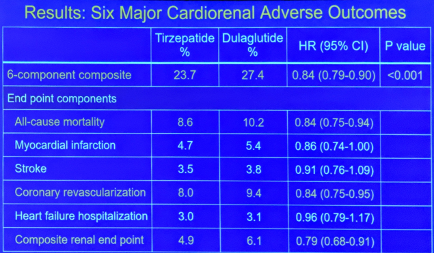
- The results corroborate previous findings that incretin‑based therapies can deliver multi‑system cardiorenal benefit beyond glycemic control and weight loss. Such benefits, Dr. Nissen noted, often are realized rapidly in the treatment course. Within Kaplan Meier curves for all composites, tirzepatide and dulaglutide groups separated within six months of treatment initiation, even though this period often consists of initiation and dose escalation.
- Adverse event profiles were noted to be similar between dulaglutide and tirzepatide arms. However, Dr. Nissen did note that adverse events in gastrointestinal disorders increased in the tirzepatide group compared to dulaglutide.
- On heterogeneity, Dr. Nissen shared that pre-specified subgroup analyses showed that all subgroup HRs favored tirzepatide. No statistically significant heterogeneity across age, sex, region, baseline risk, or other “usual suspect” subgroups was found during the secondary analysis.
- A subsequent statement released by a Lilly spokesperson echoed Dr. Nissen’s remarks at ACC 2026: “For adults with type 2 diabetes who are at increased cardiovascular risk, these expanded SURPASS CVOT findings suggest Mounjaro may offer benefits beyond blood sugar and weight, but also the serious complications that shape long-term outcomes. This data adds to a growing body of evidence supporting Mounjaro as a more comprehensive approach to managing type 2 diabetes.”
2. Secondary analysis of VESALIUS-CV: Evolocumab (Amgen’s Repatha) reduces the risk of first major cardiac event in PWD without CVD
In a late-breaking presentation, Dr. Nicholas Marston (Harvard University) presented an analysis of the phase 3 VESALIUS-CV study showing that evolocumab substantially reduced the risk of a first major cardiovascular (CV) event. Results were published simultaneously in JAMA. These data were built upon the full results of the VESALIUS-CV trial (n=12,257) presented at AHA 2025.
- As background, VESALIUS-CV was a randomized, double-blind, placebo-controlled trial of evolocumab in 12,257 patients with atherosclerosis and/or diabetes. Patients were at high risk of CV events but had no prior MI or stroke. LDL cholesterol levels were 90 mg/dL or greater. At early CV disease stages, evolocumab, a PCSK9 inhibitor sold under the brand name Repatha, conferred a 20% risk reduction in all-cause death, 25% risk reduction in major adverse cardiovascular events (MACE) at five years of study. The benefits were found across key secondary endpoints, although the greatest risk reduction (36%) was found for MI. Benefits were also consistent across all subgroups, including age, gender, qualifying disease state, baseline LDL-c, and baseline lipid-lowering therapy. In people with diabetes but not qualifying for atherosclerosis, evolocumab led to 29% risk reduction in MACE. Evolocumab also significantly reduced LDL-c by 55% (63 mg/dL absolute reduction). At Week 48, the evolocumab group achieved a median LDL-c of 45 mg/dL, while the placebo group reached 109 mg/dL from the baseline median of 115 mg/dL. These data were highly impressive and support the use of evolocumab in addition to traditional statin therapy for intensive LDL cholesterol lowering. However, previous results did not demonstrate whether evolocumab could prevent a first major cardiovascular event (MACE) in PWD without significant atherosclerosis, leading to this analysis.
- This subgroup analysis examined outcomes in patients without any known significant atherosclerosis. The cohort included 3,655 patients with a median age 65 years, 57% of whom were female. Patients were followed for a median of 4.8 years. The dual primary endpoints were composites of coronary heart disease death, MI, or ischemic stroke (3-P MACE) and 3-P MACE plus ischemia-driven arterial revascularization (4-P MACE).
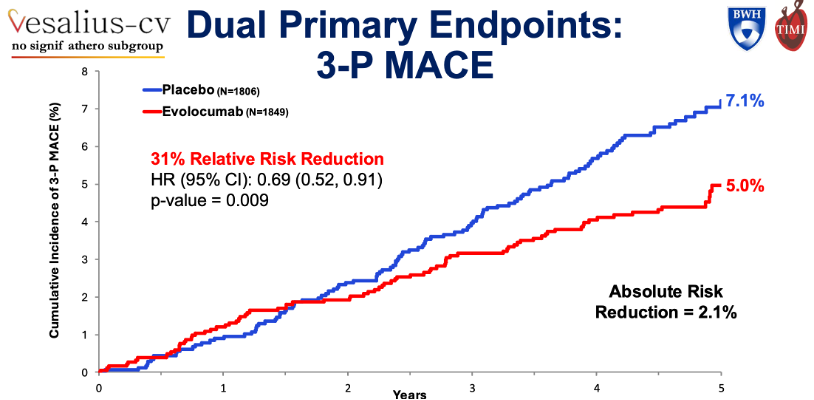
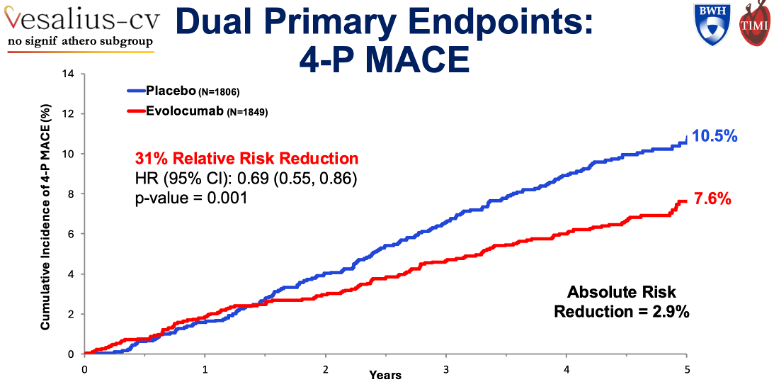
- Evolocumab led to significant decreases in LDL cholesterol levels, risk of 3-P-MACE, 4-P-MACE, and all-cause mortality. Dr. Marston said that LDL cholesterol levels were 52 mg/dL versus 111 in the evolocumab versus placebo arms at Week 48 (p<0.0001). The therapy significantly reduced the risk of 3-P MACE and 4-P MACE each by 31% (hazard ratio 0.69, p=0.009; hazard ratio 0.69, p=0.001, respectively) (see figures above). The absolute risk reduction was 2.1% and 2.9%, respectively. The hazard ratio for cardiovascular death was 0.68, and the hazard ratio for all-cause mortality was 0.76 (see figure below).
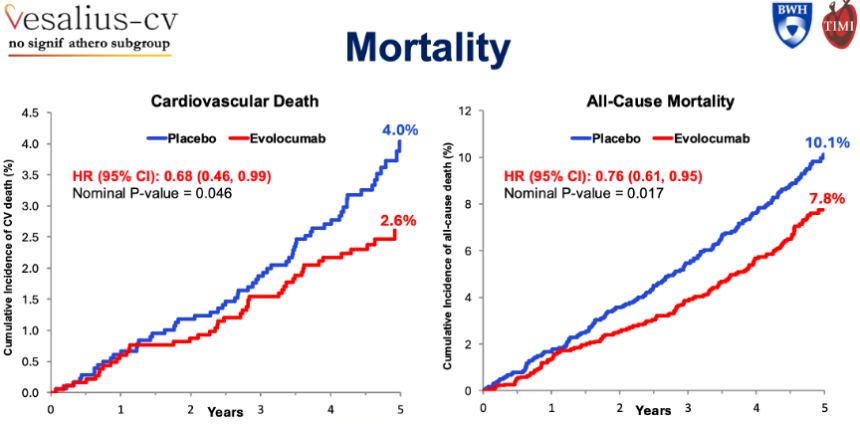
- Interestingly, the beneficial effect of evolocumab became apparent after one year of treatment for this subgroup, compared to a near-immediate effect for patients with established CV disease. Dr. Marston also noted that systematic imaging to assess CV disease was not required based on guideline recommendations, meaning that some patients may have had significant, undiagnosed atherosclerosis. During the discussion section of the presentation, Dr. Ann Marie Navar (UT Southwestern) reminded the audience that the “majority” of patients with diabetes have atherosclerotic cardiovascular disease, even if undiagnosed. She therefore urged the study authors to refer to patients as undiagnosed, not as patients without CV disease, an important distinction.
- These data support the early intensification of lipid-lowering therapy beyond statins, even for those earlier in the disease process. Dr. Marston said that LDL cholesterol levels should be lowered to about 40 mg/dL in these patients, a goal that has typically been reserved for very high-risk secondary prevention patients.
3. Analysis of the STRIDE trial shows consistent benefit of semaglutide (Novo Nordisk’s Ozempic) on ankle-brachial index for T2D and peripheral artery disease across disease states
Dr. Marc Bonaca (University of Colorado Anschutz) presented an additional analysis from the STRIDE trial suggesting that semaglutide may improve ankle-brachial index (ABI). ABI is a measure of peripheral artery disease (PAD) severity that compares blood pressure in the ankle with blood pressure in the arm. A low ankle-brachial index may indicate blockage of the arteries in the legs. The STRIDE trial (n=792) evaluated semaglutide 1.0 mg in people with T2D and early-stage PAD, characterized by muscle pain in the legs during activity. The 52-week trial was completed in 2024, achieving its primary endpoint of change in maximum walking distance on a constant load treadmill test. Full results were presented at ACC 2025. Semaglutide conferred a 21% increase in maximum walking distance from a baseline of 185 meters versus an 8% increase with placebo from a baseline of 186 meters. Participants in STRIDE reported that PAD has a moderate-to-high impact on their health-related quality of life, with nearly 65% of patients reporting a moderate-to-severe limitation in their ability to walk. Initial analysis of the STRIDE trial indicated that semaglutide increased ABI in participants, but it remained unknown if this was consistent across disease stages and if it persisted after treatment discontinuation, leading to this study.
- Methods. Change in ABI from baseline to Week 52 was a secondary outcome in the STRIDE trial. It was also assessed at Week 57 after ceasing treatment. ABI was reported as a ratio to baseline and presented as estimated treatment ratios (ETRs), a ratio of endpoints in the semaglutide versus placebo groups. A mixed model was used for repeated measures analysis with an interaction term between the treatment and subgroups adjusted for the baseline of the endpoint.
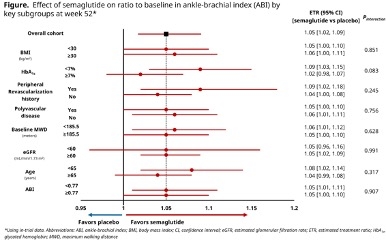
- Results. The mean ABI was 0.75 at baseline, with an ABI of 0.5-0.8 indicating moderate arterial disease. At 52 weeks of treatment, semaglutide increased ABI (estimated treatment response [ETR] of 1.05, p=0.0037). An ABI of 1.0-1.4 is considered normal, indicating that semaglutide may allow patients to improve from moderate disease to a normal state. The semaglutide group had 8% more responders at ≥10% improvement to ABI compared to placebo and had 6% more responders showing ≥15% improvement. The increase in ABI was also consistent across subgroups (see figure below). At Week 57, ABI remained increased compared to placebo (ETR 1.05, p=0.0042).
- Dr. Bonaca concluded that semaglutide increased ABI with consistent effects across subgroups. These benefits persisted for five weeks following treatment discontinuation, which may indicate long-term benefit. These observations suggest a direct vascular effect of semaglutide and warrant further investigation.
4. Primary results from CORCEPT’s MOMENTUM study delivered by Mount Sinai’s Dr. Deepak L. Bhatt: Hypercortisolism as more prevalent than previously assumed
In this standing-room-only afternoon session, Dr. Deepak L. Bhatt (Mount Sinai Fuster Heart Hospital) presented the first results from the MOMENTUM study (n=1,086) which investigated the prevalence of endogenous hypercortisolism in patients with resistant hypertension. Dr. Bhatt said that resistant hypertension is common; around 13% of patients with hypertension exhibit a resistant phenotype. In these patients, secondary endocrine causes could be treatable contributors.
- Hypercortisolism is associated with excess cardiovascular risk, conferring up to an 85% greater chance of hypertension, a 4.5x risk of stroke, a 2x risk of MI, and a 6x risk of HF. Using a practical means of testing for endogenous hypercortisolism, which consists of the broadly available 1 mg dexamethasone suppression test (DST), the MOMENTUM study examined the prevalence of hypercortisolism in a US-based study in patients with resistant hypertension (see trial design below).
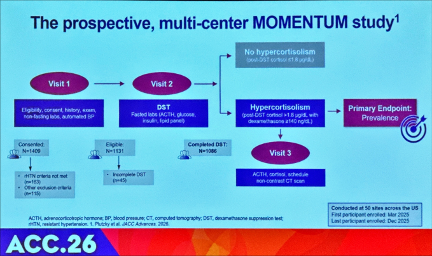
- The MOMENTUM study included participants with resistant hypertension based on the 2017 AHA criteria: (i) a systolic BP of ≥130 mmHg despite the use of ≥3 BP medications from different classes at maximally tolerated doses, including a diuretic; or (ii) SBP at any level with the use of ≥4 BP medications from different classes. Notably, individuals with non-adherence to BP medications, “white coat” hypertension (i.e. hypertension in the office only), and an eGFR <30 mL/min/1.73 m2 were among the excluded conditions.
- In adults with resistant hypertension, 27% (297/1,086 participants) were found to have hypercortisolism, identified by a post-DST cortisol of >1.8 µg/dL. Moreover, 24% of patients with hypercortisolism were found to have an adrenal nodule on CT scans, some of whom may be candidates for surgical removal. Dr. Bhatt stressed that patients with hypercortisolism “look no different” than those without it. Not only do they not have classic facial swelling or “buffalo hump”, they actually have a lower body mass index and waist circumference (see below).
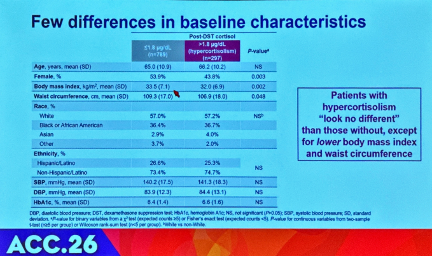
- Antihypertensive medication use was similar in patients with and without hypercortisolism due to how patients were recruited. However, for antihyperglycemic medications, patients with hypercortisolism tended to take more than those without hypercortisolism. Interestingly, this finding could be related to a higher incidence of glucose above target in people with hypercortisolism (33% versus 31%). Cardiac disorders were also found to be numerically more common in patients with hypercortisolism versus those without, including: (i) atrial fibrillation at 11% versus 9%; (ii) coronary artery disease with 13% versus 10%; and (iii) heart failure with 14% versus 10%. Lastly, reduced kidney function and a higher risk of chronic kidney disease progression were significantly more common in patients with hypercortisolism, with 18% of hypercortisolism patients in the “very high risk” CKD progression category, compared to just 8% in the group without hypercortisolism.
- While compelling and demonstrating a whole new area of research and clinical opportunity, Dr. Bhatt did note a few limitations to the MOMENTUM study, including: (i) a limited geographic footprint to the US; (ii) a low proportion of Asian patients; (iii) no differentiation between HFpEF and HFrEF; (iv) no longitudinal follow-up to assess CV event rates; and (v) no way to establish causation between hypercortisolism and increased risk. Dr. Bhatt concluded that patients with resistant hypertension should be screened for hypercortisolism and hyperaldosteronism.
5. Tirzepatide demonstrates durable reductions to cardiovascular risk versus GLP‑1 RAs in adults with obesity and without diabetes
Dr. Abdul Rasheed Bahar (Wayne State University) presented results from a large real-world comparative analysis evaluating tirzepatide versus GLP-1 RAs in adults with obesity but without diabetes. The study compared cardiometabolic outcomes between tirzepatide and mono GLP‑1 RAs in a high‑risk population without diabetes. A composite of all-cause mortality, myocardial infarction, and stroke was assessed at one and three years, alongside secondary endpoints, including acute heart failure, atrial fibrillation, HFpEF, pancreatitis, gastrointestinal events, and weight-related outcomes. Overall, the findings suggest that tirzepatide may offer meaningful long-term cardiometabolic advantages over mono GLP-1 RAs in adults with obesity and without diabetes, warranting confirmation in randomized trials.
- Study design. Using data from the TriNetX Global Collaborative Network between 2022 and 2025, investigators conducted a retrospective cohort study (n=45,138) of adults with BMI ≥30 kg/m², identifying tirzepatide and mono GLP-1RA users and matching them 1:1 on demographics and comorbidities. Participants were adults with obesity and a high burden of cardiovascular risk factors, including hypertension, dyslipidemia, and established ischemic heart disease, but no diabetes.
- Results. At one year and three years of follow-up, tirzepatide demonstrated stronger cardiometabolic benefit compared to GLP‑1 RAs. At one year, tirzepatide was associated with:
- 26% lower risk of the composite of all‑cause mortality, MI, and stroke (HR 0.74; CI: 0.62-0.91);
- 48% lower risk of all‑cause mortality (HR 0.52; CI: 0.38-0.71);
- 28% lower risk of ischemic stroke (HR 0.72; CI: 0.52-1.00);
- 29% lower risk of systolic heart failure (HR 0.71; CI: 0.59-0.84);
- and an 18% lower risk of HFpEF (HR 0.82; CI: 0.68-0.99).
- In addition, tirzepatide nearly doubled the likelihood of clinically meaningful weight loss (HR 1.80; CI: 1.52-2.12). These benefits remained durable at three years of study duration. Tirzepatide users also experienced fewer gastrointestinal side effects and had a lower risk of pancreatitis. In the long term, early separation between treatment groups continued to widen over time, reinforcing the durability of tirzepatide’s benefit.
6. CagriSema (Novo Nordisk’s amylin/GLP-1 combo) outperforms cagrilintide and semaglutide when considering a balance of efficacy and tolerability for obesity management
Dr. Sima Rawal (Arnot Health) presented a systematic review and meta‑analysis comparing CagriSema with its monocomponents – cagrilintide and semaglutide – as obesity medications. The analysis synthesized randomized controlled trials to evaluate weight loss, glycemic outcomes, cardiometabolic parameters, and gastrointestinal tolerability, aiming to clarify the optimal positioning of CagriSema relative to established monotherapies.
- Study design. The investigators systematically searched five databases for randomized controlled trials evaluating once‑weekly CagriSema, cagrilintide, or semaglutide 2.4 mg doses in adults with overweight or obesity. Five trials (n=2,803) met the inclusion criteria. A Bayesian network meta‑analysis was performed to compare absolute and percentage weight loss, A1c, fasting glucose, systolic blood pressure, waist circumference, and adverse events. Treatments were ranked using Surface Under the Cumulative Ranking probabilities.
- Results. Across the trials, CagriSema consistently ranked as the most effective therapy for weight loss and cardiometabolic improvement. It conferred the greatest reductions to absolute weight loss, percentage weight loss, and reduction in A1c values, as well as fasting blood glucose, systolic blood pressure, and waist circumference. Semaglutide ranked second for most efficacy outcomes, followed by cagrilintide. To the surprise of the investigators, CagriSema demonstrated the most favorable gastrointestinal tolerability profile, yielding the lowest probability for nausea, vomiting, diarrhea, and treatment discontinuation due to adverse events. Cagrilintide had the lowest rate of serious adverse events.
- Clinical implications. The authors emphasized that CagriSema offers the most favorable efficacy-tolerability balance among the therapies, making it a compelling first‑line option for patients requiring substantial weight loss (>15%) or those with obesity and T2D who need improved glycemic management. Ultimately, treatment selection should balance efficacy goals with individual tolerability profiles. Further work on patient selection, leveraging clinical, genetic, and metabolic profiles, may enable more personalized anti‑obesity therapy.
7. Foundation beneath the pillars: Emerging cardiovascular-kidney-metabolic concepts in heart failure
Dr. James Januzzi (Harvard University) and Prof. Harriette Van Spall (McMaster University, Canada) discussed complementary approaches to treating cardiovascular-kidney-metabolic (CKM) syndrome and heart failure (HF). Traditionally, HF has been directly addressed through therapies such as ACE inhibitors and beta blockers, yet knowledge of the condition has recently expanded to include related conditions. Obesity, diabetes, high blood pressure, and kidney disease are all associated with HF, and together these conditions are now being recognized as CKM. The presenters outlined recent advances in diagnostics and treatment for this syndrome.
- Prof. Van Spall outlined the prevalence of overlapping CKM conditions in HF, calling for treatment approaches to address this overlap. A sub-analysis of the PACT-HR pragmatic RCT (n=4,441) found that 48.4% of participants with HF had diabetes, 71.2% had hypertension, and 20.9% had CKD. Further, even for patients free of a CKD diagnosis at the time of HF diagnosis, only 10% of patients remained alive and free of CKD by five years following diagnosis. The conditions that play a role in CKM also share the same treatment cornerstones, said Prof. Van Spall. SGLT-2 inhibitors, nsMRAs, and ACE inhibitors/angiotensin II receptor blockers are used for HFmrEF, HFpEF, and CKD alike, while GLP-1 RAs are ideal for HFmrEF, HFpEF, or CKD alike. Given the overlap in treatment modalities, Prof. Van Spall urged the audience to always consider CKM syndrome as a whole and offer integrated care to decrease fragmentation. She suggested a number of models to achieve this goal, including a cardiometabolic clinic, an allied health prevention clinic, an integrated CKM clinic, virtual clinics, or even an AI-enabled health program based on the COACH pilot study.
- Dr. Januzzi discussed the use of imaging and biomarkers for the care of CKM and HF, with particular relevance for PWD. Given that diabetes is a core part of the characteristics of CKM and increases the risk of HF, he proposes a stepwise approach for evaluation and diagnosis. He said that the measurement of a natriuretic peptide (NT-proBNP or BNP biomarkers) or high-sensitivity troponin (hs-cTn) is recommended at least yearly in Stages A/B HF, as kidney disease involvement is common in these stages yet remains underdiagnosed. Stage A refers to patients with a high risk of HF. Risk factors include obesity, hypertension, hyperlipidemia, diabetic kidney disease, coronary artery disease, and certain social determinants of health, with risk being higher for male patients. Stage B refers to patients with initial structural disorders, including left ventricular (LV) systolic or diastolic dysfunction, LV hypertrophy, chamber enlargement, valvular disease, increased filling pressures, or elevated biomarkers. Patients with elevated levels of these biomarkers should be referred to cardiac imaging. He also cited Vadurganathan et al., who demonstrated that the urine albumin-to-creatinine ratio (uACR) is an essential marker for HF as well.
- Dr. Januzzi said that the future will be characterized by the greater overlap of detection measures for CKM and HF. He said that HF risk lies at the center of three approaches: clinical variables, imaging, and biomarkers, with the latter approach continuing to expand in popularity. The use of machine learning models, multimodal risk models, and CKM subgroup phenotyping will also be essential as the field moves forward. He also highlighted four therapeutic classes for which use will intensify in a targeted manner: renin-angiotensin system inhibitors (RASi), SGLT-2 inhibitors, mineralocorticoid receptor antagonists (MRAs), and GLP-1 RAs. He concluded by classifying CKM-HF as a trajectory disorder, saying that early detection and early therapeutic intervention matters. Biomarkers are useful to inform CKM risk, an essential and expanding area of prevention that was appreciated by many attendees.
8. Clinical pearls: Use of finerenone (Bayer’s Kerendia) in heart failure, chronic kidney disease, and/or diabetes
In this well-attended breakfast symposium, Drs. Javed Butler (University of Mississippi Medical Center), Vanessa Blumer (Inova), and Jennifer Green (Duke) shared clinical pearls for the use of finerenone, a nonsteroidal mineralocorticoid receptor antagonist (nsMRA). Dr. Butler explained that heart failure (HF), chronic kidney disease (CKD), and diabetes have shared pathophysiology and risk factors. Excess or dysfunctional adipose tissue, inflammation, oxidative stress, and insulin resistance are key drivers of cardiovascular-kidney-metabolic syndrome (CKM), including hypertension, dyslipidemia, atherosclerosis, diabetes, and CKD. Encouragingly, medications like GLP-1 RAs, SGLT-2 inhibitors, and finerenone address overlapping pathophysiology and improve multiple conditions.
- Dr. Blumer first discussed the clinical benefits of finerenone. The FIDELITY pooled analysis (n=13,026) found that finerenone reduced MACE by 14% and composite kidney outcomes by 23% in people with CKD and T2D. The FINE-HEART pooled analysis (n=7,008) also showed a 13% reduction in cardiovascular (CV) death or HF hospitalization in people with HF with mildly reduced (HFmrEF) or preserved ejection fraction (HFpEF). These benefits were consistent regardless of baseline A1c, eGFR, and uACR, including those without diabetes.
- Finerenone is preferred over steroidal MRAs for HF because it showed statistically significant benefits in CV outcomes and had a lower risk of hyperkalemia (high potassium levels). Compared to steroidal agents like spirolactone and eplerenone, finerenone has a more even distribution of binding between the heart and the kidneys (versus higher binding in the kidneys with steroidal agents), as well as greater selectivity and potency for the mineralocorticoid receptor, reducing off-target effects. She noted, however, that steroidal MRAs demonstrated benefit in HF with reduced ejection fraction (HFrEF), unlike finerenone, for which the role is unclear.
- Turning to practical considerations for finerenone use, Dr. Blumer directed clinicians to: (i) optimize background therapy, including RAS inhibitors, SGLT-2 inhibitors, and diuretic therapy; (ii) check potassium levels; (iii) review drug interactions (e.g., reduce dose of erythromycin, verapamil, and fluconazole); and (iv) educate patients about the risks of hyperkalemia. Clinicians should monitor potassium and eGFR levels every four to six months and albuminuria every year to assess treatment response. Finally, an early decline in eGFR values is expected with finerenone initiation, and the treatment benefit for HF events and CV deaths is sustained regardless of this initial decline.
- Dr. Green highlighted findings from the phase 2 CONFIDENCE trial (n=800) which showed that the simultaneous initiation of finerenone and SGLT-2 inhibitors conferred greater reductions in uACR than monotherapies in people with CKD and T2D. Importantly, adding SGLT-2 inhibitors lowered the risk of severe hyperkalemia (9.3%) compared to finerenone alone (11.4%), suggesting the benefits of combination therapy. She also noted that GLP-1 RAs and lipid management can be used concurrently to minimize CV and renal risk.
- Looking forward, Dr. Blumer is excited about the potential expansion of finerenone’s indication to HFrEF, with the REDEFINE-HF trial (n=5,200) expected to complete in December 2027. The FINALITY-HF trial (n=2,600) will evaluate the long-term safety of finerenone use, and the CONFIRMATION-HF study (n=1,500) will offer greater understanding of combining therapies with finerenone. During Q&A, Dr. Green also mentioned the FINE-ONE trial (n=242), which found renal benefits of finerenone for people with T1D and CKD.
9. Empagliflozin reduces the risk of atrial fibrillation in people with HFpEF
In a dynamic session, Mr. Andrew Nguyen (USC) shared findings from a retrospective study (n=217,322) evaluating the effects of empagliflozin on the risk of atrial fibrillation (AF) in people with heart failure with preserved ejection fraction (HFpEF). Mr. Nguyen explained that AF is present in approximately 60% of people with HFpEF. Given that the two conditions share pathophysiologic pathways, this study investigated whether empagliflozin reduces the risk of AF in people with HFpEF. Using data from the TriNetx Global Federated Research Network, investigators propensity score-matched people with HFpEF, including those with diabetes, who received empagliflozin versus control. Endpoints included incidence of AF, stroke, myocardial infarction, all-cause mortality, and all-cause hospitalization at five years.
- Over a median follow-up of one year, empagliflozin was associated with a 41% relative and 6% absolute risk reduction in incident AF (9% versus 15%) compared with control. Moreover, empagliflozin was associated with a 59% lower risk of all-cause mortality, a 43% lower risk of hospitalization, a 45% lower risk of stroke, and a 43% lower risk of myocardial infarction, consistent with previous studies showing cardiovascular benefits of SGLT-2 inhibitors. Mr. Nguyen hypothesized that the benefits of empagliflozin on AF may be due to reduced fibrosis and inflammatory markers, as well as enhanced ionic balance.
10. Sotagliflozin improves epicardial adipose tissue volume and functional capacity in HFpEF
Prof. Juan Badimon (Mount Sinai School of Medicine) presented two complementary analyses from the SOTA‑P‑CARDIA trial (n=88). The studies offer an understanding of sotagliflozin’s benefits and mechanisms of action in people with HFpEF without diabetes. One analysis examined MRI‑derived changes in epicardial and hepatic fat, while the other evaluated symptoms, functional capacity, and health status. Combined, these findings show that sotagliflozin improves how patients feel and function while also targeting upstream metabolic contributors to HFpEF.
- Study design. The SOTA‑P‑CARDIA trial investigated whether the cardiorenal benefits of sotagliflozin in people with diabetes can be extended to people without diabetes, as shown in the SCORED and SOLOIST-WHF studies. Participants underwent MRI at baseline and follow‑up to quantify epicardial adipose tissue (EAT), visceral and subcutaneous adipose tissue, and liver fat fraction. In parallel, patients completed the 6‑minute walk test (6MWT) and the Kansas City Cardiomyopathy Questionnaire (KCCQ), with analyses stratified by baseline symptom severity. This design enabled the simultaneous evaluation of mechanistic adipose‑tissue effects and patient‑centered clinical outcomes.
- Results. Sotagliflozin produced a reduction in pathogenic fat depots. EAT volume fell by 6.14 mL (CI: -8.72 to -3.55) with sotagliflozin compared to essentially no change on placebo (-0.06 mL), yielding a between‑group difference of -6.08 mL (p = 0.002). Liver fat fraction decreased by 1.20% (CI: -1.82 to -0.58) with sotagliflozin versus 0.30 with placebo, with a between‑group difference of -0.90% (p = 0.055). In contrast, changes in subcutaneous and visceral adipose tissue were modest and not significantly different between groups, underscoring a selective effect on metabolically active depots most strongly linked to HFpEF pathophysiology.
- In addition, nearly 80% of sotagliflozin‑treated patients achieved clinically meaningful KCCQ improvements of at least 5 points compared with 27% on placebo. Large (≥10‑point) and very large (≥20‑point) KCCQ gains occurred in 24.3% and 48.6% of sotagliflozin patients, respectively, versus 2.7% and 5.4% with placebo. 6MWT distance increased by an average of 48.6 meters, compared with 19.5 meters on placebo. One‑third of sotagliflozin patients improved test scores by at least 50 meters, whereas no placebo patients reached this threshold.
- Clinical implications. The consistent improvements in KCCQ scores and 6‑minute walk distance, together with selective reductions in EAT and liver fat, support dual SGLT1/2 inhibition as a promising, multifaceted therapy for non‑diabetic HFpEF, a population with few effective symptomatic treatment options.
11. A phase 1/2 trial shows the therapeutic potential of mesenchymal stem cells as a therapy for ischemic heart disease in PWD
In a fascinating poster presentation, Mr. Russel Saltzman (University of Miami) shared findings from the phase 1/2 ACESO-IHD trial (n=26), which evaluated the safety and efficacy of mesenchymal stem cells (MSCs) in people with diabetes and ischemic heart disease. MSCs have been investigated as a potential therapy for cardiovascular diseases (CVD) such as heart failure and myocardial infarction for nearly two decades. It is hypothesized that MSCs, either infused directly into the myocardium or peripherally via intravenous administration, contribute to cardiac regeneration by differentiating into functional cardiomyocytes or by paracrine signaling. Given that people with diabetes commonly develop CVD, investigators studied whether MSCs may improve CV health. This trial follows the phase 1/2 ACESO study (n=16) from 2020, which determined 100 million cells as the optimal dosage for this population.
- Study design and baseline characteristics. 26 participants with diabetes and ischemic heart disease were randomized 1:1 to receive 100 million bone marrow-derived allogenic MSCs or a placebo via intravenous administration. At baseline, participants were 63 years old, 12% were women, and 64% were Hispanic. All were recruited from a catheterization lab and had a history of hypertension, and a majority had dyslipidemia (89%) and obstructive coronary artery disease (77%). While the trial was initially limited to T2D, one participant had T1D due to an initial misdiagnosis as T2D. Mean baseline A1c was 7.4%.
- Primary endpoints were endothelial function (brachial artery flow-mediated vasodilation) and vascular repairing capacity (endothelial colony forming units; EPC-CFU). Other endpoints included serum biomarkers, quality of life, and safety.
- While the trial did not meet its primary endpoints, MSCs improved several atherosclerotic markers. At six months, endothelial function and EPC-CFU increased in both the MSC and placebo groups, with no statistically significant differences. Encouragingly, however, MSCs significantly reduced pro-atherosclerotic markers, such as fibroblast growth factor-2 (FGF-2) and interleukin-23, suggesting therapeutic potential. Moreover, among participants who received stent placement for obstructive coronary artery disease (77%), two in the placebo group experienced artery re-occlusion within a year, yielding an absolute risk reduction of 78% and a number needed to treat (NNT) of 4.5. MSCs were safe and well-tolerated. Looking forward, Mr. Saltzman hopes to conduct additional analyses to understand its effects on glycemia and conduct larger and longer studies to confirm therapeutic benefits.
12. ACC President Dr. Christopher Kramer delivers the opening address on the expanding role of AI and advocacy efforts in cardiovascular care
In this crowded opening session, Dr. Christopher Kramer (UVA), joined by New Orleans’ Kinfolk Brass Band, welcomed attendees to an energizing start of the conference with a forward-looking vision for cardiovascular care. Dr. Kramer touched upon several key themes, including the role of AI for the future, ACC’s mentorship programs, and resilience amid rapid policy changes. He also recognized two leaders whose careers embody the ACC’s mission. He first awarded Dr. Zohair Al Halees, recipient of the Lifetime Achievement Award, for his decades of work in congenital heart surgery, which have transformed care in Saudi Arabia and beyond. Dr. Thad Waites (Hattiesburg Clinic Heart & Vascular) also received the Presidential Citation in celebration of his work in rural health.
- On innovation, Dr. Kramer emphasized that AI is an active force reshaping cardiovascular care. He highlighted the ACC’s new contract with OpenEvidence, designed to bring concise, trustworthy cardiovascular guidance directly to clinicians’ smartphones and bedside workflows. He also announced the formation of the AI implementation task force,which will help build new pathways for education, measurement, and training. Public-private collaborations, he noted, will be essential to ensuring that clinicians can implement new guidelines and evidence‑based recommendations in real‑world practice.
- On mentorship, Dr. Kramer spotlighted the ACC’s expanding portfolio of leadership and professional development programs, spanning from high school students to senior clinicians. Notably, two new efforts are launching this year, including the Thad & Jerry Waites Rural Cardiovascular Research Fellowship, which supports early-career cardiologists committed to improving heart health in rural and underserved populations, and the Fuster Prevention Forum, which aims to educate healthcare professionals on strategies to promote healthy lifestyles and build community-based initiatives.
- On resilience, Dr. Kramer said that the past year has been marked by rapid policy changes in the nation’s capital, requiring sustained advocacy. He discussed his testimony before the House Ways & Means health subcommittee in support of the HEARTS Act, which establishes grants for CPR training and automated external defibrillators in public schools. He also described his engagement with the GOP Doctors Caucus on the implications of the “big, beautiful bill” for Medicare patients, and the ACC’s pushback against cuts in the Medicare Physician Fee Schedule. He also addressed new nutrition guidelines, noting that while many recommendations are science-based, others, such as consuming red meat and high‑fat dairy because they are whole foods, lack scientific evidence. Amid conflicting guidelines, it is important to stay grounded in data, he said. Dr. Kramer encouraged members to attend the October 2026 ACC Legislative Conference in Washington, D.C., to continue the momentum from last year’s advocacy surge, which led to meaningful increases in congressional co‑sponsorships for patient‑centered legislation.
13. *NEW* Powerful secondary analysis of the SOUL trial corroborates cardiovascular benefits of oral semaglutide on MACE and non-CV deaths
Dr. Sharon Mulvagh (Dalhousie University, Halifax, Nova Scotia, Canada) presented secondary analysis of the phase 3 SOUL trial (n=9,650). As background, in the SOUL trial, which was a trial for people with T2D and CVD and/or CKD, oral semaglutide (Ozempic) demonstrated a statistically significant and superior 14% three-point MACE (3-P MACE; CV death, non-fatal myocardial infarction, and non-fatal stroke) reduction compared to placebo in people with T2D and atherosclerotic cardiovascular disease (ASCVD) and/or chronic kidney disease (CKD). This analysis evaluated how oral semaglutide compares to placebo on first and total events of 3-P[1], 4-P (including hospitalization for unstable angina), and 5-P MACE (including acute coronary syndrome revascularization).
- Baseline characteristics by number of MACE. At baseline, the study population was 66 years old on average, 71% of whom were male. By race, 69% were white, 23% Asian, and 3% were Black. Unsurprisingly, older adults (68 years for more than one event vs. 66 years for no event) were more likely to experience MACE. Likewise, those with longer duration (16 vs. 14 years), higher baseline A1c (8.0% vs. 7.7%), systolic blood pressure (138 vs. 134 mmHg), higher hsCRP (a measure of inflammation; 2.6 vs. 1.9 mg/L), and prior history of CVD faced greater MACE risk.
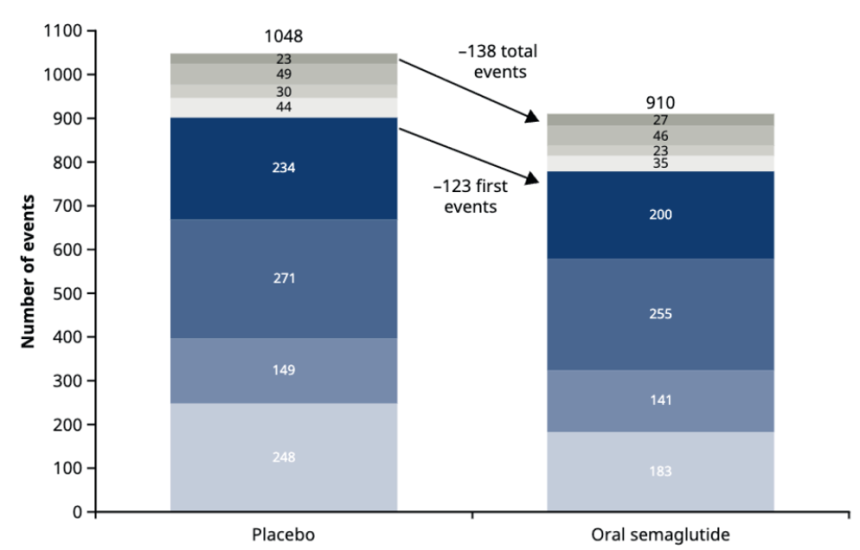
- Fewer participants taking oral semaglutide experienced CV events, compared to the placebo group. Notably, semaglutide reduced the risk of first (579 vs. 668 events) and second occurrences (83 vs. 97 events) of 3-P MACE by 15%, although the latter did not meet statistical significance or come close to it (p=0.26). Likewise, semaglutide significantly lowered the risk of first (640 vs. 725 events) 4-P MACE by 14% and first (670 vs. 777 events) 5-P MACE by 16%. The second events of 4-P MACE (96 vs. 122) and 5-P MACE (229 vs. 279 events) lowered by 22% (p=0.06) and 19% (p=0.02), respectively.
- Interestingly, the cardiovascular benefits were mainly attributed to the reduction in first events. As shown in the figure below, oral semaglutide led to statistically significant 123 fewer “first events” (HR=0.85; p=0.0006) and 138 fewer “total events” (HR=0.87; p=0.004), compared to placebo. Nonetheless, the occurrence of second events was numerically lower (10 fewer events; HR=0.90; p=0.44), suggesting continued CV benefits of oral semaglutide in high-risk patients who had non-fatal MI or stroke.
[1] Three-point MACE (3-P MACE) includes CV death, non-fatal myocardial infarction, and non-fatal stroke.
-- Elizabeth Rose, Kayla Mathieu, Nour Khachemoune, Kat Moon, and Kelly Close