Abbott highlights four posters at ADA assessing DKA in people with T1D and T2D –
The studies demonstrate that nearly half of DKA cases are not initially identified, DKA prevalence continues to rise, and related hospitalizations are associated with greater mortality and cost
Abbott issued a press release highlighting several studies presented at the ADA 86th Scientific Sessions that underscore the need for greater awareness and earlier detection of diabetic ketoacidosis (DKA). The findings come shortly after Abbott’s continuous dual glucose-ketone sensor, Duo, received CE-Mark approval and while the system remains under FDA review.
Nearly half of DKA cases are not recognized at hospital admission
One study by Dr. Eden Miller (Diabetes and Obesity Care) et al. evaluated initial admitting diagnoses among patients ultimately hospitalized with DKA using the CMS Limited Data Set from January 2017 to March 2025 (n=100,334). Researchers identified people with T1D or T2D who were hospitalized with a primary diagnosis of DKA and compared their admitting diagnosis with their final diagnosis.
Overall, 45% of patients were not initially admitted with a DKA diagnosis, with similar rates observed in T1D (41%) and T2D (42%). Among these initially missed cases, two-thirds were admitted with nonspecific symptoms such as altered mental status, fatigue, weakness, or gastrointestinal (GI) complaints (approximately half presented with GI symptoms) – common early manifestations of DKA that can mimic other illnesses.
DKA-related hospitalization rate increase in T1D is particularly pronounced among children
Another study by Dr. Jennifer Sherr (Yale University) et al. used Inovalon Insights claims data to estimate annual rates of emergency department- and inpatient-treated DKA and severe hypoglycemia among people with T1D from 2017 to 2024. During this period, DKA rates increased by approximately 24%, rising from 50 to 62 events per 1,000 patients. The increase was particularly pronounced among children, with DKA rates climbing more than 60% (from 63 to 102 per 1,000 patients), compared with a 17% increase among adults (from 46 to 54 per 1,000 patients).
In contrast, rates of severe hypoglycemia remained low and largely unchanged. Abbott suggested that this divergence may reflect improved awareness and management of hypoglycemia relative to DKA.
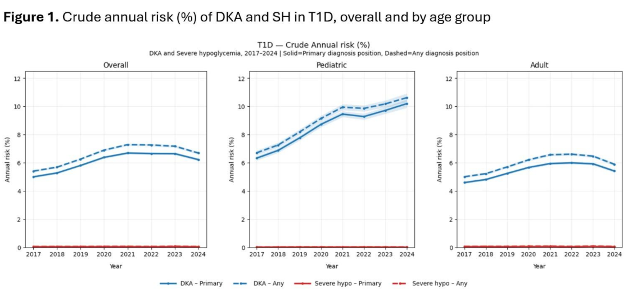
Source: ADA 2026, “Trends in the Prevalence of Diabetic Ketoacidosis and SevereHypoglycemia in Type 1 Diabetes”, Dr. Jennifer Sherr et al.
DKA-related hospitalizations are associated with greater mortality and cost
Two additional studies examined the clinical and economic burden of DKA-related hospitalizations.
A study by Dr. Rodolfo Galindo (University of Miami) et al. analyzed the 2022 National Inpatient Sample, stratifying hospitalizations among people with T2D by primary (n=99,735) or secondary (n=91,935) DKA diagnosis. Together, these admissions accounted for approximately 2.5% of all T2D hospitalizations. Compared with patients hospitalized primarily for DKA, those with a secondary DKA diagnosis were older (59 vs. 52 years) and experienced substantially worse outcomes, including longer hospital stays (9.6 vs. 4.2 days), higher mortality (12% vs. 1%), and greater hospital costs ($36,242 vs. $12,674). Abbott suggested that studies focusing only on primary DKA diagnoses may substantially underestimate the overall burden of DKA on healthcare systems.
A separate study led by Dr. Sherr et al. examined 2022 hospitalizations involving DKA among youth with T1D or T2D (n=38,874). Nearly 60% of hospitalizations in T1D were associated with DKA, compared to 4% in youth with T2D. Median length of stay was approximately two days across most groups but doubled to roughly four days among patients with T2D and a secondary DKA diagnosis. Hospital costs were also consistently higher when DKA was coded as a secondary diagnosis, reaching $16,067 versus $9,461 in T1D and $38,074 versus $13,017 in T2D.
These studies highlight the challenges of recognizing DKA early and the substantial clinical and economic consequences associated with DKA-related hospitalizations, which Abbott indicated reinforce the need for improved education and enhanced ketone monitoring capabilities.
Close Concerns’ Questions
- How will Abbott position continuous ketone monitoring clinically alongside traditional ketone testing guidelines?
- What thresholds will be used to trigger actionable ketone alerts for users?
- How will reimbursement pathways for CKM differ from current CGM coverage structures, if at all?
-- by Jeremy Alkire, Monica Oxenreiter, and Kelly Close