The US Department of Agriculture publishes a new dietary guideline for 2025-2030 –
Recommendations include limiting highly processed foods, sugared, and artificially flavored drinks; 10-page guideline replaces previous 164-page 2020-2025 guidance
The US Department of Agriculture published the new Dietary Guidelines for Americans 2025-2030 by the US government.
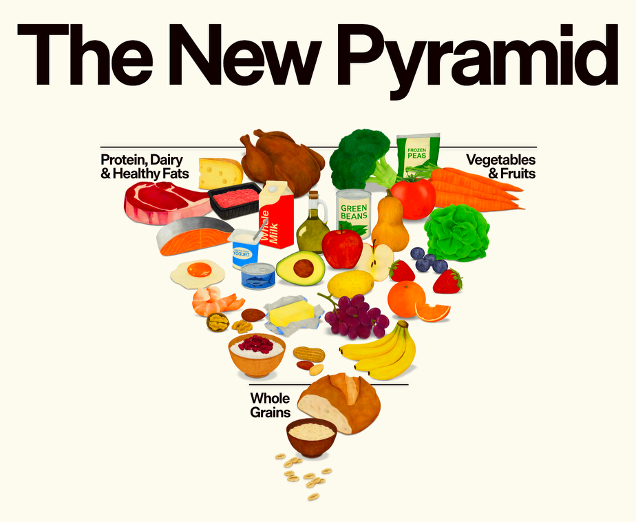
The new guideline promotes “real food” built on whole, nutrient-dense foods across protein, vegetables, fruits, healthy fats, and whole grains. Top takeaways of this document include: (i) eating the right amount; (ii) prioritizing protein, dairy, vegetables, whole grains, and healthy fat each meal; and (iii) limiting highly processed foods and added sugars, including drinks. The Food Pyramid was newly added (see figure below), with meats and “full-fat dairy” placed at the top of the inverted pyramid. The new pyramid replaces the MyPlate graphic, which was first introduced in 2011.
The document also includes detailed guidance for special populations. For individuals with chronic diseases like diabetes, obesity, or CVD, the guideline points out that low carbohydrate diet is helpful for certain diseases but encourages readers to see HCPs.
See the website, press release, 10-page guideline, 90-page scientific foundations document, and a 400+ page scientific foundation appendix. The 10-page guideline is noticeably shorter than the previous 164-page 2020-2025 guideline, reflecting an emphasis on accessibility, readability, and practicality.
Figure 1. The New Pyramid of the Dietary Guidelines for Americans
Source: Realfood.gov
Table of Contents
- Dietary guidelines aims to “restore common sense” and “Make America Healthy Again”
- The guideline partially incorporated recommendations from the 2025 Dietary Guidelines Advisory Committee
- National organizations like ADA, AMA, and AHA comment on dietary guidelines; concerns include recommendations about salt, red meat, and whole-fat dairy
- The Scientific Foundation report discloses financial relations to beef, pork, and dairy industries
Dietary guidelines aims to “restore common sense” and “Make America Healthy Again”
In the introductory letter, Secretaries Robert F. Kennedy Jr. (Health and Human Services) and Brooke Rollins (Agriculture) pointed out that federal incentives have previously promoted low-quality and highly processed foods, causing significant chronic disease burden. This guideline aims to “restor[e] common sense… to federal food and health policy” by educating “real food” and thereby “Mak[ing] America Healthy Again.” The press release invoked the Trump administration’s focus on military-readiness and fitness of the American population.
The guideline partially incorporated recommendations from the 2025 Dietary Guidelines Advisory Committee
In 2025, the Dietary Guidelines Advisory Committee (DGAC) submitted a scientific report to the US Departments of Health and Human Services (HHS) and Agriculture (USDA). The Scientific Foundation report partially incorporated or rejected recommendations by the DGAC, as detailed in pages iii through viii. For example, recommendations on fat intake, such as
- “Modify the dietary pattern to emphasize dietary intakes of beans, peas, and lentils while reducing intakes of red and processed meats”;
- “Continue to emphasize consumption of low-fat or nonfat dairy and unsaturated fats”; and
- “Reaffirm current guidance to lower consumption of butter and replace butter with vegetable oils that are higher in unsaturated fatty acids”
were not implemented in the guidelines.
In the “Concerns with the DGAC Report,” the Scientific Foundations report cites concerns that DGAC places heavy consideration on health equity. It notes that “Science should inform policy – not be constrained by it,” and that the report should reflect the evidence, independent of implementation concerns.
National organizations like ADA, AMA, and AHA comment on dietary guidelines; concerns include recommendations about salt, red meat, and whole-fat dairy
Various professional organizations have expressed mixed reactions to the newly introduced dietary guidelines, highlighting both areas of alignment and points of concern:
- The American Diabetes Association (ADA) released a statement yesterday that it “recognizes” the new dietary guidelines as an opportunity to improve health. It also appreciates the guidelines’ acknowledgement of “unique needs” of people with chronic diseases.
- The American Medical Association (AMA) released a statement in support of the new guidelines, stating that it “applauds the Administration’s new Dietary Guidelines for spotlighting the highly processed foods, sugar-sweetened beverages, and excess sodium that fuel heart disease, diabetes, obesity, and other chronic illnesses.”
- The American Heart Association (AHA) has similarly expressed its overall support but highlighted concerns that “the recommendations regarding salt seasoning and red meat consumption could inadvertently lead consumers to exceed recommended limits for sodium and saturated fats, which are primary drivers of cardiovascular disease.” The AHA also highlighted that it recommends low-fat and fat-free dairy products for heart health, as opposed to whole-fat dairy recommended in the guidelines.
The Scientific Foundation report discloses financial relations to beef, pork, and dairy industries
In the Scientific Foundation report, several academic contributors Dr. J. Thomas Brenna (UT Austin), Dr. Donald Layman (University of Illinois Urbana-Champaign), Dr. Heather Leidy (UT Austin), and Dr. Ameer Taha (UCSD) disclosed financial relations with stakeholders of the beef, pork, or dairy industries. For example, they received research grants, funding, or consulting fees from the National Cattlemen’s Beef Association. Otherwise of note, the report was put together by nine experts, compared to 20 in the previous report for 2020-2025.
--by Paul Moon, Kat Moon, Monica Oxenreiter, and Kelly Close