MannKind 4Q25 – Afrezza revenue exceeds $20 million (+25%) and full-year revenue nears $75 million (+17%); FDA approves label update for initial conversion dose; Cipla preps Afrezza launch in India –
Executive Highlights
- MannKind announced its 4Q25 and full-year Afrezza revenue results of over $20 million (+25%) today on a call led by CEO Dr. Michael Castagna and CFO Mr. Christopher Prentiss (press release, investor presentation, webcast). Management expressed much excitement about its growth throughout the year and the opportunities it has within the US pediatric diabetes market.
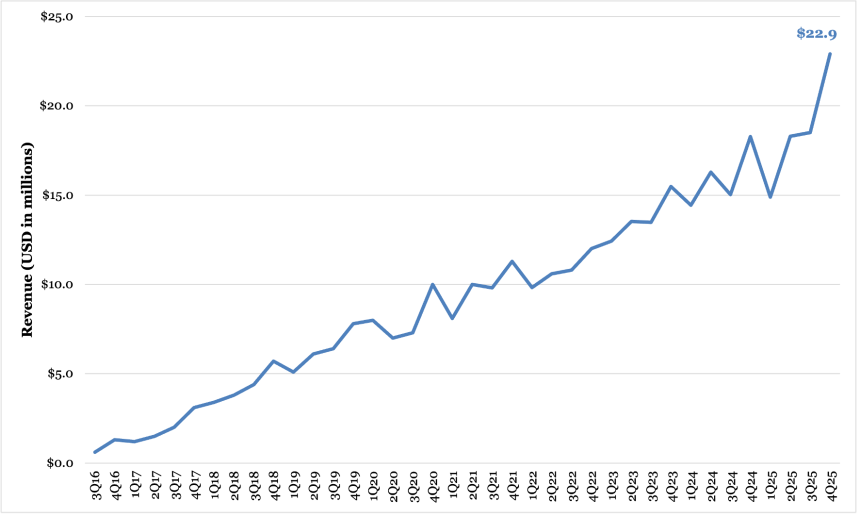
- Afrezza revenue totaled $22.9 million, up 25% from 4Q24 and 24% sequentially. Full-year 2025 revenue totaled $74.6 million, up 17% from 2024. Growth was primarily driven by increased prescribing among clinicians caring for those with T1D. MannKind also reported V-Go net revenue of $4.3 million, down 9% from 4Q24 but up 13% sequentially. Full-year 2025 revenue totaled $16.3 million, down 10% from 2024. These trends are consistent with leadership’s expectations as active promotion ceased in 4Q24. As a reminder, the sales force was seen as a particular strength of this acquisition, which continues to be a great asset. MannKind reported gross margin of 73% in 2025, down from 79% in 2024.
- Management noted that part of 4Q25’s strength was due to early shipments of Afrezza to commercial partner Cipla to support the initial launch in India. This comes a year after approval in the country. Mr. Prentiss said a total of 600,000 products were shipped to Cipla in 4Q25 to support this initial launch. India faces the world’s largest diabetes burden, with an estimated 160 million people, about 11 % of its population, living with diabetes. In that context, a rapid-acting, inhaled insulin option could offer differentiation, particularly if priced at a meaningful discount relative to the US.
- Consistent with recent quarters, MannKind’s pivot toward promoting Afrezza in pediatric populations was a major focus of 4Q25. The FDA accepted MannKind’s supplemental Biologics License Application (sBLA) for Afrezza in children aged 4-17 years. A PDUFA date has been set for late May 2026.
- MannKind has also initiated the INHALE-1st study evaluating Afrezza as first-line therapy in newly diagnosed pediatric T1D (in up to 100 participants across 10 sites), announcing that it has enrolled the study’s first patients earlier this month. Management noted early enthusiasm, with one in four pediatric HCPs reportedly seeing potential for use at diagnosis.
- The FDA approved a label update in 4Q25 clarifying Afrezza’s initial conversion dose when switching from MDI or insulin pumps. Management expressed excitement at the potential this offers to provide clearer guidance for providers and potentially support the pediatric launch.
- Ultimately, the company reported a net loss of nearly $16 million in 4Q25, compared to $7.4 million in net income in 4Q24. The bottom line results reflect higher spending in both R&D and SG&A – see inside for more.
Table of Contents
-
Financial Highlights
- 1. Afrezza revenue totals $22.9 million, up 25% from 4Q24 and 24% sequentially; full-year 2025 revenue increases 17% to nearly $75 million; Afrezza launches in India
- 2. V-Go revenue totals $4.3 million, down 9% from 4Q24 but up 13% sequentially; full-year 2025 revenue falls 10% to $16.3 million
- 3. Net loss of nearly $16 million in 4Q25; bottom line shows higher spending in R&D and SG&A
- Strategic Highlights
- Pipeline Highlights
- Diabetes-Related Analyst Q&A
- Close Concerns’ Questions
Financial Highlights
1. Afrezza revenue totals $22.9 million, up 25% from 4Q24 and 24% sequentially; full-year 2025 revenue increases 17% to nearly $75 million; Afrezza launches in India
Afrezza revenue reached $22.9 million in 4Q25, up 25% from 4Q24 and 24% sequentially. Full-year 2025 revenue totaled $74.6 million, up 17% from 2024. Growth was primarily driven by increased prescribing among clinicians caring for those with T1D. Looking ahead, management highlighted the updated ADA Standards of Care as a driver of future growth; the guidelines now position inhaled insulin as an option equivalent to injectable insulin or AID, recommending evaluation of administration method at each visit for patients not at goal. Given the increased momentum in and around AID (with an estimated 1.5 million people on AID), and the challenges of reaching target TIR (to say nothing of TITR), we are curious how much of an opportunity Afrezza presents to reach consensus targets.
Mr. Prentiss noted that part of 4Q25 revenue growth can be attributed to a sizeable shipment of products to MannKind’s commercial partner in India, Cipla, to support the commercial launch of Afrezza in the country (see more below). We are curious to know how much of 4Q25 revenue was recurring and attributed to organic growth and how much may be attributed to a one-time stocking cost – given previous rates of growth from Afrezza, we imagine stocking revenue in 4Q25 could have amounted to a couple million dollars. We are also interested in seeing how MannKind reports international revenue from India sales as this launch moves forward, and how quickly a recurring revenue base can build there.
Source: Close Concerns Knowledgebase and MannKind quarterly results
- MannKind reported a gross margin of 73% in 2025, down from 79% in 2024.
2. V-Go revenue totals $4.3 million, down 9% from 4Q24 but up 13% sequentially; full-year 2025 revenue falls 10% to $16.3 million
V-Go net revenue totaled $4.3 million in 4Q25, down 9% from 4Q24 but up 13% sequentially. Full-year 2025 revenue totaled $16.3 million, down 10% from 2024. The gradual revenue decline reflects MannKind’s strategic decision to remove V-Go from active sales promotion in 4Q24, enabling more focus on Afrezza’s commercial expansion and upcoming pediatric launch. Dr. Castagna forecasted in 4Q24 that V-Go reached its peak annual sales in 2024, and these declines are in line with company expectations and are likely to continue. The device, however, will remain available for existing users and presumably the sales force is of active interest to MannKind.
3. Net loss of nearly $16 million in 4Q25; bottom line shows higher spending in R&D and SG&A
While management expressed confidence in the future of Afrezza and the recently-acquired Furoscix from scPharmaceuticals (see more below), it acknowledged a net loss of nearly $16 million in 4Q25, compared to $7.4 million in net income in 4Q24 and $5.9 million net income for 2025. The bottom line results reflect higher spending in both R&D and SG&A. Specifically, R&D spend in 4Q25 was up nearly 2.5x that of 4Q24, and the quarter saw the discontinuation of the phase 3 ICoN-1 clinical trial for MNKD-101 (which evaluated nebulized clofazimine inhalation suspension for nontuberculous mycobacterial lung disease). SG&A spend was similarly up over 2.4x that of 4Q24, with the increase primarily attributed to costs associated with the promotion and support of FUROSCIX and transaction-related costs from the acquisition of scPharma.
Strategic Highlights
1. MannKind launches Afrezza in India with partner company Cipla
Dr. Castagna noted that Afrezza has now launched in India through commercial partner Cipla. This comes approximately one year after approval of the inhaled insulin in the country. Mr. Prentiss said a total of 600,000 products were shipped to Cipla in 4Q25 to support the initial launch. Management seemed to characterize India as a major strategic focus going forward.
- While initial shipment volume does not reflect recurring demand, we view this launch as a meaningful milestone. India faces the world’s largest diabetes burden, with an estimated 160 million people, about 11% of its population, living with diabetes. In that context, a rapid-acting, inhaled insulin option could offer differentiation, particularly if priced at a meaningful discount relative to the US. We are interested in what MannKind believes will be required to achieve sustained success in this market.
SWOT Analysis: Afrezza Launch in India
Strengths
| Weaknesses
|
Opportunities
| Threats
|
Pipeline Highlights
1. Afrezza in pediatrics: PDUFA date set for May 2026; first patients dosed in INHALE-1st study for use in new-onset T1D
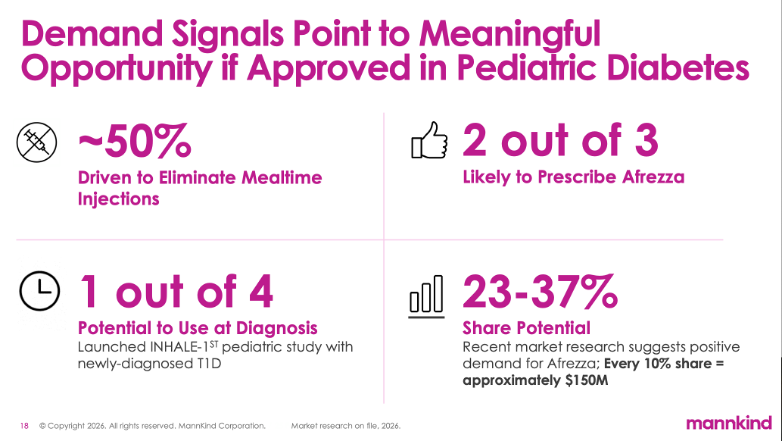
Dr. Castagna described the pediatric indication for Afrezza as one of the “most underappreciated catalysts” in the pipeline. The FDA accepted MannKind’s sBLA in October 2025, with a PDUFA date of May 29, 2026. Market research cited by management suggests strong potential demand: two-thirds of pediatric endocrinologists report they would likely prescribe Afrezza, and ~50% of HCPs cite eliminating mealtime injections as a key driver of adoption.
- The sBLA submission was first submitted in 2Q25 based on data from the INHALE-1 study in children aged 4-17 years. Topline results from the full 52-week study were shared at ISPAD 2025. Glycemic outcomes during the 26-week extension phase remained consistent with the initial 26-week randomized phase. Both groups experienced only slight increases in A1c and maintained similar TIR through 52 weeks, though TIR declined modestly from the 26-week mark in each cohort.
- MannKind has also initiated the INHALE-1st study evaluating Afrezza as a first-line therapy in newly diagnosed pediatric T1D (in up to 100 participants across 10 sites), announcing that it has enrolled the study’s first patients earlier this month. Management noted early enthusiasm, with one in four pediatric HCPs reportedly seeing potential for use at diagnosis in its market research.
- While unmentioned on today’s call, additional Afrezza studies are underway:
- INHALE-GDM (NCT06535789) is evaluating Afrezza dosing after meal tolerance tests in pregnant women aged 18–40 with gestational diabetes (n=30). Dr. Castagna shared in 3Q25 that the first 10 participants have met company expectations regarding dosing protocol and training materials.
- The INHALE-AIDEx study (NCT06880835) will assess Afrezza use and dosing during exercise in active individuals with diabetes (n=30). As confirmed by Dr. Irl Hirsch (University of Washington) at ATDC (Keystone) 2025, both INHALE-GDM and INHALE-AIDEx are sponsored by the Jaeb Center for Health Research and are actively recruiting.
2. Label change for initial conversion dose in adults accepted by the FDA
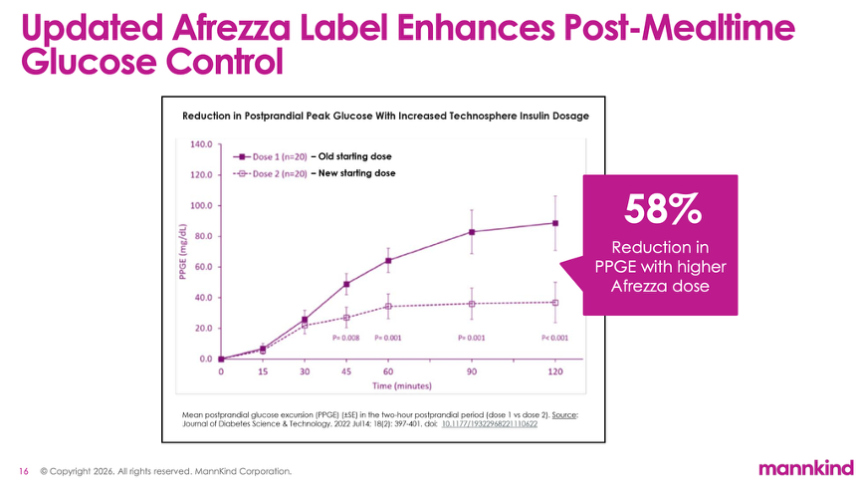
The FDA approved a label update in 4Q25 clarifying Afrezza’s initial conversion dose when switching from MDI or insulin pumps. Management expressed excitement at the potential this offers to provide clearer guidance for providers and potentially support the pediatric launch, and Dr. Castagna highlighted dose-trial data showing a 58% reduction in two-hour postprandial glucose excursions with the higher dose versus the original label (see figure below).
3. FUROSCIX ReadyFlow Autoinjector: sNDA accepted by the FDA, with PDUFA date in July 2026
MannKind announced that its supplemental New Drug Application (sNDA) for the FUROSCIX ReadyFlow Autoinjector was accepted by the FDA, and the agency has set a PDUFA date of July 26, 2026. The device is designed to streamline administration and broaden FUROSCIX’s practical applications in both outpatient and hospital settings. Leadership expects the simplified autoinjector to enable 2026 commercialization and greater uptake among cardiology and nephrology practices.
- MannKind completed its acquisition of scPharmaceuticals in 4Q25, establishing its entry into the cardio-renal market. FUROSCIX generated $23.2 million in 4Q25 revenue, up 91% from 4Q24 (when it was under scPharmaceuticals’ commercial operations) and 20% sequentially. Management outlined three growth drivers: (i) expanded hospital engagement via a dedicated team; (ii) sales force reorganization with a cardiology focus and the endocrine team covering nephrology; and (iii) increased marketing investment ahead of potential ReadyFlow approval. Management noted record growth within nephrology, which now accounts for ~15% of FUROSCIX sales, and said it expects growth to continue in upcoming quarters.
Diabetes-Related Analyst Q&A
Q (Rouhana Ruiz, Leerink Partners): What tailwinds could be driving future revenue growth both from Afrezza and for Furoscix this year and into later years? Especially how you're thinking about the new guideline updates and the Auto-injector launch for Furoscix?
A (Dr. Michael Castagna, CEO): On Afrezza and Furoscix, I think what you've seen, really over the last two or three years for Afrezza, we were reducing and running it for profitability, so it wasn't being run for growth. I think that's an important context for everybody. People say, “Why didn't Afrezza grow faster?” The reality is until we had pediatric safety and efficacy, it wasn't going to be something we can invest in because we always believed pediatrics was the inflection point for the brand, and we tried various things over the years in the adult segment. With the advent of GLP-1 RAs taking off, we felt arguing over T2D and arguing over insulin needs wasn't the most productive use, but we did want to maintain and grow it a little, but we didn't feel the productivity would be there from an increased investment relative to other shots on goal we had. From that perspective, that's where Afrezza was being managed. Last year we brought in a whole new team, we got the data readout, we met with the FDA, our conviction around pediatrics grew tremendously and that's, to us, the focus of the future. Our president, Nik, has done a good job building out the team, getting the infrastructure ready.
We got a series of boards to confirm some of the research and really get this ready for launch, including the kickoff of the INHALE-1sttrial. So I'd say, you're going to see that investment go up as we progress through the second half, but I would expect that after approval in May, if all goes well with FDA, you'll start to see some additional growth on Afrezza as we get to Q3 and Q4 and exit the year.
On Furoscix, the autoinjector is something obviously we put a lot of value on in the deal. We felt the underlying growth trends were great. But when we talk to physicians and you think about the patient experience and the caregiver experience, having an autoinjector just makes it so much easier just from a mental burden, let alone a training for the patient or the caregiver.
We feel that will be a meaningful transformation. That, again, is coming up in the next five months here in July. Four months from now, we should be hopefully getting ready for launch. And hearing from the FDA label discussions. So both of those are on track. We've heard or seen nothing from the FDA, but nothing that's a showstopper at this point. We feel pretty good about these assets, hopefully hitting their PDUFA dates.
Q (Gregory Renza, TRUIST Securities): First, just for Chris, how should we be thinking about the evolution of gross margins and operating margins over 2026 as you take the reins with Furoscix and have Afrezza potentially going into this year?
Second for Mike, could you give us color and remind us on how MannKind leverages FDKP to enhance the delivery, efficacy and tolerability of dry powders and how doctor ad patient views have evolved over the years?
A (Mr. Chris Prentiss, CFO): Thanks. To talk about gross margin dynamics, the on-body infuser has a slightly lower gross margin than Afrezza historically has. Before the auto injector is approved and launched, there will be a slight decline in gross margin that will then improve significantly as the auto injector is launched later this year.
So, I think you'll see a little bit of a hit in 2026 and then significant improvement in 2027 and beyond. The other thing to note is just as the ramification of the purchase accounting, we now have this intangible asset, which is the on-body infuser and when approved the auto injector that those are intangible assets that are amortized. You see that's 4 million in Q4. That will obviously play out over the year.
That is technically part of COGS. If you look at our COGS and our margin disclosures in the 10-K, you'll see a more significant impact to margin. Those are non-cash. That's a non-cash item, but that will be included in margin going forward.
A (Dr. Castagna): Then your question, FDKP, if I heard it correctly, is just, how is it critical? Why is it important? FDKP is really what founded the formulation behind AFREZZA and the scalability in the company and the moat that we have around our technology. It really is used to deliver drug deep into the lungs by either protecting the molecule, make sure it gets there and making sure the molecule can fly there. As you remember, many dry powders and nebulizers have wide variability in their delivery. It’s not just the FDKP in the powder, it's also the device platform we have.
Those two things go hand in hand to deliver deep lung penetration and consistent lung penetration. We see that in AFREZZA and in the 3D imaging studies we did that. That's important. We believe as you look at the various molecules, we've already worked on them and got approved as well as what's in the pipeline.
80% to 99% of that powder is FDKP. It's a critical ingredient in everything that we do and the formulations that we make, and you continue to see that help, whether it's in the MannKind work that we're doing the IPF with to a one in ten nerve as well as Afrezza and enough example Treprostinil. We think it's important, we think it helps shape the particle size and is a barrier to access this molecule.
Q (Brandon Folkes, HC Wainwright): Firstly, on your Afrezza pediatric opportunity, can you just talk about the market research you did and what did this return and where the opportunity lies initially versus new patient starts versus switch patients? Should we think about any bolus of switch patients upfront looking to go to needle free or pump free?
A (Dr. Castagna): Yeah, I think on the first Afrezza pedes market research, this was new research that just came in over the last few weeks. I think we were looking to update the research we did previously that gave us some conviction. We feel that it was important to share.
This is recent data, and it was really done amongst a group of physicians in a quantitative way that wasn't in an interactive or I'll say, trying to sell them, was just displaying what the data says and the product profile. We were encouraged to see those results because that's before a medical education or representative detail, etc.
I think it just shows you that there's a large opportunity. The one that did surprise us is the percent naive patients that may potentially come in into the product as it wasn't in our original framework.
I think as we were looking to do, INHALE-1st, it just really convinced us that that was the right study to do and scale and that study enrolled nicely. We're just kicking off the first ten patients and then we'll evaluate that and then open up for the other 90. That study is well on its way, and I think it'll be an important study to just understand the dynamics in endo practice and children's hospitals around, how do they create teaching protocols, how do they really have to change for onboarding patients? How do they train patients on basal versus mealtime control? When do they give doses, school nurses program? There’s a lot in that trial that we're learning from daily that I think will apply to the launch. That’s really good there and then, but is there going to be a bolus of switch patients? I think the answer is the majority of the patients in the initial launch will come from switching.
Over time, as people get experience, I think we'll come from naive, but we're not turning on a large DTC campaign day one of launch. We shouldn't expect this really fast patient influx because all the consumer advertising we're doing, I think we're taking a methodical approach, getting the key account team across the 50 to 70 centers out there we're targeting, which will treat the majority of the kids. Then, we have the community sales force targeting the rest. We feel pretty good about the strategy that we want to walk before we run and spend a ton of money.
But we have this opportunity upside, and when we get the consumer research that's just coming back, we'll look and see how fast that activation should start. And when should that start? Because we do believe there's a consumer component here, obviously with families and kids. They're on the second molecule. You know, look, the teams are working very well together day to day on that program, and so it's progressing nicely.
Close Concerns’ Questions
- How do Cipla and MannKind plan to approach the launch of Afrezza in India? Will they target endocrinologists in the country’s largest cities first, those who express the greatest preliminary interest, or some other approach?
- What type of support will MannKind offer on the clinical and patient’s sides for Afrezza’s launch in India?
- Will MannKind’s educational strategies used to train pediatric endocrinologists on Afrezza dosing through BluHale differ than those used to train adult endocrinologists?
- What revenue does MannKind expect for Afrezza in 2026?
- What momentum can still be gained among adults with T1D? To what degree are people moved to start because of Breakthrough T1D CEO?
-- by Jeremy Alkire, Riya Chatterjee, Monica Oxenreiter, and Kelly Close