Vertex 3Q25 – T1D cure zimislecel (VX-880) phase 1/2/3 trial completes enrollment, but dosing trial temporarily postponed; Journavx pain medicine quarterly revenue hits $20 million while second phase 3 DPN trial expected shortly –
Executive Highlights
- Vertex reported its 3Q25 financial results this afternoon in a call led by CEO Dr. Reshma Kewalramani – see the press release, presentation, and webcast.
- In T1D, the pivotal phase 1/2/3 FORWARD trial (n=52) of zimislecel, formerly known as VX-880, a stem cell-derived islet with standard immunosuppression, has completed enrollment. While the dosing completion of the phase 3 portion of the study has been temporarily postponed pending an internal manufacturing analysis, this didn’t sound like a meaningful problem to us, despite the delay. To preserve trial integrity, the company will provide further details only once dosing is complete. In 2Q25, management announced expectations to complete dosing for the phase 3 portion of the trial “in the near term,” with regulatory submission planned for 2026.
- In Vertex’s kidney portfolio, the phase 2b AMPLIFIED trial (n=45) assessing inaxaplin in people with AMKD and other comorbidities, including T2D, is on track to complete enrollment by the end of this year.
- Sales for Journavx (suzetrigine), a twice-daily, oral, selective non-opioid NaV1.8 inhibitor, totaled $19.7 million, up a whopping 1.6x from 2Q25. Journavx was FDA-approved in January 2025 for moderate-to-severe acute pain. From mid-March, when Journavx became available at pharmacies, to mid-October, more than 300,000 prescriptions were successfully filed across hospitals and retail settings, up from 110,000 prescriptions through mid-July. Additionally, more than 170 million individuals have gained access to Journavx, representing over half of the covered lives in the US. This number includes formal coverage with two of the three large national PBMs and unrestricted access in 19 state Medicaid plans, up from 16 states in 2Q25.
- Vertex continues to advance its pain pipeline:
- The phase 3 trial (n=1,100) of Journavx (suzetrigine) in diabetic peripheral neuropathy (DPN) continues to enroll participants and is expected to complete in May 2027. A second phase 3 DPN trial is expected to launch this month. Enrollment completion for both phase 3 studies of suzetrigine is expected by the end of 2026.
- The phase 2 trial (n=300) continues to evaluate VX-993, another oral NaV1.8 inhibitor, for DPN. The trial is currently enrolling patients and expected to complete in May 2026.
- On cash, Vertex ended 3Q25 with $12 billion, up 7% from 3Q24 and flat from 2Q25. The company attributed the increase in cash to operating activities – we note that the increase would’ve been bigger but was partially offset by repurchases of Vertex’s common stock to share repurchase programs.
Table of Contents
- 1. Enrollment completed for phase 1/2/3 study of zimislecel (VX-880) for T1D; dosing portion of study completion temporarily postponed
- 2. Complete enrollment for the phase 2b AMPLIFIED trial of inaxaplin for APOL1-mediated kidney disease and comorbidities, including T2D, expected by the end of 2025
- 3. Journavx (suzetrigine) sales total $19.6 million for moderate-to-severe acute pain in its third quarter of launch
- 4. Vertex to initiate second phase 3 DPN trial of Journavx this month; phase 2 trial for VX-993 enrolling and dosing patients
- Analyst Q&A
- Close Concerns’ Questions
1. Enrollment completed for phase 1/2/3 study of zimislecel (VX-880) for T1D; dosing portion of study completion temporarily postponed
Vertex announced the completion of enrollment of people with T1D in the phase 1/2/3 FORWARD trial (n=52) of zimislecel (previously called VX-880), a stem cell-derived islet with standard immunosuppression. The company also said that the dosing aspect of the phase 3 portion of the study has been temporarily postponed pending an internal manufacturing analysis. Management emphasized that, as FORWARD is a pivotal trial, it is crucial to maintain study integrity; therefore, it did not provide any additional information. The company will provide further details once dosing is complete. While, given this announcement, we assume that the the expected timeline for the trial could be impacted, we don’t see that as any real kind of setback given the major unmet need. In 2Q25, management announced expectations to complete dosing for the phase 3 portion of the trial “in the near term,” with regulatory submission planned for 2026.
Previously, full one-year follow-up results of the phase 1/2 trial (n=12) were presented at ADA 2025 and simultaneously published in NEJM. Among 12 participants who received a full dose and were followed for at least one year, all demonstrated glucose-responsive C-peptide production, elimination of severe hypoglycemic episodes, A1c <7.0%, and TIR >70%. Most participants (83%) no longer required exogenous insulin by Month 12, with a mean 92% reduction in exogenous insulin use. The treatment was well tolerated, with no serious adverse events related to zimislecel.
- In 2Q25, Dr. Kewalramani reiterated that zimislecel has a target population of ~60,000 people in the US, Canada, and the EU. This population includes ~45,000 individuals who experience extreme glucose fluctuations and ~15,000 patients who have already undergone kidney transplantation and are on lifelong immunosuppression. Zimislecel received multiple regulatory designations, including Regenerative Medicine Advanced Therapy (RMAT) and FDA Fast Track in the US, PRIME in the EU, and Innovation Passport in the UK.
While not mentioned in recent calls, Vertex also continues to develop potential treatments for T1D through methods that do not require immunosuppression. For example, its preclinical hypoimmune program in collaboration with CRISPR Therapeutics evaluates gene-edited stem cell-derived islets to eliminate the need for immunosuppressants.
VX-264, a stem cell therapy using an encapsulation device, was discontinued in March 2025 given the lack of efficacy seen in Part B of the phase 1/2 trial.
2. Complete enrollment for the phase 2b AMPLIFIED trial of inaxaplin for APOL1-mediated kidney disease and comorbidities, including T2D, expected by the end of 2025
In September, the phase 2/3 AMPLITUDE trial (n=466) of inaxaplin for the treatment of APOL1-mediated kidney disease (AMKD) completed enrollment. This progress aligns with the company’s expected timeline to complete enrollment in 2025. Once the cohort has been treated for 48 weeks, Vertex plans to conduct a pre-planned interim analysis and potentially file for accelerated approval in the US.
Vertex is also on track to complete enrollment of the phase 2b AMPLIFIED trial (n=45) assessing inaxaplin in people with AMKD and other comorbidities, including T2D, by the end of this year.
3. Journavx (suzetrigine) sales total $19.6 million for moderate-to-severe acute pain in its third quarter of launch
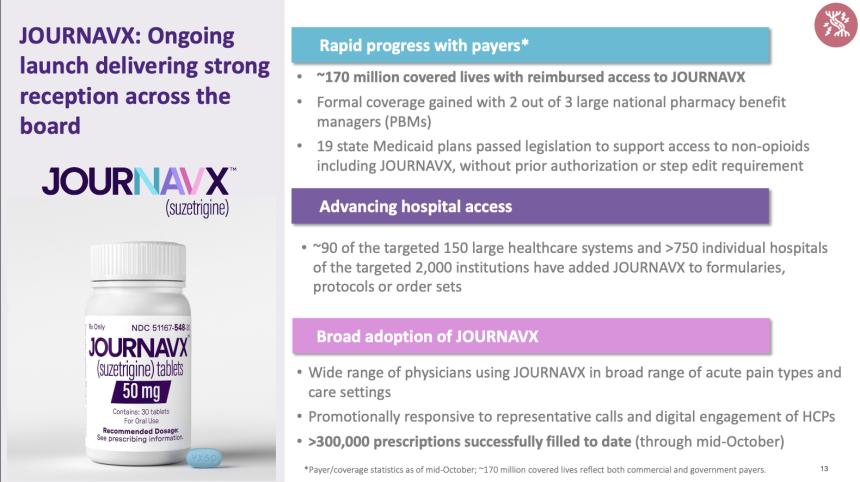
In the third quarter of launch, sales for Journavx (suzetrigine) totaled $19.6 million, up 1.6x from 2Q25. As a reminder, Journavx is a twice-daily, oral, selective non-opioid NaV1.8 inhibitor FDA-approved in January 2025 for moderate-to-severe acute pain. From mid-March, when Journavx became available at pharmacies, to mid-October, more than 300,000 prescriptions were successfully filed across hospitals and retail settings (up from 110,000 prescriptions through mid-July).
Additionally, more than 170 million individuals have covered access to Journavx, representing more than half of the covered lives in the US. This number includes formal coverage with two of the three large national PBMs and unrestricted access in 19 state Medicaid plans. Approximately 90 of the 150 large healthcare systems that Vertex targets, as well as more than 750 individual hospitals of the 2,000 targeted institutions, have added Journavx to their formularies, protocols, or order sets. Vertex expects access to Journavx to continue expanding for the remainder of 2025 and into 2026. Reiterating its statement from 2Q25, management said that Journavx has a multi-billion-dollar potential.
Source: Vertex 3Q25 presentation slides
4. Vertex to initiate second phase 3 DPN trial of Journavx this month; phase 2 trial for VX-993 enrolling and dosing patients
The phase 3 trial (n=1,100) of Journavx (suzetrigine) in diabetic peripheral neuropathy (DPN), launched in 3Q24, continues to enroll participants. This trial compares suzetrigine, Lyrica (pregabalin), and placebo in people with DPN, and is expected to complete in May 2027. In today’s call, Vertex announced its plans to launch a second phase 3 DPN study this month, with the goal of securing DPN as the first painful neuropathic pain (PNP) indication for suzetrigine. Enrollment completion for both phase 3 studies of suzetrigine is expected by the end of 2026.
- Results of the phase 2 trial (n=192), announced in December 2023, showed that Journavx demonstrated statistically significant and clinically meaningful reductions in the numeric pain rating scale (NPRS) of over two points (out of a scale of 0-10). More than 20% of patients in the mid- and high-dose groups achieved a 70% or greater reduction in pain from baseline at Week 12. Following these positive results, the FDA granted Fast Track Designation for Journavx in PNP and Breakthrough Therapy Designation in DPN.
Vertex’s pipeline for DPN also includes VX-993, an oral NaV1.8 inhibitor, in the phase 2 trial (n=300). The trial is currently enrolling and dosing patients, with expected trial completion in May 2026. Similar to the DPN trial of Journavx, this trial compares VX-993, Lyrica (pregabalin), and placebo in people with DPN.
- VX-993 was previously in development for acute pain but discontinued following topline results from the phase 2 trial (n=367) announced in 2Q25. While the study achieved adequate exposure and separation between dose arms, VX-993 did not meet the primary endpoint compared to placebo. The time-weighted Sum of the Pain Intensity Difference (SPID) over the first 48 hours of VX-993 treatment was numerically higher (SPID of 75, 72, and 54 for high-, mid-, and low-doses) compared to placebo (50), but lower than acetaminophen/hydrocodone bitartrate (94), a prescription drug that combines acetaminophen and an opioid analgesic. Based on these results, Vertex decided not to advance VX-993 as a monotherapy for the treatment of acute pain.
Analyst Q&A
On Journavx (suzetrigine)
Q (Salveen Richter, Goldman Sachs): On the pain franchise, you talked for a bit about getting that third PBM on board prior to really opening up distribution. Could you just help us understand what's being finalized on that end? Thank you.
A (Mr. Duncan McKechnie, SVP North America Commercial Operations): I would say that we're in productive, ongoing conversations with the third PBM. And, of course, we'll keep you updated as soon as we have news. And as you know, in the meantime, patients who are not covered can get Journavx through the patient support program. Overall, we're pleased with the progress on access to date. It will continue to expand over the balance of 2025 and 2026. And in the meantime, of course, a key performance indicator is continued physician uptake and prescription growth while we secure access.
And on that point, although you didn't ask, I would just reference the prescription growth we saw 10,000 prescriptions in quarter one, 90,000 prescriptions in quarter two, 170,000 prescriptions in quarter three, and, of course, several thousand in October. We're very happy with the acceleration we're seeing in prescriptions as we finalize access.
Q (Terence Flynn, Morgan Stanley): Are there any updates on the NOPAIN Act and what you guys are doing on that front? And then I know you mentioned that there's some phase 4 data for Journavx coming up here. Are we going to see anything on time to discharge setting? I know that's something that some physicians have asked about in the past. Thanks so much.
A (Dr. Reshma Kewalramani, CEO): On the NOPAIN final list, it was supposed to be released on October 31st, so last Friday, and we understand that it has been postponed due to the government shutdown. We continue to advocate vigorously for the inclusion of Journavx.
And, as we've discussed before, although the dollar amount may be small for hospital outpatient or surgeon center patients covered by Medicare, we believe the principle is truly important. The NOPAIN Act was literally designed for a medicine like Journavx. We continue to have our conversations, but the finalization and release of the list have been delayed. I don't have an updated timeline for when it will be out.
We’ve now completed enrollment in two phase 4 studies. One is multimodal therapy and is used prior to and post-op aesthetic and reconstructive surgeries, and another one is used in orthopedic and general surgeries. The data you will see later this week is in the aesthetic and reconstructive surgery area. And the trust of the data is about opioid reduction compared to what's seen in the literature. We have a whole host of additional studies forthcoming that examine various other endpoints, including discharge; however, those data are not yet ready.
Q (David Risinger, Leerink Partners): For Journavx, how many of the 170 million lives have unrestricted access, and how many commercial lives are covered by the major PBMs?
A (Mr. Duncan McKechnie, SVP North America Commercial Operations): Of the 170 million lives, 113 million are unrestricted. As I've communicated before, all of the contracts that we have done, all of the agreements we have in place, are for no prior authorization, no step edit. So, we're very pleased indeed with that progress. And as I alluded to in one of the earlier questions. We continue to make progress with the third PBM, where we're in active conversations and indeed with the Medicare plans as well.
Close Concerns’ Questions
- What ‘internal manufacturing analysis’ may contribute to the completion of the dosing portion of the phase 1/2/3 FORWARD trial of zimislecel?
- Will the temporary postponement of the phase 1/2/3 FORWARD trial impact the study’s expected timeline?
- What progress has the company seen with the preclinical development of hypoimmune cure for T1D?
- How does Vertex expect the efficacy of inaxaplin to compare between patients with APOL1-mediated kidney disease compared to those with comorbidities, including T2D?
- Does Vertex plan to study Journavx or VX-993 in DPN as a combination therapy?
--by Esther Min, Jeremy Alkire, Nour Khachemoune, and Kelly Close