FDA delays priority review of Sanofi’s Tzield (teplizumab) for stage 3 T1D –
Reuters reports that internal documents from the FDA cite a patient death, along with seizure incidents and a blood-clotting event, in a patient who had taken Tzield; no causality with Tzield suspected
The FDA has delayed its review of Sanofi’s Tzield (teplizumab) under the Commissioner’s National Priority Voucher program, which accelerates the review process for drugs deemed critical to public health or national security. According to Reuters, which says it had access to the agency’s internal documents, the FDA appears to have delayed its review because it is investigating whether Tzield was associated with a potential treatment-related death involving possible related post-launch side effects, including a seizure and blood-clotting episode. While all experts with whom we spoke expressed their views of the importance of investigation of the death, none appeared to think Tzield would be the direct cause.
Sanofi’s Tzield is currently approved for stage 2 T1D (defined as “early stage” T1D, meaning T1D with positive auto-antibodies but not taking insulin), as the drug slows down progression to stage 3 T1D (which is insulin-requiring T1D diagnosis in the traditional sense). The FDA is evaluating Tzield for stage 3 T1D, which, if approved, could help preserve beta cell function and improve overall outcomes for patients.
Reuters publishes story on a death related to Tzield
Reuters published a piece late last week asserting that the FDA has delayed its current review of Tzield. The piece says that according to agency’s internal documents, seen by Reuters last week, a death of someone who had taken Tzield could be treatment-related. It discussed possible post-launch side effects, including a seizure and blood-clotting episode. (Presumably a seizure could also come from severe hypoglycemia or other ailments.) While all investigators with whom we spoke said they imagine that the death was not directly related to the therapy, the death will of course be investigated.
A spokesman for Sanofi told Reuters that its assessment of the patient death is ongoing and that no causal relationship to Tzield has been established at this time. The spokesman also said that blood clotting and seizures have no known causal association with Tzield based on the company’s assessment of its database.
It goes without saying, we hope, that the death is an incredible tragedy. We send enormous sympathy to all those to whom the patient was close - friends, family, colleagues, and all the communities in which they lived.
Experts speak out about priority review pause
While it is too early to tell what impact, if any, the disclosure of these incidents will have on Tzield or what the FDA’s review might conclude, experts say the stakes are high.
“I believe Tzield represents one of the most important advances ever in type 1 diabetes research,” said University of Florida’s Dr. Mark Atkinson. “It would be a shame to overreact to this news. That said, our number one priority is always safety, and I think we need to take a step back and let the investigation on the cause of this unfortunate and tragic situation play out. It would be a tragedy for the research and care communities if we don’t see strong interest in Tzield and other disease-modifying therapies moving forward … I am a 100% believer in the cause, but I am open to the notion of a delay if this is the decision made by regulators.”
Multiple investigators said that were surprised by these developments and all said the priority would be proceed as is very normal in circumstances like this – proceed with the investigation and let the data analysis continue.
Background on the case
As pointed out by Reuters, the fatality of the 30-year-old man who died is characterized in FDA documents as a serious post-marketing adverse event affecting the current sBLA[1]/voucher review, not as a death that occurred in the phase 3 PROTECT study (n=328), phase 3 ßETA PRESERVE study (n=723), or another named Tzield trial.
The FDA’s public adverse-event database lists one public case that links Tzield to a death in someone who was given Tzield and also had sepsis. It isn’t known by us when his death was relative to when Tzield was given. The database has been very difficult to manage: while we have seen the case report of the (above-mentioned) 30-year-old man, which was filed in September 2025, involved him experiencing a seizure, pyrexia (high fever), sepsis, and cardiorespiratory arrest, among a list of other adverse events associated wtih Tzield, it is not easy to identify in casual review of FAERs (the FDA’s adverse event reporting system – the database has had long-standing challenging that date back decades) [2]. Additional information regarding history of the 30-year-old patient (beyond medications and reason for use), precise timeline of exposure and symptom onset, diagnostic evidence, and other patient data is currently not publicly accessible. Because there are many deaths that happen each year to people with T1D, who die disproportionately more often than those without T1D[3], we express caution related to causality and causation.
Background on Tzield
For readers who are not familiar with Tzield, we note that the therapy was introduced in the United States in 2022. Tzield is known as a breakthrough drug by many, as it is the first disease-modifying therapy approved for T1D to delay the onset of stage 3 T1D.
Tzield is taken by infusion, and its uptake has been modest, largely due to lack of screening for stage 1 T1D and stage 2 T1D, and some may say in part due to its high cost. Its list price is $193,000 in the United States, where it has been on the market the longest. It is also approved in the EU (January 2026, following positive meetings in late 2025), UK (August, 2025), Canada, China (September, 2025), Israel, Saudi Arabia, UAE, and Kuwait. We estimate there have been about 1,500 infusions in total as of 3Q25. See figure below for the estimates for Tzield therapies used per quarter, generated by Close Concerns using Sanofi announcements and historic Closer Look documents.
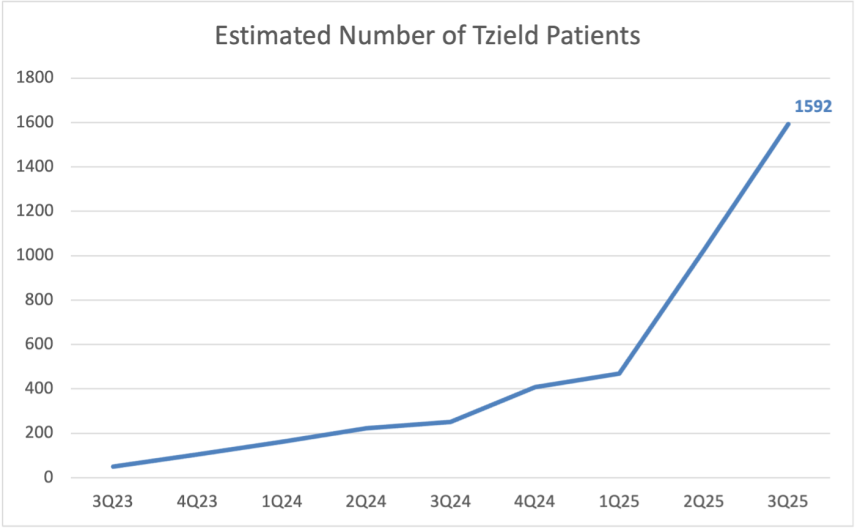
In total, based on eight quarters of reports, Sanofi reports US clinical trial exposure of Tzield to be 773 (of the 1,500), while post-launch 474 adverse event cases have been reported in the FDA’s public-adverse event database. In all, this translates to approximately 820 infusions. Going back to our 2021 piece when teplizumab was approved, we see from the dQ&A survey that approximately half of 3,000+ surveyed who responded surveyed supported approval, with about 25% the reverse. We expect to hear more from the FDA when the investigation is complete.
Further learning opportunities
In the meantime, for further learning of this novel disease-modifying therapy, see below for several interviews Close Concerns has been fortunate to conduct that may be instructive.
- Our 2023 interview with University of Florida’s Dr. Des Schatz on Sanofi’s acquisition of Provention Bio and considerations for Tzield and other disease modifying therapies for T1D.
- On the current state of debate on screening for type 1 diabetes: how much do we want to know?
- On easing the burden for people living with T1D
- On verapamil’s potential in T1D
- On the role of precision medicine and responders to therapy
- On anti-thymocyte globulin and considerations for clinical vs. therapeutic engagement
- On pricing and understanding the risk-benefit tradeoffs of Tzield
- We also recommend Closer Look readers read the interview we were fortunate to secure with Dr. Anastasia Albanese-O’Neill from September, 2024 about the international consensus guidance for monitoring people with early-staged T1D. As a reminder, Breakthrough T1D (then JDRF) and ADA published the staging system for T1D back in 2015, led by work from Dr. Aaron Kowalski, CEO, Dr. Dick Insel (later of J&J), and Dr. Sanjoy Dutta, along with ADA’s Dr. Bob Ratner.
- On the impact of the consensus document
- On screening initiatives
- On advocacy and the role of regulatory agents
- On the next steps and integration into clinical practice
- On “hot debates” and the process of reaching consensus
- On biggest takeaways
- We also believe interested readers may also find helpful “The Challenges and Opportunities for T1D autoantibody screening” – this was a May, 2025 discussion with top Sanofi leaders including Ms. April Kelly and Mr. John Strayer, that gave us significant “food for thought.”
- Key Takeaways
- On the challenge of implementing T1D screening guidelines
- On sharing narratives to raise awareness about T1D screening
- On getting PCPs and pediatricians on board to screen for T1D
- On “putting the power back into the patient's hands”: How Sanofi is increasing public awareness and education for screening
- On Sanofi’s education efforts for screening in Europe
- On Sanofi’s partnerships for driving education
- On diabetic ketoacidosis (DKA) and the effectiveness of screening and monitoring in helping to reduce incidence rates
- On trends in autoantibody screening in the US
Close Concerns’ Questions
- To what degree should the maxim “do no harm” be interpreted for people with T1D? How does the best education around Tzield work?
- To what degree those who read Mr. Wingrove’s article be concerned about safety in the hospital and avoid Tzield when they could benefit from it? How can misinformation about Tzield be avoided?
- How will the reported adverse event incidences affect Tzield’s priority review for a younger age to be allowed Tzield infusions and/or for expansion in indication to those with stage 3 T1D (insulin requiring T1D)?
- Unrelatedly, when will ADA (and/or others? AACE? The ENDO Society? TOS?) form a consensus around a staging system for T2D? We are curious about how the organizations may see potential for disrupting, delaying, or preventing T2D or pre-T2D.
--by Elizabeth Rose, Kat Moon, Kayla Mathieu, Monica Oxenreiter, and Kelly Close
Appendix: Partial Teplizumab development timeline
- October 21, 2010: MacroGenics/Lilly’s phase 3 trial for teplizumab failed to meet primary composite endpoint of daily insulin dosage and A1c levels in patients with recent-onset type 1 diabetes
- March 11, 2011: Tolerx and GSK announce failure to meet primary endpoint in DEFEND
- May 30, 2018: Provention acquires teplizumab from MacroGenics
- June 9, 2019: Results from phase 2 TN-10 study presented at ADA 2019 and published in NEJM with an editorial
- August 6, 2019: FDA grants Breakthrough Therapy Designation to teplizumab
- April 17, 2020: Teplizumab commenced rolling BLA submission for teplizumab
- November 2, 2020: Provention completes rolling submission of teplizumab BLA
- January 4, 2021: FDA accepts teplizumab BLA under Priority Review
- April 9, 2021: FDA identified deficiencies in BLA for teplizumab and requested additional PK/PD data
- April 23, 2021: Provention and FDA had an informal meeting to discuss comparability between Provention’s intended AGC Biologics-manufactured product and Lilly’s historical product
- May 27, 2021: FDA Advisory Committee meeting voted 10:7 in favor of teplizumab approval to delay the onset of clinical type 1 diabetes in at-risk individuals
- July 2, 2021: FDA issued Complete Response Letter for teplizumab BLA
- July 12, 2021: Teplizumab receives Innovation Passport in the UK
- August 5, 2021: Provention Bio … Management optimistic about teplizumab’s potential approval: respond to CRL with PK/PD data from PROTECT
- September 13, 2021: topline PD data from PROTECT trial, completed FDA meeting about product quality and manufacturing, plans for FDA meeting about PK modelling
- October 1, 2021: Provention submitted briefing documents and requested Type A meeting with FDA
- November 18, 2021: Type A meeting with FDA about PK modelling
- November 22, 2021: Provention shares top-line PK data, plans to schedule Type B pre-BLA resubmission meeting
- January 27, 2022: Provention announces takeaways from Type B pre-BLA resubmission meeting, plans to resubmit BLA in 1Q22
- February 24, 2022: Teplizumab BLA resubmission along with extensive patient, provider, and payer communication
- May 5, 2022: Teplizumab PDUFA date set for August 17, 2022
- August 4, 2022: Teplizumab PDUFA date set extended to November 17, 2022
- November 3, 2022: Excitement peaking for upcoming FDA decision on teplizumab
- November 17, 2022: FDA approves Provention Bio’s teplizumab under brand name Tzield for the delay of clinical type 1 diabetes in people with stage 2 type 1 diabetes
- May 15, 2023: Interview with Dr. Desmond Schatz on Sanofi’s acquisition of Provention Bio and considerations for Tzield and other disease-modifying therapies for type 1 diabetes
[1] sBLA is a supplemental biologics license application. While BLAs are requests to introduce new products, sBLAs are requests for FDA approval for changes to already-approved biologics.
[2] We have spent significant time trying to navigate FAERS over many years – nearly every person with whom we have spoken about this piece noted how challenging it was to use
[3] Diabetologia, March 22, 2022, “Mortality trends in type 1 diabetes: a multicountry analysis of six population-based cohorts” Paz L. D. Ruiz, Edward Gregg, Jonathan Shaw, Dianna Magliano, et al.