Beta Bionics launches public real-world data dashboard for the iLet system –
Dashboard includes outcomes from all eligible users with no exclusions or “fine print”
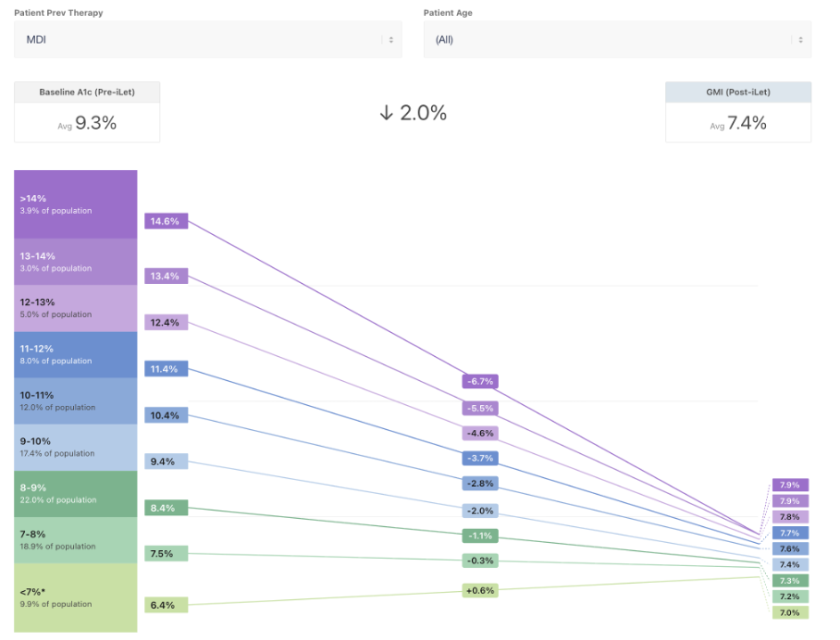
Beta Bionics announced today that it will begin publicly sharing near real-time, real-world data for its iLet Bionic Pancreas through a continuously updated online dashboard. According to the company, the dashboard includes outcomes from 100% of eligible iLet users meeting two predefined criteria: (i) a provider-reported baseline A1c; and (ii) at least two weeks of cloud-uploaded device data. Beta Bionics noted that no additional exclusions are applied.
Beta Bionics positions dashboard as a new model for AID real-world evidence transparency
The publicly accessible dashboard will display continuously updated glycemic outcomes from eligible iLet users without applying additional filtering criteria. Beta Bionics said that the initiative aims to simplify interpretation of real-world AID performance while reducing ambiguity around inclusion criteria and cohort selection.
Source: Beta Bionics
The company also released a companion guide to help clinicians evaluate real-world evidence across AID systems more broadly. According to the announcement, the guide encourages providers to examine factors including:
- Sample size;
- Baseline A1c reporting;
- Inclusion and exclusion criteria;
- Device settings; and
- Observation periods.
As competition grows between commercial AID systems, interpretation of real-world outcomes has become increasingly important for clinicians evaluating differences in automation strategies, onboarding burden, and glycemic performance across broader populations.
Transparency discussions are increasingly important in assessing diabetes technology
Beta Bionics framed the initiative as an effort to establish a higher standard for transparency within diabetes technology. The move comes at a time when manufacturers across the diabetes technology ecosystem are increasingly emphasizing the importance of real-world evidence to support adoption, reimbursement discussions, and differentiation between systems.
The dashboard may also reflect Beta Bionics’ continued strategy of focusing on simplicity and broad usability. Management has frequently described the iLet system’s minimal settings required to initiate the system and reduced meal-announcement requirements as differentiators intended to support use across broader populations, particularly for those who may struggle with carbohydrate counting and numeracy.
Dashboard launch comes shortly before ADA 2026
The company said it plans to feature the dashboard prominently during the ADA 2026 Scientific Sessions and clinical discussions at its exhibit booth. Additionally, on Saturday, June 6, Beta Bionics is scheduled to present two posters featuring real-world glycemic outcomes among iLet users with T1D and T2D, further expanding the company’s growing body of real-world evidence ahead of what is expected to be a major discussion year for AID systems at ADA.
Close Concerns’ Questions
- Will the dashboard allow stratification by baseline characteristics of participants?
- How does Beta Bionics expect this dashboard will affect clinicians’ and patients’ understanding of the iLet compared to other AID systems?
-- by Riya Chatterjee, Jeremy Alkire, Monica Oxenreiter, and Kelly Close