Madrigal enters global licensing agreement with Pfizer for phase 2 oral DGAT-2 inhibitor ervogastat for MASH –
Pfizer received upfront payment of $50 million and is eligible for milestone payments and royalties; ervogastat may offer additive benefits with Rezdiffra (resmetirom)
This morning, Madrigal announced that it has entered an exclusive global license agreement with Pfizer for ervogastat, an oral DGAT-2 inhibitor, and two early-stage candidates for the treatment of metabolic dysfunction-associated steatohepatitis (MASH).
Under the terms of agreement, Pfizer received an upfront payment of $50 million and is eligible for milestone payments and royalties on net sales. Madrigal has rights to develop, manufacture, and commercialize ervogastat globally.
We look forward to learning more about this candidate at JPM 2026, where Madrigal will be presenting at 1:30 pm on Monday. See here for our preview, and stay tuned for our coverage!
Table of Contents
- DGAT-2 inhibitors block triglyceride synthesis, reducing fat deposition and inflammation in the liver
- Ervogastat significantly improved MASH and fibrosis in a phase 2 trial when co-administered with an ACC inhibitor
- Madrigal has expanded its MASH pipeline following approval of Rezdiffra
- Madrigal will explore additive benefits of combining ervogastat and Rezdiffra
- Close Concerns’ Questions
DGAT-2 inhibitors block triglyceride synthesis, reducing fat deposition and inflammation in the liver
DGAT-2 inhibitors block the enzyme called diacylglycerol acyltransferase 2 (DGAT-2), which catalyzes the final step of triglyceride synthesis and storage in the liver (see figure below), lowering lipotoxic fat and inflammation.
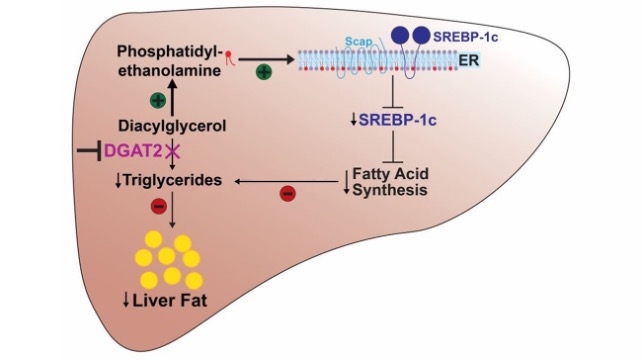
Source: UT Southwestern Medical Center and Cell Metabolism 2024
DGAT-2 inhibitors have previously demonstrated benefits for MASH in clinical programs. In March 2024, Ionis announced favorable phase 2 results of a once-monthly injectable ION224, a DGAT-2 antisense inhibitor. ION224 met the primary endpoint of statistically significant >2 point improvement in NAFLD Activity Score (NAS) score, including in people with F2 and F3 fibrosis, with both doses (90 mg and 120 mg). While not statistically significant, 32% of participants with MASH receiving treatment also achieved fibrosis improvement vs. 12.5% on placebo at one year. Despite the benefits, since 4Q24, ON224 has no longer been listed on Ionis’s pipeline.
Ervogastat significantly improved MASH and fibrosis in a phase 2 trial when co-administered with an ACC inhibitor
A phase 2 trial (n=256), completed in February 2024, evaluated ervogastat monotherapy and a combination therapy of ervogastat and clesacostat (an Acetyl-CoA carboxylase [ACC] inhibitor crucial enzyme for fatty acid production) in people with MASH with advanced liver fibrosis (stages F2-F3). The primary composite endpoint was MASH resolution without fibrosis worsening, at least one stage of fibrosis improvement without MASH worsening, or both, at Week 48.
According to the results published on the Lancet, greater proportion of the ervogastat group achieved the primary endpoint (45%-52% depending on doses vs. 38% on placebo) but did not reach statistical significance. The dual therapy with ervogastat and clesacostat met the primary endpoint (63%-66% depending on doses vs. 38%).
Safety and tolerability profile was favorable, with most adverse events being mild or moderate. However, the dual therapy was associated with deviation of fasting lipid and apolipoprotein levels.
Previously, the dual therapy received a Fast Track designation by the US FDA in 2Q22.
Madrigal has expanded its MASH pipeline following approval of Rezdiffra
Madrigal’s Rezdiffra (resmetirom) was FDA-approved in March 2024 as the first treatment for MASH in adults with moderate-to-advanced liver fibrosis (stages F2 to F3). The approval was based on positive results from the phase 3 MAESTRO-NASH trial, in which 30% of participants on resmetirom 100 mg (vs. 10% on placebo) achieved MASH resolution with no worsening of fibrosis after one year of treatment. The trial also met its other primary endpoint, in which 26% of participants on 100 mg (vs. 14% on placebo) achieved a ≥one-stage improvement in fibrosis with no worsening of MASH. Resmetirom is also evaluated for cirrhosis (stage F4 fibrosis) in the phase 3 MAESTRO-NASH OUTCOMES trial (n=700), which is expected to complete in 2027.
In July 2025, Madrigal further expanded its pipeline by licensing China-based CSPC Pharmaceutical Group’s oral GLP-1 RA (MGL-2086, formerly known as SYH2086) for MASH. The drug candidate is a preclinical oral small molecule and an orforglipron derivative.
Madrigal will explore additive benefits of combining ervogastat and Rezdiffra
In today’s press release, Madrigal expressed interest in exploring the benefits when resmetirom is co-administered with ervogastat. Given that the two drugs have different mechanisms of action, the company anticipates additive efficacy. In 2026, Madrigal will evaluate drug-to-drug interaction between resmetirom and ervogastat and meet with the FDA about a phase 2 combination trial.
Close Concerns’ Questions
1. Are any details available about the two other early-stage candidates for MASH that Madrigal licensed?
2. What additional benefits does Madrigal expect from the combined treatment of ervogastat and Rezdiffra?
3. Will Madrigal also explore the effects of combining ervogastat with its preclinical oral GLP-1 RA (MGL-2086)?
4. Might it be possible to know what factors led Pfizer to downsize its MASH pipeline?
-- by Kat Moon and Kelly Close