AZ 3Q25 – Farxiga records over $2.1 billion for third consecutive quarter (+8% CER); Farxiga + baxdrostat combination therapy in phase 3, upcoming baxdrostat data at AHA 2025; oral PCSK9 inhibitor laroprovstat phase 3 trials continue –
Executive Highlights
- AstraZeneca reported its 3Q25 results this morning in a call led by CEO Mr. Pascal Soriot – see the press release, presentation slides, clinical trials appendix, and webcast. AZ reported a record-breaking quarter overall, with revenue totaling $15.2 billion (up 10% CER), driven primarily by its oncology portfolio.
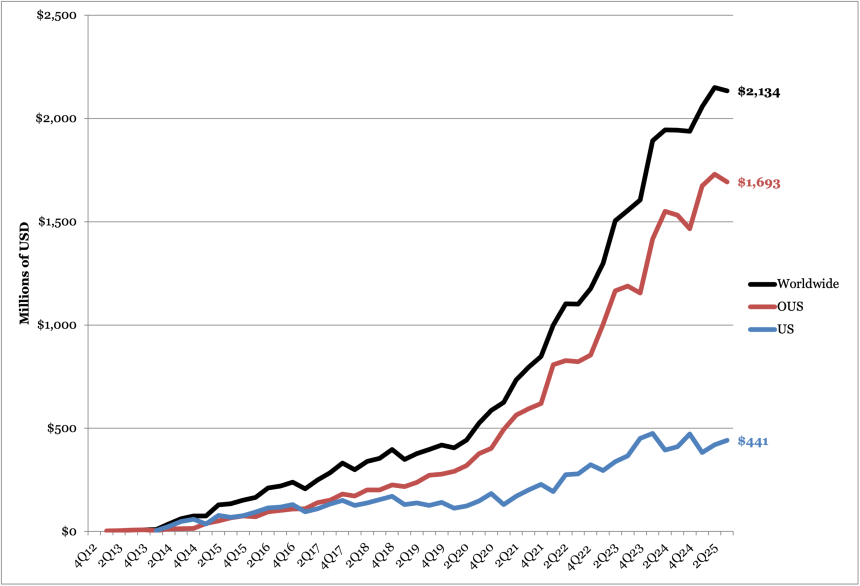
- SGLT-2 inhibitor Farxiga (dapagliflozin) surpassed $2 billion for a third consecutive quarter, totaling $2.1 billion (up 8% CER from 3Q24 and flat sequentially). The company attributed this growth to increased demand across chronic kidney disease (CKD) and heart failure (HF) indications. The slight sequential decline was due in part to an unexpected generic launch of dapagliflozin in the UK in 3Q25. OUS sales were nearly 80% of AZ’s global revenue, totaling $1.7 billion (up 11% from 3Q24 and down 2% sequentially). In the US, Farxiga revenue totaled $441 million (up 7% from 3Q24 and up 5% sequentially). Emerging markets continued to grow ($893 million, +18% CER), though EU sales experienced a slight decline ($698 million, -2% CER).
- AZ’s clinical trial appendix provided numerous updates on its obesity pipeline:
- AZD5004 (oral GLP-1 RA). In 4Q24, AZ initiated two phase 2b trials for AZD5004 (VISTA for obesity and SOLSTICE for T2D), with data anticipated in 1H26 for both trials. The therapy is expected to enter phase 3 trials pending this data.
- AZD6234 (long-acting amylin analog). Data from the phase 2b trial (APRICUS for obesity) are expected in 1H26. The phase 2 ARAY trial (n=64) was initiated in 1Q25 in adults with overweight or obesity and T2D and also taking a GLP-1 RA, with data expected in 2026.
- AZD9550 (dual GLP-1/glucagon RA). The phase 2b ASCEND trial (n=360) of AZD9550 in combination with AZD6234 was initiated in 1Q25 for adults with obesity or overweight with at least one weight-related comorbidity. Results are expected in 2H26. In line with trends set by Novo Nordisk and Lilly, the company noted today the potential for candidates like AZD9550 to segment the range of incretin therapies now in development.
- Farxiga is being investigated as a combination therapy with baxdrostat, balcinrenone, and zibotentan in phase 3 trials. Although the phase 2b MIRO-CKD trial (n=324) of Farxiga combined with balcinrenone lists an expected data readout in 3Q25, those results do not appear to be publicly available. Separately, AZ released BaxHTN monotherapy results at ESC 2025 (simultaneously published in NEJM) and will present Bax24 findings at AHA 2025.
- On MASH, the phase 2b FORTUNA trial (n=220) in adults with MASH who are carriers of the PNPLA3 148M risk allele was discontinued due to efficacy.
- Oral PCSK9 inhibitor laroprovstat advanced to phase 3 trials in 2Q25 and continues to be of great interest to the competitive landscape. Merck is set to announce its own phase 3 oral PCSK9 inhibitor data this weekend at AHA 2025.
Table of Contents
- Financial Highlights
-
Pipeline Updates
- 1. Data anticipated in 1H26 for phase 2b long-acting amylin analog and phase 2b oral GLP-1 RA; dual GLP-1/glucagon RA trials continue with potential for segmentation
- 2. Farxiga in a phase 3 trial as a combination therapy for heart failure and CKD; baxdrostat monotherapy trial results to be presented at AHA 2025
- 3. MASH candidates in phase 1 or 2 development
- 4. Oral PCSK9 inhibitor laroprovstat (AZD0780) phase 3 trials actively recruiting
- Analyst Q&A
- Close Concerns’ Questions
Financial Highlights
1. Farxiga revenue totals a record $2.1 billion, up 8% CER from 3Q24 and down 0.7% sequentially; generic availability in the UK drives slight decline
SGLT-2 inhibitor Farxiga (dapagliflozin) revenue exceeded $2.1 billion for the third consecutive quarter (up 8% CER from 3Q24 and flat sequentially). AZ attributed overall growth to increased global demand, primarily in CKD and HF. The growth of the SGLT-2 inhibitor class overall is supported by cardiorenal guidelines, informed by trial‑proven reductions to HF hospitalizations, and demonstrates slowing CKD progression. OUS sales made up nearly 80% of AZ’s global revenue, totaling $1.7 billion (up 11% from 3Q24 and down 2% sequentially). Emerging markets continued to grow ($893 million, +18% CER), while the EU experienced a slight decline ($698 million, -2% CER). In the US, Farxiga sales totaled $441 million, up 7% from 3Q24 and up 5% sequentially. The company said that despite the earlier-than-expected entry of generic dapagliflozin in the UK in 3Q25, demand has continued.
- Farxiga continues to lead the global SGLT-2 inhibitor market, surpassing BI/Lilly’s Jardiance (empagliflozin) for the third quarter in a row. In 3Q25, Jardiance totaled $2.8 billion (up 40% from 3Q24 and up 39% sequentially). As a reminder, Jardiance received approval in the US, EU, and UK in 2023 for adults with CKD, supported by the results of the EMPA-KIDNEY trial. Farxiga has been approved for CKD in the EU and UK since August 2021 and for CKD in the US since April 2021.
- The patent for Farxiga’s indication for glycemic management in people with T2D, as well as in combination with exenatide, expired on October 4, 2025. It was first approved by the FDA in early 2014. Farxiga’s method of use patents for CKD extend as far as October 4, 2029, with additional renal patents extending through April 1, 2041. Patent protections related to cardiovascular indications, including risk reduction for hospitalization due to heart failure, are expected to expire on September 9, 2040. As a reminder, since January 2024, AZ has partnered with Prasco to sell an authorized generic version of dapagliflozin.
Farxiga Worldwide Financial Results
| Farxiga | 3Q24 | 4Q24 | 1Q25 | 2Q25 | 3Q25 |
| Revenue (Millions) | $1,943 | $1,938 | $2,057 | $2,150 | $2,134 |
| YOY Reported Growth (CER) | +25% (+27%) | +21% (+22%) | +9% (+17%) | +11% (+24%) | +10% (+8%) |
| Sequential Reported Growth | Flat | Flat | +6% | +5% | -1% |
Farxiga 3Q25 Geographic Financial Results
| Farxiga | Revenue (Millions) | YOY Reported Growth | Sequential Reported Growth |
| US | $441 | +7% | +5% |
| OUS | $1,693 | +11% | -2% |
| Total | $2,134 | +10% | -1% |
Farxiga Sales (4Q12-3Q25)
Pipeline Updates
1. Data anticipated in 1H26 for phase 2b long-acting amylin analog and phase 2b oral GLP-1 RA; dual GLP-1/glucagon RA trials continue with potential for segmentation
AZ’s clinical trials appendix outlined numerous updates to its obesity pipeline:
- AZD5004 (oral GLP-1 RA). In 4Q24, AZ initiated two phase 2b trials for AZD5004 (VISTA for obesity; SOLSTICE for T2D), with data anticipated in 1H26 for both trials and expectations to enter phase 3 trials pending results. AZD5004 has been in development both as a monotherapy and in combination with other therapies such as dapagliflozin and AZD0780.
- AZD6234 (long-acting amylin analog). Data from the phase 2b trial (APRICUS for obesity) are expected in 1H26. The phase 2 ARAY trial (n=64) was initiated in 1Q25 for AZD6234 in adults with overweight or obesity and T2D taking a GLP-1 RA, with data expected in 2026.
- AZD9550 (dual GLP-1/glucagon RA). The phase 2b ASCEND trial (n=360) of AZD9550 in combination with AZD6234 was initiated in 1Q25 for adults with obesity or overweight with at least one of the following weight-related comorbidities: (i) hypertension; (ii) dyslipidemia; or (iii) obstructive sleep apnea. Results are expected in 2H26. In today’s call, EVP of Biopharmaceuticals R&D Dr. Sharon Barr said that there is a potential for market segmentation with AZD5004, AZD6234, and AZD9550 potentially serving distinct patient segments or different combination regimens for obesity and T2D.
2. Farxiga in a phase 3 trial as a combination therapy for heart failure and CKD; baxdrostat monotherapy trial results to be presented at AHA 2025
Farxiga is being investigated as a combination therapy in phase 3 trials with baxdrostat (aldosterone synthase inhibitor), balcinrenone (non-steroidal selective mineralocorticoid receptor modulator), and zibotentan (selective endothelin A receptor agonist). In 4Q24, Mr. Soriot emphasized the need for combination therapies, highlighting that 40% of patients have kidney disease due to hypertension, 40% due to diabetes, and the remainder due to other causes.
- Farxiga + baxdrostat: In March 2024, AZ initiated the phase 3 BaxDuo-Arctic trial (n=2,455) examining Farxiga in combination with baxdrostat vs. Farxiga monotherapy in people with CKD and high blood pressure. The study is expected to complete in December 2027. People with T1D or uncontrolled T2D are excluded from the trial. The primary outcome will be a change in eGFR from baseline to two years. Baxdrostat was added to AZ’s pipeline with the company’s acquisition of CinCor Pharma in February 2023.
- On today’s call, Dr. Barr emphasized that baxdrostat is explicitly designed for individuals with difficult-to-manage hypertension while on other therapies. In 3Q25, AZ announced results from the BaxHTN trial at ESC 2025 and they were simultaneously published in NEJM. AZ will be announcing results from the Bax24 trial this coming weekend at AHA 2025. The trial investigated the effect of baxdrostat on ambulatory blood pressure in people with resistant hypertension.
- AZ initiated the phase 3 BaxDuo-Pacific trial (n=5,000) in 1Q25, investigating Farxiga with baxdrostat vs. Farxiga monotherapy in people with CKD and high blood pressure. The primary outcome is the time to first renal composite event and results are expected in 2026.
- AZ also added the phase 3 PREVENT-HF trial (n=11,300) in 1Q25, examining Farxiga in combination with baxdrostat vs. Farxiga monotherapy in people with T2D, a history of hypertension, established CVD, and CVD risk factors. The primary endpoint will be time to CV death or first heart failure event with results expected in 2026.
- Farxiga + zibotentan: AZ is investigating this combination therapy in a phase 3 trial for CKD and high proteinuria.
- Initiated in 4Q23, the phase 3 ZENITH High Proteinuria trial (n=1,835) is evaluating Farxiga in combination with zibotentan versus monotherapy in adults with CKD and high proteinuria. The trial is expected to complete in January 2027. The primary outcome is the change in eGFR from baseline to two years. Adults with T1D are excluded from the trial.
- In 2Q23, the phase 2 ZENITH-CKD study showed significant and clinically meaningful reductions in UACR at 12 weeks compared with dapagliflozin alone. After 12 weeks of treatment, the UACR difference of zibotentan/dapagliflozin versus dapagliflozin alone was 34%.
- The phase 2 ZEAL trial (n=195), investigating Farxiga in combination with zibotentan for adults with liver cirrhosis and with features of portal hypertension was discontinued in 2Q25 due to efficacy.
- Initiated in 4Q23, the phase 3 ZENITH High Proteinuria trial (n=1,835) is evaluating Farxiga in combination with zibotentan versus monotherapy in adults with CKD and high proteinuria. The trial is expected to complete in January 2027. The primary outcome is the change in eGFR from baseline to two years. Adults with T1D are excluded from the trial.
- Farxiga + balcinrenone: This combination is being evaluated in a phase 2b trial for CKD and a phase 3 trial for HF and impaired renal function.
- Completed in 2Q25, the phase 2b MIRO-CKD trial (n=324) investigated Farxiga in combination with balcinrenone in adults with CKD and albuminuria. The primary endpoint is the change in UACR from baseline to 12 weeks. People with T1D or uncontrolled T2D are excluded from the trial. While the data readout was scheduled for 3Q25, the results have not yet been made public.
- The phase 3 BalanceD-HF trial (n=4,800) for Farxiga in combination with balcinrenone in adults with heart failure and impaired renal function is currently recruiting. Completion is expected in June 2027 with initial data anticipated in 2026. The primary outcome will be a composite of CV death, HF hospitalization, and HF event without hospitalization at 38 months. People with T1D are excluded from the trial.
3. MASH candidates in phase 1 or 2 development
The AZ pipeline features multiple candidates in phase 1 or 2 development for MASH, including for liver cirrhosis, the most severe stage of fibrosis. There are currently no therapies available for liver cirrhosis. See the table below for a summary.
Drug (mechanism) | Trial | Study population | Primary endpoint | Trial status |
AZD9550 (dual GLP-1/glucagon RA) | Phase 1 CONTEMPO (n=90) | Adults with overweight or obesity with or without T2D | Safety, tolerability, and PK parameters | Data anticipated in 2H26 |
AZD2389 (anti-fibrotic mechanism) | Phase 2 BORANA (n=40) | Adults with liver fibrosis and compensated cirrhosis | Safety and tolerability | Data anticipated in 2H25 |
zibotentan/dapagliflozin (endothelin A receptor antagonist/SGLT-2 inhibitor) | Phase 2 ZEAL (n=195) | Adults with cirrhosis with features of portal hypertension | Change in hepatic venous pressure gradient (HVPG) | Trial discontinued due to efficacy as of 2Q25. Data readout in 2Q25. |
AZD2693 (PNPLA3 ASO) | Phase 2b FORTUNA (n=220) | Adults with MASH and who are carriers of the PNPLA3 148M risk allele | Efficacy, safety, and tolerability | Trial discontinued due to efficacy in 3Q25. |
Mitiperstat (MPO inhibitor) | Phase 2 COSMOS (n=90) | Adults with MASH | Safety, tolerability, PD parameters | Trial discontinued as of 4Q24 due to “strategic portfolio prioritization” |
4. Oral PCSK9 inhibitor laroprovstat (AZD0780) phase 3 trials actively recruiting
As of 2Q25, AZ initiated three phase 3 clinical trials for AZD0780 (laroprovstat), which are all actively recruiting:
- AZURE-LDL (n=2,800) will evaluate LDL-C reduction in patients with dyslipidemia and a history of clinical ASCVD or who are at risk of a first ASCVD event.
- AZURE-HeFH (n=405) will evaluate LDL-C reduction in patients with heterozygous familial hypercholesterolemia.
- AZURE-Outcomes (n=15,100) will evaluate the time to first event of any component of MACE-Plus, a composite endpoint that includes death, myocardial infarction, stroke, revascularization, heart failure, and thromboembolic events. Patients included will either have dyslipidemia and established ASCVD or will be at high risk of a first ASCVD event.
Recall that in 2Q25 AZ said its planned multi-billion-dollar US manufacturing facility will produce therapeutics such as laroprovstat, its oral GLP-1 RA, and combination small molecule products. This facility is part of AZ’s $50 billion US investment plan announced in July 2025. No further updates on this clinical trial program were offered in today’s remarks.
Analyst Q&A
On the cardiometabolic portfolio, including PCSK9, baxdrostat, and Farxiga
Q (Mr. Sachin Jain, Bank of America): I wonder if you could just remind us of the obesity portfolio, the oral and Amylin as we look for Phase II data next year. How are you thinking about your target competitive profile given the competitive landscape is rapidly changing? Obviously, with oral, we've seen the ortho data since you last presented, and with Amylin, we've had the Lilly data out today.
A (Dr. Sharon Barr, EVP): We are moving forward with multiple molecules in our weight management portfolio. That is AZD5004, that is currently in phase 2 for patients with obesity and type 2 diabetes. AZD6234, that's our long-acting Amylin peptide subcutaneous injectable that is also in Phase II for the same patient populations, and AZD9550, and that's our dual GLP-1 glucagon receptor agonist, also subcutaneous injectable, also in Phase II.
As we move all three of these forward at pace, of course, we're looking to have highly competitive molecules that give us reason to believe that these could be valuable treatment options for patients.
As we move forward, we're also thinking about the potential for market segmentation, and we know that there will be room for multiple mechanisms. And the bar is high. We've seen the very interesting data from eloralintide today. And so that gives us more reason to believe that a selective Amylin receptor agonist similar to 6234 has the potential for efficacy in terms of weight loss and better blood sugar control for patients with type 2 diabetes.
We have seen no red flags to date and continue to move forward at pace, and expect to enter phase 3 pending competitive data, and we'll be making those decisions in 2026.
Q (Mattias Haggblom, Handelsbanken): On Forxiga, following the invalidation of the patent in U.K. and subsequent generic launch, remind me why this loss would not encourage generic companies to explore similar challenges elsewhere in Europe prior to patent expiration in 2028 and why the situation in U.K. was unique?
A (Mr. Pascal Soriot, CEO): It's a very specific U.K. law. We can cover the details separately with you if you want, offline. But just for everybody's interest, it's a very specific U.K. law that doesn't apply to other countries.
Q (Mattias Haggblom, Handelsbanken): Merck will present phase 3 data for its oral PCSK9 inhibitor this weekend. Once we get the detailed data, what in particular will your team be studying to better understand its clinical profile and how it compares with your own small molecule PCSK9 inhibitor currently in phase 3?
A (Dr. Sharon Barr, EVP): Our own laroprovstat is a true small molecule inhibitor of PCSK9 currently in Phase III. We have shared the phase 2 data. They're very encouraging. And we note that because our PCSK9 is a true small molecule, it does not require solubility enhancers, and it doesn't require fasting. And so it offers a target patient profile that we think is very attractive for both monotherapy and combination approaches.
We’re exploring combination approaches with a small molecule Lp(a) that is in our portfolio in Phase I. And it also allows us to easily combine with statins, which is standard-of-care. We were thrilled to see that with combinations, we were able to bring 80% of patients on study to their LDL-C lowering goals, and so we think that we're in a very solid place in the competitive landscape.
We’ll be watching Merck's data to understand how we can continue to meaningfully differentiate ourselves in this landscape as we continue to work on our go-forward plans. We remain very positive about the potential for pravastatin in this environment and for the potential to really meaningfully change patients' lives because dyslipidemia is not yet solved. And we know that the majority of patients aren't reaching their LDL-C lowering goals. And so there's still a major unmet medical need in the marketplace.
Close Concerns’ Questions
- What is driving the uptake of Farxiga over Jardiance in similar patient populations for CKD and heart failure?
- What legal precedents or factual circumstances in the UK challenge rendered the patent for Farxiga vulnerable?
- How exactly is AZ thinking about combination therapies: as distinct product segments, adjunctive add‑ons, as options for nonresponders, or otherwise?
- What is the timeline, capacity, and product allocation plan for the new US manufacturing facility and which therapies will be prioritized?
-- by Kayla Mathieu, Nour Khachemoune, Monica Oxenreiter, and Kelly Close