Regeneron 1Q26 –Eylea franchise revenue totals $941 million (-10%) amid biosimilar competition; PCSK-9 inhibitor Praluent achieves sales of $67 million (+18%) –
Executive Highlights
- Regeneron reported its 1Q26 financial results on a call led by President and CEO Dr. Leonard Schleifer, President and CSO Dr. George Yancopoulos, CFO Mr. Chris Fenimore, SVP of Investor Relations & Strategic Analysis Mr. Ryan Crowe, and Executive Vice President and Head of Commercial Ms. Marion McCourt. See the press release, webcast, and investor presentation.
- Regeneron reported global combined net sales for Eylea (aflibercept 2 mg) and Eylea HD (aflibercept 8 mg) of $941 million in the US in 1Q26, down 10% from 1Q25 and down 14% sequentially. Management said that physician demand for Eylea HD increased sequentially by 10% despite typical seasonality trends. Regeneron said that there was a modest reduction in inventory in the first quarter and that continued inventory absorption will impact net sales in 2Q26 by about $20 million.
- In the US, Eylea HD revenue totaled $468 million, up 52% from 1Q25 but down 8% sequentially. Eylea sales totaled $473 million in the US, down 36% from 1Q25 and down 18% sequentially. Declines were attributed to conversions to Eylea HD and biosimilar competition.
- A large focus of discussion was the April 2025 approval of an extended dosing interval for up to five months for Eylea HD for wAMD and DME. The extended interval will be available for patients following one year of successful treatment response, as measured by assessed visual and anatomic outcomes. The approval is based on 96-week data from the pivotal PULSAR trial in wAMD and the PHOTON trial for DME.
- Regeneron provided key updates on its licensing agreement with China-based Hansoh Pharmaceuticals to develop olatorepatide. The therapy is a once‑weekly dual GLP‑1/GIP agonist (HS‑20094). In a randomized, double blind, placebo-controlled trial of 604 adults across 33 sites, the therapy met its co-primary endpoints, achieving up to 19% mean body weight loss by Week 48. A phase 2 trial for olatorepatide for obesity is enrolling “rapidly,” said the company.
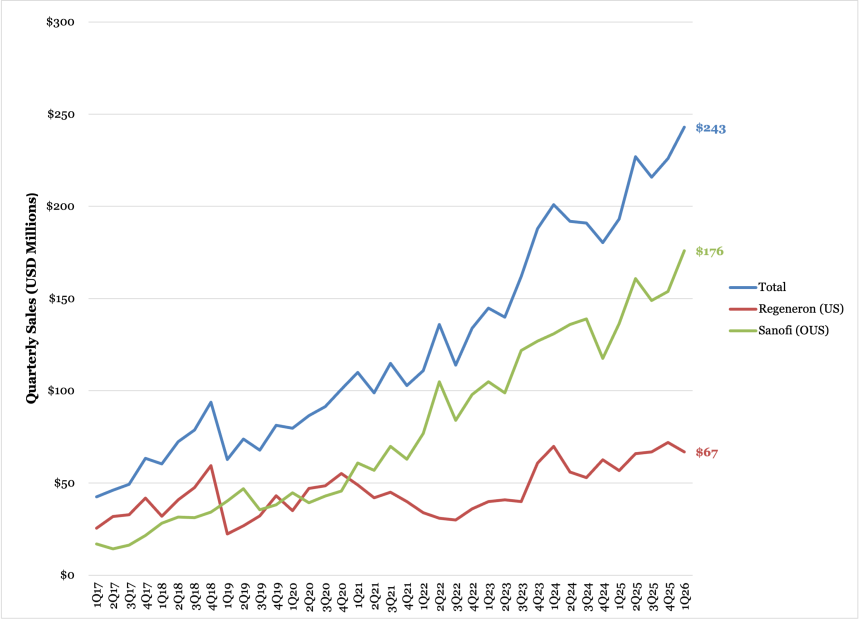
- US sales of PCSK-9 inhibitor Praluent totaled $67 million, up 18% from 1Q25 but down 7% sequentially. While limited discussion of the therapy occurred on today’s call, Regeneron announced an agreement with the US government in April 2026 to offer Praluent for direct patient purchase on TrumpRx, in addition to other MFN pricing agreements.
Table of Contents
- 1. Eylea and Eylea HD net sales total $941 million (-10%) in the US, while Eylea HD performs well ($468 million, +52%), Eylea HD dosing interval FDA approved to five months for wAMD and DME
- 2. Phase 3 program for GLP-1/GIP RA olatorepatide in obesity with and without T2D is enrolling; combination trial with PCSK9 Praluent initiating shortly
- 3. Praluent sales total $67 million (+18%); MFN agreement to offer therapy for direct patient purchase
- 4. Additional data from phase 2 COURAGE trial of trevogrumab (anti-myostatin antibody) for muscle preservation when combined with semaglutide expected in 2026
- Close Concerns’ Questions
Financial and Pipeline Highlights
1. Eylea and Eylea HD net sales total $941 million (-10%) in the US, while Eylea HD performs well ($468 million, +52%), Eylea HD dosing interval FDA approved to five months for wAMD and DME
Regeneron reported global combined net sales for Eylea (aflibercept) and Eylea HD (aflibercept 8 mg) of $941 million in the US in 1Q26, down 10% from 1Q25 and down 14% sequentially. Recall that Regeneron maintains exclusive rights to the Eylea franchise in the US, while Bayer is responsible for sales outside of the US. Management said that physician demand for Eylea HD increased sequentially by 10% despite typical seasonality trends and expressed confidence in the franchise’s continued performance. Regeneron said that there was a modest reduction in inventory in the first quarter and that continued inventory absorption will impact net sales in 2Q26 by about $20 million.
- In the US, Eylea HD revenue totaled $468 million, up 52% from 1Q25 but down 8% sequentially. Eylea sales totaled $473 million in the US, down 36% from 1Q25 and down 18% sequentially. Declines were attributed to conversions to Eylea HD and biosimilar competition.
- Over 100 million injections of Eylea HD and Eylea have been administered worldwide since launch,and Eylea HD now contributes half of net sales for the company’s retina franchise.
- In OUS sales, handled by Bayer, net sales of Eylea and Eylea 8 mg were $729 million. The company said that total Bayer collaboration revenue was $287 million.
- A large focus of discussion was the April 2025 approval of an extended dosing interval for up to five months for Eylea HD for wAMD and DME. The extended interval will be available for patients following one year of successful treatment response, as measured by assessed visual and anatomic outcomes. The approval is based on 96-week data from the pivotal PULSAR trial in wAMD and the PHOTON trial for DME. Sustained efficacy and safety were demonstrated for the extended dosing interval over two years. Regeneron said that the approval will also allow for greater treatment individualization – some patients may require dosing every four weeks, while others will enjoy treatment efficacy at up to a 20-week interval, equating to only two or three injections per year.
- Management anticipated unit demand growth for Eylea HD in 2Q26 of 10%, in line with 1Q26 growth. However, for Eylea, Regeneron anticipates that demand will decline in the mid-to-high teens in 2Q26. This will come ahead of the potential launch of biosimilars in the quarter, as discussed in previous quarters.
- Regeneron has also resubmitted its application for the Eylea HD pre-filled syringe to the FDA. The FDA previously conducted an inspection and re-inspection at Catalent Indiana, which manufactures products for the company. Management said that the FDA did not act by the April 2026 date for the company’s application for a second contract manufacturer, so the application remains pending. The company expects a regulatory decision on one or both applications in 2Q26.
2. Phase 3 program for GLP-1/GIP RA olatorepatide in obesity with and without T2D is enrolling; combination trial with PCSK9 Praluent initiating shortly
Regeneron provided key updates on its licensing agreement with China-based Hansoh Pharmaceuticals to develop olatorepatide. The therapy is a once‑weekly dual GLP‑1/GIP agonist (HS‑20094) with a deal worth up to $1.9 billion inked in 2Q25. Regeneron will eventually be responsible for commercialization outside of the Chinese Mainland, Hong Kong, and Macau.
- Management highlighted this therapy on today’s call. In March, Hansoh reported positive phase 3 results for olatorepatide that were comparable to a previous study of tirzepatide for obesity. In the randomized, double blind, placebo-controlled trial of 604 adults across 33 sites, the therapy met its co-primary endpoints, achieving up to 19% mean body weight loss by Week 48. Regeneron said that the therapy’s gastrointestinal tolerability profile was particularly promising. Hansoh plans to present these data at an undisclosed medical meeting this year.
- A phase 2 trial for olatorepatide for obesity is enrolling “rapidly,” said the company, and two global phase 3 programs are expected to be initiated this year. One will include patients with obesity, and one will be for patients with obesity and T2D.
- Previously, in 3Q25, Regeneron expressed plans to explore combination regimens to address obesity‑linked comorbidities. Today’s call reaffirmed this, saying that a clinical trial to explore a combination of olatorepatide and PCSK9 Praluent (alirocumab) will initiate “shortly.” While currently approved GLP-1 RAs lower LDL-C levels by <10%, Regeneron projects that the combination has the potential to achieve >50% LDL-C lowering along with weight loss.
3. Praluent sales total $67 million (+18%); MFN agreement to offer therapy for direct patient purchase
US sales of PCSK-9 inhibitor Praluent totaled $67 million, up 18% from 1Q25 but down 7% sequentially. International sales are recorded by Sanofi, which pays Regeneron a 5% royalty. While limited discussion of the therapy occurred on today’s call, Regeneron announced an agreement with the US government in April 2026 to offer Praluent for direct patient purchase on TrumpRx, in addition to other MFN pricing agreements. In exchange, Regeneron will not be subject to future US government pricing mandates and will receive tariff relief for three years.
- Recall that in May 2025 a Delaware jury ruled that Amgen committed antitrust and tort breaches by leveraging Enbrel (etanercept) and Otezla (apremilast) to obtain exclusive formulary placement for Repatha and exclude Praluent.
Praluent Sales by Geography (1Q17-1Q26)
4. Additional data from phase 2 COURAGE trial of trevogrumab (anti-myostatin antibody) for muscle preservation when combined with semaglutide expected in 2026
While trevogrumab remained unmentioned on today’s call, additional information on the therapy was included in the presentation slides published today. The therapy is an anti‑GDF8/anti‑myostatin antibody for muscle preservation. At EASD 2025, Regeneron presented an interim 26‑week analysis from the ongoing phase 2 COURAGE trial (n=1,005) which evaluated the effects of trevogrumab alone or together with garetosmab (anti‑activin A), on weight loss quality in people with obesity when combined with Novo Nordisk’s semaglutide (GLP‑1 RA).
- The trial showed that adding trevogrumab, with or without garetosmab, significantly preserves 50-80% of the lean mass lost with semaglutide alone. Specifically, 7% of total weight loss was from lean mass in the triple therapy group, compared to 18% from semaglutide with trevogrumab and 33% from semaglutide alone. The dual therapy was generally well tolerated, whereas the triple‑antibody arm had a higher discontinuation rate.
- The phase 2 trial has transitioned to a 26-week maintenance phase, where semaglutide will be discontinued to evaluate the efficacy of trevogrumab on weight maintenance. In its presentation slides, Regeneron said it expects to report additional proof-of-concept data this year. According to ClinicalTrials.gov, the trial is expected to complete in October 2026.
Close Concerns’ Questions
- How might continual manufacturing challenges related to Catalent Indiana affect the uptake of the Eylea franchise?
- How does Regeneron envision olatorepatide competing in the GLP-1 RA arena, which has a number of strong competitors?
- Does Regeneron view the loss of Eylea sales to Eylea HD as detrimental in any way?
- How will Regeneron position muscle‑preserving antibody combinations commercially, especially in combination with GLP-1 RAs?
-- by Nour Khachemoune, Kat Moon, and Kelly Close