Tandem 2Q26 – Revenue totals $255 million (+6%) as PayGo adoption reaches 10% of US sales; Mobi Tubeless submitted to the FDA; Control-IQ+ expands to pregnancy and T2D –
Executive Highlights
- Tandem reported its 2Q26 financial results on a call today led by CEO Mr. John Sheridan and CFO Ms. Leigh Vosseller. See the press release, presentation, and webcast.
- Revenue totaled $255 million in 2Q26, up 6% from 2Q25 and up 3% sequentially. Management attributed growth to continued adoption of Tandem Mobi, increasing PayGo pharmacy utilization, and strong international execution despite ongoing infusion set supply constraints.
- US revenue totaled $179 million, up 5% from 2Q25 and 12% sequentially. Pharmacy adoption continued to expand during the quarter, with approximately 10% of US sales occurring through the pharmacy channel versus 6% in 1Q26.
- OUS revenue totaled $75 million, up 7% from 2Q25 and down 13% sequentially from the exceptionally strong 1Q26.
- Worldwide pump shipments totaled more than 33,000 in 2Q26, increasing more than 10% from 2Q25 and approximately 14% sequentially, representing Tandem's strongest second-quarter shipment performance to date. US shipments reached approximately 22,000 pumps, up 7% from 2Q25, while international shipments increased to approximately 11,000 pumps, up 19% from 2Q25 and 10% sequentially.
- Tandem continued scaling its PayGo pharmacy strategy in the US, with approximately 10% of US sales now occurring through the pharmacy channel and formulary coverage reaching ~45%, near the high end of the company's 2026 target.
- Tandem received FDA clearance and CE-Mark approval for Control-IQ+ in pregnancy for people with T1D, making it the first AID system approved for this indication in the US. The CE-Mark also expanded the indication to adults with T2D in Europe.
- Mr. Sheridan and Ms. Vosseler highlighted continued product and pipeline momentum, including: (i) the FDA 510(k) submission for Tandem Mobi Tubeless; (ii) US launch of Dexcom G7 15 Day compatibility; (iii) expansion of FreeStyle Libre 3 Plus compatibility internationally; (iv) early progress from direct commercial operations in Europe; and (v) reiterated plans to begin a scaled Mobi Tubeless launch in 2H26.
Table of Contents
-
Financial Highlights
- 1. Worldwide 2Q26 revenue totals $255 million, up 6% as US pharmacy adoption and Mobi uptake drive growth
- 2. New pump shipments in 2Q26 total 33,000, a second-quarter record; worldwide shipments increase over 10% from 2Q25
- 3. Gross margin expands to 57%, with continued operating margin improvement
- 4. 2026 guidance reaffirmed at $1.065-$1.085 billion (+5%-7%); 3Q26 revenue guidance of ~$265 million
-
Control-IQ Highlights
- 1. Control-IQ+ receives FDA approval and CE-Mark approval for pregnancy in T1D; CE-Mark also expands indication to adults with T2D
- 2. Pay-as-you-go model (PayGo) reaches 10% of US sales with ~45% formulary coverage
- 3. International direct commercial expansion progresses in the UK, Switzerland, and Austria; France launch planned for 4Q26
- 4. Stable T2D retention supports long-term expansion strategy
-
Pipeline Highlights
- 1. Mobi Tubeless FDA submission completed; scaled US launch remains targeted for 2H26 as Tandem enters the tubeless pump market
- 2. Dexcom G7 15 Day integration launches for Mobi and t:slim X2; international Mobi rollout and expanded FreeStyle Libre 3 Plus compatibility continue
- 3. AIDANET pivotal trial expected later this year as Tandem advances next-generation fully closed-loop algorithm
- Analyst Q&A
- Close Concerns Questions
Financial Highlights
1. Worldwide 2Q26 revenue totals $255 million, up 6% as US pharmacy adoption and Mobi uptake drive growth
Tandem Quarterly Revenue (2Q13 - 2Q26)
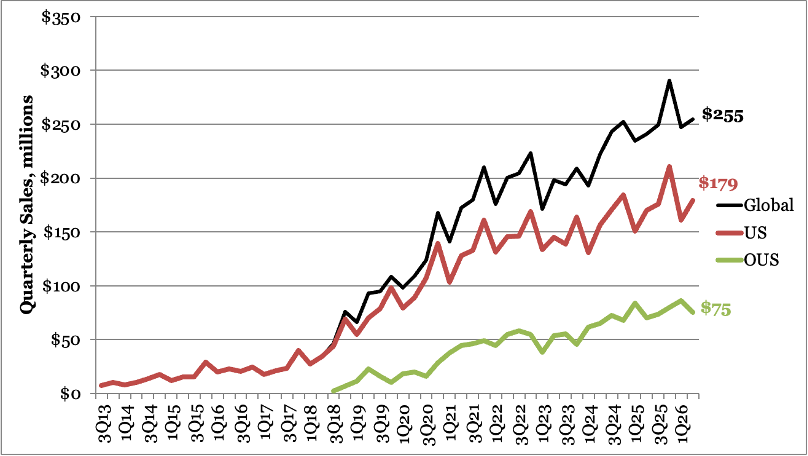
Revenue totaled $255 million in 2Q26, up 6% from 2Q25 and up 3% sequentially. Management attributed growth to continued adoption of Tandem Mobi, expanding pharmacy access, and strong international execution despite ongoing infusion set supply constraints.
- US revenue totaled $179 million, up 5% from 2Q25 and 12% sequentially. Pharmacy adoption continued to expand during the quarter, with approximately 10% of US sales occurring through the pharmacy channel versus 6% in 1Q26. Management noted that approximately 45% formulary coverage has already been secured, approaching the high end of its full-year target.
- OUS revenue totaled $75 million, up 7% from 2Q25 but down 13% sequentially from the exceptionally strong 1Q26. Management attributed international growth to continued execution of its direct commercialization strategy, with direct sales representing approximately 13% of international revenue, more than double prior-year levels. Reported revenue included an approximately $3 million headwind from distributor inventory buybacks and destocking associated with the transition to direct commercial operations.
- During Q&A, management explained that international supplies revenue was pressured by ongoing infusion set supply constraints. Although Tandem received the expected inventory allocation from its supplier during the quarter, products arrived too late for distributors to fulfill orders before quarter-end. Management believes 2Q26 represented the greatest impact from these shortages and expects constraints to ease throughout the remainder of 2026.
2. New pump shipments in 2Q26 total 33,000, a second-quarter record; worldwide shipments increase over 10% from 2Q25
Tandem Quarterly Pump Shipments (2Q13 - 2Q26)
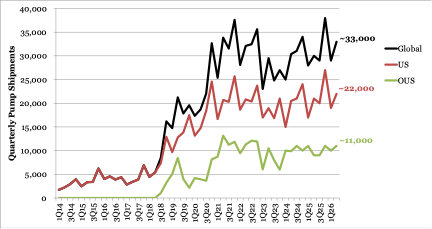
Worldwide pump shipments totaled more than 33,000 in 2Q26, increasing more than 10% from 2Q25 and approximately 14% sequentially, representing Tandem's strongest second-quarter shipment performance to date. US shipments reached approximately 22,000 pumps, up 7% from 2Q25, while international shipments increased to approximately 11,000 pumps, up 19% from 2Q25 and 10% sequentially.
- Approximately 70% of new customers transitioned from multiple daily injections (MDI), with MDI conversions increasing by the “mid-single digits” from 2Q25, supporting confidence in stronger pump growth during 2H26. Tandem Mobi now represents more than half of all new customer pump shipments, while renewals continued to account for more than half of US pump shipments, growing at a double-digit rate.
3. Gross margin expands to 57%, with continued operating margin improvement
Tandem reported a gross margin of 57%, increasing from 52% in 2Q25 and 55% sequentially, representing the second-highest quarterly gross margin in company history. Management attributed margin expansion primarily to favorable pricing from the PayGo pharmacy strategy, increasing Tandem Mobi volumes, and continued product cost improvements.
- Operating margin improved to -5% of sales, an improvement from -22% in 2Q25. The company reported an operating loss of $13.8 million, down from $32 million in 2Q25. Operating expenses were $159 million in 2Q26. Tandem also lowered expected FY26 stock-based compensation expense to approximately $65 million, down from prior guidance of $80 million, reflecting changes to the company’s equity granting practices.
- Tandem ended 2Q26 with $456 million in cash, cash equivalents, and investments, compared to $570 million at the end of 1Q26. Management attributed the decline primarily to investments in a new customer relationship management (CRM) platform supporting global commercial initiatives, the second annual payment related to the Roche settlement agreement, and an additional strategic investment in insulin patch company CeQur.
4. 2026 guidance reaffirmed at $1.065-$1.085 billion (+5%-7%); 3Q26 revenue guidance of ~$265 million
Management reaffirmed its full-year 2026 revenue guidance of $1.065-$1.085 billion, representing 5%-7% growth for full-year 2026. As previously announced, Tandem expects US revenue of $730-$745 million (+3%-5%) and international revenue of $335-$340 million (+9%-10%) in 2026. Gross margin guidance remains 56%-57%. For 3Q26, the company guided to approximately $265 million in revenue, including $180 million in the US and $85 million internationally.
- Ms. Vosseller attributed gross margin expansion primarily to stronger pharmacy pricing and increasing Tandem Mobi production volumes, which continue to improve manufacturing costs. Looking ahead, management expects gross margin to decline approximately one percentage point in 3Q26 as PayGo pump adoption temporarily outpaces conversions of existing customers to higher-margin pharmacy supplies, before reaching approximately 60% in 4Q26.
- Management reiterated that it expects the strongest financial performance to occur in 2H26, particularly in 4Q26, driven by: (i) continued expansion of the PayGo pharmacy model; (ii) increasing direct commercial operations in Europe; (iii) seasonal strength in US durable medical equipment (DME) pump sales; and (iv) continued adoption of recently launched technologies.
Control-IQ Highlights
1. Control-IQ+ receives FDA approval and CE-Mark approval for pregnancy in T1D; CE-Mark also expands indication to adults with T2D
During the quarter, the company received FDA clearance and CE-Mark approval for Control-IQ+ use during pregnancy in people with T1D, making it the first AID system approved for this indication in the US. The CE-Mark also expanded Control-IQ+ in Europe to include adults with T2D, further broadening Tandem's addressable market. Management emphasized that these approvals strengthen Control-IQ+'s position as the broadest indicated AID system currently available and represent another step in expanding access to automated insulin delivery globally.
- The approvals build upon Tandem's broader strategy of expanding Control-IQ+ across patient populations and geographies. During prepared remarks, CEO Mr. John Sheridan highlighted these label expansions alongside continued global rollout of Tandem's technology portfolio, noting that pregnancy and T2D represent important opportunities for future growth. Management positioned these label expansions as part of Tandem's broader strategy to expand Control-IQ+ across patient populations and geographies. Mr. Sheridan highlighted pregnancy and T2D as important opportunities for future growth.
2. Pay-as-you-go model (PayGo) reaches 10% of US sales with ~45% formulary coverage
Management devoted considerable attention to its ongoing transition toward the Pay-as-you-go (PayGo) reimbursement model through the US pharmacy channel, describing the initiative as one of Tandem's most important strategic priorities. During the first full quarter following launch, approximately 10% of US sales occurred through the pharmacy channel, while formulary coverage expanded to approximately 45%, already approaching the high end of management's original 2026 target range. Mr. Sheridan noted that Tandem's focus has shifted from securing pharmacy access to driving utilization among eligible patients, adding that the company is beginning to realize operational efficiencies from the new commercial model.
- While PayGo continues to create near-term revenue headwinds because pumps are no longer reimbursed upfront through DME, management reiterated that the model should generate superior long-term economics through higher recurring supply revenue. During Q&A, Mr. Sheridan characterized implementation challenges as a “normal learning curve” associated with end-to-end changes across prescribing, customer support, and order fulfillment.
- Ms. Vosseller also noted average monthly pharmacy supply reimbursement exceeded Tandem’s initial $350-per-patient modeling assumption in 2Q26. Tandem already has contracts with the three largest pharmacy benefit managers (PBMs) and is negotiating with additional payers.
- Pharmacy adoption also provides several pathways to growth. During Q&A, management highlighted that eliminating the upfront pump cost may facilitate conversions from MDI, accelerate renewals for out-of-warranty customers, and make it easier for patients under contract with competing technologies to switch to Tandem.
3. International direct commercial expansion progresses in the UK, Switzerland, and Austria; France launch planned for 4Q26
Management highlighted continued progress in Tandem's strategy of transitioning from distributor-based sales to direct commercial operations in key international markets. Following launches earlier this year, the company's direct organizations in the United Kingdom, Switzerland, and Austria continued gaining traction during 2Q26, with direct channel sales representing approximately 13% of international revenue, more than double prior-year levels. Mr. Sheridan described these early results as encouraging and noted that the company's new commercial infrastructure, CRM platform, and sales organization are beginning to improve productivity while strengthening customer relationships.
- Looking ahead, Tandem plans to expand direct operations into France during 4Q26, while continuing its broader international rollout of Tandem Mobi and Control-IQ+ technologies. Although management acknowledged temporary revenue headwinds from distributor inventory buybacks associated with these transitions, executives reiterated that direct commercialization is expected to support stronger long-term pricing, margin expansion, and customer engagement.
4. Stable T2D retention supports long-term expansion strategy
During Q&A, management discussed Tandem’s experience among people with T2D. Mr. Sheridan said Tandem’s T2D attrition is only “modestly higher” than its T1D rate and has remained stable for approximately five years. He attributed this in part to Tandem’s strategy of selectively targeting people believed to have a high likelihood of success on pump therapy.
- Management continues to view T2D as a major underpenetrated opportunity in both the US and internationally. Mr. Sheridan said Tandem's T2D attrition has remained only "modestly higher" than T1D for approximately five years, which he attributed to selective patient targeting. Tandem expects several potential catalysts, including FreeStyle Libre 3 Plus compatibility, pharmacy access, Mobi Tubeless, increased PCP/HCP awareness, and the potential removal of Medicare’s C-peptide requirement. Mr. Sheridan said Tandem recently met with CMS alongside other stakeholders regarding the C-peptide requirement and expects an update during August.
Pipeline Highlights
1. Mobi Tubeless FDA submission completed; scaled US launch remains targeted for 2H26 as Tandem enters the tubeless pump market
Tandem completed its FDA 510(k) submission for Mobi Tubeless in 2Q26 and continues to target a scaled US launch in 2H26. Mobi Tubeless is designed to transform the existing Mobi pump into a tubeless AID system simply by changing supplies, allowing users to alternate between tubed and tubeless wear on the same hardware platform. Tandem expects Mobi Tubeless to become its first tubeless offering and the world's first extended-wear tubeless pump.The international Mobi rollout remains in its early stages, with Tandem planning to bring Mobi to more than 10 countries by the end of the year, including several of its largest markets.
- Tandem described the tubeless pump opportunity as a major potential growth driver for the company. During Q&A, Mr. Sheridan estimated that the traditional tubed pump market is growing at a mid-single-digit rate, compared with more than 20% growth for the tubeless segment. As well, he emphasized that the Mobi Tubeless could represent an inflection point for Tandem's revenue curve once fully launched.
- Pre-commercial preparations are already underway ahead of FDA clearance. Tandem plans to complete internal and HCP training, update payer contracts, conduct an early-access program lasting several weeks, and support the launch with an aggressive marketing campaign
- Next-generation Mobi will incorporate both Sigi and existing Mobi technology. The company has transferred Sigi’s technology resources from Switzerland to San Diego. Tandem expects Mobi Tubeless to have a meaningful commercial life of approximately two to three years before transitioning to the next-generation platform continues.
2. Dexcom G7 15 Day integration launches for Mobi and t:slim X2; international Mobi rollout and expanded FreeStyle Libre 3 Plus compatibility continue
Tandem continued expanding its global pump and CGM portfolio in 2Q26, with Dexcom G7 15 Day compatibility now available for both Mobi and t:slim X2 in the US. Mr. Sheridan also provided updates on continued international Mobi expansion and broader FreeStyle Libre 3 Plus compatibility. The company described these initiatives as part of its efforts to achieve broad coverage across devices and markets.
- FreeStyle Libre 3 Plus compatibility for t:slim X2 has now expanded to seven countries outside the US, with two additional markets expected later this year. This builds on Tandem's 1Q26 plans to begin European integration during the year.
- Dexcom G7 15 Day computability launched for both Tandem Mobi and t:slim X2 in the US during the quarter, with international markets expected to follow. Additionally, t:slim X2 is now compatible with Abbott’s FreeStyle Libre 3 Plus in seven countries outside the US. The company described how these integrations are part of its strategy to offer the broadest possible coverage across devices and geographies.
- Tandem also continued expanding its infusion-set portfolio. AutoSoft+ launched in Canada in late July and is designed to enable quick set changes with reliable one-handed insertion. Expansions to additional geographies, including the US, are planned for later this year. Tandem also expects AutoSoft+ to reduce demand for infusion-set SKUs currently under allocation.
- Management reaffirmed that seven-day SteadiSet remains on track for launch in 1H27, following manufacturing scale-up. SteadiSet is FDA-cleared for wear of up to seven days and is intended to provide additional infusion-set choice across Tandem’s tubed and tubeless offerings.
3. AIDANET pivotal trial expected later this year as Tandem advances next-generation fully closed-loop algorithm
Tandem provided new detail on AIDANET, its next-generation fully closed-loop AID algorithm. The system has been developed through a longstanding research collaboration with the University of Virginia. AIDANET has been in active development and clinical testing for several years. Following FDA IDE approval in 2Q26, Tandem expects to initiate its pivotal trial later this year, representing an important milestone toward commercialization of the platform.
- AIDANET is being developed for people with T1D and T2D, with Tandem aiming to expand AID adoption among both experienced pump users and those new to pump therapy. The company believes the system has the potential to help users achieve guideline-recommended TIR without meal announcements or other user inputs, moving toward a fully closed-loop experience.
- Beyond automation, the system is also being designed to incorporate additional contextual information and deliver more personal insulin dosing in response day-to-day variability. Tandem described this as an ambitious goal and said its development and user-experience teams have spent the past two years working toward this objective.
Analyst Q&A
Q (Mathew Blackman, TD Cowen): Could you talk about some of the areas of friction in the pharmacy transition process that you're finding, and maybe whether there have been any surprises, good or bad, in that discovery process relative to the full-year guide you gave, just the conviction you have today still in that full-year guide for 20% of pumps shipped through the pharmacy, 10% for the installed base, 15% of revenue, just anything that helps give us some confidence as well that the ramp is going as planned. Thank you.
A (John Sheridan, CEO Tandem): I'd say that we're actually very pleased with the early PAYGO experience. It reinforces our conviction that this is an important and meaningful opportunity for the business. I would say that the things that we experienced this quarter would be the normal learning curve that comes along with implementing a new process. As we've said, the process, actually, is an end-to-end change in how we do business, how the ACPs prescribe, how we service the customers, and how we fulfill orders. So, it's a meaningful change to the business. But I would say there was nothing that was surprising. We feel like we're on track. We're still continuing to work on developing efficiencies. I think that when you look at the performance, 10% of the sales went through pharmacy. When you think about that, it's really the first quarter of meaningful presence in the pharmacy channel. We're very happy with it, and it just continues to reinforce the fact that this is a significant opportunity for us, and we're going to continue to plug away as we have.
Q (Felipe Lamar, Truist Securities Inc): Your largest competitor [Insulet] called out retention issues in the Type 2 communities. I'm wondering if you could maybe comment on your experience with Type 2 patients in the quarter, and if you're seeing any of those trends. Thanks for taking the question.
A (Mr. Sheridan): I think that, again, just like pharmacy, the Type 2 expansion is another huge opportunity for us, and that's going to really drive growth going forward. It's an underpenetrated market, both in the US and internationally. It certainly requires market development, and there's still a lot of learning to do. We're not going to talk specifically about the numbers today. It's early, and there's still a lot of sources of growth that's in process. But I will say, relative to attrition, that our Type 2 attrition, it's really modestly higher than our Type 1 rate, and it's been stable over the past five years. We've employed a strategy where we intentionally are selective and focused on patients who have the highest likelihood of success. And I think that's pretty much what's driving that success in the attrition for us. And as far as the indicators that I think that we want to keep track of, there's the C-peptide decision with CMS. We went and actually spoke to CMS in the last few weeks with a consortium of others trying to eliminate the C- peptide decision. And I think we made it very clear on what the impact is on the Medicare population of having to do this. And I think we left the meeting pretty optimistic. And it's this month, it's August, when we expect to hear results. We also expect tailwinds from FreeStyle Libre 3, from Mobi tubeless pharmacy access, and we continue to invest in, I would say, just digital marketing and creating awareness with PCPs and HCPs. So, I think, again, we're very excited about this. It's an important part of our strategy going forward, and we anticipate seeing growth in Type 2 MDI during the year, and we'll continue to report on it as things go on.
Q (Lawrence Biegelsen, Wells Fargo Securities LLC): I think US pump shipments were a little soft in Q2, year- over-year basis, sequential basis for what we typically see, and new starts were flat, and I think you had expected them to be up year-over-year in Q2, I think. So, is there anything to call out in Q2? And it does look like you need 12% to 13% year-over-year pump growth in the second half to reach the midpoint of the US pump guidance. So, what are the drivers of that acceleration in pump shipments in the second half?
A (Leigh Vosseller, Executive Vice President, CFO, Treasurer): We saw strong growth. And remember, we're at the very beginning of a lot of our initiatives that we expect to gain momentum across the year. So to your question about what's really going to drive that back half strength, we have a number of new products under launch right now. So, an example would be FreeStyle Libre 3, which we launched late last year, Mobi Android also late last year, early into this year, and we're already seeing results from that. We're seeing that our Mobi starts are growing to more than half of our new pump starts. We have pharmacy, which, as John spoke to earlier, it's the first full quarter of that. And it's really removing that affordability barrier that people have had to shift to pump therapy. And so, as we drive that momentum forward, those are some of the areas that we expect to really put us – give us that back half strength. One thing I'll highlight on the new starts this quarter, while we were just short a few hundred pumps from growth, actually what we saw were that MDI conversions, which arguably is the most important metric, grew mid-single digits year over year. And it's been an improving trajectory over the last few quarters, and so that's the signal that we need to support the confidence that we have for the year in terms of reaching that back half strength and continue to see new start growth this year.
Q (Anna Runci, Piper Sandler & Co.): I wanted to ask on gross margin, was really strong in the quarter, much better than we had modeled. I'm just curious to understand the thought process behind the reiterated gross margin guide, given the outperformance there and the strong adoption you're seeing on the pharmacy side, and curious why it's supposed to step down sequentially in the third quarter. So, just any thoughts that would be helpful.
A (Ms. Vosseller): We are very excited to share this gross margin progress that we're making. It's something that's been, I would say, a point of contention for many years, and to have this significant of a step up is a really good demonstration of where this can go in the future. And that's on still a relatively low percentage of sales coming from pharmacy. And so, two things really drove the strength this quarter. It was the pricing benefit from the pharmacy channel as we continue to push that adoption percentage. Also, the fact that the Mobi volumes are growing and scaling, and so that's contributing from a cost perspective. As we look ahead, we guided to a point step down in Q3, but still achieving that 60% gross margin in the fourth quarter. And that just comes from the variability as we push this pharmacy adoption. And so, the two levers are really what percentage of pumps go through pharmacy at that $0 price, which actually creates a headwind on sales, which pressures the gross margin. And then you have that added benefit that comes from the people ordering supplies in the pharmacy channel. And so, as we look forward to the pacing, we anticipate that the pump adoption in PAYGO might outpace in the next quarter the pharmacy supplies adoption. And so, that just plays a little bit with the margin optics, but in the long term, this is really going to drive great strength overall as we continue to accelerate this initiative. question, please.
Q (Suraj Kalia, Oppenheimer): Looking at tubeless Mobi and the ramp there, are there any gross margin dynamics we should keep in mind during a phased launch? Does it carry a different consumable mix or cost structure that could create any temporary changes in the margin before you reach scale?
A (Ms. Vosseller): It's a really important point - with any new product that you launch, you're not going to reap the full benefits until you get to a level of scale. And so, much like when we first launched Mobi a few years ago, we saw a little bit of a headwind in gross margin, but not incredibly meaningful. It just more so keeps it flattened and not necessarily continuing to step up. But there's really nothing else to speak to. We're super excited for that technology to come to market. And so, the other area I would speak to as we think about a launch of a product of that magnitude would be you might see a step up in sales and marketing as we make sure that we're getting the awareness out there as quickly as possible.
Q (Joanne K. Wuensch, Citibank): I just want to double click on Tobi, and I want to confirm or ask if it has been filed with the FDA, and what is your current updated timing on that launch? Thank you.
A (Mr. Sheridan): I have to say we have filed it, and we did file it in the second quarter. Right now, it's under review. We're very excited about this. We've made this clear, it's the first extended wear patch that'll be on the market. It's going to be a great product, and we're very excited to have it out there. When it comes to what's next, I mean, we're obviously going to be awaiting clearance, but we are planning on having clearance and actually beginning the scaling launch in the second half of this year. What we have to do still is once we get the clearance, there's some things we'll probably have to do to make changes in the documentation for the FDA. There's training we've got to conduct with our own people and with HCPs. There're contracts we've got to, go out and start to modify. And then we initiate this early access program where we put patients on the product for a few weeks to a month just to make sure that it's performing the way we expect it to. So, we're planning for all of this, including, kind of an aggressive marketing program once it does get approved. And, well, again, really looking forward to getting this into the market this year. But it'll be a scaled launch for the rest of this year. question, please.
Q (Mike Kratky, Leerink Partners LLC): To follow up on Matt's question earlier on the confidence in maintaining that 20% of US shipments through the pharmacy this year. I mean, it would seemingly require a fairly major step up for 3Q and 4Q. So, just curious in terms of the quarterly cadence between 3Q and 4Q that's built into your expectations there. And is that 4Q exit rate a reasonable assumption for a jumping-off point for 2027?
A (Ms. Vosseller): So, the way I'll start first is thinking about what the opportunity is. And today, we already have 45% formulary coverage. And so, we're at a point where we're nearing the high end of our range of goals for this year in terms of coverage and access. And so, the opportunity exists. As John talked through how we launched in the second quarter, in the early months, there are just things you learn and you have to scale and you have to adjust and you have to pivot along the way. And the momentum is strong. And so, we feel really good that it's going to keep growing. In fact, in the second quarter, we shipped more pumps through PAYGO than we did all of last year in our old pharmacy model. And so, it's moving in a really good direction. And when you take away that cost for patients, it's easier to bring new patients onto the technology. So, we just have to get through some of these early learnings and really start driving that awareness with HCPs and the patients that this opportunity exists. And so, when we thought about second quarter, we built in a pretty hefty step up in terms of percentage that we would expect to go through pharmacy and a really high exit rate as well. So, we haven't given any specific details on what those numbers are, but it will continue to step up meaningfully each quarter. And we feel very convicted in the ability to achieve that.
Q (Kieran Ryan, Deutsche Bank Securities Inc.): I just wanted to check in on how you're tracking on converting users over to pharmacy at renewal. If you want to maybe talk about some of the patterns and trends you're seeing there and how that compares to some of the other pharmacy growth opportunities and new starts or in-warranty conversions, which I think are kind of the most attractive for you since they don't come with the pump as well.
A (Ms. Vosseller): We haven't really spoken to any particular details about the sources where pharmacy is driving the most opportunity. But as you point out, I'll go through a couple of just pieces of information. For new starts, it's very attractive. Many of those folks who are coming from MDI have never moved to pump therapy because of the cost. So, it's something that it makes it easier to have those conversations about what the products offer because they don't have to worry about the cost burden in mind as much. For renewal customers, where it can help when they're out of warranty would really be that they don't have to wait as long. Sometimes they go through that same cycle where they don't want to make that next purchase, their pump's still working fine, but this helps them be able to move forward more quickly with a renewal and/or a switch. If they were on t:slim and they want to move to Mobi, it gives them that opportunity. We don't particularly focus on shifting our own in-warranty customers over, but it does make it easier for patients who want to convert from other technologies that may be in a contract to shift to our product in the pharmacy channel. So, there are many ways where we can drive this penetration with pharmacy that will contribute to us achieving that 20% target that we've set out for the year.
Q (Elaine Cui, Raymond James & Associates, Inc.): I was wondering, can you share some more color on how your conversations with payers have evolved since introducing PAYGO? You mentioned seeing a higher price than your initial expectation, which sounds interesting. Could you share a little about what might be driving this and do you see an opportunity for a higher price in the future?
A (Ms. Vosseller): So, from the payer perspective, I would say we already have contracts with the top three PBMs. So, we have really great coverage there. And basically, anyone else that's left, we pretty much are talking to them. And we're at different points or stages in our negotiation. And so, it's going very well. The new model is making a big difference in terms of getting that formulary coverage versus the model that we had last year. So, we're going to continue to pursue that. And as we look ahead, it will become more about protecting and defending what we have and continuing to drive preferred access in cases where we don't have that today. The pricing, so we had set out, I'm going to say, a modeling assumption for people to start at $350 per month per patient. The contracts that we have, have varying levels of rebate associated with them. And also, an unknown for us is what level of copay assistance that patients might actually utilize. And so, we factored in conservatively that we could do at least $350 a month. We did indeed do better than that in the second quarter. But I would dare say we don't have a sustainable trend necessarily to say this is the new number that it will be. So, we want to monitor this over the next couple of quarters and see where it starts to shake out on a regular basis. And then we can talk more about what that looks like in the future. I think it's fair to say that we have our eyes set on a higher number down the road, as we see in the market that competitively others speak to higher price points. And so, we look forward to driving towards that number ourselves.
Q (Dimitri Tahal, Mizuho Securities USA LLC): It looked like international supplies were maybe a little weaker than expected. And I don't know if you can provide any color on what happened there in the quarter and maybe if there's anything we should be thinking about looking at the rest of the year. And maybe a quick follow-up. We all look forward to Mobi tubeless. And just I feel like we haven't heard much about Sigi lately, and I don't know if we can get an update around that. Thanks.
A (Ms. Vosseller): I'll start with the supplies question internationally. So, we have been, I would say, on our worldwide business managing through and supply chain constraints with infusion sets that come from a third party. It's something that began late last year, but became more impactful here in the first half of 2026. We believe the greatest impact was in the second quarter, and for us, that was the primary reason that we saw softness in supply sales in the second quarter. We did receive the level of inventory or allocation that we expected to get in the second quarter, so we can say that we believe we're on track with our supplier with what we should get this year. It just came so late in the quarter, we weren't able to turn it around and get it into distributors' hands before we closed the quarter. So, it's really more of a timing element there. And again, we do think second quarter had the greatest impact. We'll still see some impact in the next couple of quarters, but it will lessen across the year. And at this point, we feel like we're managing well through the situation, and we still feel confident in achieving our guidance for the year.
A (Mr. Sheridan): And then relative to Sigi, I would say that we have taken the technology resources from Switzerland and brought them here to San Diego. And now we are working on, I would say, the next generation Mobi. The next generation Mobi will incorporate the Sigi technology and also some of the Mobi technology. And that's going to come to market in a while. I would say that right now our focus really is to get Mobi tubeless to the market, and we think that Mobi tubeless is going to have a meaningful life, on the order of two to three years. And in that timeframe, we'll continue to work on the next generation Mobi, which, as I said, will include the technology that we purchased from Sigi. And we think that will be a great next product, but it's not going to be in the market for a little while.
Q (Grace Nguyen, BofA Securities, Inc.): Just wanted to ask how we should think about the launch ramping and uptake into 2027 with other competitors coming to market potentially end of this year and early next year with their patch pumps. And maybe any preliminary thoughts on market growth in the US in 2027 and how these patches can accelerate growth.
A (Mr. Sheridan): I think when you look at the market today, there's a tube space and a tubeless space. And if you look at the market growth rate in the tube space, it's single digits, maybe mid-single digits. And if you look at the growth rate of the market in the tubeless space, it's over 20%. And so we think getting into that market with a tube product is going to give us access to a significantly higher interest level, and it's going to drive meaningful growth to the point where I think this will be an inflection point in our revenue curve when it's on the market and fully released. I think, as I said, there's still uncertainty from the FDA, and we've got to get through our launch processes, but I would say that we do expect to have the product on the market in the second half of this year. I would say that 2027 is really going to be a full year where we have the product in the market. I do believe it will compete effectively against all of the existing devices that are near release as well. And I can say that we've done that through a number of marketing panels where we've basically just spent a lot of time understanding what people like about what's on the market as well as tubeless Mobi. And then at the ADA, we had a number of seminars or sessions with physicians where we actually sat them down in the room and we showed them the product. We showed them how we needed to transition from a tube to a tubeless device. And I have to say that the response was just overwhelmingly positive. So, we think Mobi tubeless is going to be a very important device for us. It'll start this year, but I think 2027 will be the year where we really see the positive impact on not only on revenue but on margin.
Q (Jonathan D. Block, Stifel, Nicolaus & Co., Inc.): I'm just curious, Leigh, roughly how much higher has pharmacy been running above that initial $350 per month assumption. And maybe what that does or doesn't say about the number of people transitioning to pharmacy for supplies. In other words, if it is running decently above, I think that would imply that the number of conversions is running a little bit behind plan if I've got that correct and any thoughts why that would be the case.
A (Ms. Vosseller): I'm not going to speak to the difference that we found price versus the modeling assumption we had put out specifically, other than your point is accurate that some of that pricing benefit was part of the reason for the overachievement in the quarter. What we did see in this early adoption phase, and this is really as there's a lot of things to work on as the volumes are coming through pharmacy, there was a little bit more of a focus on getting the PAYGO pumps out the door. So, thinking about bringing those new patients into the family who really want a pump and for patients who are already ordering supplies from us through DME who are happy customers, no rush to push them through. A lot of it's a balancing act because all of this takes physicians time to write new prescriptions. And so as we get the workflows going and the efficiencies driving, we'll continue to push on those conversions of existing customers. So, the pump adoption slightly outpaced I would call the patient conversion or adoption that you have there on the supply side. And we expect that may continue into the third quarter, but that it will really start to change as we get into the fourth quarter and going into next year when we have that co-pay assistance to help people, especially when they usually meet those deductible resets in the first quarter.
Q (Dane Reinhardt, Senior Equity Research Associate, Robert W. Baird & Co., Inc.): It’s been a few quarters now since you've kind of had that Type 2 label expansion. I think you're a few quarters in now as well to really pushing with your sales force and having them go on kind of the full offense there. So just any indications of maybe what percentage of your new starts are Type 2 right now and just what you're seeing in that underlying market from an overall growth perspective?
A (Mr. Sheridan): Yeah, thanks, Dane. I think we've chosen to stay away from actually giving specific numbers about how we're doing. And I think what we really want investors to focus on is the broader indications for adoption. This year, we've really worked with the sales force, in terms of they have objectives in terms of, of Type 2 sales, et cetera. And as I said, when you look at these indicators, they're all moving in a positive direction. And we think that's going to drive growth over time. And I mentioned the C-peptide decision. We expect that's going to be made this month. We expect it to be positive. We don't really know how that implementation will occur, but I think any steps in a positive direction will be good for people with Type 2. And then we also have a number of, like just structural things, like we have FreeStyle Libre 3, which we know is, something that's going to drive. It's a large market. It's underpenetrated. It's going to drive Type 2 interest. Mobi tubeless, of course, will. And so will the pharmacy access. So, I think there's a lot of things that we've got lined up that are all going to have a favorable effect. But, I think we've chosen not to speak directly about the numbers at this point in time.
Close Concerns Questions
- Have the expanded indications for Control-IQ+ in recent meaningfully transformed the demographics of new users?
- Does Tandem anticipate Mobi users will switch tubed and tubeless options frequently, or will users self-select toward one modality over the other?
- Is there an update on steel cannula infusion site availability?
-- by Caroline Metz, Riya Chatterjee, Monica Oxenreiter, and Kelly Close