Tandem 1Q26 – Record first quarter revenue of $247 million with highest OUS sales to date and best first Q; Control-IQ+ approval for pregnancy in T1D = exciting; PayGo model expands –
Executive Highlights
- Tandem reported its 1Q26 financial results on a call this afternoon led by CEO Mr. John Sheridan and CFO Ms. Leigh Vosseller. See the press release, presentation, and webcast.
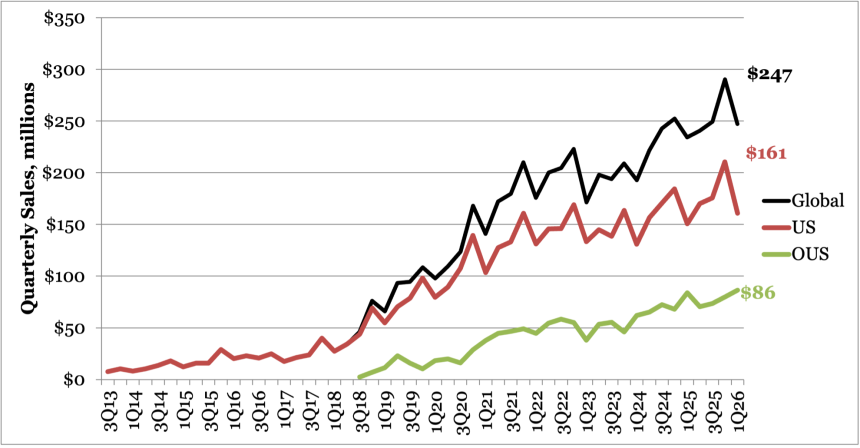
- Revenue totaled $247 million in 1Q26, up 6% from 1Q25 and down 15% sequentially, pretty typical seasonality. This represented the company’s strongest first quarter to date. Sequential revenue followed the company’s strongest quarter of all time, partially explaining declines.
- US revenue came in at $160 million, up 7% from 1Q25 and down 24% sequentially, contributing one hundred percent of Tandem’s growth. The revenue represented Tandem’s best US first quarter sales of all time, while still reflecting a $1 million headwind from the adoption of PayGo.
- OUS revenue totaled $86 million, up 3% from 1Q25 and up 8% sequentially, representing the highest international sales quarter in the company’s history. Look at this green line, and then think about what percentage of people in the US with diabetes are of the world’s people with diabetes – it’s clear how much upside there is!
- Tandem’s worldwide pump shipments totaled 29,000 in 1Q26, the company’s best first quarter performance to date. This rose 4% from 1Q25 and fell 24% sequentially in 4Q25, which was the company’s best-ever quarter with revenue of $290 million. Record US shipments accounted for 66% of new pump shipments (19,000), up 12% from 1Q25 and down 30% sequentially.
- In April 2026, Tandem received FDA approval for its Control-IQ+ algorithm for use during pregnancy for women with T1D. This marked a major regulatory milestone as the first commercially available AID system in the US for pregnancy in T1D. Management said today that the company is also awaiting CE Mark in Europe for this indication this quarter, 2Q26.
- Management continued its discussion of a structural transition to a pay-as-you-go (PayGo) model through the pharmacy channel in the US. Tandem said that it began executing contracts for the PayGo model in March, in which Tandem pumps will be distributed with $0 upfront cost and revenue will shift toward recurring pharmacy reimbursement. It has continued expanding contracts covering t:slim X2 and Mobi with an increase to 40% formulary coverage as of this call.
- Management also discussed key integration and expansion updates for t:slim X2 and Mobi, spanning international launches, operating systems, and CGM integrations. These updates are expected to provide tailwinds for the company.
Table of Contents
-
Financial Highlights
- 1. Worldwide 1Q26 revenue totals $247 million, up 6% with strongest international sales quarter to date ($86 million)
- 2. New pump shipments in 1Q26 total 29,000, a first quarter record
- 3. Gross margin of 55% with reductions to operating margin and an operating loss; $570 million in cash and cash equivalents from profitability improvement and debt refinancing
- 4. 2026 guidance of $1.065-1.085 billion (+5-7%) reaffirmed; 1Q26 guidance overperformed ($236-$240 million); 2Q26 guidance of $255 million
-
Control-IQ Highlights
- 1. Tandem has received FDA approval for Control-IQ+ in pregnancy with T1D, a first for the US
- 2. Pay-as-you-go model (PayGo) through the US pharmacy channel experiences expectedly slow uptake; expansion planned for 2026 with initial headwinds
- 3. Tandem’s direct sales in three European countries continue
-
Pipeline Highlights
- 1. G7 15 Day integration launched for t:slim plus Android compatibility for Mobi; international Mobi launch and FreeStyle Libre 3 Plus integration to follow
- 2. Hardware: Mobi Tubeless launch on track for 2H26 with significant market opportunity
- 3. Development continues on fully closed-loop system with FDA filing targeted for 2027
- Analysts’ Q&A
- Close Concerns’ Questions
Financial Highlights
1. Worldwide 1Q26 revenue totals $247 million, up 6% with strongest international sales quarter to date ($86 million)
Tandem Quarterly Revenue (2Q13 – 1Q26)
Source: Tandem, Close Concerns
Revenue totaled $247 million in 1Q26, up 6% from 1Q25 and down 15% sequentially. This represented the company’s strongest first quarter to date. Sequential revenue followed the company’s strongest quarter of all time, partially explaining declines. Management said that US sales were the primary driver of this growth.
- US revenue was $160 million, up 7% from 1Q25 but down 24% sequentially, contributing heavily to Tandem’s overall growth. The revenue represented Tandem’s best US first quarter sales of all time, while still reflecting a $1 million headwind from the adoption of PayGo. Pharmacy channel sales represented 6% of US sales, which management said was significant based on volumes.
- OUS revenue totaled $86 million, up 3% from 1Q25 and 8% sequentially, representing the highest international sales quarter in the company’s history. This was in part due to favorable currency dynamics, according to Ms. Vosseller. She also said that the company’s “go direct” strategy has been well-executed so far: direct channel sales increased to approximately 11% of total international sales compared to less than 5% historically. The sky is the limit – look at the green line below and the trajectory.
2. New pump shipments in 1Q26 total 29,000, a first quarter record
Tandem Quarterly Pump Shipments (2Q13 – 1Q26)
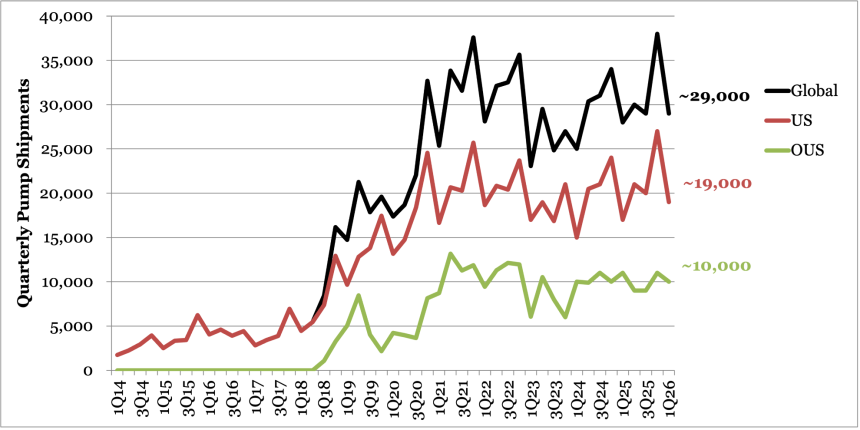
Tandem’s worldwide pump shipments totaled 29,000 in 1Q26, the company’s best first quarter performance to date. This rose 4% from 1Q25 and fell 24% sequentially in 4Q25, which was the company’s best-ever quarter. Record US shipments accounted for 66% of new pump shipments (19,000), up 12% from 1Q25 but down 30% sequentially. OUS shipments totaled 10,000 units, down 9% from 1Q25 and sequentially. The sequential declines were expected based on seasonal trends, no doubt.
- Over 50% of shipments were attributed to renewals, while new starts were predominantly people taking multiple daily injections. These starts represented two-thirds of new customers, consistent with previous quarters. During Q&A, management said that it expects Mobi Tubeless, when launched, to attract a significant customer base in line with broader market trends.
3. Gross margin of 55% with reductions to operating margin and an operating loss; $570 million in cash and cash equivalents from profitability improvement and debt refinancing
Tandem reported a non-GAAP gross margin of 55%, the highest first quarter margin in the company’s history. This represents a four-point increase from 1Q25 but a four-point decrease from 4Q25. Ms. Vosseller attributed the gross margin improvement to continued execution on pricing, discipline, and product cost improvements.
- Ms. Vosseller reported an operating margin of -7% (improved from -15% in 1Q25) and an operating loss of $17.4 million, returning to a loss after a positive operating income in 4Q25 of over $8 million. Operating expenses were $154 million in 1Q26. Investments in SG&A to expand the US sales force and prepare for global growth initiatives were offset by declines in R&D spending.
- Tandem ended 1Q26 with $570 million in cash, cash equivalents, and short-term investments. This is a substantial increase from $369 million in 1Q25 and $293 million in 4Q25. Tandem took on convertible debt financing in February 2026 that yielded net proceeds of $276 million with 0% interest; this was great to hear about, along with free cash flow generation of about $5 million.
4. 2026 guidance of $1.065-1.085 billion (+5-7%) reaffirmed; 1Q26 guidance overperformed ($236-$240 million); 2Q26 guidance of $255 million
Management reaffirmed its full-year 2026 revenue guidance of 5% to 7% growth, representing $1.065 billion-$1.085 billion in revenue. As previously announced, Tandem expects $730-$745 million in US revenue (+3-5%) and $335-340 million (+9-10%) in international revenue in 2026, which is certainly increasing as a percentage of global sales. We imagine growth is expected to continue to be driven by new technology, expanded geographic reach, and broader pharmacy access. Management has explained that the ongoing US transition to pharmacy distribution and a pay-as-you-go (PayGo) model will moderate revenue growth in 2026 because it eliminates the upfront revenue recognition associated with the DME channel. While the adoption of PayGo will likely create ~$75 million in pricing headwinds, it will certainly make it easier for many to afford pump therapy without the cost of major medical equipment.
Control-IQ Highlights
1. Tandem has received FDA approval for Control-IQ+ in pregnancy with T1D, a first for the US
In April 2026, Tandem received FDA clearance for its Control-IQ+ algorithm for use during pregnancy for women with T1D. The label expansion applies to both the t:slim X2 and Mobi pumps. This marked a major regulatory milestone as the first commercially available AID system in the US for pregnancy in T1D. Management said today that the company is also awaiting CE Mark in Europe for this indication this quarter, where Control-IQ+ would join Medtronic’s MiniMed 780G and CamDiab’s CamAPS FX as options for pregnancy in T1D. Tandem will host a product theater highlighting pregnancy management at ADA 2026, as well as training events for healthcare providers that have been launched.
- The approval follows the company’s 510(k) submission announced during Tandem’s 4Q25 call in mid-February of this year. The decision was supported by results from the CIRCUIT trial (n=88) from October 2025. Tandem plans to launch provider education for this indication beginning at ADA 2026.
- The CIRCUIT trial was a 14-site randomized controlled trial across Canada and Australia comparing the t:slim X2 pump with Control-IQ to standard care in pregnant women with T1D (n=88). From 16 weeks of gestation through delivery, participants using Control-IQ achieved a mean Time in Pregnancy Range (TIPR; 63-140 mg/dL) of 65% versus 50% with standard care, a 12.6% improvement equivalent to roughly three more hours per day in the pregnancy target range. Other findings include:
- Durable glycemic benefit: Glycemic improvements emerged within the first week after Control-IQ initiation with median TIPR rising from about 55% to nearly 70% and remaining durable through gestation with particularly strong overnight gains. By late pregnancy, TIPR approached 75%, which the authors indicated as a notable outcome especially given increased insulin resistance in the third trimester.
- Maternal outcomes: Beyond TIPR, Control-IQ users achieved lower A1c values (-0.5% at 24 weeks and -0.4% at 34 weeks from a baseline of 7.3%), lower total daily insulin requirements (about 28 units/day less), and numerically lower preeclampsia rates (14% versus 25%).
- Comparable safety outcomes: Safety outcomes were comparable, with one severe hypoglycemic event and two diabetic ketoacidosis (DKA) events in the Control-IQ group versus one instance of DKA and one postpartum severe hypoglycemia event in standard care. Neonatal outcomes were generally similar, though hyperbilirubinemia and NICU stays over 24 hours were modestly higher in the closed-loop group.
- The approval builds on Tandem’s continued expansion of Control-IQ+, which already supports people with T1D ages two and up along with adults with T2D. Management framed the pregnancy filing as one of several regulatory milestones expected to expand Control-IQ’s clinical impact.
2. Pay-as-you-go model (PayGo) through the US pharmacy channel experiences expectedly slow uptake; expansion planned for 2026 with initial headwinds
Management continued its discussion of a structural transition to a pay-as-you-go (PayGo) model through the pharmacy channel in the US. Tandem said that it began executing contracts for the PayGo model in March, in which Tandem pumps will be distributed with $0 upfront cost and revenue will shift toward recurring pharmacy reimbursement. It has continued expanding contracts covering t:slim X2 and Mobi with an increase to 40% formulary coverage as of this call. Management said that the company will continue working to improve efficiency and customer satisfaction by enhancing the pharmacy experience.
- Throughout March, adoption met Tandem’s expectations, with less than 5% of its customers ordering a pump through their pharmacy benefit. Less than 5% of the install base also purchased their supplies through this channel. Tandem said that first quarter sales faced an approximate $1 million headwind from the adoption of PayGo and expects impact to grow as the model expands. Management expressed confidence in achieving the company’s pharmacy access goals for the year.
- Management highlighted favorable long-term effects with the PayGo model, saying that pharmacy supply reimbursements can be over four times that of the DME channel, with payback achievable within “a handful of months.” Management suggested roughly $350 per month per customer initially while mentioning that the shift reduces patient out-of-pocket burden, removes large deductibles, and improves prescribing simplicity. These factors are expected to support stronger adoption and double the lifetime value of each customer to Tandem.
- Tandem already has contracts with the top three PBMs (about 80% of covered lives), though formulary access is currently available to about one-third of these individuals, with expansions ongoing.
- Approximately 20% of pump shipments are expected to go through Tandem’s PayGo model in 2026 overall. Tandem has previously noted that this shift will help to partially offset upfront revenue pressure as more users transition from DME to pharmacy reimbursement over time.
3. Tandem’s direct sales in three European countries continue
Mr. Sheridan again discussed Tandem’s direct commercial operations in Switzerland, the UK, and Austria that were launched in 1Q26. This marks Tandem’s first major step in its long-term international growth strategy and replaces distributor-led models with in-country sales and logistics. Management has previously noted that the shift required building local commercial infrastructure and hiring in-country teams, as well as coordinating distributor separations and implementing reimbursement systems.
- Management again framed these three markets as a blueprint for broader international expansion, with all lessons learned guiding Tandem’s future transitions to direct operations in additional markets in 2026 and 2027. These transitions are expected to deepen engagement and support improved pricing and margins.
- Looking ahead, Tandem expects to operate under a hybrid international structure, combining additional key European markets with select distributor partnerships and local market expertise.
Pipeline Highlights
1. G7 15 Day integration launched for t:slim plus Android compatibility for Mobi; international Mobi launch and FreeStyle Libre 3 Plus integration to follow
Management discussed key integration and expansion updates for t:slim X2 and Mobi, spanning international launches, operating systems, and CGM integrations. These updates are expected to provide tailwinds for the company. Mr. Sheridan said that all of these launches are designed to improve global accessibility by nature.
- As of March 2026, Tandem Mobi is available for use with Android smartphones in the US. During Q&A, management said that about 60% of its t:slim X2 users use iOS, with about 40% using Android. If this ratio holds for Mobi, this integration therefore represents a significant opportunity to expand Tandem’s userbase, particularly for switches from MDI.
- Management said that Tandem is preparing for the international launch of t:slim X2 integration with Abbott's FreeStyle Libre 3 Plus CGM. This will begin in select European countries in 2Q26 and scale to additional countries throughout the year. Tandem said that this will greatly expand access to the company’s Control-IQ technology.
- The commercial rollout of Tandem Mobi outside of the US will also begin in 2Q26. Tandem has also recently expanded its direct commercial operations in the UK, Switzerland, and Austria.
- t:slim X2 gained interoperabilitya with Dexcom’s 15-Day G7 sensor two days ago, with Mobi expected to follow in 1H26. Mr. Sheridan said that this will enable Tandem pumps to provide CGM data directly to the company’s Sugarmate app, and that future plans will integrate insulin data as well.
2. Hardware: Mobi Tubeless launch on track for 2H26 with significant market opportunity
Management reaffirmed plans to file a 510(k) in 2Q26 for the Mobi Tubeless patch pump with launch targeted for 2H26. This would mark Tandem’s entry into the patch pump category and the use of the term “tubeless” that has been associated with Insulet’s Omnipod 5 up to this point.
- Recall that Mobi Tubeless is designed to offer a new infusion site option for the existing Mobi pump. This will enable interchangeability between tubing and patch wear and allow for more personalization and flexibility without requiring users to switch platforms. Management positioned the offering as the first tubeless pump with extended wear technology – it will incorporate Tandem’s SteadiSet extended-wear infusion set technology, which supports seven-day wear duration and further advances pump wearability.
- In terms of commercial launch, management said that it would proceed gradually and that Tandem hopes for the tubeless pump to become available to patients this year. Management said that the broader tubed insulin pump market is growing at a low-single-digit rate compared to an about 20% growth rate for the tubeless market, which represents a significant opportunity for Tandem.
- On pricing, management said that it expects a significant portion of its current 325,000 customers to switch to the tubeless infusion set option. Ms. Vosseller said that Tandem has not formally announced pricing but that the new option will be similarly priced to the current Mobi supply.
- While unmentioned on today’s call, Tandem’s broader hardware pipeline includes a next-generation Mobi pump featuring further miniaturization derived from Sigi technology. This signals continued hardware refinement beyond the initial tubeless launch.
3. Development continues on fully closed-loop system with FDA filing targeted for 2027
Tandem reiterated its plans to continue work on a fully closed-loop AID algorithm with a pivotal study expected to launch later this year. No further detail was provided on today’s call, but the company has previously targeted a regulatory filing with the FDA in 2027. Tandem has had a longstanding partnership with the University of Virginia to work toward this goal. Tandem has previously said that the system will maintain compatibility with the CGMs that are currently compatible with t:slim X2 and Tandem Mobi.
Analysts’ Q&A
Q (Matt Miksic, Barclays): One of the other companies in the space talked about the market seasonality, and it sounded like some slowness. What are your perspective on that and on what you've seen? Could you also characterize the major drivers of the growth in the quarter, on whether it's uptake in T2D, or whether it's uptake through pharmacy, or whether it's new sensor integrations?
A (Mr. John Sheridan, CEO): Matt, I’ll just start off and talk about the market and whether it’s growing or not. I think it’s still large and very under-penetrated. It’s great to have T2D as a part of the market for us now. We’re excited about the fact that we’re bringing a great deal of new technology and business model changes that we believe will really help us grow new starts from MDI. If you look back in 2025, there is a number of pump companies in the market. They all did pretty well. I would say it appears to us that the market is growing.
As I said, we’re very excited about this year in particular, because we have so much technology and business model, you know, modifications are really going to position us for growth, this year and beyond. I’ll let Leigh answer some of the questions about seasonality.
A (Ms. Leigh Vosseller, CFO): Sure. I’ll just say that we didn’t see anything, I would say, unusual or different from what we typically see in the DME space starting off the year. Our pump shipments came in line with where we expected, which was about a 30% sequential decline in the U.S. from the fourth quarter. Nothing really to note there. Unfortunately or fortunately, the answer to your question about the major drivers is it really is a little bit of all of the above. We have a lot of things, as John suggested, working in our favor this year with our new product launches, our business model transformations, and I would say as we start to gain traction, everything’s coming together to drive us towards a very successful and strong growth year altogether.
Q (Chris Pasquale, Nephron Research): International pump revenue was up despite pump shipments in that segment being down. You talked about a couple of one-time items. Were those two things related and could you quantify the one-timers that you had this quarter, so we can think about the go-forward run rate?
A (Ms. Vosseller): Sure. You’re right, there were a lot of moving parts internationally, and it varies the answer depending on if you are comparing to last year, comparing to expectations, but I’ll touch on a few of those. When you look year-over-year, a significant part of the growth was coming from currency fluctuation, so there was favorability in the environment that helped that growth year-over-year. When you look at also last year, first quarter and second quarter, in the first quarter, it’s a little bit tougher comparison for us because last year there was a shift in timing of sales. It was more favorable, about $5 million in the first quarter versus the second quarter. As we go into Q2, it will be an easier comparison for us.
Within the quarter compared to when we set our guidance expectations, there were also a few moving parts, and one was just simply that we had estimated a headwind of approximately $5 million for going direct in certain international markets. We’re seeing a bit of a timing difference there. We’ve realized about $1 million of that, and we expect $3 million-$4 million to push into the second quarter. We did have some favorability in our Swiss market, just a one-time, I would say, accounting benefit that we had, which was largely offset by some of the infusion set noise that we saw as we’re managing through some of these shortages we’re seeing in the quarter.
I think that it’s a lot, but the underlying comment I should make is that overall, we’re very excited about the international operations. We still see strong demand in the market for our products, and in the markets where we’ve gone direct, we’re already hearing a very positive reception to us in the market as we’re closer now to the physicians and the patients.
Q (Matthew O’Brien, Piper Sandler): On Mobi, if you do get the approval late this year, is it fair to think that you don’t want to disrupt what’s typically a stronger DME part of the year, so a bigger launch next year in 2027 and no real disruption from launching Mobi? As people are expecting Mobi, I don’t want an air pocket in any of the quarters as people are waiting for that system.
A (Mr. Sheridan): Thanks, Matt. I think that when it comes to our submission, we’re on track to submit it this quarter. We also plan on getting clearance in the second half. There’s some uncertainty with the FDA, but they’ve been doing a really nice job lately in getting things done quickly. As you know, when it comes to guidance, we typically don’t include new products yet until they’re actually in the market.
When it does come, let’s just say we get the clearance in the second half, we have a phased commercialization process where we actually observe the product in small groups of people first, increase the size of the group of people using it, and then get to the point where we feel we’ve uncovered or found nothing that we would want to make sure that we fix before it actually gets into full commercial launch. This is just a practice that we’ve used from the very beginning. While we do an excellent job of testing these products, you really can’t find everything until you use it over time with large groups of people. We’ll go through that process, and that depends on the timing.
If we can get it to the market before the fourth quarter starts, we’d want to do that. We’ll have to wait and see when the actual approval or the clearance occurs.
Q (Mike Kratky, Leerink Partners): It looked like US sales through the pharmacy ticked down slightly from 7% in the fourth quarter to 6% in the first quarter. Can you talk about how that lined up with your expectations, what factors contributed to that, and what you’ve seen so far this quarter to support your confidence in the 15% for the year?
A (Ms. Vosseller): Sure. Great question. I think most importantly starting off, is you really can’t compare our pharmacy experience this year in 2026 to what we saw in 2025. It’s a whole different world with the change in the business model that we have going on. If, for example, last year our pharmacy contracts included reimbursement for the pump, that was a premium to even what we get in DME.
It’s a very different environment. As we came into this year, the first quarter, we’ve had two major work streams that we’re focused on. One is building up the coverage, we were pleased to be able to report that we’re already at approximately 40% formulary coverage. We expect that we can still increase that across the year as we look forward to the end of the year. The other piece of it was the operational piece, and that was implementing, you know, an end-to-end change in our workflows. It changed everything of how physicians prescribe, how we engage with the patients, how we process and fulfill orders. That’s what we’ve been focused on, the execution of that piece.
It really all started late in the first quarter in the last few weeks of it, and so we’re at the very early stages of it. So far, you know, we’re excited about the opportunity it presents. Nothing’s changed our conviction and our ability to grow and scale that across the year. We look forward to future quarters when actually we can report the headwinds that are coming from the volumes that we’re bringing through.
Q (Phil for David Roman, Goldman Sachs): We heard from a competitor yesterday that it sounds like everybody’s acting rationally or fairly on pricing. How have negotiations around pricing gone so far, and what is baked into that $350 number expectation for the year? What level of conservatism is in there?
A (Ms. Vosseller): Sure. Happy to talk about that. I would agree. I would say that we’re all behaving rationally when it comes to pricing. We’re excited to be in this market and take advantage of the pricing opportunity that was already set in the pharmacy channel for insulin pump products. When we thought about how to set expectations for the year, I would call them more modeling assumptions right now because it is new for us, and it’s an early experience. What we said was to expect about $350 per month per patient as they order supplies. What’s factored into that would be there’s an array of contracts that were entered into with varying rebate structures in them. At this point, we don’t have enough experience to say what that mix will look like on a sustainable basis.
That’s the baseline that we’ve set for now. It’s still the right way to think about it. As we start delivering on more volumes and gain more traction and experience, we’ll be able to update those assumptions in the future.
Q (Ravi for Richard Newitter, Truist Securities): First, on the infusion sets shortage, would you mind quantifying that and suggesting what the impact might be in 2Q26? Second, on the sales force expansion, there seems to be a theme now running across your peers and with Tandem now itself. What is the opportunity that the sales force is going to be going after and what patient population it can unlock?
A (Mr. Sheridan): Let me just talk about the situation with infusion sets, and Leigh can talk about guidance. First of all, I’ll say that it’s unfortunate, our supplier has had some capacity challenges that actually began in the fourth quarter but continue to pressure us in the first quarter. This is both in the U.S. and internationally. We’ve been working very closely with them. I think we practically have daily calls with them, the operational team as well as the executive team. It’s a top priority for us. I would say that when you actually look at the impact, it’s only a small number of SKUs that are really subject to the capacity shortages.
The unfortunate part about it is for those people who are impacted and the HCPs who support them, it’s really significant. We’re doing everything we can to be creative. We’re looking for options in terms of lengths, colors, you name it, to see if we can provide intermediate solutions until this is taken care of. We’re also looking at managing inventory to do everything we can to provide as broad a coverage as possible. I will say, unfortunately, that this is something that probably won’t be resolved for a quarter or 2. I think we expect to see some progress in the second half of the year. That’s what we’re dealing with right now. Like I said, we’re taking it very seriously.
A (Ms. Vosseller): From the perspective of the impact, all we’re sharing is that it was a modest impact in the quarter, both U.S. and internationally. We factored that same level of impact as we set the expectations for the second quarter. As John said, we’re managing it very closely. We’re working through it. We see a line of sight to the end of this in the long term.
Q (Jeff Johnson, Baird): Leigh, I’ll follow up on the comment you made there on the infusion set impact. I know you’re not quantifying it, but let me go after it this way. Supplies missed our model by about $11 million this quarter, and very well could be that we’re bad modelers. I’ve been told that before. If our model missed or if you missed our model by $11 million, does a lot of that get attributed to the shortfall? I’m trying to understand, does the year-over-year impact stay the same in Q2 as it was in Q1? Am I anywhere near ballpark based on my model points?
A (Ms. Vosseller): I would say that that is a bit on the high side for the impact of this. I would put it more modest than that. If you think about it, there’s 2 ways to think about the size of this. First of all, there is backorder situation, but also to John’s point, some of the ways we’re helping to solve the problem for patients is offering an alternative. Just because we had some backorder situations doesn’t mean that we haven’t recovered sales in other ways, in order to satisfy patient needs. It’s not near that big. It’s something that we expect to be a bit disruptive again in the 2nd quarter, but it’s something that we can work through.
We’ll continue to talk more and, you know, maybe more about the modeling assumptions in the supply sales, maybe it’s a little bit of price or other pieces of it that are not working there.
Q (Matthew Taylor, Jeffries): First, on your clearance for T1D pregnant woman, can you frame the size of that opportunity and how incremental that could be? On adding Android capability, is there any analog we can look at for thinking how that adds any incremental growth through coming quarters?
A (Mr. Sheridan): First of all, we’re very excited to have received pregnancy clearance actually just a few days ago. It was based on data from CIRCUIT trial that was published in JAMA recently. I’m happy to say we’re the first and only AID system approved for pregnancy in the U.S. for both Mobi and t:slim using Control-IQ. We also expect CE mark here this quarter. If you look at the clinical data, the control group, the Control-IQ group experienced a 12.5% improvement time in a tighter range of 63 to 140 milligrams per deciliter. That’s about 3 more hours a day. It was for the length of the pregnancy, really substantial improvement and a great performance by the system.
When it comes to the size, I would say that it’s obviously pregnant women, but it’s also women considering pregnancy. It’s not a really large group of people. I don’t think I can put a number on it at this point in time, but it’s a meaningful and important group of people, and we’re very happy to have this. We’re now in the midst of kicking off training and events for HCPs. As I think I mentioned in the remarks that we do plan to have a symposium at the ADA.
Just real quickly, relative to Android, we have a number of people that we monitor who use Android and iOS applications on our mobile apps on t:slim. I would say roughly 60% of those use iOS. Android represents a big opportunity for us. I have friends who use our product and have been waiting for Android to become available. it’s meaningful. It’s another great opportunity for us to just drive MDI growth in 2026 and beyond. It’s a meaningful addition to the portfolio.
Q (Joanna Wuensch, Citi): With Mobi being submitted in the 2Q to the FDA and on track for 2H approval, and assuming there’s nothing in your guidance for it, how do we think about kicking off 2027 launching that product, and how are you preparing for it?
A (Mr. Sheridan): For launching the product, as I mentioned, we have a phased commercial process to release it. We’re hoping that we actually get it on the market, this year. I think that when it comes, we’ll have to see what the timing looks like. When you think about, when you think about the market today, there really is a tube market and a tubeless market. The tube market is growing at maybe single digits, low single digits, whereas the tubeless market is growing in double digits, you know, in the 20% range. A significant opportunity. I think that when you look at the competition that’s out there today, we’re in the pharmacy now.
We’re going to have a tubeless device, and I would say we feel like we have a better algorithm. I think that there’s a big opportunity for us to do two things. One, I think we’re going to drive MDI conversions to our device. At the same time, I think there’s potential for competitive conversions. I think that’s, unless you wanted to add anything to that, Leigh, but that’s pretty much what I would describe. It’s a big opportunity for us. We recognize that, and we’re really excited about it.
Q (Suraj Kalia, Oppenheimer): To Joanne’s question, John, how would you define the low-hanging fruit for 7-day Mobi? Would there be a price differential? Leigh, U.S. sales were up 5%, pump units up were roughly 12%, and then, there’s a 6% PBM contribution. Can you help us thread the needle here?
A (Mr. Sheridan): The financial benefits, Suraj, is the fact that the infusion plate lasts 7 days, whereas an infusion set lasts 3 today. There’s a margin benefit from having that extended time. It’s also a substantial customer experience improvement in that they don’t have to change the product as frequently. I think that it all this stuff adds up, and we’re doing everything we can to get gross margin up, this is certainly a help in that. The real benefit here is customer experience, and that’s where our focus is.
A (Ms. Vosseller): To your question on the first quarter in the U.S. When you look at pump shipments, you’re seeing it on a rounded basis. The actual growth rate was 10%, so the spread between the growth rate on shipments and the sales growth is not as substantial as it might seem on the surface. It really is just pricing that’s the differential.
Q (Barry Biegelson, Wells Fargo): Leigh, by my math, it looks like new starts were down slightly year-over-year in Q1 and down modestly sequentially by our math. Is that right? Do you still expect new starts in the U.S. to grow in 2026?
A (Ms. Vosseller): Yes, new starts, your math is accurate when we look at it year over year and even down sequentially, mostly due to just the regular seasonal impact that we see. This was how we had structured the year in terms of our own modeling assumptions, that we would continue to see that slight decline in the first quarter, but we would return to growth as we look ahead. We are very convicted in the ability to return to growth because we’ve been seeing improvement over the last few quarters from our low middle of last year. It’s really the traction we’re seeing on our new product launches. We look forward to pharmacy making a real difference there too.
Now that we’ve removed that cost barrier, more and more people can move to pump therapy without having to worry about an upfront cost. As we continue to build on that initiative and drive these new product launches, we do expect to see that return to growth this year.
Q (Michael Polark, Wolfe Research): I’m interested in learning about the process to convert someone in the base to pick up supplies at pharmacy. I get the incentive for a new user with no upfront, but for that compliant happy user through DME, how do you get them to the pharmacy? What does the outreach from you to them look like? What does the outreach from you to a physician look like? Can you remind me for the, on the financial incentive, how different is patient out-of-pocket for supplies only in the DME versus pharmacy?
A (Ms. Vosseller): I’m glad you asked. It’s a really good question because I think there might be an assumption that it would be easy just to move people over. There is work involved to that point. First and foremost, when a customer comes in, to place their quarterly order, which is usually quarterly, I should highlight, mostly not monthly. We will check their benefits to see if we have coverage for them on formulary. We’ll share with them the out-of-pocket benefits, and that’s the true motivator for them is, the out-of-pocket is typically lower or with copay assistance, we can make it be lower, if nothing else. Once we get them understanding and ready to move forward, it does require a new prescription.
That requires reaching out to the physician to get them involved, to have them write the prescription. Getting their attention and time to focus on that. In some cases, they want to focus on customers who haven’t yet moved to pump therapy. It’s a process. That’s something that we’re working on, and it is one of the key drivers as we look ahead to really maximize this pharmacy opportunity. It’s not only bringing more patients to Tandem, but it is converting that existing base we have. If you think about, you know, the multiples you see if you could easily move 300,000 people and get that price benefit, that makes a significant difference on our revenue growth and our margins. It is one of the activities we’re very much focused on.
Q (Priya Sachdeva, UBS): Really nice to see the cash flow generation in the quarter, which has typically been a heavy cash burn quarter for you guys, would love to maybe hear about what changed this quarter and how sustainable is this level of cash generation going forward?
A (Ms. Vosseller): A lot of this comes from the cost discipline that we have. While we’re focused on growing revenue, we’re also equally focused on driving improved margins. This year we demonstrated a 1% positive EBITDA in the first quarter, and I believe that’s the first time we’ve done that since 2022. To your point, Q1 is a tougher quarter because of the seasonal dynamics in our business. It’s really meaningful to us that we were able to show positive EBITDA and this cash flow generation. I appreciate that you noticed that.
Q (Elaine for Jason Bedford, Raymond James and Associates): You gave us guidance for 2Q and 4Q, and we can get to an implied 3Q. Why would it stay relatively flat for the first 3 quarters, at least according to my math? When we think about the year-over-year expansion, how much of it is driven by Mobi scaling versus the pharma transition?
A (Ms. Vosseller): It’s a great question. First, I’ll start with the Q1 to Q2 being relatively flat. A little bit of that is really just product mix. When you look at where revenue will go from Q1 to Q2, both U.S. and internationally, more of that step up is coming from supplies. Globally, even though supplies are going to have a better gross margin eventually in the U.S. with our new reimbursement model in pharmacy, today, supplies will still have a lower gross margin than pumps. It’s really just reflective of the product mix going into the second quarter.
Then, it should start to step up from there, scaling towards that 60% in the fourth quarter, and that will come from our pricing benefit that we expect, both with our direct operations outside the U.S. continuing to build and with the pharmacy benefit that can come from converting more customer in the supply base to pharmacy in the U.S. I would say this year price will be a very prominent driver of gross margin, but we are continuing to see benefit from Mobi as it’s scaling in volumes. For pumps, we started seeing that benefit in 2025 as we were building more. For supplies with Mobi, we’re really going to start to see that difference this year. That will be a contributor to the gross margin improvement across the year.
Q (Jon Block, Stifel): When I look at that international pump ASP, the actual ASP seemed to step up really nicely from recent quarters. Leigh, any color, how much is FX? How much is the direct transition? Does this even trend higher from the current 1Q result as the business percent that is direct continues to increase? Most importantly, any way to think about, call, exit 26 pump ASP, as we head into the following year?
A (Ms. Vosseller): I will start by saying the assumption that we’ve made in guidance for the year is that pump ASPs outside the U.S. with these changes with going direct should land somewhere in the $2,800-$2,900 range. We did see, I’m going to say say, extra benefit in the 1st quarter because of this 1-time accounting benefit we got in the Switzerland market. We were able to recognize a level of revenue there because of the acquisition of certain customer rental contracts that were already in existence from our distributor. This 1-time benefit is what really drove the incremental pump ASP in the 1st quarter. Otherwise, it should settle into that $2,800-$2,900 range for the rest of the year.
Q (Anthony Petrone, Mizuho): On the US side, a competitor had a recall announcement. FDA came out in April and reported more adverse events on one of the primary competitors. What is the chatter out there? Is that creating any opportunities just for share capture, as you look to Mobi or even otherwise? On the competitive dynamics in the quarter, in terms of the follow-up on spend as you get ready for the Mobi launch, just thinking a little bit on the DTC is there a big DTC campaign that’s planned around Mobi Tubeless?
A (Mr. Sheridan): Regarding recalls, you know, it’s unfortunate, but that’s one of the things that happens in this marketplace. The real intent of the recall is to ensure that the diabetes community is aware of safety issues that might impact the use of their products. I would say it’s something that happens to everybody. When we have it happen, we do our very best to ensure that patients are safe, and they understand the risks. I don’t think there’s no benefit that’s going to come from that. You don’t like to see it happen, but you recognize that it’s part of dealing in a market that has life-saving technology. When it comes to competition in general, I would just say it’s a large and expanding under-penetrated market with new entrants. I would say Q1 was consistent with our expectations. It’s a very highly competitive market, but there’s nothing really that specific to point to that changed. I’ll also say that, you know, we are very confident in our ability to deliver new technology to the market. The team has done an amazing job in the last several quarters, and we continue to do it this quarter and in the second half of this year.
It’s going to really impact the business when it comes competitively. As well as we’re now moving to the pharmacy benefit where the out-of-pocket is substantially lower, and that’s going to be a big benefit. We feel very good about where we’re heading competitively, but specifically to the marketplace today, I don’t think that It’s very competitive, yeah, but nothing’s really changed.
Q (Mathew Blackman, TD Cowen): Leigh, I heard you say 40% formulary coverage to date. Could you frame that relative to your expectations where you hope to exit the year? Is the next whatever percent, let’s call it 60%, a heavier lift?
A (Ms. Vosseller): Happy to put some context around that. I think what’s important to understand is typically, new formulary additions happen on a January 1st or July 1st cycle. We’re very excited that we’ve been able to add this coverage across the quarter, so we’re a bit off cycle here. I mean, it shows, first of all, the receptivity to us moving to this PayGo reimbursement model and then also the acceptance of our products within the channel. The team isn’t stopping. I mean, I feel like when I look at my email, I see announcements every week that show another formulary addition, some bigger than and smaller than others. The team is working hard and working to drive that up across the year.
In order to achieve our goals for pharmacy this year, we’re right on pace with where we need to be. I’m not going to share a specific goal, but I think we’re very well-positioned to drive the pharmacy access in order to hit the targets that we’ve set out.
Q (Zack for Bill Plovanic, Canaccord Genuity): As for the T2D ramp, can you give more context as to how that’s going? You’ve talked about in the past difficulties you had with the C-peptide testing requirements. Can you just give us an update on what’s happening there?
A (Mr. Sheridan): Sure, first of all, we’re really excited about T2D. It’s a big opportunity not unlike, it’s even less penetrated than the T1D market U.S. internationally. Really our focus is on market development at this point in time. I’m not going to talk specifically about numbers today. We really want to see sustained trends before we report numbers. That’s we’re going to wait a little while it’s early for us. That being said, there’s many positive sources of growth that are happening right now in type 2 in the near future. We expect tailwinds from FreeStyle Libre 3, from Mobi Android, Mobi Tubeless Pharmacy. Those are all great.
We do anticipate positive news from Medicare access, and we think they’re going to get rid of the C-peptide requirement, but we’ll have to wait and see. As far as the company goes, right now we’re focused on just creating awareness clinically and on the product benefits. Big market, under-penetrated. We’ve got a lot of positive things going on. We’re excited about it, and we do anticipate seeing growth in T2D starts, MDI starts this year.
Q (Travis Steed, BofA): As you’re moving the PayGo into the pharmacy, how’s the trend? From the 40% coverage that you got, how much of that is tier 1 at this stage?
A (Mr. Sheridan): Sure. I’ll answer the first part of the question, Travis. I mean, first of all, you know, our early experience really does reinforce our conviction that this is a great opportunity for us, for the business and for our customers. We’re moving forward aggressively. It’s our top priority. As Lee mentioned, when operationalizing pharmacy, there’s a lot going on there. It’s a change to the physicians’ processes, the way we service our customers and how we process and fulfill orders. I would say that, you know, right now we’re working to improve the experience. There’s certainly some behavioral change that we have to work with. There’s learning curve, there’s efficiency opportunities. These are things that we’re very focused on right now.
I’ll say we have a strong team. We’re making good progress. I think, you know, it starts off slow and will gradually increase as we get through the year. Again, this will be a meaningful part of our business certainly by the end of this year and as we move into 2027.
A (Ms. Vosseller): Just a quick comment on your question about tiering. We have a variety of our contracts where we are on different tiers, and the real difference that it makes to us at least is the amount of rebate that you pay in the various tiers and then what the influence that that has on the patient’s out-of-pocket and the amount of co-pay assistance that we might have to use. We are not sharing any breakdown of any of our contracts in particular, we are on tier 1 in some, tier 2 in some, tier 3 in some. It does vary across the board.
Q (Shagun Singh, RBC Capital Markets): On Mobi Tubeless, how do you think about the mix between the different products that you will be selling with Mobi Tubeless coming on board? How we should think about pricing? How do you expect to compete with the current patch pump form factor, more from MDIs or competitive share gains? Anything you can share on the go-to-market strategy that you haven’t already discussed?
A (Mr. Sheridan): Well, Shagun, the first thing I think that’s important here is that, we already have 325,000 customers in the U.S. A significant portion of those use the pump today already, this is an infusion set option for them to choose. We think, there’s probably going to be pretty good conversion amongst those people. I think people are going to try it out first, try both ways out and see what they like. The other aspect is certainly when it comes to new starts, now that we have a tubeless product in the market, we expect to see, we’re going to benefit from the fact that tubeless is very important to people.
It’s a form factor that they want, and we expect to see a lot of progress there. Leigh, you want to add anything to that?
A (Ms. Vosseller): Just to your question on pricing, to John’s point, being the Mobi pump, it’s the same pump hardware regardless of which infusion set they choose. When it comes to pricing, we haven’t really discussed our approach yet, for now, you can think about it as being similarly priced to Mobi supplies.
A (Mr. Sheridan): Yeah, it’s a supply pricing issue. It’s the same pump. Obviously same price for the pump.
Close Concerns’ Questions
- What does Tandem expect in terms of uptake of its technology among pregnant patients with T1D?
- Does Tandem expect international sales to continue to grow with its direct model on the continent?
- How does management expect customer retention to change under the pharmacy model?
- How will expanded CGM interoperability such as the recent Dexcom G7 15-Day announcement influence prescribing from clinicians?
- How is Tandem approaching the T2D market, which was not greatly discussed during today’s call?
-- by Nour Khachemoune, Jeremy Alkire, and Kelly Close