Dexcom Investor Day highlights long-range growth strategy: G8 launch expected by 2028, international reimbursement expansion accelerates, and focus on supporting T2D –
Executive Highlights
- Dexcom hosted its Investor Day today in Tempe, Arizona (see webcast and presentation), providing a broad update on the company’s long-term strategy across CGM innovation, international expansion, and future biosensing applications. CEO Mr. Jake Leach led the event and was joined by CFO Mr. Jereme Sylvain and COO Mr. Jon Coleman as well as a whole slew of investors and other stakeholders that made their way to Tempe[1].
- Management reiterated confidence in sustaining durable double-digit growth over the remainder of the decade, supported by continued penetration of intensive insulin users as well as further expansion into basal-only insulin users, non-insulin-using T2D, prediabetes, and health and wellness markets with its over-the-counter (OTC) CGM Stelo. Mr. Sylvain outlined Dexcom’s expectation for at least 10% annual organic revenue growth through 2030 alongside gross margin expansion into the high-60% range, driven in part by manufacturing efficiencies and transition toward longer-wear sensors, including G7 15 Day and future G8 systems. Clearly, economies of scale are working and this transition, we must say, with “longer day wear” being tested has gone, if not picture-perfectly (while complaints about quality are very real, this is forever away from BGM for so many), pretty darn well (see more comments at our endnote[i]).
- A major focus of the Phoenix gathering was to educate investors and stakeholders on Dexcom’s push into broader T2D populations. Mr. Leach emphasized that this market is substantially underpenetrated, despite growing evidence highlighting its value. Dexcom also highlighted its CONNECT randomized controlled trial, which evaluated CGM use in people with T2D not using insulin. The trial will be read out in just a few weeks at ADA 2026. Management also reiterated expectations that Medicare coverage for non-insulin T2D could take effect in 2027, which Mr. Sylvain described as one of the largest opportunities embedded in Dexcom’s long-term growth assumptions.
- International expansion represented another major theme throughout the event. Undoubtedly, this is exciting – everyone wants everyone to have access to CGM. Mr. Leach and Mr. Sylvain discussed Dexcom’s increasingly segmented global portfolio strategy, introducing Dexcom Flex as a sensor primarily intended for people with T2D not on intensive insulin therapy in cost-sensitive markets. Meanwhile, Stelo is expected to continue targeting wellness and prevention-oriented populations as it launches in new markets outside the US. Dexcom’s G-series portfolio, including G7 and future G8 platforms, will remain focused on intensive diabetes-management populations requiring advanced AID integration and alerts. We hope to continue to hear more on people with plain old straight up T1D who do not have CGM and could surely benefit – while penetration keeps getting stronger in this population, there are many that still have clinicians who do not believe in it or support it (truly) and of course, it goes without saying that given that there are many people with diabetes who cannot even afford BGM, there are far more that can’t afford CGM – access has improved and there are still so very many factors (even just “hassle factors”) for the vulnerable. That said, the company is on it and we were impressed to hear more plans about reaching the underserved people with T1D and T2D on insulin or SUs who do not have CGM.
- On the R&D front, Dexcom also provided meaningful updates on its future sensing roadmap. Mr. Leach said the company expects to submit Dexcom G8 to the FDA next year, with a launch anticipated in late 2027 or early 2028. The initial G8 launch will focus on adaptive sensing designed to improve reliability and reduce physiologic variability, while future iterations are expected to incorporate multi-analyte sensing, including continuous ketone and potassium monitoring to better support those with diabetes and chronic kidney disease or cardiovascular disease. Many, of course, do not have CKD and want to avoid it and want to avoid potential euglycemic DKA that can come alongside use of SGLT-2 inhibitors – we look so forward to the time when we can understand what this improved healthcare will look like, when people with T1D have access to safe combination therapy (for those with T2D not on insulin, SGLT-2 inhibitors are very safe to take as they are glycemic-dependent – this is not the case for those on insulin or taking SUs or for anyone with T1D who opts to take an SGLT inhibitor off-label).
Table of Contents
-
Top Highlights
- 1. CEO Mr. Jake Leach outlines Dexcom’s next growth phase, focused on broader CGM access, scalable infrastructure, and customer-focused innovation
- 2. Broadening CGM adoption in T2D: Dexcom targets basal insulin, non-insulin T2D, and prediabetes populations through new clinical evidence and software tool.
- 3. International growth strategy accelerates: Dexcom Flex, Stelo expansion, and broader reimbursement efforts
- 4. Management projects durable ≥10% annual revenue growth through 2030 alongside margin expansion driven by 15-day product conversions and manufacturing efficiency
- 5. Dexcom details future G8 platform and adaptive sensing roadmap
- 6. Stelo app update expected to roll out in 2Q26
- 7. Looking beyond diabetes: Dexcom explores new frontiers in inpatient CGM use and chronic disease management
- Analyst Q&A
- Close Concerns’ Questions
Top Highlights
1. CEO Mr. Jake Leach outlines Dexcom’s next growth phase, focused on broader CGM access, scalable infrastructure, and customer-focused innovation
CEO Mr. Jake Leach opened Dexcom’s Investor Day by framing the company’s next phase of growth around three priorities: (i) broadening access to CGM; (ii) building scalable global infrastructure; and (iii) improving the user experience through software, connectivity, and automation. Mr. Leach positioned the company as more than a hardware manufacturer, instead framing Dexcom as a long-term data and biosensing platform capable of supporting people across the continuum of metabolic health. He repeatedly returned to the idea that reducing friction, whether through simplified onboarding, lower cost, improved reimbursement, or more automated insights, will be essential to expanding CGM adoption beyond intensive insulin users.
- Mr. Leach described significant progress in scaling Dexcom’s manufacturing and commercial infrastructure to support this growth. He pointed to ongoing investments in manufacturing automation, global supply chain expansion, and AI-enabled operational efficiency as foundational to supporting future growth, margin expansion, and broader access. CFO Mr. Jereme Sylvain similarly said that manufacturing scale, product transitions, and infrastructure investments will remain key drivers of Dexcom’s long-term growth, particularly as the company transitions users toward G7 15 Day and future G8 systems.
- Management also reiterated confidence in sustaining durable double-digit revenue growth over the remainder of the decade, supported by continued penetration in intensive insulin users as well as expansion into basal insulin, non-insulin T2D, prediabetes, and additional over-the-counter (OTC) biosensing markets.
- Mr. Leach said that future innovation will combine sensing hardware with software-enabled personalization to a greater degree. He highlighted Smart Basal, Smart Bolus, and AI-supported decision-support tools as examples of products intended to simplify diabetes management for both clinicians and users. During Q&A, he said many people eligible for CGM continue to leave physician visits without prescriptions, underscoring that future growth may depend as much on reducing onboarding complexity and workflow friction as on expanding reimbursement.Management positioned usability, streamlined onboarding, and software-guided automation as key levers to help move CGM into larger patient populations.
2. Broadening CGM adoption in T2D: Dexcom targets basal insulin, non-insulin T2D, and prediabetes populations through new clinical evidence and software tool.
Dexcom devoted substantial attention to how it will promote CGM adoption beyond those on intensive insulin therapy and into the broader T2D population, particularly among basal insulin users, people not using insulin, and those with prediabetes. Mr. Leach described these groups as a major long-term growth opportunity and repeatedly emphasized that CGM remains significantly underpenetrated despite growing evidence supporting its clinical value.
- In Q&A, Mr. Leach said that basal insulin users are an area where Dexcom believes CGM can meaningfully improve therapy engagement and persistence. He said that many individuals initiating basal insulin today experience limited glycemic improvement and can be frustrated with therapy escalation, creating an opportunity for CGM to support more informed treatment decisions and sustained engagement. According to Mr. Leach, basal insulin users already represent the largest portion of Dexcom’s new T2D customers in the US despite current limited coverage. Dexcom had previously expanded its US sales force by 40% to better call on primary care providers in anticipation of a “wave” of T2D patients initiating CGM; since then, its share within PCPs and basal-only T2D has increased, and this strong foundation will support further penetration as coverage continues to expand.
- Management also detailed its expectations for future Medicare expansion for non-insulin T2D. Mr. Leach said that Dexcom expects CMS coverage to materialize in 2027 and characterized the timing as a matter of “when,” rather than “if.” Mr. Sylvain described this anticipated coverage expansion as one of the largest opportunities embedded within Dexcom’s long-range growth assumptions.
- Dexcom also highlighted the upcoming readout of the CONNECT randomized controlled trial, which evaluated CGM use in people with T2D not using insulin. The study is expected to be presented in just a few weeks at ADA 2026, on Saturday, June 6 oral presentation at 1:45 pm CT. Mr. Leach said that Dexcom enrolled participants across a wide spectrum of T2D management, including individuals using oral medications and some not taking glucose-lowering medications at all. Management suggested these data may help support future payer discussions and continued expansion of CGM beyond intensive insulin populations.
- Prediabetes and diabetes prevention also emerged as important longer-term opportunities. Mr. Sylvain discussed Dexcom’s belief that CGM may eventually become part of routine preventive care and metabolic screening, while Mr. Leach referenced ongoing work evaluating CGM use in areas such as gestational diabetes and earlier metabolic risk identification.
3. International growth strategy accelerates: Dexcom Flex, Stelo expansion, and broader reimbursement efforts
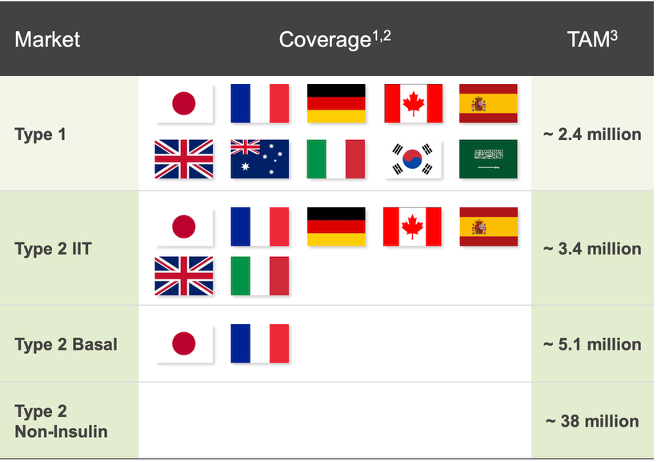
Leadership repeatedly pointed to international expansion as a key contributor to future growth, stressing that most people with diabetes live outside the US and that CGM penetration remains comparatively low across many global markets. Mr. Leach described international growth as one of Dexcom’s core strategic priorities and said the company is increasingly applying lessons learned from the US market internationally.
Source: Dexcom Investor Day Presentation
- A major focus of the discussion was on Dexcom’s expanding international product portfolio. During Q&A, Mr. Leach explained that Dexcom Flex is primarily being positioned for people with T2D not using intensive insulin therapy, offering a lower-cost and simpler CGM experience intended to support broader reimbursement and adoption in international markets. He suggested that Flex may be particularly important in regions where cost sensitivity and reimbursement differ substantially from the US. Dexcom has already initiated a limited rollout of Flex in Germany for basal-only and non-insulin-using T2D, with a full rollout expected in the country soon and additional markets coming soon thereafter.
- Meanwhile, Stelo will largely target health, wellness, and prevention-oriented populations outside the US. Dexcom announced that it will launch Stelo in South Korea, New Zealand, Australia, and the UK in late 2026 or early 2027. Dexcom’s G-series portfolio, including G7, Dexcom ONE+, and future G8 systems, will remain focused on more intensive diabetes-management populations. Mr. Leach identified three large markets that it plans to enter in the next two years, whose total intensive insulin-using population exceeds 15 million people: India (Dexcom spoke extensively on its launch plans here at DTechCon last week), Brazil, and Mexico.
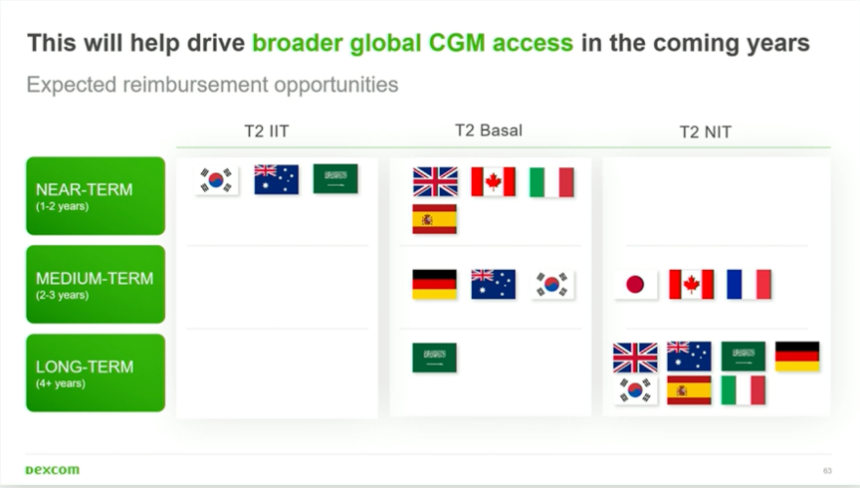
- Mr. Sylvain said that Dexcom has intentionally increased investment in international infrastructure, sales support, and reimbursement efforts in anticipation of broader global adoption. The company shared that recently unlocked markets have already shown encouraging uptake following reimbursement expansion, pointing specifically to recent access wins in France and Canada (2025).Management suggested these launches reinforce the degree to which reimbursement remains one of the primary gating factors for CGM adoption internationally.
- Mr. Leach also acknowledged that reimbursement timing internationally remains difficult to predict precisely, though he expressed confidence that access expansion will continue steadily over time (see below). He said that Dexcom consistently sees meaningful adoption increases following reimbursement wins and suggested that international growth may increasingly contribute to overall company performance over the long-range plan.
Source: Dexcom Investor Day Presentation
4. Management projects durable ≥10% annual revenue growth through 2030 alongside margin expansion driven by 15-day product conversions and manufacturing efficiency
Mr. Sylvain outlined Dexcom’s capital allocation strategy and long-term growth outlook.
- Specifically, Dexcom expects to deliver at least 10% organic annual revenue growth through 2030, driven by several catalysts:
- New product launches and market expansion. This includes the global launch of Dexcom Flex; launches of Dexcom G8 in the US and internationally; international expansion of G7 15 Day and the 15-day version of Dexcom ONE+; and Stelo launches in international markets and growth in the US – Mr. Sylvain said this product has enormous potential for the hundreds of millions of people globally with prediabetes.
- Coverage expansion. Dexcom expects the number of people with CGM coverage globally to more than double by 2030, from roughly 23 million to approximately 52 million across the US and the top 10 international markets alone. Mr. Sylvain added that coverage expansion is likely to outpace actual CGM adoption, leaving substantial runway for future growth.
- Improved retention and utilization. While Mr. Sylvain did not provide specific retention targets, he said that Dexcom’s investments in AI-driven engagement tools and customer service improvements are expected to support higher retention rates over time.
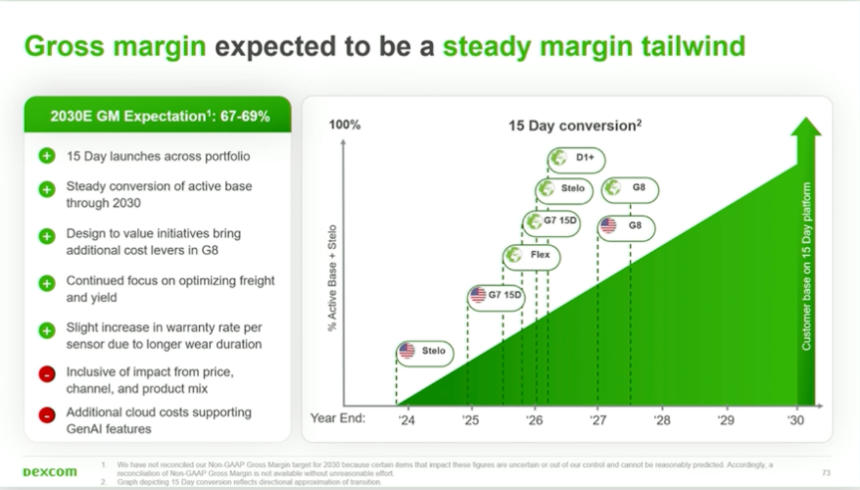
On profitability, Mr. Sylvain said he expects gross margin to expand to the “high 60s percent” range by 2030, up from the 63%-64% guided for 2026, as 15-day products become the core of the portfolio (see below for Dexcom’s estimated conversion timeline to 15-day products). He also noted that Dexcom G8 is expected to further reduce manufacturing costs by approximately 10% versus G7, despite its technological upgrades – we’re curious to see if some of this cost reduction or economies of scale will result in greater benefits for patients or systems. We were glad to hear, of course, that Dexcom plans to continue optimizing freight and reducing scrap to further realize economies of scale, thereby providing yet another way to expand gross margins.
Source: Dexcom Investor Day Presentation
- On operating expenses, Mr. Sylvain said Dexcom will continue prioritizing R&D investment to promote its broad innovative pipeline. R&D expense is expected to represent 12-12.5% of revenue in 2030, only modestly below the approximately 13% in 2025. Dexcom also expects to maintain similar investment levels in sales and marketing (~16% of revenue) and G&A (10-10.5% versus 11.5% in 2025). Mr. Sylvain added that existing G7 manufacturing lines can also produce G8, reducing incremental capital requirements for next-generation sensor launches.
- Beyond patient-facing software applications, Mr. Sylvain briefly discussed AI’s role in improving internal efficiency, noting that AI-related use cases saved approximately 750,000 worker hours in 2025.
- Beyond investing in organic growth initiatives and tuck-in M&A, Mr. Sylvain reiterated Dexcom’s commitment to share repurchases through 2030. Dexcom has authorized a $1 billion share repurchase program and expects to allocate at least half of its annual free cash flow toward repurchases through the end of the decade.
5. Dexcom details future G8 platform and adaptive sensing roadmap
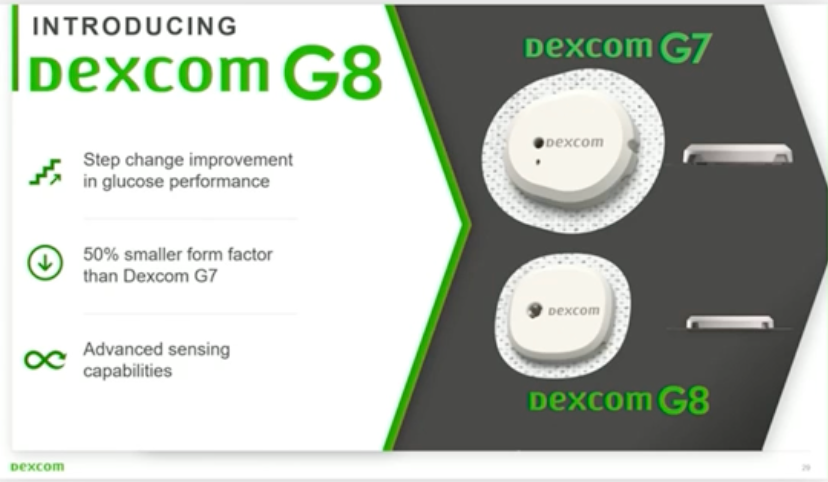
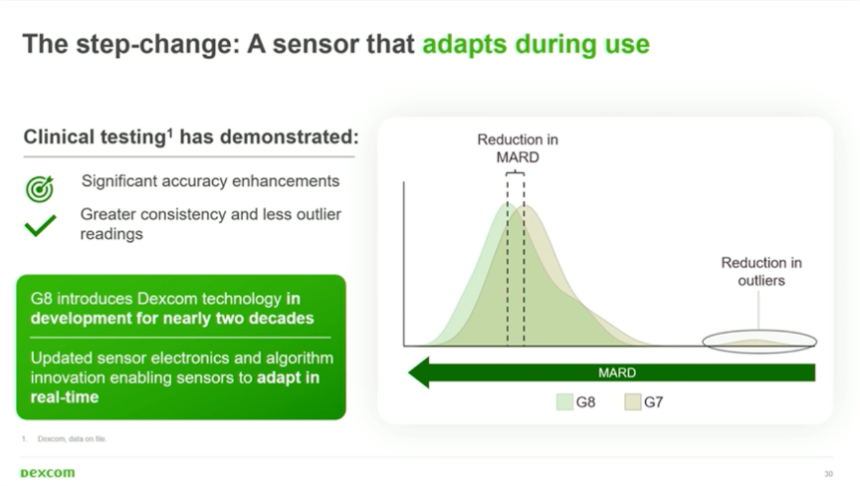
Dexcom’s next-generation sensor, Dexcom G8, was also a focus of the company’s Investor Day. Mr. Leach explained that one of the most significant updates in the initial G8 launch will be adaptive sensing technology designed to better account for physiologic variability. Using a new silicon chip and algorithm capable of measuring signals beyond glucose, G8 is expected to reduce some of the discordant outliers seen with G7 and improve day-to-day reliability. Dexcom plans to submit G8 to the FDA next year, with launch expected in late 2027 or early 2028.
Source: Dexcom Investor Day Presentation
Source: Dexcom Investor Day Presentation
- Mr. Leach also shared that “soon after” the initial G8 launch, Dexcom plans to introduce hardware enabling multi-analyte sensing. He emphasized the importance of identifying analytes with the greatest clinical impact, highlighting potassium as a significant unmet need, particularly for chronic kidney disease and cardiovascular disease management (see more below). Because some analytes are not enzyme-based, like glucose, Dexcom is investing in additional sensing technologies that can eventually be integrated into a subcutaneous sensor platform.
- During Q&A, Mr. Leach also reiterated the importance of continuous ketone monitoring across parts of the diabetes care spectrum. Dexcom is currently working to integrate ketone sensing into the G8 platform. While he reiterated that the first G8 release will focus on improving accuracy and reliability, ketone sensing is expected to be included in a subsequent version of the platform. Dexcom is currently collecting clinical data to determine how best to measure and communicate ketone readings to users.
- Discussing the transition of G7 users to G8 during Q&A, Mr. Leach reiterated that Dexcom G8 is expected to lower costs for Dexcom while also delivering meaningful user benefits. As a result, the company intends to promote rapid adoption of the platform.
6. Stelo app update expected to roll out in 2Q26
Mr. Coleman said that Dexcom’s experience with Stelo in the US over-the-counter T2D non-insulin-using population has generated meaningful insights that will inform the major app update planned for 2H26. This planned update includes:
- Enhanced nutrition support, including the ability to log meals within seconds using a photo, with AI-generated meal scores and explanations for those scores;
- Expanded trend analysis capabilities allowing users to review longitudinal patterns and weekly trends, as Mr. Coleman emphasized that visualizing glycemic responses over time is critical to driving lasting behavioral change; and
- A new AI-powered coaching experience that provides personalized insights and allows users to interact with a virtual assistant to ask glycemia-related questions. Mr. Coleman suggested that the Dexcom Virtual Assistant represents the company’s “next step toward intelligent care.”
He also reiterated that many of these Stelo updates are expected to inform future G-Series product enhancements.
7. Looking beyond diabetes: Dexcom explores new frontiers in inpatient CGM use and chronic disease management
Dexcom management outlined several additional strategic priorities for the company’s future CGM portfolio.
- In the inpatient setting, Mr. Leach reported “steady progress” toward FDA clearance of the first CGM approved for routine hospital use, with launch expected next year.
- Mr. Leach also discussed expanding Dexcom’s continuous monitoring platform into chronic diseases adjacent to diabetes, including chronic kidney disease (CKD) and cardiovascular disease (CVD). He highlighted Dexcom’s continuous glucose-potassium monitor (CGPM) as a potential solution to the increasing risk of dyskalemia as CKD progresses. He noted that there are currently no home-based potassium monitoring options, with testing today generally limited to blood draws performed in hospitals or laboratories. Given that hyperkalemia is a major risk factor in both CKD and CVD, management believes continuous potassium monitoring could address a significant unmet need. Mr. Leach said that approximately 20% of annual healthcare costs for patients with both T2D and CKD are related to potassium imbalances.
Analyst Q&A
Q (David Roman, Goldman Sachs): I want to start with one strategy question and maybe tie it to the financials. Jake, you concluded there by talking about the very future vision for the company. Maybe you could talk a little bit about kind of how you're kind of pushing the bounds here of interstitial tissue monitoring and how that applies across multiple parameters, including the hospital setting. And then maybe just isolate my related question here to Jereme, as you kind of go through the LRP and talk about the 10% growth, is it any further perspective you can help us with, to think about your assumptions around volume versus price and mix over that time horizon?
A (Mr. Jake Leach, President and CEO): You know, when we think about continuous sensing and the value it can provide, we've obviously found an extremely powerful use case in glucose, originally starting in diabetes, but now starting to expand into prediabetes, health and wellness, longevity options, and within the hospital. But I do feel that there's a significant opportunity to continue to expand that impact by bringing other analytes into our platform. I think Dexcom is uniquely good at that; we are good at creating technologies that sense subcutaneously continuously for users. The important thing to do is to figure out what are those analytes are that are critically important to increase that impact. When we think about those other analytes, we think about potassium being a pretty significant opportunity for something that is an unmet need today, and there are quite a few others.
Not all of them are enzyme-based, which is what our glucose sensors are. So, we're making investments in other sensing technologies that can be applied to the subcutaneous sensor probe so that we can sense multiple analytes all at the same time.
I do feel that over time, we're going to continue to lean into our flywheel, which is this idea of building this incredible wearable that creates this technology and senses anything that's helpful to be sensed interstitially. If there's already a way to do it, we're going to lean into that, and we're going to continue to use our software capabilities to amplify the value of that data.
A (Mr. Jereme Sylvain, CFO): In terms of the price volume mix, the way to think about it is we've typically thought about 2% to 3%, similar to what you see today. Not every year is the same. We have assumptions around when coverage comes, when it kicks in. We obviously have assumptions around competitive bidding, but we do assume that the mix comes down over the life. We’re not going to talk about volume because our assumption is 10%+ revenue growth. I think as you pulled out the models, and as you can see what our coverage expansion expectations are, a 2% to 3% price increase. This is not every year the same with mix coming down, as we've for the most part transitioned a significant amount of our product to the pharmacy in the US coverage, and CMS fee for service is going to be heavily in the DME, give it as Part B coverage, and so you start to see that mix clearly coming down going forward.
Q (Jeff Johnson, Baird): Could you help us with the timeline? I know you talked about late 2027, early 2028 for G8, and then about other analytes. Second, in the past, t you've made comments about whether we need to get to ketones, we can get to ketones fairly quickly. No mention of ketones today. It seems like your biggest competitor is still making progress towards ketones. Where is your pathway on ketones specifically?
A (Mr. Leach): We do think there is a component of diabetes care where ketones are important when we think about the spectrum of care. But when I when we look at the current unmet needs out there, we talked about in the priority, and G8 is the accuracy and reliability of these sensors needs to be better. We are in the process of integrating ketone sensing into G8, but we did feel that the most important thing is to accelerate the technology around the accuracy and reliability of the product. That’s why we're introducing this new technology that's going to be a step change in performance for all users.
Ketones, it will be part of the G8 platform. They're just going to come afterwards. Not going to give any exact timelines because frankly, we're in the midst of doing clinical data right now, figuring out how to make this an impactful metric for users. I think there's still quite a bit of clinical work that needs to be done to determine how to appropriately measure and communicate readings to users and what to do with that information. It's not nearly as clear as glucose, and so we're working on those clinical studies right now. Once we have that determined of exactly how to go to market with it, we'll be there.
Q (Jeff Johnson, Baird): Internationally, you're going to have a lot going on in the next two years or three years, with four products, three new large markets. One, what could go wrong there with all those balls in the air? Two, how will you position Stelo versus Flex versus ONE+? Is there any market where you're going to have all four in the same market?
A (Mr. Leach): It's critically important that we invest in our international infrastructure and our ability in the international markets, because in the long run, that's actually where the bigger marketplace is. I'm incredibly excited about pushing harder and harder into those markets. We've built a lot of leadership in the United States, and it's time to take that and all the learnings and apply it internationally. It's significant as you see, it's one of my three focuses is to expand this international market share because. The vast majority of people with diabetes do actually live outside the United States.
A (Mr. Coleman): The role of Stelo is really going to be focused on health and wellness outside of the US, and the other three products will be focused on diabetes and those different groups within diabetes care. That's the shortest way to sort of answer that. There are some people who migrate, as I mentioned earlier, from T2D into Stelo, and we're informing them that they have coverage if they do have coverage, so that they can migrate over the series. That's the way we'll, in essence, be positioning those different products in the portfolio.
Maybe to your last question on the focus, that's one of the reasons why, when you see the investment in sales and marketing in the targeted investments, one of the things we've done, and this has been a key priority of Jake's, is to carve out dollars to make sure we're supporting that international expansion. If you see leverage in the organization and from all the work that we've done, really, the opportunity then is to invest back in growth verticals. What could have gone wrong is if you don't support it, invest in it the right way. But I think that's what we've particularly done in terms of how we've set up the organization.
Q (Larry Biegelsen, Wells Fargo): Jereme, any color on sales margin assumptions in terms of cadence? For Jake, on the T2D non-insulin opportunity, why do you think it's taking longer for the CMS proposal and mid-2027 for the finalization, a conservative assumption? Related to that, on the study that you're going to show at ADA, how important do you think it is to see a benefit in the patients on GLP-1 RAs and oral meds?
A (Jeremy Sylvain, CFO): We haven't necessarily gone year by year. We'll do that as we kind of get into guidance by year. Clearly, I think an easy way to think about gross margin, at least in the near term, is we talked about exiting this year in the US, approaching 50% of our population moved over, but I think what's really helpful is as you think about next year, and your starting point is much, much higher as you roll forward that base. That's an opportunity for gross margin. When you combine that with some of the G7 15 Day work that we'll be doing, you can probably tell that there's some really interesting, shorter-term gross margin opportunities given some of that G7 15 Day base moving over. Maybe that gives you at least some context for it. We don't have a cadence to provide. We'll do that as part of our annual guidance.
A (Mr. Leach): Around NIT coverage from CMS, we've been clear that we never anticipated that to happen in 2026. We've mentioned we'd be ready, but we did always anticipate it would happen in 2027. Again, it's hard to predict decisions from the federal government, but what I will say is we are confident that it's just a matter of time before this decision happens. We figured it would be helpful to provide, for the first time, our estimate of when we think it's going to happen. We’re saying mid-2027 is when the coverage will actually kick in and be effective for users. If it comes earlier in the year, we'll be ready, and it's going to be upside.
On the study at ADA, it's important to show why we enrolled in the study we did. It's important to show the improvement that anyone sees across the entire spectrum of people with diabetes, including those who aren't even on a glucose-lowering medication. You saw 8% of the patients in that study aren't on a lowering medication. It’s really about showing the benefit of CGM, this entire population, which we have confidence in; we've seen the data from our registry and what's happening there, and we're obviously confident that the outcome of the next study as well.
Q (Joanne Wuensch, Citibank): How should we think about revenue over the next couple of years? Second, what is it about Flex that you think works in the OUS environment that makes sense to bring it to the US?
A (Mr. Sylvain): I think that we're not giving guidance by year. We've tried to give you what was a lot of the catalyst by year. You guys could take a look at it and say, “Hey, when is the coverage expansion taking place? When are your product launches going to take place?” We've been very clear. We wanted to basically underwrite a base case for everybody. That 10% plus is a nice way to do that. We want to be conservative in terms of how we're thinking about providing a number and give you guys at least the building blocks to start to think about it. That’s the starting point, at least of the 10% plus. From there, as we get into our annual guidance, we'll start to give more clarity as to what that looks like. But the hope is, in looking at the LRP by providing all of those levers, it allows you at least to give some thought as to where those years you think might be interesting and interesting potential for upside. But for now, a 10% plus per year is what we're given by year, and we'll get more clarity as we move on.
A (Mr. Coleman): On the question about Flex, again focused on type 2 NIT patients and potential and basal patients as well. The question about the US vis-à-vis Flex is yet to be determined, whether that is a different product and/or a software sort of app that's geared toward people who have those needs. That's the way I'd answer that question. We've not yet made that decision and/or are prepared to sort of speak to it more than that.
Q (Chris Pasquale, Nephron): Two questions. One, G8 comes to market. G7 won't be that long in the tooth, particularly the G7 15 Day version. Are you anticipating any difference in the adoption curve, or are you going to try to push this for a rapid conversion across the customer base? Does it become a premium product initially for patients that really value that extra accuracy? Jereme, can you go into a little detail on competitive bidding, the latest thoughts there on how you expect that to change the market, the impact that you are baking in?
A (Mr. Leach): No specific plans on exactly how we convert. I'll tell you how we're thinking about it. G8 is actually a cost reduction for us as well. It would be a strong benefit for us to provide the technology to all of our users because it is a wearable cost improvement. I do see that technology is going to be applicable across our entire customer base, so we're going to move it as fast as we can. As Jereme mentioned, one of the benefits of this technology is that we've taken a lot of learnings from all of the different launches we've done and all the scale that we've built. It can be built; we can retrofit the G7 lines to manufacture these G8 systems. That's really going to help us in our ability to have enough capacity to serve all the customers as we go. I do want to see a rapid uptake and a rapid changeover because of all the benefits this product has for the users.
A (Mr. Sylvain): To your question on competitive bidding, so our assumption there is that 2028 is the letter of the laws is when that would play in. We’ve taken a look at what obviously the OIG report would have indicated, which didn't really indicate that there was a lot of opportunity there. We know that, really, CMS is heavily focused on fraud and potential risk around that. A lot of the concern, we think, is around fraudulent billing of homes that are actually never shipped and or sold. That's where a lot of the concern is in terms of our assumptions around it. Look, we've put in assumptions for some nominal price impacts associated with it. The reality is, is we think it's appropriately priced and we think it's appropriately transferred. We don't want to get ahead of ourselves there. But obviously, we built a range of those assumptions into there to make sure that we were covered in the event that it did take place. But I think the most important part, starting in 2028, is what the LRP assumes. If things change, we'll certainly come back to you with an update as that is how those assumptions play out.
Q (Matt O'Brien, Piper Sandler): Jake, you've mentioned OUS eventually being the same size as US, so the interplay just between US and OUS growth over the LRP. How does that look? I'm assuming the US is much faster. Then to Jereme, you know that the gross margin expansion is around 140 bps per year. How does that interplay with OUS getting in, or how does it influence gross margin over the LRP?
A (Mr. Leach): There's a lot in our plans that we control in terms of the products we build, where they're available at markets. One of the things we don't specifically to control the exact timing on, is access expansions. We work very hard to advocate for it because of the belief in the outcomes we see from this technology. We do know that overtime access and expansion both here in the US, but particularly internationally, it's trailing a little bit from the US; that access is going to continue to open.
One of the things we do see is that when we do get international access wins, we see pretty significant growth in those markets. I think we saw some of that in our Q1 results, that most of that growth came from new markets where we just recently opened up access. It's hard to exactly put out the cadence of how this happens, but we are confident over time that the access will grow, and the international market is going to continue to grow.
A (Mr. Sylvain): I think the answer is I wouldn't underplay either of them. Right. There's a massive opportunity in the US, but there's also a massive opportunity outside the US. There are both books of businesses we think have a real opportunity for growth.
The gross margin certainly as you move outside the US and we grow certainly volumes in that perspective with those moving to a G7 15 Day as well. You might find that the higher reimbursed markets ultimately yield higher margins, but as a portfolio, the entire portfolio moves. So, even as international growth grows, you're getting the benefit of shifting your G7 to US customers, OUS customers onto the G7 15 Day platform as well, which is a significant piece of it. You're getting your Dexcom one plus customers outside the US, also moving onto a G7 15 Day platform.
The best way to think about the cadence is to look at our product launch, and we gave you product launches by year that will help you feel the cadence between OUS and US, but really across the board, all of those regions are going to move to a G7 15 Day OUS and US. But really, across the board, all of those regions are going to move to a G7 15 Day.
Q: Jake, I heard you mentioned G7 15 Day rolling out. You made an update to the adhesive that's being received. I thought the adhesion code had been cracked. What are you working on there? Is the over patch forever in Dexcom’s future, or is the G8 patchless?
A (Mr. Leach): It’s a crazy mix where you're trying to have a sensor, adhere to a patient's body, think about little kids running around, all the different ages, all different stages, diabetes, without obviously causing irritation. The code's definitely not cracked. We still have patches that don't last the entire time. It's not a high number, but we want all sensors to stay at here as long as they possibly can. A big part of that is adding breathability to the adhesive. That is something that G7 launched with one version of a patch. We updated that patch. This is now the third update of patch technology to that product because we're always trying to improve the experience for users and obviously, the longevity of these sensors. This new patch has a pretty significant impact on patch survival for the G7 15 Day product. We're going to roll it out across the entire product portfolio over time, but we're never done. There's still going to be opportunities to enhance it. On the over patch, yes, it's something that some users use. Not everybody uses it. It's something that we feel is a nice option for people, but it shouldn't be mandatory. We’re working towards it not being a mandatory component of our system. But we do think some patients do really like it. They come up with their own versions. You can see Amazon's full of these different things. They work really hard to make sure these sensors stay on because they're so important to them.
Q (Jason): First, basal has been lagging here in terms of adoption. Jake, you spoke early on about Smart Basal. Is this the tool that opens up that opportunity? Jereme on that, you said mid 40% basal penetration exiting the LRP. What does the US penetration look like in that?
A (Mr. Leach): We absolutely are designing products that are specifically geared towards capturing more share of a population and meeting the unmet needs out there. You can see from that graph I showed, basal insulin therapy without this type of technology is not very satisfying for users. They go on to an injection sometimes for the very first time. They're injecting themselves once a day with this low dose insulin, that's not resulting in better glucose control. It's actually resulting in worse glucose control in many cases. That’s pretty dissatisfying. You may not keep taking the insulin you got to keep work with the physician. Physicians frustrated. We really think that this technology can accelerate that outcome to a point where the patient is interested in continuing that therapy, but also very interested in the value that CGM is bringing them. I do think it's a tool for capturing more sharing and he starts getting more, he starts and then ultimately retaining them. It is an important part of our strategy to expand into the basal today in the US, the majority or the largest portion of our new customers are still insulin users and T2D MDI and Basal, that is the largest portion of customers. That NIT number is continuing to increase. But there is some complexity in that NIT coverage right now where only 25% is covered. So, as we get more coverage there, I think we're going to see some similar growth there.
A (Mr. Sylvain): To your question on basal, the number we said that was a US-focused number. It's really into that mid-40s from where this year it’s crossing into that we said 20% to 25% as we exited last year. It's getting into that figure. Outside the US, it’s very, very small relative to that. That coverage unlocks today is really it's only in Japan and France. As you get to 2030, again we expect unlocks of coverage to take place pretty significantly over that period. But the number would be significantly less than that, just given the approval timeline. So, it's a real opportunity. I think we're going to exit with a lot of opportunity for basal to penetrate those markets outside the US.
Q (Jason): For the role and focus of the new board members, what do you expect them to have that you didn't have?
A (Mr. Leach): It's really significant experience in scale operations, Medtech quality. What we're looking for, no one has ever scaled a business like this before in Medtech, in terms of the number of patients who are serving in the speed at which this category is growing. It’s really just to help provide additional advice and guidance. I'm new to the CEO role, and so it'll be helpful to add that skillset to the board. We don't have independent Medtech directors on our board right now, so it'll be helpful to have that experience as well as some high volume.
One of the things we've been pretty focused on is the refreshment of our board. We've actually, with the addition of these two new board members, in the last three years, we've brought in six new directors. We already have four that we've added in the last two and a half years across AI healthcare. Rick Osterloh from Google has really significant experience in scaled operations of consumer tech as well as AI integration, with his experience at Google. I really think that we're building a board for the future, for where we're headed, and these Medtech and operations directors are going to help us with that.
Q (Rich Newitter, Truist Securities): Should we be thinking of the OUS growth rate over the life of the long-range plan outpacing the US? If that's the case, do we need T2D NIT as you move up the penetration curve and 2027 beyond to kind of sustain a double-digit US growth rate? Or, should we keep that in the high single digit, low double digits?
A (Mr. Sylvain): We haven't necessarily gone down and gone down each OUS, US in the LRP. The expectation is certainly the unlocks across both of them. You can see the expectation of the CMS coverage here next year is a significant it's the biggest unlock out there. That’s the reason why we're not talking down either, because ultimately $12 million, $15 million, once the Medicaid lines come along, would be the biggest expansion in the US we've ever seen. It's a massive opportunity unlock there. At the same time, you've seen all the OUS countries we think that are coming in. To top down either or to say that both don't have opportunities, significant opportunities over the LRP, we haven't necessarily split those out. What I would say is, we've always said our long term algorithm coverage is what we've always aimed to do. I think that's why we've worked so hard to create the clinical evidence that ultimately drives coverage. What I would say is longer term, our expectation is coverage comes and that's part of our growth algorithm is showing that CGM improves lives, showing it takes costs out of the system. The best way to think about it is any sort of LRP we give, we do assume coverage is coming and we're working hard to get that coverage rather than specific particular coverage unlocks. I would just expect us to continue to work to do to do the work around clinical coverage because that does unlock lives.
Q (Rich Newitter, Truist Securities): On the NIT penetration forecast exiting the plan. What is the T2D percentage was you said that's embedded in the LRP? What are you assuming for the wear, for the adherence or compliance?
A (Mr. Sylvain): The assumption is that we exit at that 10% to 15% penetration across that population US. OUS obviously very much, much smaller given the unlock comes later into the LRP and where utilization is similar to what we have posted up on our website. It's the 75% to 80% utilization. Again, as you go deeper and deeper into that population, you could potentially see that change. But what we found is when coverage is there and it comes back to coverage, when coverage is there, you see people wear it and you see people wear it at a high clip. Those are the assumptions.
Q (Josh Jennings, Cowen). Jereme, you mentioned about coverage, and with the work being done in the prediabetes population, is the expectation that ultimately you can deliver the clinical efficacy and cost effectiveness in that cohort and that large cohort? Where should we be thinking that’s where Stelo will live and breathe within this LRP?
A (Mr. Sylvain): Look, certainly we expect to be able to demonstrate outcomes in prediabetes. We've seen it. We see people wearing still them all the time that have prediabetes. and the outcome is very different than what you would typically measure today under diving, right. Diving is typically as you measured, you're thinking about things like A1c, right. On prediabetes, your A1c hasn't risen to that level quite yet to where you would expect to see but things like time and range, healthcare reduction and preventative care, you can't measure those types of things overtime. So, Jake alluded to a day when everybody is wearing the sensor, that's just part of your annual, physical or as part of what you would do to prevent diabetes. We do expect overtime for that to be a use case that ultimately plays out because we know we can demonstrate the benefits of doing so. Whether that's coverage, whether it's employers covering it as part of health and wellness plans, whether it's through programmatic approaches, those are the things I think we're still working through and how we demonstrate that clinical evidence. But make no mistake, we're building a product to help folks prevent ever getting to diabetes. That obviously focuses on that prediabetes space. And, of course, in the health and wellness space.
A (Mr. Leah): I'll add is that we do see it as a very powerful screening tool and we've already started working on algorithms with some of the real-world data. We have to come up with better ways to diagnose the actual condition of diabetes instead of the typical A1c test or glucose tolerance test. We've also been doing some work in gestational diabetes, in pregnancy that, you know, gestational diabetes impacts 10% of pregnancies. Right now, it's usually not diagnosed till later in the pregnancy. We do feel that using CGM as a screening tool there, could find the diabetes earlier and help the mother and baby have much better outcomes. There’s an opportunity for this tool to be used pretty widely in terms of just screening. There’s the whole aspect of treating. Once you understand you have a potential issue, helping with the education and the learning around how to improve the health condition.
Q: Earlier in the year, you alluded to potential to go beyond enzymatic testing process and interstitial fluid, and looking at other mechanisms of testing to expand the menu even further. Can you talk about where you are in that development process?
A (Mr. Leach): We definitely see, as I mentioned, this opportunity for us to lean into this capability we have around developing technology that subcutaneously senses multi-analytes and our ability to scale that technology and so we are making investments and working R&D on other mechanisms for sensing because some of these analytes, like you mentioned, creatine you can't sense it with an enzyme, so you need something else. Enzyme enzymatic technology is what we founded our glucose sensor on and some of the other ketone sensors, lactate are all using enzymes. Potassium does not.
We’re moving into this realm of not just enzymatic sensing and our venture group has been making investments in companies that you have some alternate sensing technologies and we're also working on some of them internally that are non-enzyme based, more to come, early days. But when we think about the long run of this company and what we're capable of, it goes far beyond diabetes.
Q (Shagun Singh, RBC): The big focus here is capitalizing on the large TAM, and from that standpoint, you also indicated that access is growing faster than penetration just from a commercial standpoint. Where is the biggest focus in order to unlock that or drive penetration higher?
A (Mr. Leach): The number one priority right now is ensuring that users that we have the best solution for users because there are a lot of people who see their physician who have coverage for CGM and aren't walking out of there with a prescription. That's really about building the right experience for those users and their physician, making sure the awareness is there. Right now, we're working through this coverage on the NIT, rolling 25% of people are covered. It adds some complexity. Whenever we cover the expansion that happens, we see a bolus, just like we saw in early 2025 when we started to see the PBMs covering CGM for all people. We get this bolus, but then there's a lot of work to educate around the access that exists, and that access paradigm continues to change, and can you just open, open up? As we build better solutions that meet more of these customer needs, it's around capturing more share and understanding, basically increasing the number of new patients that are coming onto CGM. I do think by focusing on the experience and the products, we can do that.
A (Mr. Coleman): I think the matching experience and needs is number one. And then the second is taking the learnings from Stelo and this new app that we're going to be launching in the short term and leveraging it like crazy across the portfolio.
Close Concerns’ Questions
- In which additional markets does Dexcom plan to launch Flex? What primary factors are going into deciding which markets are prioritized for launch?
- When might updates to users’ experience with Stelo be translated to the company’s G-Series CGMs?
- Will Dexcom’s entry into Mexico and Brazil come with Flex or one of its existing G-Series sensors?
- What sort of updates is Dexcom unveiling to better support clinicians in incorporating Smart Basal, and eventually Smart Bolus, into their workflow?
- What specific features will Dexcom Flex offer users?
- Exiting the investor day, what most impressed Dexcom about the impressions and questions and comments from analysts and investors? What new ideas did it develop, if any, as a result of the day?
-- by Jeremy Alkire, Riya Chatterjee, and Kelly Close
[1]Dexcom first announced that it would expand its manufacturing to Arizona a decade ago, back at JP Morgan 2016, and it started building in 2017. We remember well the confidence with which then CEO Kevin Sayer took on this challenge – quarterly revenue was but about a tenth of what it is today and the company didn’t yet have an insulin dosing claim. It’s so inspiring to see from whence the company has come and what a boon to attract so many people to Arizona in the hot sun (the high was 108 degrees and the low about 70 degrees!).
[i]In terms of history, Dexcom has come such a long way and undoubtedly saved the lives of so many that previously suffered severe hypoglycemia. We remember the days very well of the STS, the G4, G5, G6, the current G7, and to hear about the G8 (below) was inspiring, indeed. While the STS wasn’t, looking back, reliable, accurate, or easy to use, it was continuous, and a miracle for so many suffering the ravages of severe hypoglycemia. While so many people today still experience this complication of diabetes due to unstable insulin or multiple other reasons (both multiple daily injections (MDI) as well as “basal only” can both be such challenging insulin regimens), continuous glucose monitoring is such a panacea for people to have the right starting point of knowing where they are. Due to access problems or problems related to clinical inertia or problems related to stigma or lack of education, many people with T1D or those with T2D on insulin or SUs still do not have CGM, the future is upon us due to the awareness of the need for CGM (real-time or intermittent for everyone with any kind of diabetes).