Dexcom 1Q26 – Revenue totals $1.2 billion (+15%), with record new global patient starts and new international milestones; on products, Dexcom redesigns Stelo app and characterizes timing for new patch adhesive rollout to come in “the coming weeks” –
Executive Highlights
- Dexcom reported its 1Q26 financial results today on a call led by CEO Mr. Jake Leach and CFO Mr. Jereme Sylvain - see the press release, webcast, and presentation.
- Dexcom reported first quarter revenue of $1.2 billion in 1Q26, up 15% (+12% operationally) from 1Q25 and down 5% sequentially. US revenue came in at $832 million, up 11% vs. 1Q25. Sequentially, US sales fell 7%. International revenue of $360 million represented 30% of sales, the highest ever as a percent of total sales and just under its highest ever of $368 million in 3Q25. International growth of 26% growth versus 1Q25 provided some momentum[1]. Sequentially, sales outside the US fell 2%. Management attributed growth in the quarter to strong continued global CGM demand, broader G7 15 Day adoption in the US, and sustained contribution from Stelo.
- Dexcom reported a GAAP gross margin of 62.9% in 1Q26, up from 56.9% in 1Q25 and flat with 4Q25’s improved margin performance – the gross margin was certainly impressive. Dexcom ended the quarter with ~$2.4 billion in cash, cash equivalents, and marketable securities, down from $2.7 billion a year earlier and up more than $400 million from year-end 2025. Mr. Sylvain attributed recent strength on the cash front to significant free cash flow generation in 1Q26.
- Dexcom reported strong global demand in 1Q26, with a record number of new patients globally and sequential improvement in US new starts, which management reported to be near-record level. In the US, momentum was particularly strong in T2D, with non-insulin users emerging as the fastest-growing segment. Dexcom continues to position this population as a key long-term growth driver. Dexcom announced that Prime Therapeutics will extend CGM coverage to all people with diabetes under its plan beginning this summer (the payor seems quite active in the field of late). This expands commercial coverage to now reach more than seven million people with T2D not using insulin by the end of 2026.
- Management also cited the 12-month real-world Dexcom Global Registry data presented at ATTD 2026, which showed statistically significant A1c reductions and strong Dexcom CGM adherence in a broad non-insulin using population with T2D. Dexcom will also present results from its randomized controlled trial in patients with T2D not on insulin therapy at ADA 2026.
- Additionally, Dexcom discussed a range of software and hardware updates that it expects to roll out over the course of 2026.
- Dexcom’s major redesign of the Stelo app will launch “in the coming weeks,” and the company is working on expanding its Smart Basal rollout, which remains in pilot phase.
- Dexcom also expects its newly cleared patch adhesive technology to roll out “in the coming weeks.” The upgraded adhesive was designed to improve sensor survivability and strengthen performance consistency across the CGM portfolio.
- International expansion of Dexcom’s product portfolio remains a key focus of the company. In 2026, the company plans to launch Stelo internationally, beginning with select markets in Europe, Middle East, and Africa and Asia-Pacific regions, and introduce a new CGM system in the Dexcom ONE+ category designed to extend market reach and address additional segments.
- While questions from analysts kept the tone of the conversation a bit more challenging than usual, the tone overall of the call was positive and would term management’s tone friendly, patient, and constructive. It would be tough to listen to this call without learning – we urge you to tune in to the webcast particularly if you are new to the market and education is one of your goals. We look forward to watching to see if Dexcom works to do more to help people with diabetes on insulin who are still not at their glycemic targets – it would be great to see this improve given that most recent data still shows that hovering close to 20% despite so much new technology and so many new therapeutics.
[1]While the quarter had momentum, international sales were robust in part due to an easier single digit growth comp for OUS from 1Q25.
See below for our top highlights.
Table of Contents
-
Financial Highlights
- 1. Worldwide 1Q26 revenue of $1.2 billion rose 15% year over year (+12% organically) and fell 5% sequentially
- 2. GAAP gross margin of 62.9%, up sharply from 56.9% one year ago; cash totals $2.4 billion
- 3. Dexcom reiterates full-year guidance of $5.16-$5.25 billion (+11%-13%) and raises profitability guidance, reinforcing operational leverage
-
Business Highlights
- 1. Record new starts globally; US business strength reflects sequential growth in new starts driven by non-insulin T2D and G7 15 Day
- 2. Increasing focus on T2D non-insulin expansion: expanded US coverage by Prime Therapeutics; data presented at ATTD 2026; major randomized controlled T2D trial readout anticipated at ADA
- Pipeline Highlights
- Analyst Q&A
- Close Concerns’ Questions
Financial Highlights
1. Worldwide 1Q26 revenue of $1.2 billion rose 15% year over year (+12% organically) and fell 5% sequentially
Dexcom Quarterly Revenue (2Q12 – 1Q26)
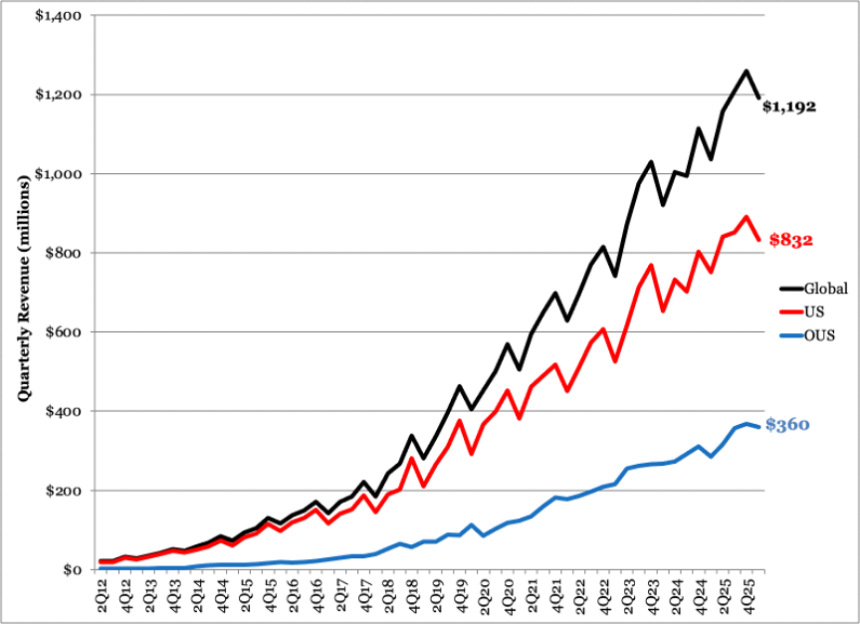
Dexcom reported first quarter revenue of $1.2 billion in 1Q26, up 15% (+12% operationally) from 1Q25 and down 5% sequentially. Management attributed the quarter to strong continued global CGM demand, broader G7 15 Day adoption across US channels, and sustained contribution from Stelo. In Q&A, Mr. Leach noted that US CGM category remains only ~30% penetrated among covered lives, leaving a substantial runway even before future coverage expansion.
- US revenue was $832 million for 1Q26, up 11% from 1Q25. Sequentially, sales fell 7% – sequential 4Q-1Q declines are typical with US seasonality. US sales continue to make up a majority of Dexcom’s business at 70%, similar to 71% in 4Q25. This has fluctuated only slightly in the last dozen quarters, generally ranging from about 70%-74%. Management highlighted momentum across diabetes care, with particularly strong share gains in T2D, including the largest increase among people with T2D not using insulin. In Q&A, Mr. Leach said Dexcom is seeing momentum build behind G7 15 Day, with nearly 50% of the US base expected to convert to the product by the end of the year.
- International revenue was $360 million, with 26% growth from 1Q25. Sequentially, sales fell 2%. Mr. Sylvain described international growth as widespread across core markets, with some of the largest increases coming from countries where Dexcom recently expanded access, including France and Canada. In Q&A, he noted that there were no tender or timing dynamics driving the quarter. Instead, he said Dexcom is benefiting from broader access, product portfolio tailoring, and share gains in markets that had previously been exclusive to competitors.
2. GAAP gross margin of 62.9%, up sharply from 56.9% one year ago; cash totals $2.4 billion
Dexcom reported a GAAP gross margin of 62.9% in 1Q26, up from 56.9% in 1Q25 and roughly flat with 4Q25’s improved margin performance. Non-GAAP gross margin reached 63.5%, up from 57.5% in 1Q25. Mr. Sylvain attributed the improvement to continued manufacturing efficiencies, more normalized freight costs as global inventory levels improved, and early benefits from the transition to G7 15 Day.
- GAAP net income totaled $200 million, nearly doubling from $105 million in 1Q25. Non-GAAP net income reached $216 million, representing 75% growth from 1Q25.
- Operating income was $255 million, or 21% of revenue, compared to $134 million, or 13% of revenue, in 1Q25. Non-GAAP operating margin rose to 22%, up from 14% in 1Q25.
- Dexcom ended the quarter with ~$2.4 billion in cash, cash equivalents, and marketable securities, up more than $400 million from year-end 2025. Mr. Sylvain attributed this to significant free cash flow generation in 1Q26, noting that Dexcom’s cash position provides flexibility for ongoing capital allocation.
3. Dexcom reiterates full-year guidance of $5.16-$5.25 billion (+11%-13%) and raises profitability guidance, reinforcing operational leverage
Management reiterated full-year 2026 revenue guidance of $5.16-$5.25 billion, representing 11%-13% growth. While revenue guidance was unchanged from 4Q25, Dexcom raised its full-year profitability outlook following a strong first quarter, increasing non-GAAP operating margin guidance to 23.0%-23.5% and adjusted EBITDA margin guidance to 31.0%-31.5%.
- Non-GAAP gross margin guidance was reiterated at 63%-64%, despite 1Q26 performance tracking well against the range. Mr. Sylvain said Dexcom left gross margin guidance unchanged due to uncertainty, including fuel prices and shipping routes. Specifically, Mr. Sylvain said in Q&A that there is about 50-100 basis points of potential gross margin risk tied to fuels and resins given the current geopolitical stresses, noting that Dexcom likely would have raised gross margin guidance absent that uncertainty. He emphasized that the underlying business is outperforming expectations.
- Dexcom continues to expect margin expansion from improved freight and manufacturing efficiencies, growing contribution from G7 15 Day, and disciplined cost control, even as the company supports incremental operating expense tied to its Ireland manufacturing facility and ongoing Stelo advancements.
Business Highlights
1. Record new starts globally; US business strength reflects sequential growth in new starts driven by non-insulin T2D and G7 15 Day
Dexcom reported strong global demand in 1Q26, with a record number of new patients globally and sequential improvement in US new starts, which management reported to be near-record level. Growth was supported by continued expansion across the diabetes spectrum and improving execution in the field.
- In the US, momentum was particularly strong in T2D, with non-insulin users emerging as the fastest-growing segment. Management attributed this to a combination of broader payer coverage, improved field targeting, and rising clinical awareness, as more than six million people with T2D not using insulin are currently covered for Dexcom CGM across the three major PBMs. Management said Dexcom’s sales teams are increasingly focusing on these newly covered populations.
- By product, a key driver of new starts in the US was the G7 15 Day system, which has seen an “outstanding” launch across DME and pharmacy. Management emphasized strong physician and patient feedback already, driven not only by extended wear time but also by the new sensor algorithm, which improves upon the 10-day G7’s accuracy. The company expects continued conversion of the installed base, estimating roughly 50% of US users will be on the G7 15 Day system by the end of 2026.
2. Increasing focus on T2D non-insulin expansion: expanded US coverage by Prime Therapeutics; data presented at ATTD 2026; major randomized controlled T2D trial readout anticipated at ADA
Dexcom continues to position non-insulin T2D as a key long-term growth driver, reporting meaningful progress on both coverage and evidence generation.
- On coverage, Dexcom announced that Prime Therapeutics will extend CGM coverage to all people with diabetes under its plan beginning this summer. This expands commercial coverage to now reach more than seven million people with T2D not using insulin by the end of 2026. Management reiterated that the largest remaining opportunity is Medicare expansion, which covers approximately half of non-insulin T2D patients. They framed broader coverage as a “matter of time,” supported by increasing clinical and real-world evidence.
- In evidence, Dexcom presented 12-month real-world Dexcom Global Registry data at ATTD 2026 showing statistically significant A1c reductions and strong Dexcom CGM adherence in a broad non-insulin using population with T2D. Participants in the analysis (n=318) had A1c reduction of 0.5 percentage points from a baseline of 7.4%, reaching a 0.7 percentage point reduction at one year. At one year, participants also reported an average 2.4 kg (~5 lbs) weight loss, lower diabetes distress, and improvements in nutrition and exercise habits.
- Dexcom will also present results from its randomized controlled trial in patients with T2D not on insulin therapy at ADA 2026. Management expects the trial to support future US and global reimbursement decisions. Dr. Tom Martens (International Diabetes Center) will present the data readout on June 6 at 1:45 pm CT, which will be followed by Dr. Harsimran Singh’s (Weill Cornell) presentation on the lived experiences of this population with CGM.
Pipeline Highlights
1. Software innovation: Stelo to receive updates to Smart Meal Logging and app in 2Q26; Smart Basal pilot underway
Dexcom discussed a range of software updates that it expects to roll out over the course of 2026.
- Dexcom’s major redesign of the Stelo app will launch “in the coming weeks,” including: (i) a more modern, consumer-friendly interface; (ii) expanded AI-driven insights; (iii) enhanced food logging capabilities, including macronutrient tracking; and (iv) greater use of the data brough in by compatible wearables like the Oura Ring for insights on suggested lifestyle changes. Management emphasized that the redesign was driven by user feedback, particularly demand for more contextual interpretation of glucose data, including nutrition and behavioral insights.
- Dexcom is also working on expanding its Smart Basal rollout, which remains in its pilot phase. This tool aims to improve basal insulin titration by enabling more precise dose adjustments and faster optimization. With this pilot phase, the company is focusing on introducing any necessary updates to ensure strong workflow integration across both endocrinology and primary care settings before the full launch.
- Dexcom did not discuss Smart Bolus on today’s call, a new feature that it introduced at ATTD. The feature aims to help patients on MDI deliver accurate fast-acting insulin doses titrated over time without increasing hypoglycemia. The feature will provide personal dose guidance by incorporating user-entered carbohydrates, meal timing and type, current glucose levels and trends, and insulin history.
2. Hardware innovation: New patch technology to roll out “in the coming weeks”
Management briefly touched on its new manufacturing with the newly cleared patch adhesive technology. They expect this to roll out commercially “in the coming weeks.” The upgraded adhesive was designed to improve sensor survivability and strengthen performance consistency across the CGM portfolio, ultimately enhancing users’ wear experience. At ATTD, Chief Technology Officer Mr. Girish Naganathan cited internal data showing that 82% of G7 15 Day sensors lasts the full 15 days with the patch, with 89% of sensors lasting 14 days. This does not come at the expense of skin safety, with no increase in skin irritation from the previous patch reported so far.
Dexcom also explained at the conference that it plans to roll out the patch for Dexcom G7 15 Day users in the US in late 2Q26 or early 3Q26, followed by its rollout for G7 internationally in 3Q26 and for the 10-day G7 in the US in 4Q26.
3. International launches of Stelo and new CGM product planned for 2026
International expansion of Dexcom’s product portfolio remains a key focus of the company. Looking ahead to 2026, the company plans to:
- Launch Stelo internationally, beginning with select markets in Europe, Middle East, and Africa and Asia-Pacific regions; and
- Introduce a new CGM system designed to extend market reach and address additional segments. Previously, Dexcom has described this product as CGM platform as positioned within its lower-cost Dexcom ONE+ category, hoping to reach into new patient segments and price-sensitive markets.
Mr. Leach has positioned international expansion as one of his three major focuses as CEO. Outside of product launches, management also touched on reimbursement expansions for its existing CGM portfolio internationally. Strong international growth in 1Q26 was driven in part by large markets with recent coverage expansions, like France and Canada. They also expect further coverage expansions in select international markets over the course of the year.
Analyst Q&A
On G7 15 Day
Q (Travis Steed, BofA): On the G7 15 Day, on the better algorithm and the better customer experiences – is that something where that product helps new starts as it launches? How do you think about the margin impact of G7 15 Day rolls out versus inflationary impact on margins?
A (Mr. Jake Leach, CEO): I'll take the part around the product and the starts, and Jeremy will fill in with the margin perspective. I absolutely believe that the G7 15 Day is helping drive the momentum that we're seeing. We did see improved performance across our entire portfolio when it comes to the reliability of our product. When you think about the G7 15 Day in particular, it has that new algorithm and the extended wear. That is something that patients very much value the convenience of the longer wear.
The algorithm and the performance and reliability of that product is really driving new starts as well as conversions over to it. We're making good progress towards converting the base over to that product. We estimate nearly 50% will be converted by the end of the year over to this new 15-day product. Jereme, want to fill in on margin?
A (Mr. Jereme Sylvain, CFO): On margin, you're exactly right, Travis. We kept it in hold just because of the impact of oil on both fuels and resins. Obviously, resins play a large part in our product as well. There's probably about 50 to 100 basis points of potential risk associated with fuels and resins over the course of the year. So, absent that, we would be raising the gross margin guidance. You can see in the first quarter, we had a really solid performance. Typically, we step back from Q4 into Q1. And with some of the work that we've done over the course of the year, that was flat coming into Q1, which should give hopefully you and everybody else a lot of confidence that the work we've been putting in place to help improve throughput, quality and really yields is really starting to play out.
Think about it that way. It's about 50 to 100 basis points. Obviously if oil prices come back down to normal, we'll certainly revisit it and revise it at that point. But right now, we've got a placeholder for that, the underlying performance of the business, though, is outperforming expectations as we got into the year.
On new patient starts and retention
Q (Robbie Marcus, JPMorgan): It was close to a record new patient start, and that's been the language the past four quarters. We're now a full year without a record new patients start, and if I remember on the fourth quarter call, you said the top end of the sales guide assumed a record. One, do you feel like the lower end is maybe more appropriate if we don't see a record? Two, do you think you can maintain the current sales growth if you don't put up a new record in the future?
A (Mr. Sylvain): Let me be clear. Globally, we did have a record new patient quarter this quarter. So globally it was a record. That’s helpful to give that context. In the US, it was close to a record. Sequentially, it was an improvement from Q4. We’re certainly seeing the momentum building behind G7 15 Day and as we move into the year. I certainly think we're seeing some sprouts in our case of performance there. We did take share both in the US and internationally. Hopefully that gives some clarity around record.
That helps at least give you that context. As you talk about the full year, being the low end would be not records globally, the high end would be records globally. Obviously, we're tracking well given the first quarter is a record. That gives you some context for that. In terms of the year as you think about the year, our goal here is as we move forward over the course of the year and our goal is to continue to unlock coverage. We talked about one being in Prime Therapeutics in the US commercial space. We haven't talked a lot about outside the US, but outside the US we have plans to unlock coverage over the course of the year.
Our expectation is to continue to unlock that coverage and help drive that growth algorithm. I know that you have that context. Hopefully it gives you at least our viewpoint on the year. Obviously, it's a good start to the first quarter. Certainly, the momentum building with G7 15 Day. Jake alluded to it a little bit earlier. We have Stelo launching here with a new skin, which will be an excellent new app experience that's going to launch outside the US as well, which I think is going to be an awesome opportunity to bring Stelo outside the US.
Obviously we're looking at 15 Day opportunities outside the US as well. And given what we've seen in the US with the performance of 15 Day, we're really excited to bring that outside the US. I think we have a lot of irons in the fire as we move into the year with, of course, some big unlocks potentially happening here. We expect them to happen just timing wise. We're going through with the CMS coverage unlock. So, there's just a lot of opportunities here, a lot of catalysts over the course of the year. But it starts with a record in the quarter and it was a record globally in the quarter.
Q (Anna, Piper Sandler): I know there's always a focus on new patient starts, but I also wanted to ask about retention. What trends are you seeing there today, particularly in the domestic market, and how has that contributed to the results in the quarter? How do you expect this metric to evolve?
A (Mr. Leach): When we think about retention, it's been fairly consistent. Both retention and utilization really help drive the active base. When we look at that, we’ve targeted increasing our experience and really setting the standard both with the product and also the service behind it. And as Jereme mentioned, our NPS scores have been going up quite a bit. I think that bodes well for the future, when we think about things like retention and utilization. It's been fairly consistent for a period of time now, but one of our goals is to improve it so that we can continue to improve the active base growth.
On Smart Basal
Q (Jayson Bedford, Raymond James): The Smart Basal launch was in an early access stage earlier in 1Q26. When do you expand this launch?
A (Mr. Leach): We are still in a pilot launch, and the idea of what we're doing is we're making sure that the system as designed fits into the clinical workflow, because it's designed for very broad use. We’re talking about lots of different clinical environments. You get into those offices, large diabetes clinics and then small primary care offices. The work that we're doing right now, as we've done this pilot launch in a number of sites, is really making sure that that is flowing well. And we’ve learned a couple of things that have led to some updates to the system. We're not validating the algorithm. We know that the patient experience around this system is excellent. It's more around how does it fit into the clinical workflow, because when we broaden the launch, we want it to be extremely easy and very successful for users and physicians. We do plan to do that throughout the year, and we just want to make sure that we've got all the bases covered on that workflow before we do it. But once we figure all of that out, we're going to launch it in a very big way.
On Stelo
Q (Issie Kirby, Redburn): I wanted to ask about Stelo and how that is tracking. What has prompted the redesign there? And with the international launch, just how broad do you expect to go? Is this a product that you could see pushing into markets where you're not currently present?
A (Mr. Leach): We have seen Stelo as a fantastic opportunity to reach more patients. It's tracking well to our estimate that we kind of set up at the beginning of the year. It’s been out for over a year and we've learned quite a bit. One of the main things that we're hearing from users is they want more context around the real time glucose data. And so over time, we started adding features to the current version of Stelo, particularly around the capture of nutrition.
So, meal logging and using AI to analyze those meals. As we took a step back, we looked at the current version of Stelo and how we were implementing that. It gave us an opportunity to look at redesigning the experience to better match what customers are looking for, both in the aesthetics of the mobile app and in the functionality. This new Stelo app that we're going to launch here very shortly is a complete redesign of the user interface. It has a much more technology forward aesthetic, as well as the insights that are provided to users, adding context to their glucose experience, their glucose excursions, their glucose variability, as well as their nutrition.
We're finding that nutrition is a really important part of helping users connect the dots in how to make sense of their glucose data, and then also how to make healthy lifestyle changes. This new version of the app puts those insights front and center and has a pretty significantly overhauled insight engine. I think the insights that the app provides today are helpful, but we wanted to make them much more personalized and take more advantage of the data that we're integrating into the system, such as what comes from the different activity trackers people are using the Oura Ring, the sleep scores, bringing more context and more analysis of that personalized data for each user.
That’s built into the new Stelo version that we're going to launch here. We’re really excited about that being a great opportunity for people who may have tried Stelo but it didn't yet meet their needs. There’s a great opportunity for them to try it again, as well as to enhance the experience of our current and future customers.
Speaking of the international launches, so we are looking at countries both in the EMEA and APAC regions. We'll start, with a smaller number and then continue to expand it. But I do feel like it is an opportunity for many, many markets for us to have an entry point with a product that really meets the needs of the users.
On type 2 diabetes data and coverage expansions
Q (Larry Biegelsen, Wells Fargo): On T2D non-insulin, we did hear the RCT presentation is slated for ADA. Will we see a publication before ADA and do you plan to share any color on the trial results at the Investor Day? Any color on how we should think about T2D non-insulin, on unlocking or catalyzing the next leg of growth in the US CGM market, or even stepping back to that strong double digit growth that you've talked about in the past, in terms of the CGM market going forward?
A (Mr. Leach): Speaking of the randomized control trial for the non-insulin using population, we are planning to do the full readout at ADA and we are anticipating the results there are going to be similar to what we've seen, when we look at our registry data and all of the other data that we generated in this population, really significant improvements in the glucose outcomes for these. These folks that frankly aren't usually measuring glucose in any way.
Many of them aren't taking finger sticks. When you provide them with real time feedback from our CGM, they're making the changes, the behavior modifications, they're learning about how to better manage their diabetes. Therefore, getting the A1C reduction, which is what that study is powered for, we don't plan on publishing. It will be featured in a major publication, but it won't be before the readout.
The readout at ADA will be the first time we do the readouts. As we think about the unlocking of coverage, we've got both continued unlocking of commercial coverage. This large population of NIT folks that sit in Medicare. It has the potential to really provide durable growth for a long time here in the US, when you think about that opportunity. We’re going to continue to advance access for these folks, and as we think about the field and how we're building out our products and serving this population, we're going to continue to build products that help us grow that active user base. We think about new patients. It's also retention and utilization of these populations. The more we do with the product and the service and the experience, the more that active base is going to grow.
Q (Matt Taylor, Jeffries): On the CMS coverage. Your competitors said they're not going to call them months, basically implying could happen soon. I know you don't know exactly what's going to happen, but what are your thoughts on whether that could come before, kind of the usual process of going through the RCT and submitting your application? Kind of what's the range of outcomes for when that could happen, you think?
A (Mr. Leach): At this point in time, the RCT may not be required for that CMS coverage. I think in my conversations with the folks at CMS, it's very clear that they understand the benefit of CGM for this category. So, hard to estimate exactly when this coverage is going to come. But as we've said before, it's really just a matter of time. And when that coverage does come, it provides a great opportunity for some durable growth here and also continued patient impact. Right. This product does provide significant benefits for all people with diabetes. And so as I said, my prepared remarks, we're not going to be happy to everybody with diabetes has coverage for this product and we're looking for that globally. And so again, hard to call exactly. But we do know that the benefits are clear. And we look forward to the decision.
Q (Jeff Johnson, Baird): Jereme, you talked about some of the coverage unlocks outside the US. Are you inching closer? Is there any progress or any body language or gut feel on moving towards basal coverage in some of the other bigger markets out there? Was there any one-time or tender timing thing that that helped that 17% OUS constant currency growth? Specifically, is there anything that we have to think about as a tough comparison for 1Q next year?
A (Mr. Sylvain): Outside the US, there's mounting bodies of evidence that continue to grow. Obviously, we've had MOBILE and other studies that have come out, so the dialogue with a lot of the international bodies has continued to progress in a good way. We’re continuing to look to unlock that basal coverage. We're in lots of different conversations about how to do so, whether it's in private or payers and whether those start to make it on tenders. There's a lot of things moving by country, and I would expect to have wins in pockets here and there over the course of the year. We'll give some updates on those as they come.
In markets where basal coverage already exists, clearly the study we've done in type 2 is going to generate some evidence to keep that moving. As Jake mentioned we're not going to stop until everybody has access. So, stay tuned. But there's a lot of good underlying work happening there.
In terms of any kind of one-timers, no, there really wasn't. We pay attention and, we've heard some kind of comments about tenders and timing in one time. The reality is, the way tenders work, folks use this product repeatedly. You don't use it once and then move away. So, tenders typically allocate out product for some time because people use the product year-round. We haven't seen any of that. We’ve been putting up tenders for some time, and we've been winning quite a few tenders. Our product portfolio approach has gone into quite a few different tenders that may have been exclusive with a competitor that are now dual formula, and that's happened in many of the cases we've seen over the course of the year. It's our opportunity to get into these markets with a product portfolio that makes sense and take share, and you're seeing that taking place.
Q (Marie Thibault, BTIG): I wanted to drill down a little bit more on your comments about the share gains in the T2D population this quarter. How sustainable does that momentum feel to you out in the field since the quarter ended, and just how much of it you think is linked to the G7 15 Day launch versus sustainable momentum from your salesforce?
A (Mr. Sylvain): There's a few things that we've seen playing out. I think all are good things around share taking and the outlook longer term.
First and foremost, we pay a lot of attention to customer satisfaction. Our NPS scores have jumped up with G7 15 Day. We saw that playing out in the first quarter, and that is sustainable. The customer experience is moving in the right direction. I think that's an exciting moment for us. Certainly the launch of the 15 Day helps.
The new algorithm has certainly wowed customers. So when you have a product like that out into the market, when you have the coverage wins that we've had over the course of time with our low copays, it's really providing an opportunity to get in front of physicians, demonstrate the value of the product, but also make sure we're letting physicians know that we have the lowest copays and the most coverage across the board. We’re not going to stop until we win in these categories. Given we have the best coverage, I don't think there's any reason we wouldn't look to do so.
I think our opportunity is to continue to take share and continue to take share until we're market leaders in every category. We're obviously market leaders in some of those categories, and we have some room to go in the categories that historically didn't have coverage. I think having the 15 Day product, having the improving customer satisfaction score, and having the best coverage all bode well to take share for some time to come.
A (Mr. Leach): What I'd add is when you think about the long run. As we are developing this product portfolio for the different categories of patients, think about a feature like our Smart Basal that is designed to change the experience of going on to basal insulin – we're still seeing the majority of our new patients be in that type 2 insulin using population, both intensive and basal-only. With basal penetration still being around 20% to 25% as a category, there's still a lot of opportunity for us to grow and take share there. That’s what that system is really designed for, to generate the experience that both users and physicians are looking for, in both driving outcomes and ease of use.
Q (Brett, Leerink Partners): I wanted to go back to type 2. Going into the Analyst Day, obviously we're going to see the data at ADA, and you say it's a matter of time there for CMS coverage, but for your LRP and thinking long-term about the algorithm, would you expect CMS coverage is coming within that number, or do you think we would need to actually have that coverage in hand before that's included within your long range plan?
A (Mr. Sylvain): I think for long range plans, I would expect us to include our assumptions around that. I don't want to get into what we're going to do at our Investor Day. I think it's an opportunity for us to talk about it. Obviously, we'll have some line of sight into when we'll give our thoughts around it, in terms of how we think about it. It doesn't stop the fact that we'll push hard to go as soon as possible to get the coverage, because at the end of the day, there's a lot of folks who need this product. So, I would expect us to talk about our assumptions, and if those assumptions end up differing based on timing of the approval. But yes, we will give our viewpoint into the future and assumptions around that. You can expect to get more information around that at Investor Day.
Q (Richard Newitter, Truist Securities): Congratulations on the Prime Therapeutics announcement. How long does it take for these things to have an impact? Are you banking on a contribution from that coverage to get to 11%-13%, or is that something that has been largely left as an upside?
A (Mr. Sylvain): I'll start with the coverage and the way it typically works. As you go on typical national formularies, and Prime has a national formulary, the second it's turned on, if you have a script and you go to the physician, you're covered. It’s generally immediate on those national formularies. You should see it here essentially this summer. It's going to be turned on for everybody that's covered there. That will ultimately help new patients, and they're helpful for our long range engine. New patients aren't the only driver obviously, with retention, utilization, and price mix. All of that plays into the guidance. While this is certainly helpful, I think it gives us a lot of bullishness around the business and penetration adoption going forward, at the end of the day, it wasn't necessarily counted on something that was a major contributor to the original guide.
We talked about the original guide saying nominal wins over the course of the year, but really coverage for the most part remaining as is. As we get more unlocks, that certainly helps over the course of the year. So hopefully it gives you some context. Obviously, we're excited as we start to unlock more and more over time.
If you have six million covered lives in the space, but 24 to 25 million people impacted with type 2 diabetes, that means 25% of the people that see their physician that have type 2 diabetes have coverage. The faster we can get coverage, there's a much higher likelihood that as a patient you’ll have commercial coverage. It really unlocks the ability for physicians to then go deeper into existing coverage opportunities, where they feel much more comfortable writing scripts and allowing folks to go to the pharmacy where they have coverage there. Certainly, we'd expect a similar phenomenon with CMS coverage, as that can help kind of rising tide. So hopefully that gives you some context as to why it's helpful across the board, but also gives you some context to how we thought about the guide and the timing and the process.
Q (Collin, TD Cowen): I wanted to come at the CMS. Some people seem to be treating it as a binary event. But is it possible that there's any language around stipulating that patients are on orals or other diabetes medications? And would that change your expectations for the adoption trajectory over the next couple of years?
A (Mr. Leach): I think that’s a question out there: What are the stipulations CMS would require in order to get coverage? CMS has always had requirements. I mean, it's one of the ways that they make sure that you qualify for coverage. When it was intensive insulin, you had to prove that you were taking multiple shots per day. You needed to submit glucose logs when it moved to basal or modifications of restrictions. But you had to demonstrate you were taking one shot a day. CMS has always put things in there to make sure that that they're there, that folks qualify.
I think our big takeaway is there's a lot of conversation. What if you require metformin or something along those lines to demonstrate it? Most folks who are diagnosed with diabetes are ultimately then diagnosed with some medication. From our point of view, whether it's all folks or all folks with some sort of form of medication, this is a massive expansion and a massive opportunity to help serve this population. I wouldn't be surprised if CMS puts something in there just to make sure you prove you have it, whether it's script or whether it's script plus that. But either way, that the majority of the diabetes population that's going to be covered.
So we’re not necessarily all that concerned from that perspective. And when you say, is it binary or not? I mean, typically the way the CMS does its coverage expansion. And so, it is a bit binary in terms of how they expand it, the process in which they expand it but in terms of the thought process around whether there's limiters, I wouldn't expect that any limiters really, truly limit the ability to impact the population in a meaningful way, or that it changes the opportunity for us to grow in this space.
Q (Daniel Markowitz, Evercore ISI): It's great to hear the call out on share gains in type 2 non-insulin. It sounds like the 15 Day is helping a bit, but is there anything you're doing to the organization or the salesforce in order to prepare for this market unlock? Maybe more focused on PCP versus endos? And how should we think about the OpEx impact related to increasing contribution from type to non-insulin market going forward?
A (Mr. Leach): We're continually evolving both the product portfolio and the service, as well as the way our field team is calling to make sure that we're serving all the people that have coverage for this product. For those that don't have coverage, we have our Stelo, an over-the-counter product that is available. We have continued to advance the service. As I mentioned in prepared remarks, we've made a lot of updates to our technical support, our web forms, the digital tools that that folks can, can use. And that's one of the reasons why we believe we see our user satisfaction scores improving.
It is a big deal for this type two population. We do feel that it's the product. As you mentioned, the 15Dday is definitely helping us here in driving share gain. But it's also the experience they're having with Dexcom and making sure that we meet all of their needs. We’re going to continue to do that.
When we talk about the salesforce, we are using some advanced tools to analyze the data that's out there and target these patients, find their prescribers. The number one thing we need to do is continue to educate all the different pockets here around the coverage that exists because, as Jereme mentioned, when only 25% of this population is covered today, it can be complicated, particularly for those primary care physicians that aren't prescribing CGM every day for many, many patients. Right? They don't know.
That’s what our field team is doing. We're finding the folks that are seeing these patients, making sure they're aware of the coverage, and then helping make sure they know how to write the prescription for CGM, because it's new for many of these folks. As we continue to expand, we're going to continue to look for efficiencies and productivity across the salesforce. But as you mentioned, primary care is the main location where these folks are being seen. It's why we expanded our salesforce in 2024, was really to gear up so that we could call on this, this broader group of physicians.
Q (Anthony Petrone, Mizuho): I’m looking at some of the historical data out there, like the MOBILE study a few years back, the Libre studies out there, the registry data, and the meta analyses. I'm assuming that the starting A1c levels in the RCT that will be presented are a little bit lower. How do you level set the expectation on what we should be looking for a statistically meaningful A1c reduction out of the RCT?
A (Mr. Leach): It's an important question when we think about care and the A1c reduction. so I think our registry data is a good example of this population. They do come in with a spectrum of A1c levels, and some are quite high because they have not yet progressed to insulin and they're on some other glucose lowering medications. But a big part that we know of managing diabetes is there's a behavior component to it. There's also a medication adherence component to it. And so those are two things that CGM absolutely targets, and that's why we see the improvements that we see.
I think as we looked at our registry data, that is a reasonable estimate for what we expect. I think what the main thing we're expecting is a statistically significant improvement that meets a threshold for reimbursement. I think we're confident that CGM will drive that type of an outcome in these patients. We do really look forward to sharing the full readout with everybody at ADA coming up next month.
On guidance
Q (Joane Wuensch, Citi): How should we think about the next couple of quarters? And could you comment on revenue growth rate throughout the remainder of the year, in particular for the second quarter, if there's anything else we should be aware of as we think of our models?
A (Mr. Sylvain): While we don't necessarily guide to quarters, it's a good question. I'll give you some things to think about over the course of the year. I think it's best to give maybe a little bit of comps and then reset on where the guidance was.
When we got to the year, we obviously had 11% to 13% organic growth, and we said it'd be relatively split across US and OUS. And that really hasn't changed. What you do see is the US comps are a little bit more difficult in the first part of the year and a little bit easier in the back half of the year, and vice versa. You see, the international comps are a little bit easier in the first half of the year and a little bit more difficult in the back half of the year. We still were anchoring around this same commentary around the split across the two. And that's the way I think we would think about it.
Hopefully that gives some context, that things really haven’t changed. We'll certainly be happy to talk about the way folks have typically thought about it over the course of the year. I think, for the most part folks are thinking about the cadence relatively well. There's a few folks that are perhaps outliers. But for the most part, I think the way most folks are thinking about our business with the pretty consistent over the course of the year have done a really nice job.
Q (Jonathan Block, Stifel): Could I go back to the prior question and push a little bit on the 11% to 13% organic revenue growth being evenly split between US and international? If you look at 17% international, I think you said there was nothing sort of abnormal in terms of tenders. T2D NIT seems certainly more of a 2027 event than a 2026 event, and I'm looking at what seems to be a high level of sensitivity from investors around that US number. Could you tell us why you've got this conviction and why wouldn't it be more like 10+% in the US this year? One that is poised to accelerate next year with T2D NIT, instead of that equally weighted 2026?
A (Mr. Sylvain): I think the question you're asking is fair. We exited last year with a relatively split US and OUS business and when you look at the comps year-over-year, you can see where there's some wins and you can see some opportunities there. As you know, we saw ramp in the international business into the back half of last year. As we comp some easier first half, you can see one quarter in isolation can be sometimes a bit of a challenge, as you kind of zoom out and you look at our performance over the course of last year and to the opportunities ahead of us. I mean, we still feel very, very excited about the opportunities in the US business. We still feel very, very excited about the opportunities in the international business, and we see continued momentum across both. We'll certainly keep you posted over the course of the year.
But as we look at it, we still see a lot of opportunity in the US, especially when you think about the coverage wins. This comes with Prime Therapeutics and some opportunities to get out in front of that, as well as some of the tenders that we would expect to win over the course of the year. We still think it's balanced, and if the numbers are slightly off by 0.5% or something like that by the end of the year, we'll always look back and have a conversation about it. But, as we looked into the crystal ball at the start of the year, nothing's changed in terms of the split. We continue to believe that both businesses can operate quite strongly over the course of the year.
Q (David Roman, Goldman Sachs): When we look at the totality of the US market now with two major players having reported, it looks like the market is in a period of slower growth. As your competitor noted, that may be due to no major coverage expansion or new indications. Could you give us your perspective on how you're seeing the US market unfold here, and what's assumed in your guidance and any detail that you can provide, whether it's new patient starts or other metrics to kind of corroborate the health of both the US market and your business? What would be helpful as we think about the balance of the year?
A (Mr. Leach): If you take a step back and look at the US market, there's still a pretty significant opportunity. If we think about it, about 30% penetration into the covered lives is where we are as a category. That means that only 1 in 3 people that have coverage for CGM are using it. That other two thirds is out there today. That's before we talk about any expanded coverage. As we look at new patients, we are always striving for a record number of new patients every quarter. This quarter came in the US, very close to a record. As a global record number of patients across the entire globe. We feel like the category there's a lot of strength here. If we just focus in on the US, there's still a long runway to go. We mentioned a new PBM now covering CGM by the end of the year, that's going to add another million lives to that non-insulin using population. When we think about that, that provides a lot of opportunity.
Frankly, our team is getting much better at targeting this new coverage as we saw in some of the share gains that we had in this group. There still a solid rate of growth going forward for the US.
Q (Richard Newitter, Truist Securities): I just wanted a clarification. Did you say that you have an incremental 150 basis point headwind that you're now contemplating in 2Q to 4Q, which is getting absorbed in your reiterated gross margin guidance?
A (Mr. Sylvain): It's 50 to 100 basis points.
Q (Chris Pasquale, Nephron): Jereme, you touched on the gross margin strength, but leverage in the middle of the income statement was excellent this quarter as well. I know you tweaked up the high end of your operating margin, EBITDA ranges, a little bit there, but those seem pretty conservative given where you're starting and the normal cadence we see throughout the year. Did some spending get pushed out from 1Q26 that's going to come back later? That might make this year look a little bit different. I’m looking in particular at R&D. Being flat in dollar terms is a bit of an outlier.
A (Mr. Sylvain): I'm glad you brought it up because it's been a lot of work by the team to get there. We do a lot of that work in the back half of last year. We typically don't like to raise guidance after one quarter, but on operating expenses, you saw good performance in the fourth quarter as well as now in the first quarter. In terms of the way to think about the operating margin guidance, obviously we raised the midpoint by 75 basis points, a pretty big raise considering just one quarter behind us. We do expect R&D spend to continue to increase. And so we did some good work around managing expenses and taking on some initiatives.
We've leaned into things like AI to be more efficient, but we're not going to pull back on spend into R&D. So you're right. Being flat year-over-year, I wouldn't expect that to continue. But we're going to continue to invest in Ireland. In Ireland, we'll keep ramping up over the course of the year as that manufacturing facility continues to ramp up. You really start to ramp a manufacturing facility right before you turn it on, and we turn it on in the fourth quarter. So you can probably imagine in Q2 and Q3 we will ramp up a little bit. I don't know that it's necessarily pushed back. It's always been part of the plan.
There's things going on underneath it that make a ton of sense. But I do appreciate you acknowledging it. There's been a lot of leverage. We had 300 basis points of leverage and operating expenses spend last year. That's playing through a little bit this year. Ultimately, our underlying business is continuing to get leverage despite the investments in Ireland.
On cash
Q (Bill Plovanic, Canaccord Genuity): Really impressive free cash flow in the first quarter, especially considering the first quarter is typically a not so good for free cash flow. With that cash balance, the commentary and the press release, could you help us understand what that means? Does that mean you have more than enough to pay back the convert if you choose to do so? At that time, like another $1 billion and $1.2 billion. Are you looking to buy something? What's that use of cash?
A (Mr. Sylvain): Obviously that's something near and dear to my heart. We worked quite hard in terms of uses of cash. You're certainly right. As we're able to generate cash, we've paid down our convert last quarter. And that was one of the reasons to isolate cash. We did $500 million in share buybacks in the last back half of last year having the extra cash on the balance sheet.
I think that provides us multiple opportunities. It does provide us the opportunities to look at, which we've always talked about, M&A, whether it's geographic expansion or capabilities we don't have. We'll certainly always look at that. And having the capital to do that's important. But it's also important to have it in the event we do want to do things around capital markets. We haven't been shy about share buybacks. What I think we would we'd plan to do is talk to you a little bit more about it here in a couple of weeks at Investor Day. Obviously, we're going to have a section there talking about capital allocation. I'd expect to dig into it a little bit more there. I think it's important that that folks understand we are able to generate quite a bit of cash in this business, and it's something that we'll be focused on here for the foreseeable future.
On future growth
Q (Shagun Singh, RBC Capital Markets): Can you talk a little bit about what the right growth rate is in your view for your US and OUS business, excluding Stelo? How should we think about those underlying growth rates? And, as we think about the type 2 non-insulin intensive market opening up, are there any comments you can make if you haven't already on lifetime patient value, and how that impacts financials going forward?
A (Mr. Sylvain): Let me I'll anchor on what we said this year. I think as we get out beyond this year, I'll really punt it to Investor Day because we'll start to get into longer term conversations.
This year we talked about 11% to 13% growth. We talked about it being split across the US and OUS, and about one point contribution from Stelo. It really gets you down to what the core clinical markets are. Stelo won't be a meaningful contributor outside the US this year in terms of total dollar value. You can assume it's de minimis in terms of contribution to the overall business. What's most important is we get outside the US because this starts to roll up over time.
In terms of in terms of lifetime value of customer, ultimately when you think about folks getting on our product, it's why retention and utilization is something we pay so much attention to. It varies based on how you play with those variables over time. And that's why we spend so much time thinking about product launches. Jake alluded to Smart Basal, which is a really valuable way to titrate basal and make sure that you're always getting the most out of insulin usage. Clearly the longer we keep focus on the better lifetime value of customer. You've seen our bands, if you will, of utilization type 1, type 2 intensive. You know basal. Obviously, you can imagine utilization then plays into it. the lifetime value of customer differs based on the use cases. As we move into more use cases that are maybe say, 70% to 80% utilization, the value is a little bit less but still it's a massive unmet need. And the economics per purchase are generally around the same.
The goal here is ultimately making sure that we're always keeping a close eye on our cost to acquire. And we have a whole team that does that and making sure we meet the unmet need and keep patients on our products. So happy to go into more details if it makes sense. But we are paying attention to that, making sure we balance our operating expenditures with that value over time. And then as we get into the longer out years, we can talk about that in Investor Day.
Close Concerns’ Questions
- What sort of updates is Dexcom unveiling to better support clinicians incorporating Smart Basal into their workflow?
- What international markets does Dexcom expect to strengthen or expand coverage for T2D on basal-only insulin in 2026?
- What features will the new CGM in Dexcom’s ONE+ category offer?
- How has Dexcom seen the mix of Stelo users (T2D not on insulin vs wellness) evolve as coverage of anyone with T2D expand in the US?
-- by Jeremy Alkire, Riya Chatterjee, Monica Oxenreiter, and Kelly Close