AZ 1Q26 – Oral GLP-1 RA phase 2 readout at ADA 2026; Farxiga sales total $2.2 billion (-3% CER), due to LOE in 2026; Farxiga + baxdrostat (first in class for hypertension) combination on track for 2026 FDA approval and launch –
Executive Highlights
- AstraZeneca reported its 1Q26 and full-year results this morning in a call led by CEO Dr. Pascal Soriot – see the press release, presentation slides, clinical trials appendix, and webcast.
- In 1Q26, sales of AZ’s SGLT-2 inhibitor Farxiga (dapagliflozin) totaled $2.2 billion, down 3% CER from 1Q25 and up 7% sequentially. US sales totaled $449 million, up 17% from 1Q25 and down 8% sequentially. OUS sales, which comprise the vast majority (80%) of global revenue, totaled $1.8 billion – up 7% from 1Q25 and up 14% sequentially. Management attributed modest decline in total Farxiga sales to loss‑of‑exclusivity headwinds across ex‑US markets and the implementation of VBP in China, mandating price reductions on Farxiga. There’s lots of upside coming from somewhere, offsetting those losses – we imagine it is volume additions.
- Farxiga is being evaluated in multiple phase 3 combination programs, including with: (i) baxdrostat(aldosterone synthase inhibitor for hypertension); (ii) balcinrenone (non‑steroidal selective MRA for CKD and heart failure); and (iii) zibotentan (selective endothelin A receptor antagonist for CKD).
- In incretin therapies, the highly-respected Dr. Sharon Barr (EVP, Biopharmaceuticals R&D) shared data from the phase 2b VISTA (n=310; obesity) and SOLSTICE (n=406; T2D) trials, which will be presented at ADA in June 2026. In advance of the data presentation, UNC’s Dr. Klara Klein emphasized that expanding the number of oral GLP‑1 RA therapies will meaningfully increase access and personalization, particularly with respect to heterogeneity of individual response across molecules, formulations, and delivery routes. In addition, phase 2 results of multiple obesity candidates are expected in 2026:
- AZD6234 (a long-acting amylin analog): The company continues to investigate AZD6234, with data from the phase 2b APRICUS trial (n=262; for overweight or obesity) and the phase 2 ARAY trial (n=64; for overweight or obesity, T2D, and currently taking a GLP-1 RA) are expected in 1H26 and 2H26, respectively.
- AZD9550 (a dual GLP-1/glucagon RA): Data from the phase 2b ASCEND trial (n=360), evaluating AZD9550 in combination with AZD6234, are expected in 2H26. As background, the trial began in 1Q25 and enrolled adults with obesity or overweight plus at least one weight‑related comorbidity (hypertension, dyslipidemia, or obstructive sleep apnea).
- In MASH, data for the phase 1 CONTEMPO (n=118) trial investigating AZD9550 (a dual GLP-1/glucagon RA) in adults with overweight or obesity is now anticipated in 2027. This is slightly delayed compared to a previously announced study conclusion date of 2H26. In addition, results from the phase 2 BORANA (n=40) trial of AZD2389 (anti-fibrotic mechanism) were read out in 4Q25 – these have not yet been published.
- In PCSK9 inhibitors, phase 3 trials of laroprovstat (AZD0780) are ongoing with the first patient dose expected in 2Q26.
Table of Contents
- Financial Highlights
-
Pipeline Highlights
- 1. Oral GLP-1 RA elecoglipron to enter phase 3 development in 2026 for obesity and T2D; phase 2 data readout at ADA 2026
- 2. Farxiga + baxdrostat combination to launch in 2026, with PDUFA date in 2Q26
- 3. Multiple MASH candidates in phase 1 and 2 development
- 4. Oral PCSK9 inhibitor laroprovstat (AZD0780) phase 3 trials ongoing; data expected in 2027
- Close Concerns’ Questions
- Analyst Q&A
Financial Highlights
1. Record Farxiga sales total $2.2 billion (-3% CER, up 7% sequentially) in 1Q26 following loss of global exclusivity and generic entries
SGLT-2 inhibitor Farxiga (dapagliflozin) revenue totaled over $2 billion for the fifth consecutive quarter, the highest ever recorded, down 3% CER compared to 1Q25 and up 7% sequentially. US sales totaled $449 million, up 17% from 1Q25 and thought 8% sequentially. OUS sales totaled $1.8 billion, up 7% from 1Q25 and up 14% sequentially. As usual, OUS sales comprised the vast majority of global revenue, about 80%. Management attributed the modest year-over-year decline in total Farxiga sales to loss‑of‑exclusivity headwinds across ex‑US markets, the implementation of value-based pricing (VBP) in China (mandating price reductions on Farxiga), and a phased loss of exclusivity (LOE) profile in 2026. Of note, management highlighted that the US continued to perform well ahead of April’s expected generic entry, with early impact already reflected in guidance – that’s exactly what we thought when we first saw the news!
- In 4Q25, management noted that the Most Favored Nation (MFN) agreement would be a headwind in 2026, and said that its impact remains manageable given the scale of the franchise – was already reflected in guidance. The first round of the Medicare Drug Price Negotiation Program (MDPNP), which lowered Farxiga’s price by 68%, took effect in January 2026. Given that US sales are such a low percentage of the title, we are not concerned about the impact on 2026 results or beyond.
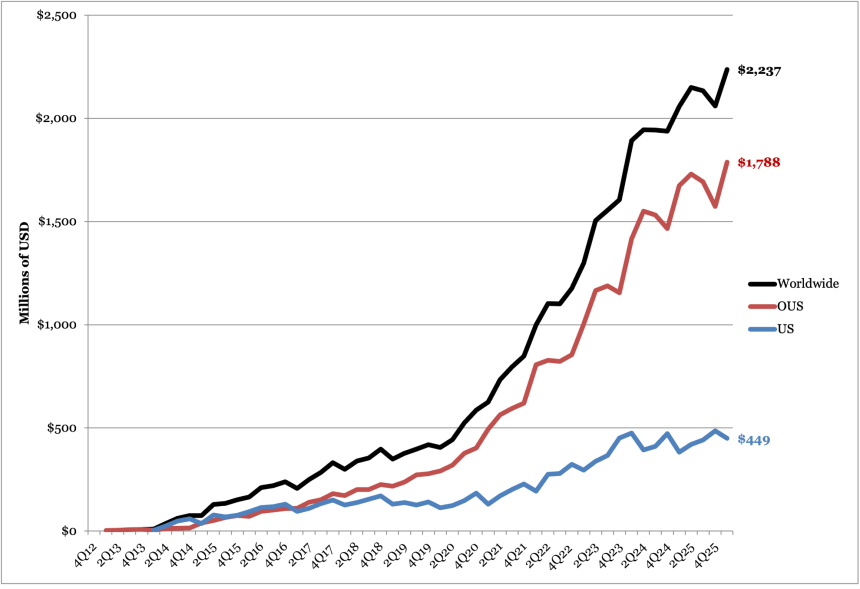
Farxiga Worldwide Financial Results
| Farxiga | 1Q25 | 2Q25 | 3Q25 | 4Q25 | 1Q26 |
| Revenue (Millions) | $2,057 | $2,150 | $2,134 | $2,060 | $2,237 |
| YOY Reported Growth (CER) | +9% (+17%) | +11% (+24%) | +10% (+8%) | +6% (+2%) | +5% (-3%) |
| Sequential Reported Growth | +6% | +5% | -1% | +10% | +9% |
Farxiga 1Q26 Geographic Financial Results
| Farxiga | Revenue (Millions) | YOY Reported Growth | Sequential Reported Growth |
| US | $449 | +17% | -8% |
| OUS | $1,788 | +4% | +14% |
| Total | $2,237 | -3% | +9% |
Pipeline Highlights
1. Oral GLP-1 RA elecoglipron to enter phase 3 development in 2026 for obesity and T2D; phase 2 data readout at ADA 2026
On today’s call, management discussed key clinical trial updates:
- Elecoglipron (AZD5004, oral GLP-1 RA). Dr. Barr shared new data from the phase 2b VISTA (n=310; obesity) and SOLSTICE (n=406; T2D) trials, which will be presented at ADA in June 2026. Leading up to the meeting, Dr. Kleinemphasized that expanding the number of oral GLP‑1 RA therapies will meaningfully increase access and personalization, particularly with respect to of heterogeneity of individual response across molecules, formulations, and delivery routes. In 4Q25, the candidate met its primary endpoints in both trials. The company will advance the candidate into phase 3 trials this year, as discussed in previous quarters.
- AZD6234 (long-acting amylin analog). While not discussed on today’s call, the company’s clinical trials appendixreaffirmed, as announced previously, that data from the phase 2b APRICUS trial (n=231; for overweight or obesity) and the phase 2 ARAY trial (n=69; for people with overweight or obesity and T2D taking GLP-1 RA) are expected in 1H26 and 2H26, respectively.
- AZD9550 (dual GLP-1/glucagon RA). Data from the phase 2b ASCEND trial (n=360), evaluating AZD9550 in combination with AZD6234, are expected in 2H26. As background, the trial began in 1Q25 and enrolled adults with obesity or overweight plus at least one weight‑related comorbidity (hypertension, dyslipidemia, or obstructive sleep apnea).
2. Farxiga + baxdrostat combination to launch in 2026, with PDUFA date in 2Q26
Farxiga is being evaluated in multiple phase 3 combination programs with baxdrostat (aldosterone synthase inhibitor), balcinrenone (non‑steroidal selective MRA), and zibotentan (selective endothelin A receptor antagonist). In 4Q24, Dr. Soriot emphasized the strategic need for combination approaches, noting that kidney disease is driven by hypertension (40%), diabetes (40%), and other causes (20%).
- Farxiga + baxdrostat: Three phase 3 trials are underway comparing Farxiga + baxdrostat combination versus Farxiga monotherapy:
- (i) BaxDuo-Arctic trial (n=2,554). In March 2024, AZ initiated the phase 3 BaxDuo-Arctic trial (n=2,554), examining the combination versus monotherapy in people with CKD and high blood pressure. The study is expected to be completed in February 2028, with a primary outcome of a change in eGFR from baseline to two years.
- (ii) BaxDuo-Pacific trial (n=5,000). AZ initiated this trial in 1Q25, investigating combination versus monotherapy in people with CKD and high blood pressure. The primary outcome is the time to first renal composite event with results expected in 2027.
- (iii) PREVENT-HF trial (n=11,300). AZ added the phase 3 PREVENT-HF trial (n=11,300) in 1Q25, examining combination versus monotherapy in people with T2D, a history of hypertension, established CVD, and other CV risk factors. The primary endpoint will be time to CV death or first heart failure event with results expected in 2027.
As background, baxdrostat was added to AZ’s pipeline following the company’s February 2023 acquisition of CinCor Pharma. Results from the BaxHTN trial were presented at ESC 2025 and simultaneously published in NEJM, demonstrating a significant reduction in systolic blood pressure in people with uncontrolled hypertension. The Bax24 trial, presented at AHA 2025, showed that baxdrostat significantly lowered 24-hour systolic blood pressure by 14 mmHg on average at Week 12 in people with difficult-to-manage hypertension. On today’s call, Mr. Ruud Dobber (EVP, Biopharmaceuticals) reiterated that the company is preparing an NME launch of baxdrostat in 2026 for difficult-to-treat hypertension, noting that commercial teams are already in place ahead of the therapy’s 2Q26 PDUFA date (June 2, 2026). The company anticipates gaining initial commercial access this year with broader Medicare Part D uptake over time.
- Farxiga + zibotentan: This combination therapy continues to be investigated in a phase 3 trial for CKD and high proteinuria. Initiated in 4Q23, the phase 3 ZENITH High Proteinuria trial (n=1,835) is evaluating Farxiga in combination with zibotentan versus monotherapy in adults with CKD and high proteinuria. The primary outcome is the change in eGFR from baseline to two years. Adults with T1D are excluded from the trial. The trial is expected to be completed in January 2027.
- In 2Q23, the phase 2 ZENITH-CKD study showed significant and clinically meaningful reductions in UACR at 12 weeks compared with dapagliflozin alone. After 12 weeks of treatment, the UACR difference of zibotentan/dapagliflozin versus dapagliflozin alone was 34%.
- Farxiga + balcinrenone: AZ is investigating this combination in the phase 2b MIRO-CKD trial (n=324) for CKD and a phase 3 BalanceD-HF trial (n=4,800) for HF and impaired renal function.
- Completed in 2Q25, the phase 2b MIRO-CKD trial (n=324) investigated Farxiga in combination with balcinrenone in adults with CKD and albuminuria. The primary endpoint was the change in UACR values from baseline to 12 weeks. People with T1D or uncontrolled T2D were excluded from the trial. Notably, at Week 12, the reduction in UACR compared to dapagliflozin monotherapy was 22.8% for balcinrenone 15 mg plus dapagliflozin 10 mg and 32.8% balcinrenone 40 mg plus dapagliflozin 10 mg.
- The phase 3 BalanceD-HF trial (n=4,800) for Farxiga in combination with balcinrenone in adults with heart failure and impaired renal function is currently recruiting. Study completion is expected in June 2027, with initial data anticipated in the same year. The primary outcome will be a composite of CV death, HF hospitalization, and HF event without hospitalization at 38 months. People with T1D are excluded from the BalanceD-HF.
3. Multiple MASH candidates in phase 1 and 2 development
AZ’s pipeline also features multiple candidates in phase 1 or 2 clinical trials for MASH, including for liver cirrhosis – the most severe stage of fibrosis. Of note, there are currently no therapies available for liver cirrhosis. See the table below for a summary.
Drug (mechanism) | Trial | Study population | Primary endpoint | Trial status |
AZD9550 (dual GLP-1/glucagon RA) | Phase 1 CONTEMPO(n=118) | Adults with overweight or obesity with or without T2D | Safety, tolerability, and PK parameters | Data anticipated in 2027 |
AZD2389 (anti-fibrotic mechanism) | Phase 2 BORANA(n=40) | Adults with liver fibrosis and compensated cirrhosis | Safety and tolerability | Data anticipated in 4Q25 (not yet published) |
zibotentan/dapagliflozin (endothelin A receptor antagonist/SGLT-2 inhibitor) | Phase 2 ZEAL(n=195) | Adults with cirrhosis with features of portal hypertension | Change in hepatic venous pressure gradient (HVPG) | Trial discontinued due to efficacy as of 2Q25. Data readout in 2Q25. |
AZD2693 (PNPLA3 ASO) | Phase 2b FORTUNA(n=220) | Adults with MASH and who are carriers of the PNPLA3 148M risk allele | Efficacy, safety, and tolerability | Trial discontinued due to efficacy in 3Q25. |
Mitiperstat (MPO inhibitor) | Phase 2 COSMOS(n=90) | Adults with MASH | Safety, tolerability, PD parameters | Trial discontinued as of 4Q24 due to “strategic portfolio prioritization” |
Source: AstraZeneca
4. Oral PCSK9 inhibitor laroprovstat (AZD0780) phase 3 trials ongoing; data expected in 2027
As of 2Q25, AZ has initiated three phase 3 clinical trials for laroprovstat (AZD0780). At JPM 2026, Dr. Aradhana Sarin (CFO) said that laroprovstat holds great potential because it is a once-daily, small-molecule therapy with no fasting or food restrictions.
- AZURE-LDL (n=2,800) will evaluate LDL-C reduction in patients with dyslipidemia and a history of clinical ASCVD or who are at risk of a first ASCVD event. Data is anticipated in 2027.
- AZURE-Outcomes (n=15,100) will evaluate the time to first event of any component of MACE-Plus, a composite endpoint that includes death, myocardial infarction, stroke, revascularization, heart failure, and thromboembolic events. Patients included will either have dyslipidemia and established ASCVD or will be at high risk of a first ASCVD event. Data is anticipated in 2027.
- AZURE-China (n=360) will evaluate pharmacokinetic parameters of AZD0780 in Chinese adults with dyslipidemia. Data is anticipated in 2027.
No further updates on this clinical trial program were offered in today’s remarks.
Close Concerns’ Questions
- How significant is the Farxiga-baxdrostat combination opportunity in extending the Farxiga franchise beyond loss of exclusivity?
- How do ecnoglipron’s phase 2 results establish it as a differentiated competitor in the rapidly evolving oral GLP-1 RA market?
- Could Farxiga be used in developing a therapy for pre-type 2 diabetes?
Analyst Q&A
On oral GLP-1 RA elecoglipron
Q (Seamus Fernandez, Guggenheim): Our question is on the positioning of the GLP-1 RAs and how you're thinking about that? Can you walk us through how the upcoming ADA presentation is really going to help us fully de-risk your strategy in this space? Help us understand that the safety supports the aggressive advancement into Phase III.
Could you also comment on whether these data are likely to convince investors that product half-life is key to differentiation on tolerability over and above planned titration schemes? We are trying to understand how the data coming at ADA is really going to wrap around the very broad Phase III program that you've initiated?
A (Pascal Soriot, CEO): Thank you, Seamus. This one is for Sharon, and maybe Ruud, you can also jump in. I just want to be clear that fully de-risking is a bit ambitious. We will fully de-risk when we are at the end of the Phase III program, but we are moving as fast as we can in o Phase III. So, over to you, Sharon/
A (Sharon Barr, EVP, BioPharmaceuticals): Thank you for the question, Seamus. As you know, the data is upcoming at ADA in June, so I cannot tell you what the data says. The conference organizers would frown on that. But we did announce that we completed the Phase IIb trials for elecoglipron and that the data that we saw in those Phase IIb trials, one for obesity and one for patients with T2D, gave us the confidence that we need to move into a very comprehensive Phase III development program.
We have dual goals there. We're looking at both weight loss efficacy and we're also looking at outcome benefits, which are key drivers for us because we are focused not solely on weight loss but on being able to address complex, interrelated comorbidities.
AstraZeneca is in a unique position with our broad portfolio. We are ideally suited to creating both monotherapies and fixed-dose combinations with elecoglipron that allow us to address comorbid disease. So, at ADA, we look forward to sharing the data and continuing this conversation. But what we saw in those data gave us the confidence that we needed to fully invest in our comprehensive program.
A (Ruud Dobber, EVP, BioPharmaceuticals): No, there's not a lot to add to what Sharon has said. The focus on outcomes and our strength with fixed-dose combinations, we have articulated a few of those potential combinations, and one of them is clearly with our SGLT2 inhibitor Farxiga. Last but not least, AstraZeneca is quite uniquely positioned regarding our global footprint. We have a very strong presence, as we all know, in the international markets, and there's still an incredibly high unmet medical need in those markets regarding obesity treatment, but clearly also diabetes.
A (Pascal Soriot, CEO): I will only add that we have a very ambitious Phase III program that is excellent, really. The team has done an amazing job. We have a very, very strong dataset, assuming, of course, the studies are positive, which we believe we have a good chance of that, of course, but we will have a very strong set of data across a very broad Phase III program to launch this product.
On baxdrostat
Q (Justin Smith, Bernstein): If I remember correctly, during the August call last year, post ESC baxdrostat, you said it could be above $5 billion. It could be above $10 billion; time will tell. Just wondered, over six months on for that, if those remarks are the same or if you would qualify those remarks at all?
A (Ruud Dobber, EVP, BioPharmaceuticals): Yes, I think that they are still the same. So once again, what we have indicated during the Investor Day is that this is potentially a $5 billion asset. Let's not forget that we are investigating. The $5 billion is built roughly half of that is in the fixed dose combination that study we will read out beyond 2027. The other one is the monocomponents, but we are also looking into a CKD for baxdrostat. There are other indications that, if successful, can move that number up to potentially $10 billion. That view hasn't changed at all.
A (Pascal Soriot, CEO): Very good. Let's end on that. Justin, you're making me nervous. We're moving into budget timing. But baxdrostat is definitely a big product. We're all excited to see it launch in many countries very soon.
-- by Kayla Mathieu, Elizabeth Rose, Kat Moon, Monica Oxenreiter, and Kelly Close