Insulet 1Q26 – $750m-plus top line, up 30%, fueled by international strength ($243 million, +59%); full-year guidance increase; full launch of updated Omnipod 5 algorithm coming soon –
Executive Highlights
- Insulet announced its 1Q26 financial results on a call today led by CEO Ms. Ashley McEvoy, CFO Ms. Flavia Pease, and COO Mr. Eric Benjamin (see press release, presentation, and webcast).
- Insulet's 1Q26 revenue totaled $762 million, up 34% from 1Q25 and down 3% sequentially. Total Omnipod revenue in 1Q26 totaled $758 million, up 37% from 1Q25 and down 3% sequentially.
- US Omnipod revenue in 1Q26 totaled $516 million, up 28% from 1Q25 and down 9% sequentially.
- OUS Omnipod revenue in 1Q26 was $243 million, up 59% from 1Q25 and up 14% sequentially.
- Following the strong start to the year, management raised its full-year 2026 revenue guidance, now projecting 21%-23% total company growth. Full-year 2026 Omnipod revenue is now expected to grow 22%-24% from 2025. US guidance was maintained, and this overall increase was driven by even greater confidence in OUS performance.
- Insulet continued to expand its global footprint in 1Q26, with management highlighting Omnipod 5, as well as Omnipod Discover, expansion into five countries in the Middle East in 1Q26: Saudi Arabia, Kuwait, Qatar, the UAE and Israel. Looking ahead, management reiterated that they plan to launch Omnipod 5 in Spain in 2H. Additionally, Greece and Croatia expansions are expected in 1H27.
- As part of its near-term innovation roadmap, Insulet highlighted a series of software-driven improvements aimed at enhancing glycemic outcomes without increasing user burden. Key algorithm updates will enter a full launch in 2Q26, including a new 100 mg/dL target that has already entered a limited market release and an updated algorithm to increase time spent in automated mode and reduce interruptions during prolonged hyperglycemia.
- Management also touted its progress toward a fully closed-loop (FCL) AID system, designed initially for people with T2D. They suggested that this system will be particularly suited for primary care settings and could significantly expand adoption in the large and underpenetrated T2D population. Insulet announced Monday that the first participant has been enrolled in the EVOLVE pivotal trial, which is intended to support an FDA submission next year and a potential launch in 2028.
- Insulet also highlighted continued advancement of its next-generation platform, Omnipod 6, which is currently in development with a planned launch in 2027. Data from the pivotal STRIVE trial evaluating the system will be presented at ADA 2026 by Dr. Lori Laffel (Joslin Diabetes Center) on Friday, June 5.
Table of Contents
-
Financial Highlights
- 1. 1Q26 revenue of $762 million (+34%); US Omnipod revenue totals $516 million (+28%) and OUS totals $243 million (+59%)
- 2. Management raises full-year 2026 revenue guidance to 21%-23% growth, with international Omnipod outlook increased to 26%-28%
- 3. Net income more than doubles to $91 million; free cash flow reaches $90 million
- 4. Nearly 1.3 million shares repurchased
-
Omnipod Highlights
- 1. International expansion continues: Omnipod 5 and Discover launch in Middle East, with footprint now reaching 19 countries
- 2. FreeStyle Libre 3 Plus integration in the US recently completed limited release
- 3. US prescriber base continues to exceed 30,000 clinicians, supported by expanded sales force
-
Pipeline Highlights
- 1. Software and algorithm innovation accelerates: Lower glucose targets and enhanced automation rolling out in 2Q26
- 2. Fully closed-loop for T2D advances: EVOLUTION2 data and EVOLVE pivotal study underway
- 3. Next-generation Omnipod 6 progresses toward 2027 launch; STRIVE pivotal data to be presented at ADA
- Analyst Q&A
- Close Concerns’ Questions
Financial Highlights
1. 1Q26 revenue of $762 million (+34%); US Omnipod revenue totals $516 million (+28%) and OUS totals $243 million (+59%)
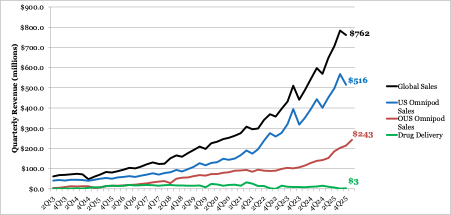
Insulet reported 1Q26 revenue of $762 million, up 34% from 1Q25 but down 3% sequentially. Consistent with prior quarters, Omnipod sales remained the core driver of performance, contributing $758 million, up 37% from 1Q25. Sequentially, Omnipod sales were down 3%.
- US Omnipod revenue reached $516 million, up 28% from 1Q25 but down 9% sequentially. Management attributed the year-over-year growth to continued strength in Omnipod 5 adoption across both T1D and the rapidly expanding T2D segment. Ms. McEvoy noted that monthly trends in T2D adoption improved throughout the quarter and into April, reinforcing confidence in the full-year 2026 outlook. She said that US growth benefited from sustained demand trends and strong commercial execution across both specialist and primary channels. Ms. Pease added that US revenue included a $10 million benefit from distributor order timing, which will reverse in 2Q26. The sequential decline was expected and tied to seasonality, specifically the annual reset of patient deductibles, which temporarily raised co-pays and coinsurance early in the year. In Q&A, Ms. McEvoy acknowledged that seasonality was “higher than usual” this quarter and suggested the Affordable Care Act transition may have also played a role. However, she reiterated her confidence coming out of the quarter and for full-year 2026.
- International Omnipod revenue totaled $243 million, up an impressive 59% from 1Q25 and 14% sequentially. Management cited accelerating uptake of Omnipod 5 in Europe, Canada, and Australia, as well as early momentum from recent launches in five Middle East markets. Ms. Pease noted that OUS growth was driven primarily by volume, supported by strong new customer starts and favorable price mix as user transition from DASH to Omnipod 5.
- Drug Delivery contributed $3 million, down 78% from 1Q25 and up 68% sequentially, consistent with expectations and prior quarters.
2. Management raises full-year 2026 revenue guidance to 21%-23% growth, with international Omnipod outlook increased to 26%-28%
Following the strong start to the year, management raised its full-year 2026 revenue guidance, now projecting 21%-23% total company growth. Full-year 2026 Omnipod revenue is now expected to grow 22%-24% from 2025, supported by greater adoption in both T1D and T2D populations.
- Full-year 2026 guidance for US Omnipod growth remained unchanged at 20%-22%, supported by continued new customers starts. International Omnipod revenue was raised to 26%-28% growth, reflecting strong early performance in recently launched markets (see below) and stable retention trends (~90% globally). Ms. McEvoy reiterated that international growth will continue to be driven by penetration in core European markets, expansion in Canada and Australia, and the upcoming Spain launch in 2H26, which she described as a high-potential market with “low AID penetration and strong CGM adoption.”
3. Net income more than doubles to $91 million; free cash flow reaches $90 million
Insulet reported a net income of $91 million, more than doubling from $35 million in 1Q25. Operating income reached $122 million, supported by strong revenue growth and ongoing manufacturing productivity gains. Free cash flow for the company was $90 million, up from $52 million in 4Q25. Insulet ended the quarter with $480 million in cash and cash equivalents, compared to $716 million at the end of 4Q25. The sequential decline in cash was primarily driven by share repurchase activity, with the company buying back ~$300 million of stock (1.25 million shares) during the quarter (see below). Despite this, Insulet retained liquidity, including access to a fully undrawn $500 million credit facility.
- Ms. Pease remained confident that Insulet would sustain strong cash generation despite increased R&D and manufacturing investments, noting that free cash flow for full-year 2026 is expected to be “approximately flat” compared to 2025 due to global capacity expansion.
4. Nearly 1.3 million shares repurchased
Insulet repurchased 1.25 million shares of common stock during 1Q26 for approximately $300 million. Management said that the buyback reflects confidence in the company’s long-term growth trajectory and strong cash generation, even as Insulet continues to invest significantly in R&D and manufacturing capacity. The repurchase contributed to a lower diluted share count and supported the company’s commitment to disciplined capital allocation.
Omnipod Highlights
1. International expansion continues: Omnipod 5 and Discover launch in Middle East, with footprint now reaching 19 countries
Insulet continued to expand its global footprint in 1Q26, with management highlighting Omnipod 5’s expansion into five countries in the Middle East in 1Q26: Saudi Arabia, Kuwait, Qatar, the UAE, and Israel. This brings total Omnipod 5 availability to 19 countries. Alongside this AID rollout, Insulet simultaneously introduced Omnipod Discover to the region, a new web-based data analytics and reporting platform that is designed to simplify diabetes data interpretation for users, caregivers, and healthcare providers.
- Looking ahead, management reiterated that they plan to launch Omnipod 5 in Spain in 2H. Additionally, Greece and Croatia expansions are expected in 1H27.
2. FreeStyle Libre 3 Plus integration in the US recently completed limited release
Insulet completed a U.S. limited market release one step closer toward a full integration of the FreeStyle Libre 3 Plus CGM with Omnipod 5. Management emphasized that this integration will expand access to the large installed base of FreeStyle Libre users — approximately 450,000 people in the US — unlocking a significant new population that could consider Omnipod 5 adoption. The integration is expected to be a key near-term growth driver, particularly as the company continues to target conversions from MDI to AID.
- FreeStyle Libre 3 Plus integration with Omnipod 5 in the US joins FreeStyle Libre 2 Plus and Dexcom’s CGM portfolio, which includes G6, the 10-day G7, and G7 15 Day. While FreeStyle Libre 3 Plus compatibility with Omnipod 5 has not yet taken place internationally, several markets in Europe and the Middle East are already interoperable with FreeStyle Libre 2 Plus[1].
3. US prescriber base continues to exceed 30,000 clinicians, supported by expanded sales force
Insulet’s US prescriber base includes more than 30,000 healthcare professionals. This is up from nearly 25,000 providers in 1Q25 and consistent with the prescriber base described at the end of 2025. In 4Q25, management explained that this growth has been driven in part by its prescriber base for T2D, which grew 62% from 2024.
- In Q&A, Ms. McEvoy said that Insulet has “doubled the amount of their professional events in the past quarter” and executed 500 peer-to-peer education programs in 2025. She emphasized that prescriber activation remains a central growth driver across both T1D and T2D and noted that Insulet is “upskilling their sales force to strengthen our messaging on clinical performance.”
Pipeline Highlights
1. Software and algorithm innovation accelerates: Lower glucose targets and enhanced automation rolling out in 2Q26
As part of its near-term innovation roadmap, Insulet highlighted a series of software-driven improvements aimed at enhancing glycemic outcomes without increasing user burden.
- Key algorithm updates will enter full launches in 2Q26, including a new 100 mg/dL target. As Chief Medical Officer Dr. Trang Ly explained at ATTD 2026, upon lowering the target from 120 mg/dL to 100 mg/dL, patients demonstrated a 4.8% increase in Time in Range, with a 12% increase in insulin delivered, allowing for tighter glycemic management. Management emphasized that this represented a meaningful clinical benefit achieved through a simple settings change. The updated algorithm has already entered a limited market release, and a broader launch expected in the coming weeks.
- In parallel, the algorithm has been updated to increase time spent in automated mode and reduce interruptions during prolonged hyperglycemia, which Ms. McEvoy said was a key pain point for both users and prescribers. She added that Insulet is pairing these two launches with greater clinical education to ensure HCPs understand the improved clinical efficacy of the system.
2. Fully closed-loop for T2D advances: EVOLUTION2 data and EVOLVE pivotal study underway
Insulet continues to make progress toward its FCL AID system for people with T2D, which is designed to require no bolusing, settings, or user interaction – though we imagine patients could still benefit from some degree of engagement. Encouraging data from the EVOLUTION2 feasibility study were presented at ATTD 2026 by Prof. Martin de Bock (University of Otago, New Zealand), demonstrating ~68% TIR without boluses. Building on this momentum, Insulet announced Monday that the first participant has been enrolled in the EVOLVE pivotal trial, which is intended to support an FDA submission next year and a potential launch in 2028. The study is expected to enroll up to 350 participants across a maximum of 40 US sites.
- Management emphasized that this system will be easier to set up in primary care settings and could significantly expand adoption in the large and underpenetrated T2D population. We imagine that the absence of prandial boluses makes T2D be perceived as less risky than T1D, contributing to Insulet’s “T2D first” approach with this technology. Insulet haspreviously said that it plans to extend the FCL platform into the T1D population sometime after 2028.
3. Next-generation Omnipod 6 progresses toward 2027 launch; STRIVE pivotal data to be presented at ADA
Insulet also highlighted continued advancement of its next-generation platform, Omnipod 6, which is currently in development with a planned launch in 2027. The system will feature Insulet’s third-generation algorithm with further improvements in automation, reduced user interaction, and better clinical outcomes. Data from the pivotal STRIVE trial will be presented at ADA 2026 by Dr. Lori Laffel (Joslin Diabetes Center) on Friday, June 5. In addition to algorithm improvements, management discussed design enhancements aimed at simplifying the user and provider experience, including a move toward a single pod configuration that streamlines prescribing and supports greater flexibility.
Analyst Q&A
On Insulet’s long-term plan
Q (David Roman, Goldman Sachs): Ashley, you've been in the role now just about a year. Could you frame the past year with your observations here? What’s gone in line with your expectations? What's going better? Where are the areas where you're focused and how are you framing Insulet now that you've been in the role 12 months?
A (Ms. Ashley McEvoy, CEO): Just last week, I marked my one year. I would say that I'm absolutely more confident now than that Insulet's potential than a year ago. You know us really as this high growth MedTech innovator doubling revenue over the past couple of years. So, I would say first and foremost, I'm preserving what makes us so special. It's this culture is remarkable. Patient focus entrepreneurial spirit and really strong competitive moats, and really just focusing around how we enhance our capabilities to really double the business once again. It’s just helpful to share some of the areas that we've been getting after as a team to unlock more value.
I would first start with innovation, and this is about doing things in parallel and at pace to continue our role as the tech leader. So, let me give you examples. It's really about being first in line to integrate day one with sensors like we're doing with the Dexcom G7 15 Day, and we will do added upcoming dual analyte sensor algorithms. David, we were slow out of the gate continuously to improve our algorithms. We've addressed that now, and we have three algorithm improvements over the next three years.
Second, is really about international and driving profitable growth globally. I'm a big believer in going deeper in core markets that matter most versus going broader at this stage. The UK is a great example of this. We're several years in the OP 5 launch. This quarter we posted record NCS. The third is about our commercial engine and being famous not just as a tech leader, but as a commercial engine. We have our second sales force expansion we've done in the past 12 months. It's happening this quarter. I've been consistently saying, it's really upskilling our force to sell clinically.
The fourth is really about strengthening our unbelievable foundation on operations as we scale globally. Costa Rica is a really good example of this. We just put in the foundation this quarter. We'll be ready to have a water type building by year end and go live in 2029. Obviously, it's all about people. I came here and there was a remarkably talented team, and I'm just supplementing that team with some new leaders that have run bigger things and know how to scale. So collectively, we can get after doubling the business again. This is what gives me confidence that we're going to continue to grow the category, serve more Podders, and really importantly, continue to increase our earnings power.
On guidance
Q (David Roman, Goldman Sachs): If you take 1Q26 performance in the second quarter guidance into consideration, the outlook implies kind of high team's growth in the back half of the year. Can you help us unpack that on a geographic basis, and your confidence into the 20% LRT guidance, if you exit 2026 potentially below that level? Is there some conservatism in the outlook, given the timeline where we are in the year?
A (Ms. Flavia Pease, CFO): Yes, the midpoint of the guidance will imply second half growth in the high-teens. I would first start by saying we still seen very, very strong performance in both the US and internationally, and as you saw, we just raise our guidance, for international and the total company, right now, last year there were a different and you tried. You asked me to unpack between the two regions. In the US last year, we saw the opposite impact with comps playing a role in how this year first half second half compares to last year first half, second half.
In international, we're going to continue having favorable impact of price mix realization. But it's going to be at a more moderate pace as we increase penetration of Omnipod 5 in our international markets. So, when we look at the comps, I do think it's also important to look at dollars of growth. When you look at this year, in total year, we're actually going to be in line at the midpoint of the guidance with the same level of dollar growth that we delivered last year.
The first half, second half is going to be different, but the primary driver of that is actually currency. If you look at us, and look at the numbers on a constant currency basis, we had the currency playing a role in the second half of 2025. That was a tailwind in the first half of 2026, again as a tailwind. So, when you adjust for those things, the first half second half phenomenon gets a little bit smoother I would say but importantly let me close where your question was leading to, which is how does this play out in terms of our outlook for next year?
On the sustainability of our 20% we feel very, very confident in our ability to drive that 20%. And what gives us that confidence are the innovation and commercial catalysts that we're going to continue to execute. This year, we're launching Libre 3 plus, which, as you saw in our prepared remarks, expands our team by another 450,000 people with diabetes. We have the algorithm enhancements. Ashley talked about the ones we're launching this year. We're going to continue with Omnipod 6 next year and then fully closed-loop in 2028 and then commercially in addition to leaning further on cleaning, selling clinically and competitively Ashley, also just mentioned that we're going to be expanding our sales force this quarter. As you can imagine, the full benefit of that expansion is really only going to be felt mostly next year. We do see that as another tailwind.
Internationally, similarly, those new product introductions are also going to have a benefit. We're going to launch Libre 3 Plus in Germany and Canada. These are two markets where there's no added sensor. Those are compatible with our products. That is another expansion of our serviceable market. In addition to that, we're going to continue to execute on our playbook of increasing access. You saw us just get the benefit of that for Canada this year with expansion of coverage and additional provinces. We just launched in the Middle East. We're going to be launching in Spain in the second half. So again, we feel very, very confident that we have the right innovation and commercial levers to continue to support the 20% growth that we put out.
Q (Robbie Marcus, JPMorgan): I want to follow up on that last question. Flavia, as we think about similar dollar growth this year that does imply deceleration as the sales base gets lower. You did mention they're going to be exiting sub 20% in the US in the second half of this year. How do you maintain that 20% growth rate over the LRP, if you're decelerating into year end and dollar growth is not increasing year-over-year? Can you fill us in on the gaps about 2027 and how that improves?
A (Ms. Pease): Going back to what I just articulated. We will continue to drive the 20% with the innovations that we're launching in 2027. We do have Omnipod 6, and the full benefit of the salesforce that we're expanding this year that will be a tailwind.
A (Ms. McEvoy): Maybe it will be helpful of our philosophy of how we set guidance, a year ago, I came in and we got the team together. We refined our strategic plan. We racked and stacked a whole portfolio of growth opportunities. This led us to really a strengthened conviction in the untapped market opportunity. Flavia was talking about the high and low penetration and, quite frankly, our proven track record of unlocking that growth.
This led us to really raise our ambition as a company, which we shared at our IR day, which is the first one we've done in ten years in November. We shared our strategies, our financial algorithm, and then we set our financial targets accordingly. Our goal is to outperform. Our quarter one results reflect us along with our increasing full year outlook for the year. This is just really good momentum. It gives us confidence in our commitments that we shared at our LS day.
Q (Jayson Bedford from Raymond James): On the 2Q26 International Growth guide, it implies a bit more of a deceleration than I would have thought, given what was a very strong 1Q comps not too much different. Is there any docking impact in 1Q26 that is related to the new international countries and then, outside of the comp, what ways on 2Q26 international growth?
A (Ms. Pease): In international, while, as I said, price mix realization will continue to be positive. The pace of it will moderate a little bit as we sort of anniversary some of these launches and, continue the evolution of our involvement from Omnipod DASH to Omnipod 5. The dollars will continue to be sequentially increasing quarter-over-quarter on a constant currency basis, but the growth rate, as you pointed out, will decelerate.
Q (Matt Taylor from Jefferies): On the tailwinds that you called out in 2027, specifically on Omnipod 6, do you expect that launch to drive just increased share gains and customer starts or could you actually get price mix benefits from the launch of Omnipod 6 as well?
A (Ms. McEvoy): This is going to be our sixth generation. It's really to continue to extend our leadership and deliver our role of continuing to build a category and bring people in from MDI. It will have our third algorithm improvement. I come back to the simplicity. If you're on MDI, how to keep it really simple. This new algorithm is going to have greater automation. It's going to have less focusing. It's going to have a reduced user interaction. It was designed exactly to bring more people into the category.
We're going to have some of our data shared at the ADA coming up in June of our STRIVE which will show about our clinical performance. But the funding may be underappreciated, as I would share is sensors have gotten really small and our Omnipod 6 also has dramatic improvement in what we call over-the-air improvements, so that people can wear it on multiple places of their body we get a lot of feedback on that. Importantly, we're also moving to a single pod, which allows prescribers to only write one script versus two scripts regardless of your sensor. It clearly has a big impact on our supply chain and simplification.
On seasonality
Q (Robbie Marcus, JPMorgan): You talked about a slowing market on seasonality and new patient starts in first quarter. One, what do you think? The market grew, and I know it's hard to give an answer without everybody else reporting yet, but what do you think? Why was it more seasonal than usual? How do you think your new patients start to see us getting first quarter?
A (Ms. McEvoy): I don't have the market exit. I would tell you 2024 and 2025 at an accelerated rate versus prior years. We're encouraged with the continued momentum. Listen, quarter one started off slow because we had higher than usual quarter one seasonality. We attribute this to the reset of deductibles and potentially the ACA transition but sequentially every month we’ve been getting better. I feel really good coming out of April as we look to quarter two and for the full year.
On T2D
Q (Travis Steed, Bank of America): On T2D retention comps, it’s curious what you’re seeing there. How is T2D ramp is going?
A (Ms. McEvoy): I mean, our T2D momentum remains strong. Our new customer starts in T2Dgrew meaningfully both year-over-year in the quarter this 1Q26 seasonality that I spoke about, when we look at our customer base, we expanded both sequentially as well as year-over-year. We’re very much at the early innings of this. I say we’re about 5% penetration and CGM is around 55%. We are actively preparing for a highly transformative launch where we’re going to be sharing our feasibility data at the upcoming ADA called EVOLVE.
We’ve just enrolled our first patient last week, and this will be what I call the industry’s first truly, fully closed-loop system for T2D and like, what do I mean by that? It’s a CGM like as you can get you put it on no bolus, no user interaction, no settings which unlock the whole primary care physician audience and really user consumer friendly training. we specifically designed our fully closed-loop to unlock that huge TAM in T2D where they need it to be a CGM like experience.
Q (Travis Steed, Bank of America): What about the retention piece?
A (Ms. McEvoy): We have healthy retentions. We’re not seeing any meaningful change year-over-year. We’re getting to know this market. We’re I would say we’re innovating our customer experience model. From an aggregate basis, our total company, we still have about 90% retention.
A (Ms. Pease): I would just say I think you were alluding to my prepared remarks. I talked a bit about a slight deterioration in the US as we continue to expand into T2D, but this was very much in line with our expectations it is a different population and the retention or attrition is exactly what we expected it would happen. We are pleased also to see that internationally, the retention actually, as we launched, Omnipod in additional markets has improved meaningfully and so on a total company basis. As Ashley said, retention remains very stable.
Q (Jeff Johnson, Baird): On T2D, I want to make sure I understand the retention and utilization comments you’re making on the US, utilization with stable retention, under a little bit of pressure. Is that implying that if I’m a T2D patient going on Omnipod 5, I’m using it every day or pretty much normally like a T1D, but just more of those T2D patients are trying it for three months or six months and then saying, maybe it’s not for me. But more of those T2Ds, are maybe dropping out after three or 6 or 9 months, not sticking with it. Is that the way to think about what you’re trying to communicate today?
A (Ms. McEvoy): I think what we’re learning in the patient journey of being T2D, again, we’re sourcing the predominant amount from MDI is a little bit of the ongoing support. Is a little bit of the ongoing support it takes them to get them on to Omnipod and the reinforcing support that we need to do really early on, and then it smooths out and really there’s a learning agility that has to happen early on. But and then what we’re finding is really good brand loyalty and really good retention over time. It is a bit of a different class than what we’ve said in T1D, but overall very encouraged with the progress that we’ve had about 18 months into this launch. Do you want to add anything to that?
A (Mr. Eric Benjamin, COO): No, I think exactly as you described, we’re seeing as you laid out utilization or Y2D stable, pretty similar to T1D and retention, the drop off particularly early. Getting folks accustomed to wearing the product as actually described is a little bit different. And so we’re learning and evolving our model of how we get folks successfully on so that they can stay enduring happy, successful customers on Omnipod.
On new patient starts
Q (Travis Steed, Bank of America): And then what percent of the new starts were typed to this quarter? I think I missed that. And then when you think about the seasonality comments, is there any impact on the seasonality from the Type 1, Type 2 mix or kind of the macro?
A (Ms. McEvoy): We had really healthy total year-over-year growth. We experienced some softness, Q1 is a slower start for trends. Our customer base is strong. I often get asked the question about type 2, and I told you, we've got really strong momentum. I often get asked about like the GLP-1s. Is that slowing down progress in type 2s? We did not observe an impact from increased GLP-1 use on type 2. We think that GLP-1s are very complementary to AID therapy, not competitive. It's in fact what we studied in our SECURE-T2D trial.
We see diabetes as a chronic progressive disease and nobody has been able to show that you can reverse beta cells. So, once you get on insulin, AID is really the standard of care from the ADA and we look again at this huge TAM of 5.5 million people with type 2 diabetes using insulin, and yet only 5% or less are using AID. We really look to unlock this right now and drive accelerated penetration when we have our fully closed loop launching in 2028.
A (Mr. Benjamin): Just to build on the numbers, the split of type 1, type 2 NCS was about 40% type 2 NCS in the quarter with similar seasonality seen in type 1. We saw ever so slightly more in type 2, but consistent across the two segments.
Q (Matthew O'Brien, Piper Sandler): I hate to beat this dead horse on new customer starts in Q1, but you've got a bunch of new competitors in the pharmacy channel. I just want to make sure there wasn't any kind of disruption, maybe early in the quarter, as they were pushing on the pharmacy side making it more difficult for you to get patients through that channel. Could that be why you saw a little bit of softness? And then my second question is there's a lot of investor consternation around the recall. Can you just frame up what you're seeing in the marketplace or from your customers in terms of the recall and the impact it's had on the business and then ability to add new patients?
A (Ms. McEvoy): Let me first be very clear. In quarter one, we don't think price had an impact. In fact, US pricing for us was positive in quarter one. We expect this to continue for the full year. What we've been seeing as others have entered the pharmacy channel, pricing and rebate behavior has been really rational and disciplined. So we are not seeing significant discounting relative to the norm. Our strategy is about creating durable, high-quality access with broad affordability. We are not going to trade long-term value for short term positioning.
I think what's really important to understand that is maybe not fully appreciated is the significant size and scale that we benefit from. Our volumes are multiples larger than the nearest competitor, and we don't expect that dynamic to change now or in the foreseeable future. That, coupled with us being the number one prescribed brand and the #1 requested, is what gives us confidence for pricing. But we still lead with a competitive advantage.
On your second question about quality and our recent medical device correction. I would say in our industry, actions are a part of being in a healthcare industry. But it was an absolute tough moment for us. And patient safety is always our number one priority. We are monitoring and we're investigating customer complaints routinely. I am proud with how our team rapidly responded to the voluntary medical device in March. We do not believe that the medical device correction did have an impact on NCS in the quarter. As I discussed, I believe the slower start was really due to the broader quarter one seasonality and the reset of the deductibles.
Now, last week was another tough week, with the FDA updating its communication about our MDC to reflect our April 10 update and misreported numbers as essays. I know this created a bunch of confusion, and we're really not happy about that. What's important to know, though, is no additional adverse events from the MDC have been reported since the April 10th update. And if anything, I think this really enunciated the high level of complexity of manufacturing sophisticated disposable electromechanical devices at scale. In our industry, it's not possible to eliminate all risk. But what matters most is how issues are identified and addressed. And in this case, we got after it early. We've implemented target of corrective actions, and we are going to continue to strengthen and invest in our quality systems and operating controls.
On future patch pump competition
Q (Larry Biegelsen, Wells Fargo): I'm going to try to ask the competition question a little bit differently than it's been asked before. You believe it'll be hard for competitors to manufacture tubeless pump or ramp the manufacturing. I don't think you're saying that there won't be any tubeless competition in the future. My question is, as your share of tubeless pumps declines from 100% today mathematically it has to go down if there's a competitor – what offsets that in order to maintain your 20% growth goal? Is it faster overall market growth or is it a greater shift from tube to tubeless pumps or both?
A (Ms. McEvoy): The short answer is this is not market share trading. This is about bringing new people into the category and expanding the category as a whole. I mean, we're the market leaders and we have a substantial distance versus the others. And I fully expect us to sustain shared leadership. We have no intention of ceding our tech leadership in next year. We're going to be on our sixth generation Omnipod while others attempt to come out with their first. We know there's been a history of the competition trying to work on tubeless solutions for decades, which really underscores how complex it is to bring these highly disposable devices to market. There's really a graveyard of a lot of failed attempts. We have a head start of really mastering how to develop and manufacture at scale, and this has given us a remarkable cost advantage and scale advantage, and we've got the earnings power to keep growing.
I think what's really important in this category is to understand that when new entrants enter, all boats rise. This increased promotion and the increased awareness will accelerate category expansion, which is exactly what we're seeing in type 2. When you look back from four years ago, we had about 60% of patients coming from MDI into the AID category, and that number is now 80%. So, the category is expanding.
On pricing in the pharmacy channel
Q (Jeff Johnson, Baird): I wanted to follow up on that pricing comment. You said net pricing was up in the US in 1Q. That's actually net of rebates up in 1Q, and it sounds like you're expecting that to be true for the year as well. We're hearing from a couple of our other companies that we speak with that they're expecting pharmacy pricing next year on a net basis to also be up again in 2027/2026. I know that's hard to predict at this point, and you won't know until you know later this year. But as we're trying to set up our models for the next year or two, would you still build in kind of flattish pharmacy pricing in the US market? Would that still be kind of how you'd guide us as we build our market or our model over the next couple of years?
Ms. McEvoy: I would say consistent with our Investor Day, Jeff, we expect pricing to be positive over the next three years. And quarter one is a data point. And we expect that to continue in full year 2026. Again, it speaks to just the strength of the clinical and the economic value proposition that ID as a category has for payers and for PBMs.
On 1Q26 performance
Q (Shagun Singh, RBC): Can you elaborate on the nature of the $10 million in revenue that shifted into Q1? And then I was hoping you could also talk a little bit more on the commercial front. You guys are strengthening your message around the algorithm time and range. You've called out three algorithm launches in the next three years. How meaningful are those upgrades and the US sales force expansion? Any way to think about the pace of that? And should we expect you to continue to do that throughout 2026?
A (Ms. McEvoy): Let me start with your first question. We had about $10 million just from some inventory from that was coming in quarter one. That’ll come out of quarter two. We had 29% growth last year, so we do have a stronger comparison. But we see momentum continuing in in the US. You’ve heard me talk a lot about what are we doing commercially to strengthen our engine, and there's a couple of things that I would share to your point.
Number one is investing in our field. It's our number one personnel item, making sure that we are upskilling our force to sell clinically, in addition to their passion of selling our disruptive form factor. We've just retrained and retested all of our reps. We actually have the largest sales reps force in the category and then we are expanding our call points with improved targeting and segmentation and improving our reach and frequency with an expanding prescriber base. They've gotten really good momentum of selling our optimized setting, which improves Time in Range. They're going to be out there this quarter talking about our new lower set point at 100 mg/dL, as well as keeping people in automated mode more. We're integrating with FreeStyle Libre 3 Plus, which brings with us 450,000 users from MDI that are on the CGM who are not yet on Omnipod. You can look at our website where we're listing all our updated clinical evidence relative to what's available in the industry. Please take a look at that.
Obviously maintaining our competitive advantage and market access and affordability is the second lever.
The third is really about getting our clinical performance out there. We've doubled the amount of our professional events in the past quarter. We executed 500 peer-to-peer education programs in 2025, really all about clinical performance.
The last really is about this brand. It was really cool to see us being dropped into culture on Scrubs. We got a lot of feedback of making the category really accessible to a lot more people, and this is what we will continue to do to grow the category.
Close Concerns’ Questions
- Does Insulet expect the share of new US starts with T2D to continue to increase or stabilize close to current levels?
- How will Insulet balance rapid international expansion with reimbursement and provider training across new markets?
- What early feedback has Insulet received from the limited US rollout of FreeStyle Libre 3 Plus integration with Omnipod 5?
- Does Insulet have a timeline for when it will expand FreeStyle Libre 3 compatibility internationally?
- Does Insulet expect the full launch of FreeStyle Libre 3 Plus compatibility in the US will meaningfully shift trends in new patient starts from MDI versus competitive switchers?
-- by Jeremy Alkire, Riya Chatterjee, Monica Oxenreiter, and Kelly Close
[1] These include the UK, the Netherlands, Italy, Belgium, Switzerland, France, Saudi Arabia, Kuwait, UAE, Israel, the Nordic countries, and Australia.