FDA approves MannKind’s Afrezza as first inhaled bolus insulin for use in children and adolescents with diabetes –
Afrezza to be capped at $35 per month for youth under 23 years old, regardless of insurance status
MannKind announced this morning that the FDA has approved Afrezza as the first and only inhaled mealtime insulin for children and adolescents aged six and older with T1D or T2D. In the afternoon, CEO Dr. Michael Castagna and SVP and Therapeutic Area Head of Diabetes Dr. Kevin Kaiserman led a conference call, sharing more insights on the approval and launch strategies. See the webcast here.
This milestone expands treatment options for more than 350,000 young people in the US, with the company positioning Afrezza as a needle‑free option designed to fit the unpredictable rhythms of childhood, from school to sports to spontaneous snacks.
In addition to today’s approval, Afrezza is recognized in the ADA Standards of Care, alongside multiple daily injections and insulin pumps.
Table of Contents
- Afrezza is capped at $35 per month for patients under 23
- Approval is based on results from the phase 3 INHALE‑1 trial
- Conference call highlights strategies for commercial launch and growth
- Implications for children, families, and the diabetes community
- Afrezza revenue totals $15 million in 1Q26, capturing 1% of the global rapid-acting insulin market
- Close Concerns’ Questions
Afrezza is capped at $35 per month for patients under 23
MannKind underscored that affordability is central to its pediatric launch. As part of the approval, the company is extending its pricing program so that any patient under 23 years old can obtain Afrezza for $35 or less per month, independent of insurance status or coverage limitations. This structure is designed to ensure that cost does not become a barrier for families navigating a new mealtime insulin option, particularly in the early years after diagnosis when treatment routines are still forming.
The company noted that Medicaid coverage is expected to bring monthly costs even lower in many states and that families will have access to individualized support through MannKind Cares to help navigate coverage, prior authorizations, and pharmacy fulfillment.
Approval is based on results from the phase 3 INHALE‑1 trial
The approval was based on a 26‑week pivotal phase 3 INHALE‑1 trial (n=230), which evaluated Afrezza versus rapid‑acting analog (RAA) insulin in children and adolescents (aged 4-17 years) with T1D. Participants used CGM throughout the study. The trial’s primary endpoint, change in A1c tested for noninferiority with a 0.4% margin, was not met in the intent‑to‑treat analysis. Mean A1c rose slightly from 8.2% to 8.4% with Afrezza and remained stable at 8.2% in the RAA group, yielding an adjusted difference of 0.18% (CI: -0.07-0.43). However, when the analysis excluded one participant who did not adhere to trial protocols and ended the study with an A1c of 15%, the mean A1c in the Afrezza group fell to 8.37%, meeting the specified noninferiority margin.
The clinical measures were comparable between groups. Time in Range (70-180 mg/dL) did not differ significantly, and severe hypoglycemia was rare in both groups. Importantly, children using Afrezza reported greater treatment satisfaction and experienced less weight and BMI percentile gain than those using injected RAA insulin.
Conference call highlights strategies for commercial launch and growth
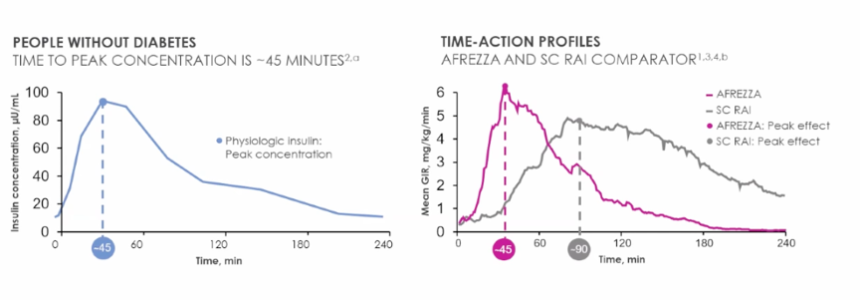
During the call, Dr. Castagna said that Afrezza is the first alternative to mealtime insulin in over a century for children and adolescents. As an inhaled insulin, it has pharmacokinetics (see figure below) that mimic insulin physiology more closely, allowing users to take Afrezza at the beginning of a meal without the need to pre-bolus and minimizing the risk of insulin stacking. Moreover, Dr. Kaiserman said that Afrezza could address common challenges of glycemic management among adolescents such as missing doses, irregular meal patterns, and fear of injection.
Figure 1. Time to peak action of endogenous insulin, injectable insulin, and Afrezza
Source: MannKind’s webcast on FDA approval of Afrezza in pediatrics
Regarding commercial strategy, the company said that it will focus on adolescents on multiple daily injections (MDI) with an A1c >8%. Market research has shown that, over time, people on AID may also transition to Afrezza; however, it is difficult to project this figure at this time. Afrezza will be available at $35 or less per month, regardless of insurance coverage, to reduce barriers to access. MannKind also aims to raise awareness through: (i) KOL engagement at conferences; (ii) commercial activities in what the company characterized as a “concentrated market” of 60 key institutions and ~1,000 prescribers; (iii) education at schools and summer camps; and (iv) the MannKind Alfred E. Mann Scholarship for students pursuing higher education. To simplify prescriptions, MannKind is also offering pediatric starter kits for lung testing requirements, an online dosing calculator, and a field team including medical-science liaisons and patient navigators. During Q&A, the company said it has done significant preparatory work to identify patients in K-12 and colleges and “[lay] the groundwork appropriately.” With the launch planned on Monday, the company has already heard from physicians who expressed interest in prescribing Afrezza next week.
Looking forward, MannKind plans to file Afrezza’s 2-unit cartridge to the FDA by the end of 2026, which will give flexibility for smaller dose adjustments; a regulatory decision is expected in 2027. It also aims to launch INHALE IQ digital ecosystem next year, which tracks Afrezza doses with CGM data. The ongoing INHALE-1st pediatric study is currently evaluating Afrezza in new-onset T1D, as well, which could expand its uptake at diagnosis. In 2028, the company will work on developing high-concentration Afrezza (20-unit) to promote uptake in T2D.
Implications for children, families, and the diabetes community
In the press release, Dr. Desmond Schatz (University of Florida) said that mealtime insulin remains uniquely challenging for kids whose eating patterns, activity levels, and daily settings vary widely, and Afrezza’s ability to dose at the start of a meal directly addresses that gap. From the family perspective, Mr. Jeff Hitchcock (Children with Diabetes) said that treatment decisions are deeply personal and that no single approach works for every child, and this approval adds another option to the diabetes toolkit.
Afrezza revenue totals $15 million in 1Q26, capturing 1% of the global rapid-acting insulin market
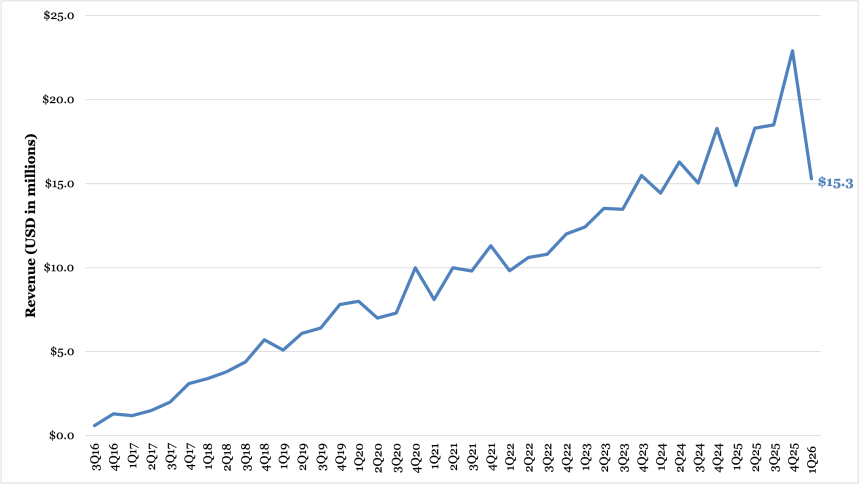
In 1Q26, Afrezza sales totaled $15.3 million, up 3% from 1Q25 but down 33% sequentially, Afrezza captured slightly over 1% of the global rapid-acting insulin market totaling $1.2 billion, consistent with previous quarters. Afrezza’s relatively weak performance last quarter was attributed to the reallocation of resources to prepare the launches of pediatric Afrezza and a salesforce reorganization that led to customer disruptions.
We are curious how the pediatric launch will impact the revenue and market share of Afrezza in the coming months.
Figure 2. Afrezza sales (3Q16 - 1Q26)
Source: Close Concerns Knowledge Base
Close Concerns’ Questions
- What marketing strategies will MannKind use to reach families, especially those who may be unfamiliar with inhaled therapies?
- How will MannKind provide education and support for school nurses and caregivers?
- What challenges might families and clinicians expect during the transition from injected rapid‑acting insulin to inhaled insulin?
-- Kayla Mathieu, Kat Moon, Monica Oxenreiter, and Kelly Close