2Q25 Therapy Industry Roundup – Double digit growth as diabetes therapy market totals ~$22 billion (+14%) and obesity rises to $6.6 billion (up 2x); D/O +14% –
Executive Highlights
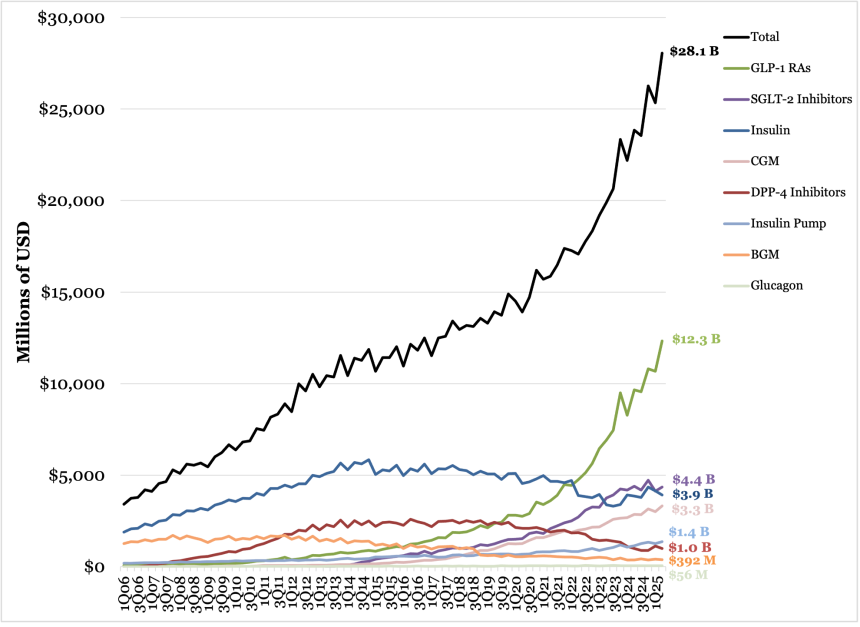
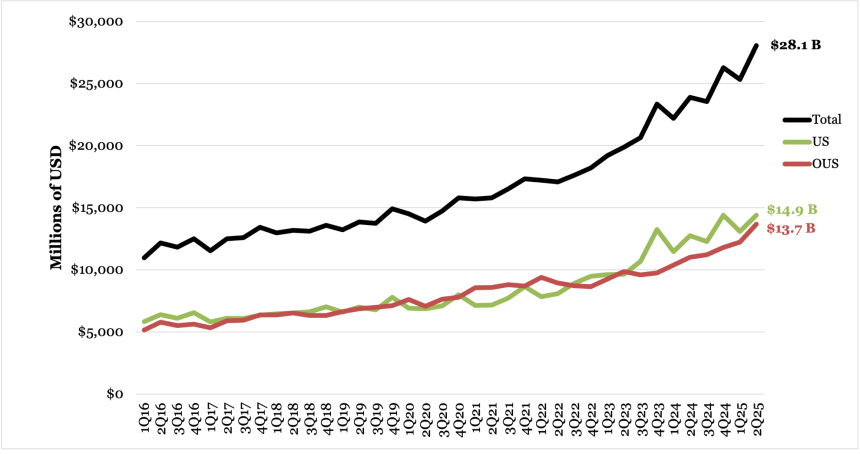
- In 2Q25, the global diabetes market grew 18% from 2Q24 and 11% sequentially to approximately $28 billion – suggesting that the field is annualizing over a hundred billion dollars. GLP-1 RAs accounted for a significant majority of growth (63%), led largely by OUS growth (63%). Since the approval of exenatide in 2005, GLP-1 RAs’ contribution to market growth increased over time. In 2000s, GLP-1 RAs accounted for ~2% of the growth, which quickly increased to over 10% in early 2010s, ~40% in 2018 when Ozempic was approved, and ~50% since 2022 when Mounjaro was approved. Aside from diabetes technologies like CGMs, insulin had the next highest contribution (2%) to the growth of diabetes market, followed by DPP-4 inhibitors (0.2%), and SGLT-2 inhibitors (0%). Notably, SGLT-2 inhibitors sales declined slightly by 1% in 2Q25, which is unsurprising given 17% growth for the class in 2Q24 and likely reflects that the class is going generic following the expiry of one of the patents for J&J’s Invokana in April 2025. Overall, therapy and technology revenue for the field reflected US revenue of $14.4 billion, up 13% from 2Q24 and 10% sequentially and sales of $13.7 billion outside the US, which rose 24% annually and 11% sequentially.
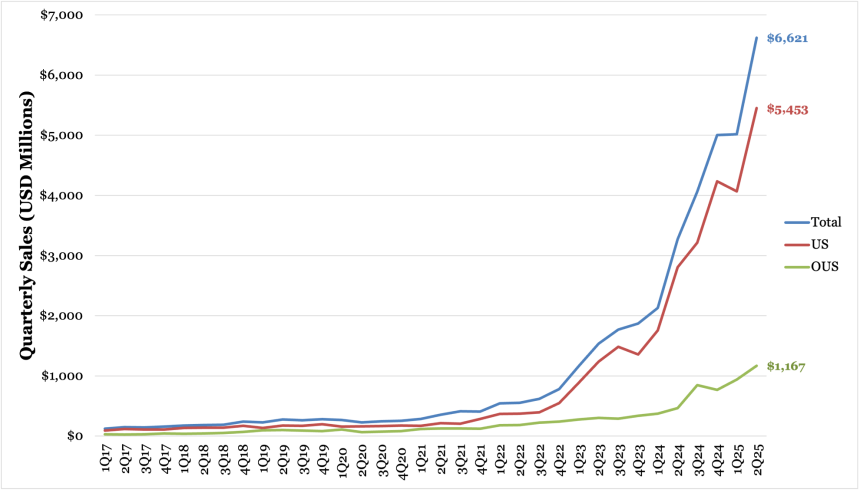
- Including global obesity sales of $6.6 billion (up 2x from $3.3 billion in 2Q24), the combined diabetes and obesity market totaled $35 billion, up 28% from 2Q24 and up 14% sequentially. Rapid growth in the obesity market continues to reflect blockbuster sales of Lilly’s Zepbound, which captured 51% market share (up from 46% in 1Q25) and Novo Nordisk’s Wegovy, representing 46% of the market (down from 50% in 1Q25). US sales totaled $5.5 billion, up almost 2x from 2Q24 and up 34% sequentially, while sales outside the US reached $1.2 billion, up 2.5x from 2Q24 and up 24% sequentially. In the US, compounding business have impacted the branded obesity market, leading Novo Nordisk to lower the 2025 guidance by six to eight percentage points for the second time this year. Both Lilly and Novo Nordisk continue to increase access by launching cash-pay Zepbound and Wegovy at their direct-to-patient platforms.
- Diabetes therapy revenue in 2Q25 totaled $21.9 billion, up 14% from 2Q24 and up 7% sequentially. By geography, OUS sales showed the strongest growth at over 20% though US sales were slightly greater – specifically, US sales totaled $11.2 billion (+8%, +6% Q/Q), while OUS sales totaled $10.6 billion (+22%, +9% Q/Q). GLP-1/multi-incretin agonist sales of $12.3 billion (+28%) continued to comprise over half (56%) of total diabetes therapy revenue in the quarter – up from 51% in 2Q24. The second largest segments were SGLT-2 inhibitors of $4.4 billion (-1%), followed by insulin of $3.9 billion (+2%), which comprised 21% and 18% of total diabetes revenue, respectively.
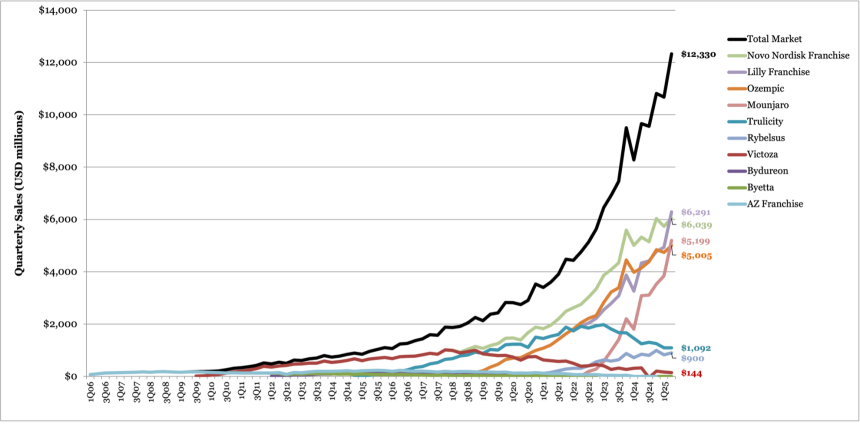
- Diabetes GLP-1/Multi-Incretin Agonists ($12.3 billion, +28%): Since 2006, GLP-1 RAs have generated more than $186 billion in cumulative revenue, with $134 billion in US sales and $52 billion in OUS sales. By geography, 2Q25 sales totaled $7.9 billion in the US (+14%; +11% Q/Q) and $4.4 billion OUS (+63%; +26% Q/Q). While GLP-1 RAs sold in the US capture approximately two-thirds of total revenue, OUS sales are growing rapidly with new launches, increasing to 36% of total revenue in 2Q25, up from 32% in 2Q24. In market share, Lilly’s Mounjaro led the market for the first time, capturing 42% of total 2Q25 sales, followed by Novo Nordisk’s Ozempic (41%). In the pipeline, candidates like orforglipron, CagriSema, and MariTide continue to emerge for diabetes and obesity.
- SGLT-2 inhibitors ($4.4 billion, -1%): The SGLT-2 inhibitor class sales was steady year-to-year and increased sequentially (+6%). By geography, US sales totaled $1.6 billion (-7%, +19% Q/Q), representing only one-third of global sales, while OUS sales totaled $2.7 billion (+3%, -1% Q/Q), comprising fully two-thirds of global sales. Since Farxiga’s EU approval in November 2012, SGLT-2 inhibitors have accumulated $87 billion in cumulative revenue, reflecting SGLT-2 inhibitors’ class benefits in glycemic, heart, and kidney health. AstraZeneca’s Farxiga (dapagliflozin) revenue surpassed Lilly/BI’s Jardiance sales for the second time, totaling $2.2 billion (+11%, +5% Q/Q) and capturing 49% of market share. This was followed by BI/Lilly’s Jardiance (empagliflozin) sales totaled $2.1 billion (-10%, -32% Q/Q), capturing 48% of market share. SGLT-2 inhibitors will begin to go generic over the next few years, with one of J&J’s Invokana’s patents having expired in April 2025.
- Insulin ($3.9 billion, +1%): Sales in 2Q25 increased 1% from 2Q24 and declined 6% sequentially. US revenue totaled $1.4 billion (-8%), and OUS revenue totaled $2.5 billion (+8%). Overall, sales for basal insulins, rapid-acting insulins, and basal insulin/GLP-1 fixed ratio combinations but not human insulin showed significant annual growth, while sequential decline was seen across the insulin market, except for basal insulin/GLP-1 fixed ratio combinations. In 2Q25, Novo Nordisk’s insulin portfolio captured 49% of global insulin sales (up from 45% in 2Q24), followed by Sanofi (26%, up from 24%) and Lilly (25%, down from 32%).
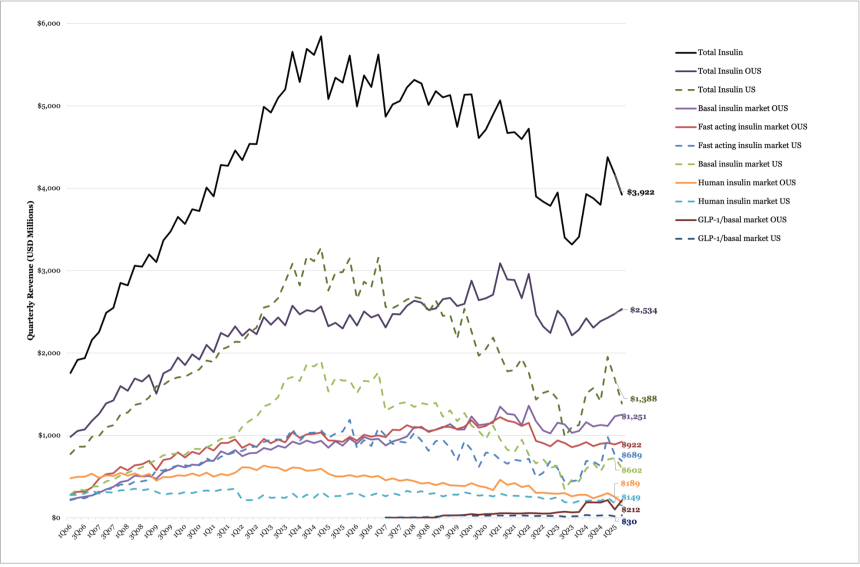
- Basal insulins totaled $1.9 billion in worldwide sales (+5%, -5% Q/Q). US sales totaled $602 million (-9%, +17% Q/Q), and OUS sales totaled $1.3 billion (+13%, +2% Q/Q).
- Rapid-acting insulins totaled $1.6 billion (+5%, -3% Q/Q). US sales totaled $689 million (+1%, -10% Q/Q), and OUS sales totaled $922 million (+6%, +4% Q/Q).
- Human insulin sales totaled $348 million (-22%, -18% Q/Q). US sales totaled $149 million (-30%, -15% Q/Q) and OUS sales totaled $189 million (-20%, -25% Q/Q).
- Basal insulin/GLP-1 fixed ratio combinations contributed $128 million to the insulin market (+20%, +2% Q/Q). In the US, basal/GLP-1 sales totaled $15 million (+4%, - 11% Q/Q) and OUS sales totaled $106 million (+13%, +3% sequentially).
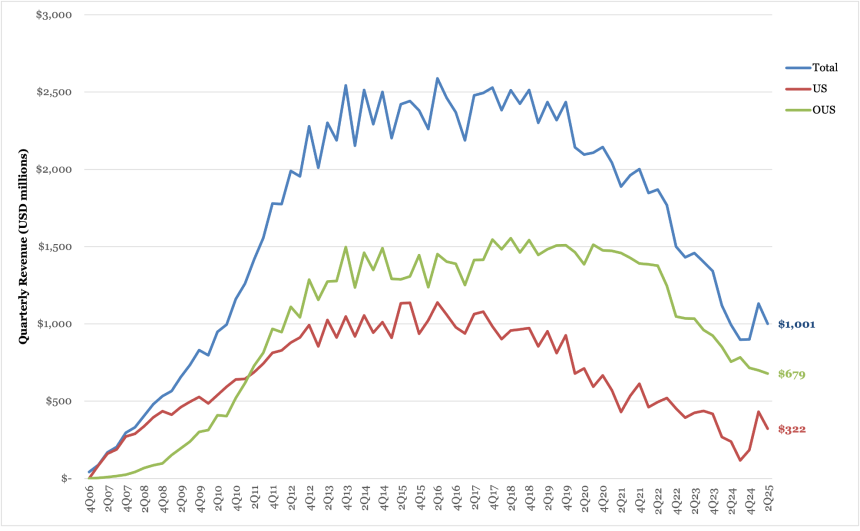
- DPP-4 Inhibitors ($1.0 billion, +1%): DPP-4 inhibitor sales totaled $1.0 billion, up 1% from 2Q24 and down 12% sequentially. US revenue reached $322 million (+35%, -25% sequentially) and OUS revenue totaled $679 million (-10%, -3% sequentially). Merck’s Januvia franchise, which includes Januvia (sitagliptin) and Janumet (fixed-dose sitagliptin + metformin), continued to hold the greatest DPP-4 inhibitor market share (62%), totaling $623 million in revenue (-1%; -22% Q/Q). BI/Lilly’s Tradjenta (+20%, +20% Q/Q) captured 25% of market share, while Novartis’ Galvus (-18%, -1% Q/Q) captured 12%. DPP-4 inhibitor market has been declining in sales for the past few years, likely due to patients switching from DPP-4 inhibitors to other first-line oral agents, as well as generic competition in markets like China and Japan.
Overall Diabetes Market
Aggregate Market Sales by Category (1Q06 – 2Q25)
Aggregate Market Sales by Geography (1Q16 – 2Q25)
Diabetes Therapy
GLP-1 and Multi-Incretin Agonists
In 2Q25, diabetes GLP-1 and multi-incretin agonist revenue totaled $12.3 billion, up 28% from 2Q24 and up 16% sequentially. Since 2006, GLP-1 RAs have generated more than $186 billion in cumulative revenue, with $134 billion in US sales and $52 billion in OUS sales. This compares to the over $88 billion in cumulative revenue generated by SGLT-2 inhibitors since 2013, including $40 billion in US sales and $48 billion in OUS sales.
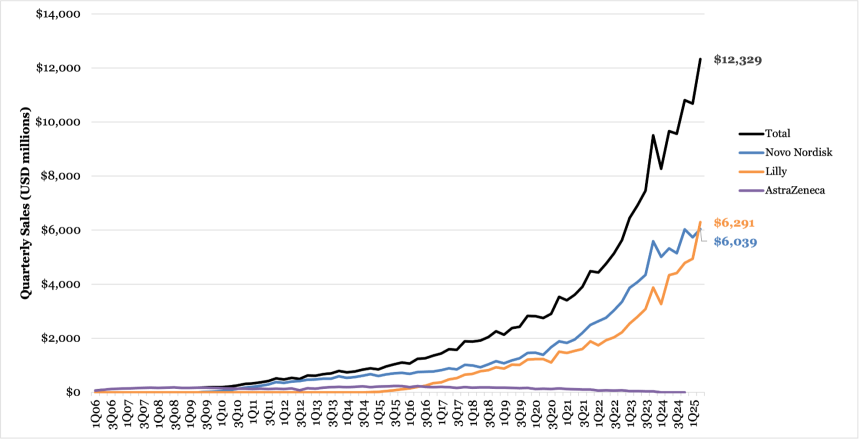
By geography, 2Q25 sales totaled $7.9 billion in the US (+14%; +11% Q/Q) and $4.4 billion OUS (+63%; +26% Q/Q). Unlike SGLT-2 inhibitors, where 37% of revenue is from the US, GLP-1 RAs continue to capture a much higher proportion of total revenue (64%) in the US. Nevertheless, OUS revenue is growing rapidly with new launches, increasing to 36% of total revenue in 2Q25, up from 28% in 2Q24. For the first time, Lilly’s Mounjaro led the market, capturing 42% of total 2Q25 sales (up from 32% in 2Q24). Novo Nordisk closely followed with 41% market share (down from 43% in 2Q24).
- Lilly’s Mounjaro, a dual GIP/GLP-1 RA, totaled $5.2 billion in 2Q25 (+68%, +35% Q/Q). For the first time, Mounjaro became the diabetes GLP-1 RA market leader – capturing 42% of global sales, as well as 42% of total (TRx) and 50% of new-to-brand prescriptions (NBRx) in the US. Mounjaro has also been launched in most major OUS markets, including Mexico, Brazil, India, and China. In 2Q25, Lilly has also: (i) submitted Mounjaro for pediatric and adolescent populations both in the US and EU; (ii) shared topline results for phase 3 SURPASS-CVOT trial; and (iii) launched a phase 3 trial (n=905) for adults with T1D and overweight or obesity, expected to complete in May 2027.
- Also in Lilly’s portfolio, Trulicity sales totaled $1.1 billion (-12%, flat Q/Q) in 2Q25. Declines in revenue continue to be driven by competitive dynamics from newer treatments like Ozempic and Mounjaro. Lilly’s GLP-1 RA portfolio totaled $6.3 billion (+45%) in 2Q25 and captured 57% of the total prescriptions in the US.
- Novo Nordisk’s Ozempic totaled $5.0 billion (+15%; -3% Q/Q) in 2Q25. In the US, Mounjaro slightly exceeded semaglutide in both new-to-brand and total prescriptions (690,000 for tirzepatide vs. 686,000 for semaglutide). To increase the uptake in the cash channel, Novo Nordisk also shared plans to include Ozempic in the NovoCare Pharmacy in 2025. OUS, Ozempic has been launched in ~80 countries. Ozempic continues to expand its indications beyond T2D and CKD with diabetes. In June 2025, Novo Nordisk received a positive recommendation by the Committee for Medicinal Products for Human Use (CHMP) of the European Medicines Agency (EMA) for use in people with T2D and peripheral artery disease (PAD), based on positive results of the phase 3b STRIDE trial (n=792).
- Novo Nordisk’s oral GLP-1 RA Rybelsus totaled $890 million in 2Q25 (-1%; -1% Q/Q), down 18% year-to-year for US sales but up 15% in OUS sales. Rybelsus was launched in over 40 countries. In December 2024 and January 2025, Novo Nordisk submitted a supplemental New Drug Application (sNDA) to the US FDA and a type 2 variant application to the EMA, respectively, to expand Rybelsus’ indication to include MACE reduction in people with T2D and established CVD and/or CKD. Novo Nordisk is also looking into high doses for obesity and T2D.
- Victoza totaled $144 million in revenue (-57%; -21% Q/Q), with declines driven by movement of GLP-1 RA market to next-generation incretin-based therapies, as well as the multiple launches of generic liraglutide. Altogether,Novo Nordisk’s GLP-1 portfolio totaled $6.0 billion (+13%; +5%) in 2Q25.
- AstraZeneca no longer shares revenue for Byetta as of 1Q22 or Bydureon as of 1Q24. Nonetheless, AstraZeneca remains invested in treatments for obesity and/or T2D and is running several phase 2b trials for oral GLP-1 RA (AZD 5004), dual GLP-1/glucagon RA (AZD9550), and long-acting once-weekly amylin (AZD6234).
- In the pipeline, candidates like retatrutide, orforglipron, CagriSema, and MariTide continue to emerge for diabetes and obesity. Excitingly, Lilly’s oral GLP-1 RA orforglipron showed up to 1.6% A1c reduction and 8% weight loss in phase 3 ACHIEVE-1 trial. Novo Nordisk’s CagriSema (fixed combination of cagrilintide 2.4 mg and semaglutide 2.4 mg) conferred 14% weight loss in people with T2D and obesity in the phase 3 REDEFINE 2 trial. Amgen’s MariTide (maridebart cafraglutide; a once-monthly GLP-1 RA and GIP receptor antagonist) conferred up to 17% weight loss in people with obesity and T2D in a phase 2 trial. Other candidates include GLP-1/glucagon dual RA (such as Altimmune’s pemvidutide and BI/Zealand’s survodutide), GLP-1/GLP-2 RA (Zealand’s dapiglutide), GLP-1/amylin analog (Novo Nordisk’s oral amycretin), and subcutaneous and oral GLP-1/GIP RA (Viking’s VK2735). For a full breakdown of what’s to come, see our GLP-1/multi-incretin agonist competitive landscape here.
GLP-1 Agonist Total Sales (1Q06 – 2Q25)
GLP-1 Agonist Sales by Company (1Q06 – 2Q25)
2Q25 GLP-1 Agonist Sales
| Revenue (Millions) | Growth | Sequential Growth | Share of Market | |
| Ozempic | $5,005 | +1o% | -3% | 41% |
| Mounjaro | $5,199 | +68% | +35% | 42% |
| Trulicity | $1,092 | -12% | flat | 9% |
| Rybelsus | $890 | -5% | -1% | 7% |
| Victoza | $144 | -57% | -21% | 1% |
| Total | $12,330 | +28% | +15% | -- |
*This total does not include sales for AstraZeneca’s Bydureon, which were not disclosed for the first time in 1Q24.
GLP-1 Agonist Sales by Geography (1Q06 – 2Q25)
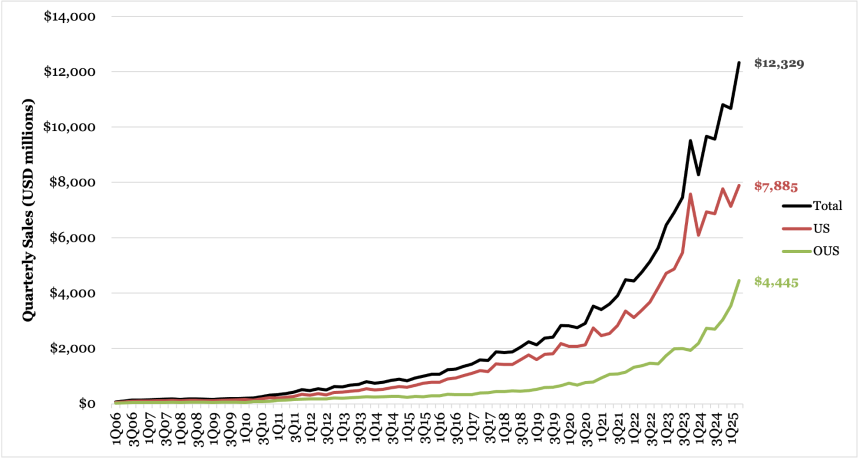
2Q25 GLP-1 Agonist Geographic Breakdown
| 2Q25 US Revenue (Millions) | US Growth | US Sequential Growth | 2Q25 OUS Revenue (Millions) | OUS Growth | OUS Sequential Growth | |
| Ozempic | $3,458 | +19% | -4% | $1,547 | +8% | flat |
| Mounjaro | $3,302 | +37% | +24% | $1,897 | +180% | +60% |
| Trulicity | $744 | -15% | -4% | $348 | -6% | +8% |
| Rybelsus | $336 | -18% | -6% | $534 | +15% | +3% |
| Victoza | $25 | -87% | -42% | $119 | -19% | -10% |
| Total | $7,885 | +14% | +11% | $4,445 | +63% | +26% |
SGLT-2 Inhibitors
In 2Q25, SGLT-2 inhibitor sales totaled $4.4 billion, down 1% from 2Q24 (without Invokana) and up 6% sequentially. By geography, US sales totaled $1.6 billion (-7%, +19% Q/Q) and OUS sales totaled $2.7 billion (+3%, -1% Q/Q). The gap between US and OUS sales has increased over the years – US sales make up just 37% of sales in 2Q25, up from 33% in 1Q25 and 39% in 2Q24. This is a shift from 2013-2016, when over 75% of SGLT-2 inhibitor sales came from the US. In comparison, GLP-1 RA sales in 2Q25 totaled $12.3 billion, 64% of which was from US revenue. Since we started tracking the SGLT-2 inhibitor market in 2013, SGLT-2 inhibitors have accumulated $87 billion in cumulative revenue, reflecting greater appreciation for SGLT-2 inhibitors’ class benefits in glycemic, heart, and kidney health.
- By product, AstraZeneca’s Farxiga (dapagliflozin) revenue surpassed Lilly/Boehringer Ingelheim’s Jardiance (empagliflozin) sales for the second time in a row, totaling $2.2 billion (+11%, +5% Q/Q) and capturing 49% of market share. US sales for Farxiga totaled $420 million (+7%, +10% Q/Q), while OUS sales were $1.7 billion (+12%, +3% Q/Q). AZ also received a sales milestone payment of $75 million from its partner in Japan in 2Q25, which was included in the total revenue. The company emphasized that this strong foundation will help support the potential launch of three fixed-dose combinations of Farxiga, which are currently in phase 3 trials. Growth was particularly impressive in emerging markets ($859 million, +15% CER) while EU revenue of nearly the same size, $765 million, reflected growth at about half the rate seen in emerging markets, or approximately 8% CER.
- Farxiga continues to lead the class internationally, capturing 63% of the OUS market, while Jardiance captured 34%. Farxiga sales first surpassed Jardiance sales OUS in 1Q21 and the therapy has since continued to lead the class internationally.
- Boehringer Ingelheim/Lilly’s Jardiance (empagliflozin) sales totaled $2.1 billion, down 10% from 2Q24 and down 32% sequentially, and capturing 48% of the market share. US sales totaled $1.1 billion, down 11% from 2Q24 and up 23% sequentially. OUS sales totaled $924 million, down 10% from 2Q24 and down 56% sequentially. Excluding the one-time $370 million payment Lilly received in 1Q25 from BI regarding an amendment to Lilly’s collaboration agreement, the adjusted sequential growth was +7% for the overall sales and -8% for OUS sales.
- Sales for Merck’s Steglatro (ertugliflozin) totaled $135 million, down 6% from 2Q24 and up 1% sequentially, and capturing 3% of the market share. US revenue totaled $41 million, down 6% from 2Q24 and up 1% sequentially. OUS revenue totaled $95 million, down 6% from 2Q24 and up 1% sequentially.
- 2Q25 marked the tenth quarter since J&J stopped reporting Invokana revenue, and we officially stopped estimating sales starting 1Q24. From 2013 to 2022, when J&J reported sales, Invokana totaled $7.9 billion. One of the patents for Invokana’s three indications, including treatment of T2D, reduction of MACE in people with T2D, and reduction of end-stage kidney disease in people with chronic kidney disease and T2D, expired April 11, 2025, according to the FDA’s Orange Book. Based on these exclusivities, the generic launch of Invokana is estimated to be November 11, 2031.
- Since April 2023, Mark Cuban Cost Plus Drug Company has offered Invokana. While initially priced at $235/month, the drug is now offered at $535/month. This cost is slightly lower than the drug’s retail price, ranging from $584-669/month.
- Since June 2025, Theracos Bio’s Brenzavvy (bexagliflozin) has been commercially available by prescription through the Mark Cuban Cost Plus Drug Company for $50 (plus shipping and handling) for a 30-day supply.
- SGLT-2 inhibitors will begin to go generic over the next few years, increasing access to these therapies, given that most people currently eligible for SGLT-2 inhibitors do not receive them. In November 2023, the FDA tentatively approved generics of two SGLT-2 inhibitors – dapagliflozin and canagliflozin – developed by Mumbai-based Lupin, which will likely launch once branded products begin to go generic.
- Farxiga. The patent for Farxiga’s indication for glycemic management in people with T2D, as well as in combination with exenatide, is expected to expire as early as October 4, 2025, following its FDA approval in early 2014. Farxiga’s method of use patents related to CKD extend as far as October 4, 2029, with additional renal patents extending through April 1, 2041 and July 18, 2039. Patent protections related to cardiovascular indications including risk reduction for hospitalization due to heart failure, are expected to expire as late as September 9, 2040. Notably, since January 2024, AZ has partnered with Prasco to sell an authorized generic version of dapagliflozin.
- Jardiance. Jardiance’s compound patent is set to expire in 2029 in the US, 2029 in Europe, and 2030 in Japan. Jardiance has won multiple indications across glycemic, CVD, and kidney health, including chronic kidney disease in the US and the UK in September 2023, which has contributed to its strong prescription growth. The approval of Jardiance was based on EMPA-KIDNEY (n=6,609), the largest kidney outcomes trial using an SGLT-2 inhibitor.
- Steglatro. Steglatro’s patent is set to expire in 2030 in the US, and 2029 in the EU, China, and Japan. Although the therapy is currently only indicated for glycemic control, a phase 3 trial investigating Steglatro in youth with T2D was completed in April 2025. This is the second study of an SGLT-2 inhibitor in the pediatric population, following the publication of a phase 3 trial investigating AZ’s Farxiga in youth and young adults (ages 10-24 years) in The Lancet in April 2022. We are curious if Merck will share results and seek regulatory approval for an indication that includes children.
We continue to wonder how progress in this drug class might be made for people with T1D, given that CKD affects 20-40% of people with T1D.[1] Few approved treatment options currently exist for people with T1D and CKD, and SGLT inhibitors may have limitations of use in people with T1D due to the risk of diabetic ketoacidosis (DKA). With adjunctive therapies and technologies like Abbott’s dual CGM-CKM, currently in development and discussed at ADA 2025, it is possible that expanded options may allow people with T1D to benefit from SGLT inhibitors safely.
SGLT-2 Inhibitor Sales (1Q13-2Q25)
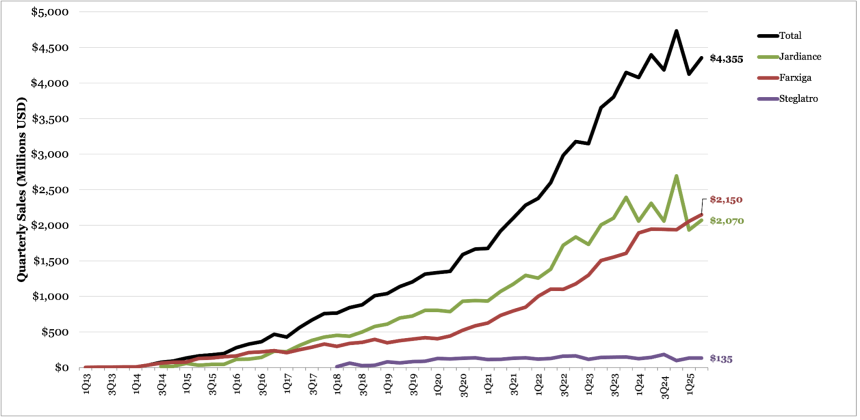
2Q25 SGLT-2 Inhibitor Sales
| Global Revenue (Millions) | Global YOY Growth | Global Sequential Growth | Global Share of Market | |
| Jardiance (estimated Lilly+BI) | $690 ($2,070) | -10% | -32% | 48% |
| Farxiga | $2,150 | +11% | +5% | 49% |
| Steglatro (est.) | $135 | -6% | +1% | 3% |
| Total | $4,355 | -1% | +6% | -- |
SGLT-2 Inhibitor Sales by Geography (1Q13-2Q25)
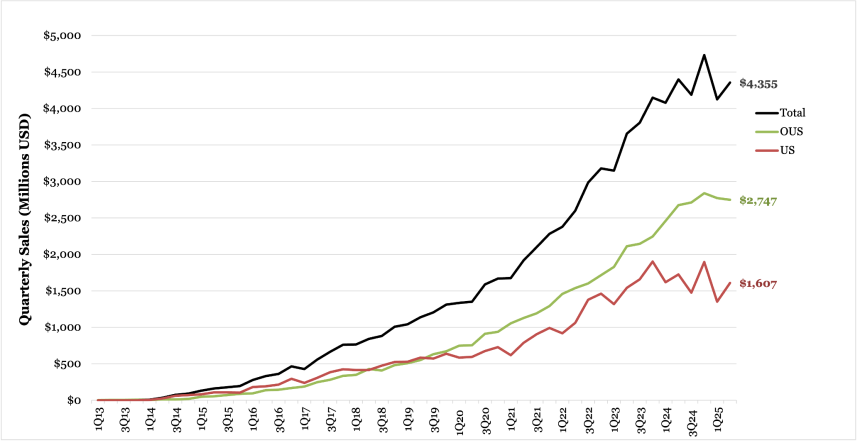
2Q25 SGLT-2 Inhibitor Geography Breakdown
| 2Q25 US Revenue (Millions) | US YOY Growth | US Sequential Growth | 2Q25 OUS Revenue (Millions) | OUS YOY Growth | OUS Sequential Growth | |
| Jardiance (Lilly+BI estimated revenue) | $382 ($1,146) | -11% | +23% | $308 ($924) | -10% | -56% |
| Farxiga | $420 | +7% | +10% | $1,730 | +12% | +3% |
| Steglatro (est.) | $41 | -6% | +1% | $95 | -6% | +1% |
| Total | $1,607 | -7% | +19% | $2,747 | +3% | -1% |
Insulin
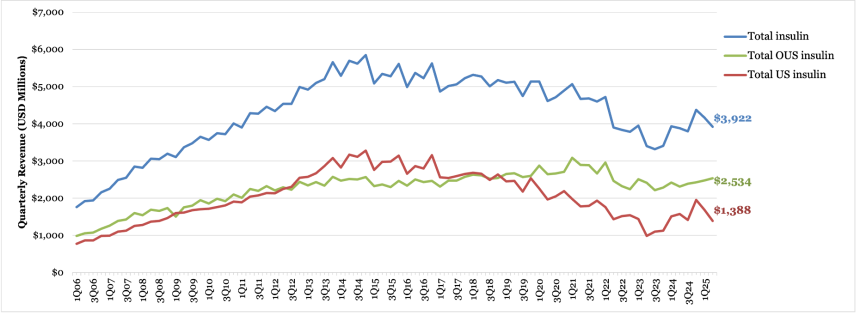
Global insulin sales totaled $3.9 billion in 2Q25, up 1% from 2Q24 and down 6% sequentially. By geography, US revenue totaled $1.4 billion (-8%), and OUS revenue totaled $2.5 billion (+8%). For Novo Nordisk, the largest player in the insulin arena, growth was largely driven by sales in the US, which totaled $533 million (+23% CER, -28% Q/Q). OUS sales totaled $1.5 billion, down 1% CER from 2Q24 and down 9% sequentially. Payer mix was partially offset by decline in volume of 30% (down slightly from 31% in 1Q25). To date since 2006, cumulative insulin revenue has reached $336 billion.
- Basal insulin sales totaled $1.9 billion (+5%, -5% Q/Q). US sales totaled $602 million (-9%, +17% Q/Q), and OUS sales totaled $1.3 billion (+13%, +2% Q/Q). Next generation basal insulins, which include Toujeo, Tresiba, and Ryzodeg, totaled $988 million (+26%, -6% Q/Q), while traditional basal insulins, including Lantus, Levemir, and Basaglar, totaled $865 million (-12%, -5% Q/Q).
- Rapid acting insulin sales totaled $1.6 billion (+4%, -3% Q/Q). US sales totaled $689 million (+1%, -10% Q/Q) and OUS sales totaled $922 million (+6%, +4% Q/Q). Next-generation rapid-acting insulins – NovoMix, Apidra, Admelog, Fiasp, Afrezza, and Ryzodeg – totaled $474 million (+6%, -6% Q/Q) and traditional rapid-acting insulins – Novolog and Humalog – totaled $1.1 billion (+3%, -1% Q/Q). Note that Ryzodeg, which is 70/30 insulin degludec and insulin aspart, divides its sales in our model as 70% in the next-generation basal segment and 30% in the next-generation rapid-acting segment.
- Human insulin sales totaled $348 million (-22%, -18% Q/Q). US sales totaled $149 million (-30%, -15% Q/Q) and OUS sales totaled $189 million (-20%, -25% Q/Q).
- Basal insulin/GLP-1 fixed ratio combinations contributed $128 million to the insulin market (+20%, +2% Q/Q). In the US, basal/GLP-1 RA sales totaled $15 million (+4%, - 11% Q/Q) and OUS sales totaled $106 million (+13%, +3% sequentially). We calculated the basal/GLP-1 RA contribution to the insulin market as 50% of the total sales for the class (with the other 50% contributing to the GLP-1 RA market).
In 2Q25, Novo Nordisk’s insulin portfolio captured 49% of global insulin sales, followed by Sanofi (26%) and Lilly (25%). Novo Nordisk’s share was up from 45% in 2Q24, Sanofi’s was up from 24% in 2Q24, and Lilly’s share was down from 32%. Despite minor variations, percent shares have largely been consistent since 2006. This breakdown excludes Biocon, which does not report insulin sales despite holding a sizable share of the total basal insulin prescription and new prescription markets.
The inclusion of basal insulin Fiasp and NovoLog in the Medicare Drug Price Negotiation Program (MDPNP), with discounted prices (down 75% to $199/month), will take effect on January 1, 2026. We are curious to see how this may affect Novo Nordisk’s market share.
- As a reminder, Novo Nordisk, Lilly, and Sanofi announced plans in spring 2023 to reduce list prices and out-of-pocket costs for insulin in the US – many of which went into effect in January 2024. In December 2024, Novo Nordisk also announced plans to reduce US list prices of insulin Fiasp and Tresiba by over 70% starting in 2026.
Insulin Market 2Q25 Category Breakdown
| 2Q25 Revenue (Millions) | YOY Growth | Sequential Growth | |
| Basal | $1,853 | +5% | -5% |
| “Next Gen” Basal | $988 | +26% | -6% |
| “Traditional” Basal | $865 | -12% | -5% |
| Rapid-acting | $1,611 | +4% | -3% |
| “Next Gen” Rapid-acting | $474 | +6% | -6% |
| “Traditional” Rapid-acting | $1,137 | +3% | -1% |
| Human | $348 | -22% | -18% |
| Basal/GLP-1 | $128 | +20% | +2% |
| Total Insulin | $3,922 | +1% | -6% |
Overall Insulin Sales by Category (1Q06-2Q25)
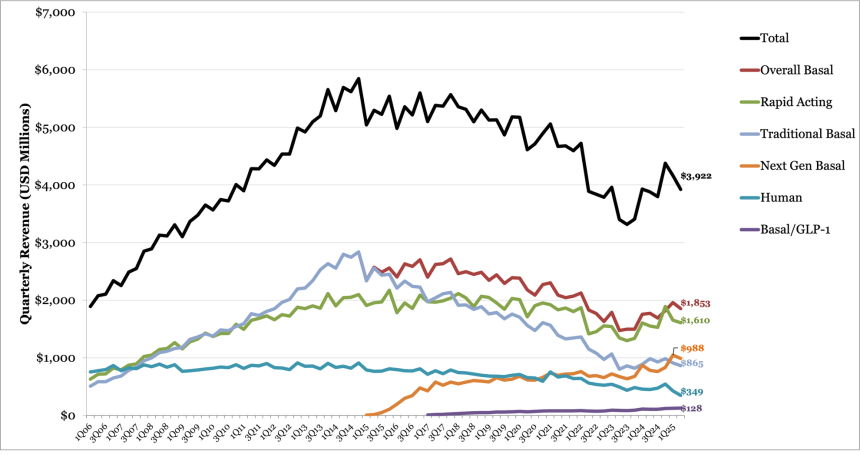
Insulin Market 2Q25 Growth Geographic Breakdown
| 2Q25 US Revenue (Millions) | US YOY Growth | US Sequential Growth | 2Q25 OUS Revenue (Millions) | OUS YOY Growth | OUS Sequential Growth | |
| Basal | $602 | -9% | +17% | $1251 | +13% | +2% |
| “Next-Gen” Basal | $224 | +35% | -30% | $764 | +24% | +5% |
| “Traditional” Basal | $378 | -24% | -8% | $487 | -1% | -3% |
| Rapid-acting | $689 | +1% | -10% | $922 | +6% | +4% |
| “Next-Gen” Rapid-acting | $91 | -1% | -33% | $383 | +8% | +3% |
| “Traditional” Rapid-acting | $598 | +1% | -5% | $539 | +5% | +4% |
| Human | $149 | -30% | -15% | $189 | -20% | -25% |
| Basal /GLP-1 | $15 | +4% | -11% | $106 | +13% | +3% |
| Total | $1,388 | -8% | -14% | $2,534 | +8% | Zero |
Overall Insulin Sales by Geography (1Q06 – 2Q25)
Overall Insulin Sales by Geography and Category (1Q06 – 2Q25)
Basal Insulin
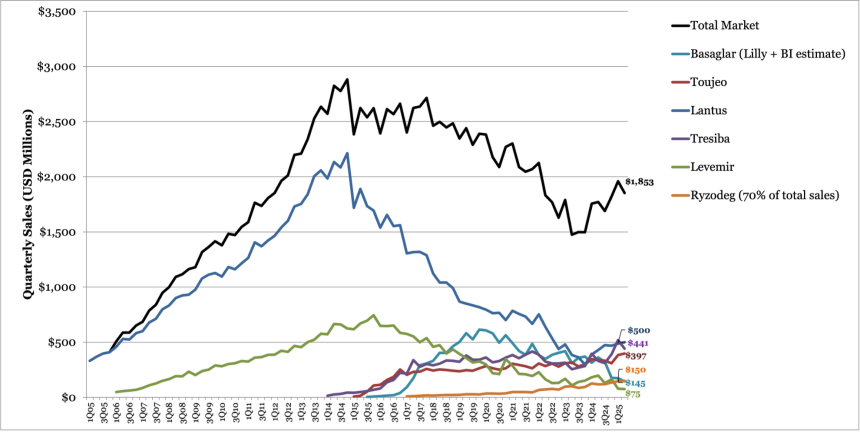
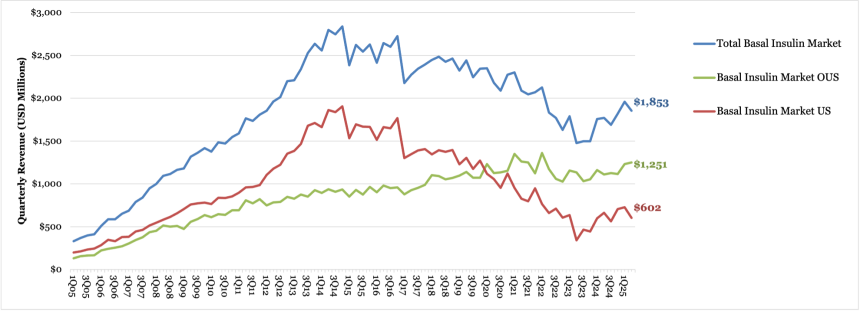
The basal insulin market totaled $1.9 billion in 2Q25 (+5%, -5% Q/Q). By geography, US sales totaled $602 million (-9%, -17% Q/Q), while OUS sales totaled $1.3 billion (+13%, +2% Q/Q). Next generation basal insulins totaled $988 million (+26%, -6% Q/Q), and traditional basal insulins totaled $865 million (-12%, -5% Q/Q). Since 1Q06, basal insulin sales total $149 billion in cumulative revenue.
- Sales for Sanofi’s Lantus totaled $500 million in 2Q25, up 17% from 2Q24 and 3% sequentially, demonstrating strong growth after a period of steady decline beginning in early 2022. Sales in the US totaled $234 million (+37%, +10% Q/Q) and OUS sales totaled $267 million (+3%, -3% Q/Q). Since 2Q24, Lantus sales in the US increased by volume due to the unavailability of a competing medicine – we imagine this refers to Novo Nordisk’s Levemir, which was discontinued in December 2024. Sales are expected to normalize in 2025 as windfall sales diminish.
- Sales for Novo Nordisk’s next-generation basal insulin Tresiba totaled $441 million in 2Q25 (+34% YOY, -15% Q/Q). Sales in North America totaled $153 million, up 53% from 2Q24 and down 38% sequentially. International sales totaled $287 million, up 25% YOY and 6% sequentially. This quarter marked the first break in Tresiba’s overall growth trend since 1Q24, which we had previously speculated to be due to Levemir’s discontinuation in the US in December 2024. Of note, with this discontinuation, Novo Nordisk revealed its plans to cut US list prices for Fiasp and Tresiba by over 70%, also beginning in 2026.
- Sales for Sanofi’s next-generation basal insulin Toujeo totaled $397 million in the quarter, growing 18% from 2Q24 and up 4% sequentially. Sales in the US totaled $70 million, up 7% YOY but down 1% sequentially. International sales totaled $326 million, up 20% YOY and up 5% sequentially. Growth was attributed to increased sales in the Rest of World (+21% CER), where Toujeo continues to increase its basal insulin market share. In the US and EU, sales were mostly stable (+3% CER). In 2Q25, Toujeo captured the third largest global market share (21%), following Tresiba (24%) and Lantus (25%).
- 2Q25 sales for traditional basal insulin Levemir totaled $75 million, down 62% YOY. In November 2023, Novo Nordisk announced that it would discontinue Levemir in the US due to constraints, formulary losses, and availability of alternative options. A full brand discontinuation, including the Levemir vial, went into effect on December 31, 2024, with market share and sales implications for basal insulin alternatives.
- Novo Nordisk’s Awiqli (once-weekly insulin icodec) is approved in the EU, Switzerland, and Canada. In the US, approval has been slower, with Awiqli receiving a Complete Response Letter (CRL) from the FDA in July 2024. The CRL outlined requests related to the manufacturing process and T1D indication, which must be resolved before the review can proceed. Novo Nordisk did not mention further details on the status of Awiqli in the US in its past three quarterly reports.
- Lilly’s once-weekly insulin efsitora alfa completed the phase 3 QWINT program, with full results of the QWINT-1, 3, and 4 trials announced at ADA 2025 after QWINT-2 and 5 announced at EASD 2024. The QWINT-1 trial met its primary endpoint, showing a non-inferior A1c reduction (1.3%) compared to insulin glargine (1.3%). The QWINT-3 trial, which also met its primary endpoint, showed a non-inferior A1c reduction (7.2%) compared to insulin degludec (7.3%) from baseline of 7.8%. For QWINT-4, no significant difference was seen in A1c reduction by insulin efsitora alfa (1.07%) or insulin glargine (1.07%). Weekly basal insulin may shift the paradigm of basal insulin treatment for T2D, allowing patients to avoid a significant number of injections per day. In 2Q25, Lilly shared that it submitted insulin efsitora alfa for regulatory approval in the EU and plans to submit to the US and Japan in 2025.
2Q25 Basal Insulin Sales
| 2Q25 Revenue (Millions) | YOY Growth | Sequential Growth | Share of Market | |
| Basaglar (BI + Lilly estimate) | $290 | -20% | -16% | 16% |
| Toujeo | $397 | +18% | +4% | 21% |
| Lantus | $500 | +17% | +3% | 27% |
| Tresiba | $441 | +34% | -15% | 24% |
| Levemir | $75 | -62% | N/A | 4% |
| Ryzodeg | $150 | +28% | +3% | 8% |
| Total | $1,853 | +5% | -5% | -- |
Basal Insulin Sales (1Q05 – 2Q25)
Basal Insulin Sales 2Q25 Geographic Breakdown
| 2Q25 US Revenue (Millions) | US YOY Growth | US Sequential Growth | 2Q25 OUS Revenue (Millions) | OUS YOY Growth | OUS Sequential Growth | |
| Basaglar (BI + Lilly estimate) | $68 | -36% | -31% | $77 | +2% | +3% |
| Toujeo | $70 | +7% | -1% | $326 | +20% | +5% |
| Lantus | $234 | +37% | +10% | $267 | +3% | -3% |
| Tresiba | $153 | +53% | -38% | $287 | +25% | +6% |
| Levemir | $9 | -93% | N/A | $66 | -19% | -16% |
| Ryzodeg | $149 | -30% | -15% | $189 | -20% | +8% |
| Total | $602 | -9% | -17% | $1,251 | +13% | +2% |
Basal Insulin Sales by Geography (1Q05 – 2Q25)
Rapid-Acting Insulin
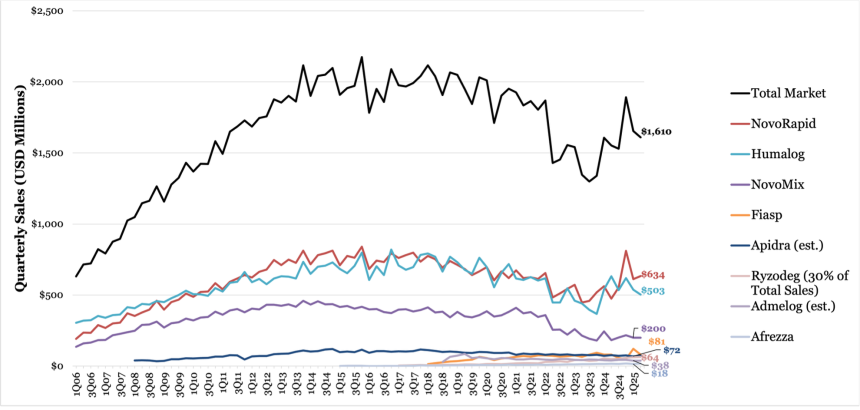
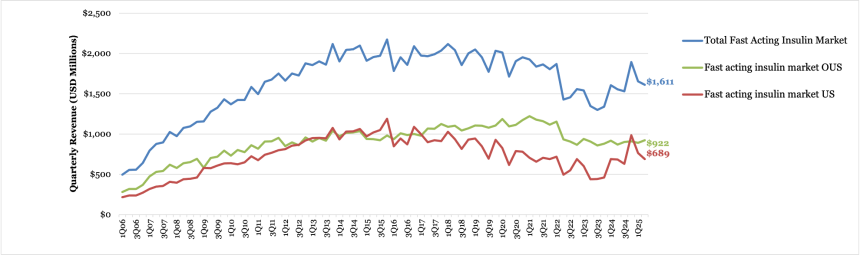
The rapid-acting insulin market totaled $1.6 billion in 2Q25, up 4% from 2Q24 and down 3% sequentially. US sales totaled $689 million, up 1% YOY and down 10% sequentially. OUS sales totaled $922 million, up 6% YOY and up 4% sequentially.
- Novo Nordisk’s NovoLog and Lilly’s Humalog continued to lead the class, capturing 39% and 31% of the market, respectively. NovoLog sales totaled $634 million, up 26% CER and down 5% sequentially. By geography, US sales totaled $294 million, up 85% CER from 2Q24 and down 5% sequentially, while OUS sales totaled $340 million, down 2% CER from 2Q24 and down 8% sequentially. Combined sales for Humalog and generic insulin lispro totaled $503 million in 2Q25, down 20% from 2Q24 and down 6% sequentially. US sales totaled $304 million, down 30% from 2Q24 and down 9% sequentially. OUS sales totaled $199 million, up 1% from 2Q24 and down 2% sequentially.
- Lilly did not disclose factors contributing to decline in Humalog sales in 2Q25. Notably, in July 2025, Biocon Biologics’s Kirsty was approved as the first and only interchangeable biosimilar to Novo Nordisk’s rapid acting insulin NovoLog (insulin aspart). In February 2025, Sanofi’s Merilog (insulin aspart-szjj) was FDA-approved as the first rapid-acting insulin biosimilar to Novo Nordisk’s Novolog (insulin aspart). While not approved yet, in July 2025, Adocia and Tonghua Dongbao’s BioChaperone Lispro (ultra-rapid insulin) demonstrated noninferiority in A1c reduction compared to Humalog in a phase 3 trial.
- Sales of MannKind’s inhaled insulin Afrezza totaled $18 million, growing 12% YOY and up 23% Q/Q. The therapy continued to capture 1% of market share. In MannKind’s 2Q25 earnings report, leadership announced that it submitted a supplemental Biologics License Application (sBLA) for Afrezza in pediatrics in 2Q25, based on data from the INHALE-1 study in children aged 4-17, which was accepted by the FDA in October 2025. Topline results from the full pediatric study, including the safety extension, have been submitted for presentation at ISPAD 2025. With nearly 80% of youth with diabetes treated in academic medical centers, MannKind is adjusting its sales strategy to focus more on institutional settings and plans to expand its sales force later this year.
2Q25 Rapid-Acting Insulin Sales
| Revenue (Millions) | YOY Growth | Sequential Growth | Share of Market | |
| NovoLog | $634 | +34% | +4% | 39% |
| Humalog | $503 | -20% | -6% | 31% |
| NovoMix | $200 | +10% | Zero | 12% |
| Apidra (est.) | $72 | -5% | +6% | 5% |
| Fiasp | $81 | zero | -70% | 5% |
| Admelog (est.) | $38 | -5% | -2% | 2% |
| Ryzodeg | $64 | +28% | -70% | 4% |
| Afrezza | $18 | +12% | +23% | 1% |
| Total | $1,611 | +4% | -3% | -- |
*Ryzodeg revenue is split 70/30 between basal insulin/rapid-acting insulin. Revenue for Admelog and Apidra are estimated using YOY for Sanofi’s “other diabetes” portfolio and the US vs. OUS revenue ratio from 4Q20.
Rapid Acting Insulin Sales (1Q06 – 2Q25)
2Q25 Rapid-Acting Insulin Sales Geographic Breakdown
| 2Q25 US Revenue (Millions) | US YOY Growth | US Sequential Growth | 2Q25 OUS Revenue (Millions) | OUS YOY Growth | OUS Sequential Growth | |
| NovoLog | $294 | +86% | Zero | $340 | +7% | +7% |
| NovoMix | $20 | +113% | +3% | $180 | +4% | Zero |
| Humalog | $3o4 | -30% | -9% | $199 | +1% | -2% |
| Apidra (est.) | $7 | -5% | +5% | $65 | -5% | +5% |
| Admelog (est.) | $34 | -5% | -2% | $4 | -5% | -2% |
| Fiasp | $11 | -50% | -81% | $70 | +19% | +13% |
| Afrezza | $18 | +12% | +23% | -- | -- | -- |
| Ryzodeg | -- | -- | -- | $64 | +28% | -70% |
| Total | $689 | +1% | -10% | $922 | +6% | +4% |
**MannKind’s Afrezza is marketed in Brazil, following approval in June 2019, but the company does not break out Afrezza revenue in Brazil. The vast majority of Afrezza’s revenue is thought to come from the US, so we have not listed international revenue here.
Rapid Acting Insulin Sales by Geography by Quarter (1Q06 – 2Q25)
Basal Insulin/GLP-1 RA Fixed Ratio Combination
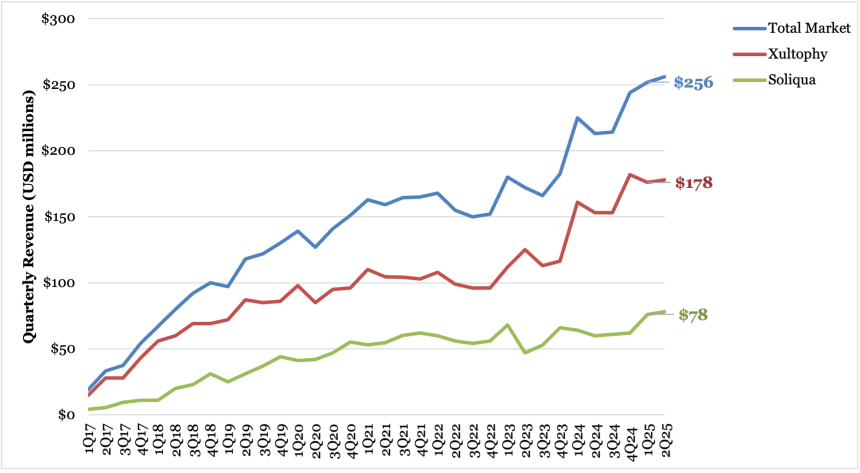
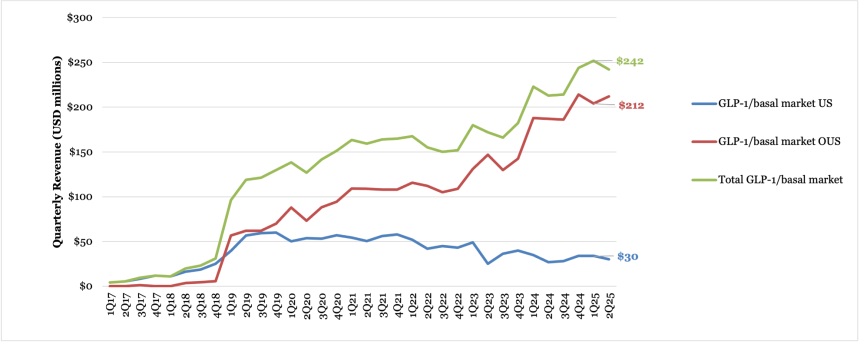
In 2Q25, revenue for Novo Nordisk’s Xultophy (degludec/liraglutide) and Sanofi’s Soliqua (glargine/lixisenatide) totaled $128 million, up 20% from 2Q24 and up 2% sequentially. By geography, US sales totaled $15 million, up 4% YOY and down 12% sequentially. OUS revenue was $106 million, up 13% YOY and up 4% sequentially.
- Following trends from past quarters, Xultophy continued to lead the market in 2Q25, with 70% of the market share, unchanged from 1Q25. Sanofi’s Soliqua accounted for the remaining 30% with $39 million in sales.
- Despite the overwhelming success of semaglutide and other incretin-based therapies, we believe that many patients can benefit from this fixed-dose therapy. In clinical practice, combination therapy may help minimize side effects (like weight gain) seen with insulin therapy, provide clinically robust improvements in A1c, help HCPs facilitate treatment intensification, and improve treatment adherence. Results from the phase 4 SOLI-SWITCH study (n=162) presented at ATTD 2025, showed that Soliqua reduced A1c by 1.2 percentage points from a mean baseline of 8.5% at Week 24, with 38% of participants achieving A1c <7.0% and seeing a median body weight reduction of 0.9 kg (2 lbs). Read more about fixed-ratio basal insulin/GLP-1 RA in Sanofi’s industry symposium at ATTD 2025.
2Q25 Basal Insulin/GLP-1 Receptor Agonist Combination Sales
| Revenue (Millions) | Growth | Sequential Growth | Share of Market | |
| Soliqua | $39 | Zero | Zero | 30% |
| Xultophy | $89 | +16% | +1% | 70% |
| Total | $128 | +20% | +2% | -- |
Basal Insulin/GLP-1 Receptor Agonist Combination Sales (1Q17 – 2Q25)
2Q25 Basal Insulin/GLP-1 Receptor Agonist Combination Geographic Breakdown
| 2Q25 US Revenue (Millions) | US Growth | US Sequential Growth | 2Q25 OUS Revenue (Millions) | OUS Growth | OUS Sequential Growth | |
| Soliqua | $11 | Zero | Zero | $21 | Zero | Zero |
| Xultophy | $4 | +16% | -33% | $85 | +16% | +5% |
| Total | $15 | +4% | -12% | $106 | +13% | +4% |
Basal Insulin/GLP-1 Receptor Agonist Combination by Geography (1Q17 – 2Q25)
DPP-4 Inhibitors
In 2Q25, DPP-4 inhibitor sales totaled $1.0 billion, up 1% from 2Q24 and down 12% sequentially. US revenue reached $322 million (+35%, -25% sequentially) and OUS revenue totaled $679 million (-10%, -3% sequentially).
- Merck’s Januvia franchise, which includes Januvia (sitagliptin) and Janumet (fixed-dose sitagliptin + metformin), continued to hold the greatest DPP-4 inhibitor market share in the field (62%). The Januvia franchise totaled $623 million, nearly flat (-1%) from 2Q24 and down 22% sequentially. US sales totaled $284 million, up 46% from 2Q24 and down 31% sequentially. OUS sales totaled $339 million, down 22% from 2Q24 and down 12%. Merck attributed declines to lower demand in China, the impact of generic competition in most international markets, and lower demand in the US due to competitive pressure – partially offset by higher net pricing in the US. We also note that one-time “true-up” in 1Q25 by more than $100 million, likely referring to rebate adjustments, contributed to sequential decline. Januvia franchise sales totaled $82 billion in cumulative revenue since 2006.
- BI/Lilly’s Tradjenta revenue totaled $255 million (+20%, +20% Q/Q), capturing 25% of market share. US sales totaled $38 million, down 13% from 2Q24 and up 72% sequentially. OUS sales totaled $217 million, up 28% from 2Q24 and up 14% sequentially.
- Novartis’ Galvus (vidagliptin), which is only available in countries OUS, followed with $123 million (-18%, -1% Q/Q), reflecting 12% market share. Management attributed the decline to generic competition in Japan. As a reminder, Daiichi Sankyo stopped reporting sales of DPP-4 inhibitors Tenelia (teneligliptin) in 2Q24, and AstraZeneca permanently discontinued Onglyza (saxagliptin) in March 2023 due to an “AZ business decision,” presumably related to now-resolved lawsuits and patent expirations in 2023.
The DPP-4 inhibitor market has been declining in sales for the past few years. We imagine that overall declines are partly due to competition from other oral agents, such as SGLT-2 inhibitors, which are recommended by the ADA as a first-line therapy for people with diabetes and comorbidity risks. In a recent survey from dQ&A (n=2,796), just 9% of patients with T2D on oral diabetes therapies were taking a DPP-4 inhibitor. In comparison, 73% were taking metformin, 28% were taking a sulfonylurea, and 25% were on an SGLT-2 inhibitor.
We are curious to see how decreasing prices (like Merck’s Januvia franchise) and ongoing patent expirations (for example, generic versions of teneligliptin were launched in India in 2015) may impact long-term DPP-4 inhibitor uptake. For the right populations, particularly people with pre-T2D and recently diagnosed T2D, we continue to think the class can be beneficial, based on data from the VERIFY trial, for example. This trial found that people with T2D on early combination therapy with a DPP-4 inhibitor (vildagliptin) and metformin spent 26 more months (62 months) with an A1c ≤7.0% than those on metformin monotherapy (36 months).
2Q25 DPP-4 Inhibitor Sales
| 2Q25 Revenue (Millions) | Growth | Sequential Growth | Share of Market | |
| Merck’s Januvia Franchise | $623 | -1% | -22% | 62% |
| Tradjenta (estimated Lilly + BI) | $255 | +20% | +20% | 25% |
| Novartis’ Galvus | $123 | -18% | -1% | 12% |
| Total | $1,001 | +1% | -12% | -- |
DPP-4 Inhibitor Total Sales by Company (4Q06 – 2Q25)
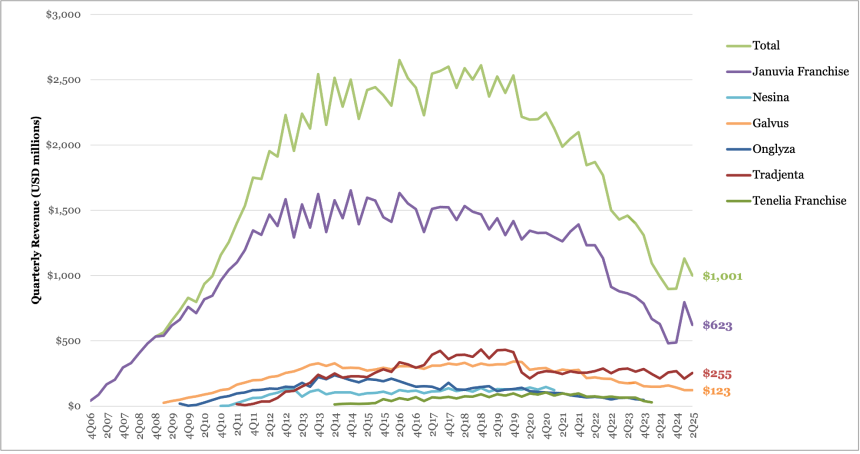
Since AZ stopped reporting revenue for Onglyza in 1Q24, this is product is no longer included in our graph. Recall that onglyza was discontinued in the US in March 2023.
2Q25 DPP-4 Inhibitor Geographic Breakdown
| 2Q25 US Revenue (Millions) | US Growth | US Sequential Growth | 2Q25 OUS Revenue (Millions) | OUS Growth | OUS Sequential Growth | |
| Merck’s Januvia Franchise | $284 | +46% | -31% | $339 | -22% | -12% |
| Tradjenta (estimated Lilly + BI) | $38 | -13% | +72% | $217 | +28% | +14% |
| Novartis’ Galvus | --
| -- | -- | $124 | -18% | -1% |
| Total | $322 | +35% | -25% | $679 | -10% | -3% |
DPP-4 Inhibitor Sales by Geography (4Q06 – 2Q25)
Obesity
In 2Q25, the obesity market continued to see rapid growth, totaling over $6.6 billion, up 2x from $3.3 billion in 2Q24 and up 32% sequentially. US sales totaled $5.5 billion, up almost 2x from the $2.8 billion in revenue in 2Q24 and up 34% sequentially. OUS sales totaled $1.2 billion, up 2.5x from $467 million in 2Q24 and up 24% sequentially. To date since 2006, the obesity market has generated $43.8 billion in cumulative revenue.
- For the first time, Lilly’s Zepbound (tirzepatide for obesity) exceeded Novo Nordisk’s Wegovy revenue and prescriptions. Zepbound totaled $3.4 billion, up 172% from 2Q24 and up 46% sequentially, capturing 51% of global sales. Since FDA approval in November 2023 and US launch in 4Q23, Zepbound sales recorded $10.8 billion in cumulative revenue. 2Q25 marks the second quarter with OUS sales for Zepbound, which totaled $1.5 million, down 79% from $7 million in 1Q25. Zepbound captured 51% of global sales, an increase from 38% in 2Q24. Zepbound also maintained leadership in the US obesity market since 1Q25, capturing 66% of total prescriptions (TRx) and 68% of new-to-brand prescriptions (NBRx) at the end of 2Q25. In comparison, Zepbound captured 60% of TRx and over 74% of NBRx at the end of 1Q25.
- On the insured channel, NBRx share was likely affected by July 1 loss of access on CVS Caremark’s national template formulary, which selected Novo Nordisk’s Wegovy as preferred. Management has seen early negative impact on Zepbound prescriptions in July and expects headwind for growth in 3Q25. Two other major PBMs, Optum Rx (affiliated with UnitedHealth Group) and Express Scripts (affiliated with Cigna), maintain open access to both drugs. New pharmacy benefit programs, like Evernorth’s (affiliated with Cigna) new cap of $200 in monthly out-of-pocket costs for Wegovy and Zepbound, will likely increase employer opt-in over time.
- For the cash channel, Zepbound vials, sold at discounted cash prices via LillyDirect, accounted for ~20% of total US Zepbound prescriptions (over one million prescriptions) and over 35% of new prescriptions in 2Q25 – reflecting an increased uptake from 1Q25, when vials accounted for 10% of TRx and 24% of NBRx. As background, LillyDirect was launched in the US in January 2024, providing direct home delivery service of prescription medications for diabetes, obesity, and migraines. With the launch of two final doses of Zepbound vials in June 2025, patients who refill within 45 days after the first fill can buy Zepbound at $349/month for 2.5 mg and $499/month for subsequent doses (5 mg, 7.5 mg, 10 mg, 12.5 mg, and 15 mg).
- Wegovy (semaglutide for obesity) captured 46% of sales in 2Q25, losing leadership in the obesity market. This market share has decreased from 50% in 1Q25, 57% in 4Q24, and 51% in 2Q24 due to Lilly’s Zepbound capturing a greater market share. Sales for Wegovy totaled $3.1 billion in 2Q25, up 75% from 2Q24 and up 13% sequentially. Wegovy has now launched in approximately 35 countries, including India in June. In the US, Wegovy has around 280,000 weekly prescriptions, and there was 2.6x volume growth of the branded obesity market in the US.
- Novo Nordisk lowered 2025 guidance by six to eight percentage points for the second time this year due to lower-than-expected growth of Wegovy sales. The company cited negative impacts from: (i) continued compounding[2]; (ii) increased competition; and (iii) slower-than-expected market expansion. Notably, it is estimated that around one million patients are on compounded GLP-1 RAs in the US. Novo Nordisk has expressed its commitment to prevent “unsafe and unlawful mass compounding … under the false guise of personalization.” In August, the company announced the filing of 14 new lawsuits.
- To make semaglutide more accessible, Novo Nordisk launched in March 2025 a direct-to-patient platform, NovoCare Pharmacy, that offers Wegovy single-dose pens for $499/month for cash-paying patients. Novo Nordisk also partnered with telehealth platforms, including Ro and LifeMD, in April 2025. Wegovy prescriptions through NovoCare pharmacy and telehealth operators have totaled 11,000, in addition to 20,000 weekly prescriptions through retail cash channel, accounting for 11% of the total prescriptions. Management said that sales penetration via the “cash channel” has been lower than expected due to compounding business.
- On the insured channel, CVS Caremark designated Wegovy as the preferred GLP-1 RA on commercial template formularies in May 2025, effective July 1, 2025. The company expects the formulary change, as well as the MASH indication, to positively impact Wegovy sales.
- Generic semaglutide is expected early next year in several OUS markets. Novo Nordisk’s semaglutide will lose its data exclusivity in Canada in January 2026. Given that its patent, which granted Novo Nordisk exclusive rights to manufacture and sell semaglutide in Canada, lapsed in 2020, generic companies like Sandoz and Hims & Hers can file for regulatory approval for generics starting next year. In India, a patent regarding specific formulations and delivery devices is set to expire in March 2026. In Brazil and China, patents are similarly set to expire in 2026, 20 years after Novo Nordisk filed patent for the active ingredient semaglutide.
- Sales for Novo Nordisk’s Saxenda (liraglutide for obesity) totaled $133 million in 2Q25, down 61% from 2Q24 and down 21% sequentially. US sales totaled $15 million, down 72% from 2Q24 and up 15% sequentially. OUS sales totaled $117 million, down 58% from 2Q24 and down 24% sequentially. Wegovy and Zepbound continues to erode Saxenda’s market share; Saxenda captured just 2% of the obesity market in 2Q25, down from 10% in 2Q24.
- In the pipeline, several candidates continue to advance. Following full phase 3 REDEFINE 1 trial readout at ADA 2025, Novo Nordisk plans to file CagriSema (fixed combination of cagrilintide 2.4 mg and semaglutide 2.4 mg) for FDA approval in 1Q26. Previously, the company submitted high dose semaglutide (7.2 mg) to the EU based on phase 3 STEP UP trial, also presented at ADA 2025, as well as oral semaglutide 25 mg to the US and EU based on phase 3 OASIS-4, OASIS-1, and PIONEER PLUS trials. Excitingly, in 2Q25 call, Lilly shared results of the phase 3 ATTAIN-1 trial of oral GLP-1 RA, orforglipron, which demonstrated 12% weight loss in people with obesity or overweight. Phase 3 trials for Lilly’s triple RA retatrutide are ongoing for multiple indications, including obesity or overweight, chronic lower back pain, and MASLD.
- Innovent Biologics’ dual GLP-1/glucagon RA mazdutide was approved in China for weight management in June 2025. BI/Zealand continues to evaluate dual glucagon/GLP-1 RA survodutide in phase 3 SYNCRHONIZE program, while dual GLP-1/GLP-2 RA dapiglutide conferred up to 11% weight loss in the phase 1b trial (n=54) for obesity, with plans to initiate a phase 2b trial in 2H25.
- Several candidates aim to minimize lean mass loss and improve weight loss quality. Regeneron’s trevogrumab (anti-GDF8/anti-myostatin) with or without garetosmab (anti-activin A), when added to semaglutide, significantly preserved lean mass loss and increased fat mass loss in the phase 2b COURAGE trial (n=1,005), as shared in June 2025. Lilly’s bimagrumab (activin receptor antagonist) demonstrated promising efficacy in the phase 2 BELIEVE trial (n=507), as announced at ADA 2025. Scholar Rock’s apitegromab (a promyostatin and latent myostatin inhibitor) reduced lean mass loss by 55% at Week 24, compared to tirzepatide alone, in people with overweight or obesity in the phase 2 EMBRAZE trial (n=87), as announced in June 2025.
Anti-Obesity Medication Total Sales (1Q13 – 2Q25)
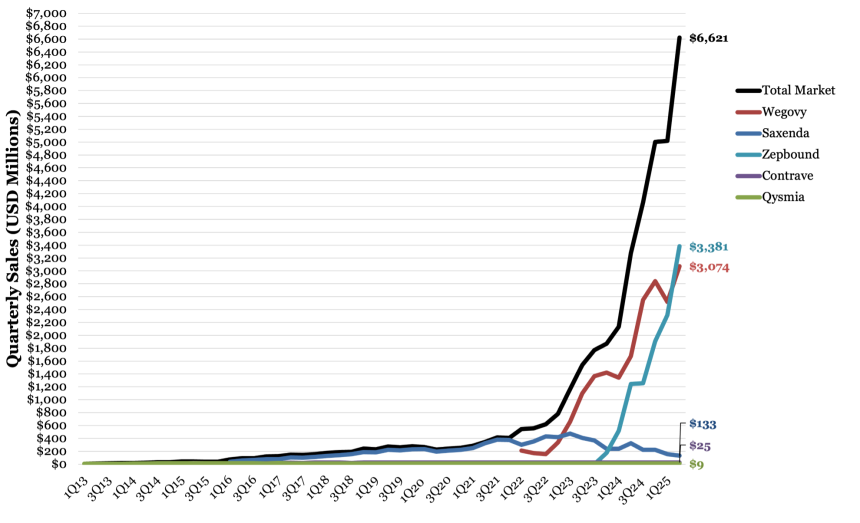
2Q25 Anti-Obesity Medication Sales
| Revenue (Millions) | YOY Reported Growth | Sequential Reported Growth | Share of Market | |
| Wegovy | $3,074 | +84% | +22% | 46% |
| Zepbound | $3,381 | +172% | +46% | 51% |
| Saxenda | $133 | -59% | -14% | 2% |
| Contrave (est.) | $25 | N/A | N/A | Flat |
| Qsymia (est.) | $9 | N/A | N/A | Flat |
| Total (est.) | $6,621 | +102% | +32% | -- |
2Q25 Anti-Obesity Medication Geographic Breakdown
| 1Q25 US Revenue (Millions) | US YOY Reported Growth | US Sequential Growth | 1Q25 OUS Revenue (Millions) | OUS YOY Reported Growth | OUS Sequential Growth | |
| Wegovy | $2,024 | +40% | +18% | $1,049 | +368% | +31% |
| Zepbound | $3,380 | +172% | +147% | $2 | N/A | -77% |
| Saxenda | $15 | -81% | +25% | $117 | -52% | -17% |
| Contrave (est.) | $25 | Flat | Flat | Flat | -- | -- |
| Qsymia (est.) | $9 | Flat | Flat | Flat | -- | -- |
| Total (est.) | $5,453 | +94% | +34% | $1,167 | +150% | +24% |
Anti-Obesity Medication Geographic Sales (1Q17 – 2Q25)
Glucagon
In 2Q25, ready-to-use glucagon sales totaled $71 million, up 18% from 2Q24 and up 18% sequentially. Growth was driven primarily by Amphastar’s Baqsimi as well as by Xeris’ Gvoke, with Novo Nordisk’s Zegalogue remaining consistent compared to 2Q24. The ADA estimates that 8.4 million people with diabetes in the US take insulin and sulfonylureas and are, therefore, at risk of severe hypoglycemia. The National Diabetes Statistics Report indicates that the rate of emergency department visits due to hypoglycemia is falling – from ~250,000 in 2019 to ~200,000 in 2020 when the latest data were published.
- Amphastar’s Baqsimi sales totaled $47 million in 2Q25, up 51% from 2Q24 and up 22% sequentially. As the only FDA-approved non-injected, nasal glucagon for treating severe hypoglycemia, this therapy continues to lead the market, with 2Q25 marking the first quarter that Baqsimi revenue exceeded the highest quarterly figure reported under Lilly’s ownership, when sales totaled $43 million in 3Q22. As a reminder, Amphastar took full control of Baqsimi from Lilly in 1Q25, including distribution management in all countries.
- The company attributed the growth of Baqsimi sales to successful integration of global commercialization at the beginning of 2025, as well as an increase in unit volume and higher average selling prices. The company expects continued growth for the second half of the year, as well as a 3% price increase in the US. Additionally, the company expects that potential approvals in Europe will further support Baqsimi’s growth.
- Growth was also driven by Xeris, with its ready-to-use glucagon Gvoke generating $23 million in net sales, up 17% from 2Q24 and up 13% sequentially. The growth was attributed to an increase in Gvoke prescriptions (~64,000), which were up 5% sequentially and flat from 2Q24. With an increase in both new prescribers and adoption among existing patients, the durable demand in the ready-to-use glucagon market is clear.
- Upon initial supply shipments, Gvoke VialDx (intravenous glucagon) sales totaled $1.3 million. The FDA approval of Gvoke VialDx in March 2025 is followed by a milestone payment from its commercial partner, American Regent, in 2Q25, with full commercial launch expected by year-end. The payment encompassed the majority of Xeris’ total $3.8 million royalty contract.
- Zegalogue sales are once again estimated at $500,000 in 2Q25, though Zealand announced further delays to resubmission of Part 1 of the NDA, for up to three weeks of dosing dasiglucagon for pediatric patients seven days or older with congenital hyperinsulinism (CHI). In 2Q25, the company explained that the third-party manufacturing facility for dasiglucagon has yet to receive a classification upgrade. As such, Zealand has adopted a supply contingency plan to help bring dasiglucagon to people efficiently. The company plans to submit Part 2 of the NDA, with analyses from existing CGM datasets to support dasiglucagon use beyond three weeks. As a reminder, in October 2024, Zealand received a Complete Response Letter (CRL) of Part 1 of the NDA, which mentioned the timing of the reinspection of a third-party manufacturing facility in August and September 2024. Zealand had initially planned the launch of dasiglucagon for 1H25 upon FDA approval.
Ready-to-Use Glucagon Sales (3Q19 – 2Q25)
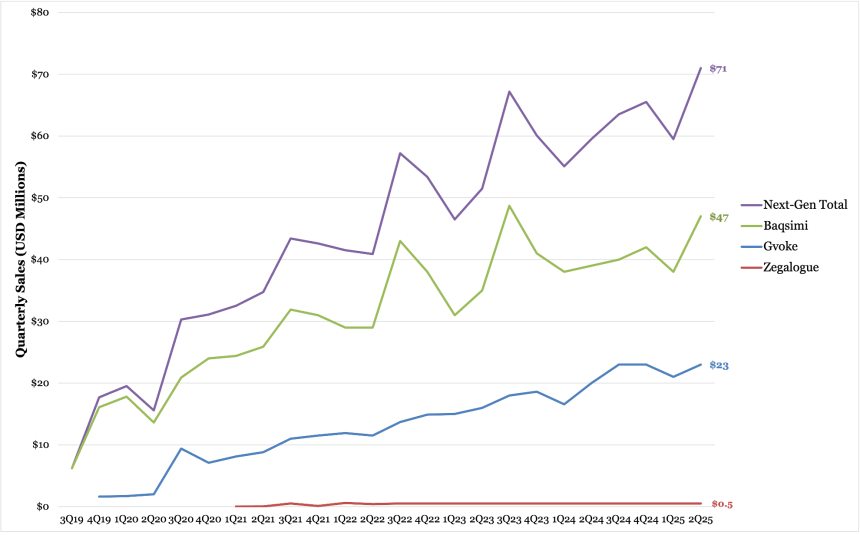
2Q25 Ready-to-Use Glucagon Sales
| 2Q25 Revenue (Millions) | YOY Growth | Sequential Growth | Share of Ready-to-Use Market (by revenue) | |
| Baqsimi | $47 | +51% | +22% | 66% |
| Gvoke | $23 | +17% | +13% | 32% |
| Zegalogue | $0.5 | - | - | 2% |
| Total | $71 | +18% | +18% | -- |
PCSK9 Inhibitors
In 2Q25 the PCSK9 inhibitor market totaled $1.2 billion, up 35% from 2Q24 and up 13% sequentially. The US market totaled $565 million, up 35% from 2Q24 and up 7% sequentially. The OUS market totaled $656 million, up 35% from 2Q24 and up 18% sequentially. Since 2017, PCSK9 inhibitors have generated $15.7 billion in cumulative revenue.
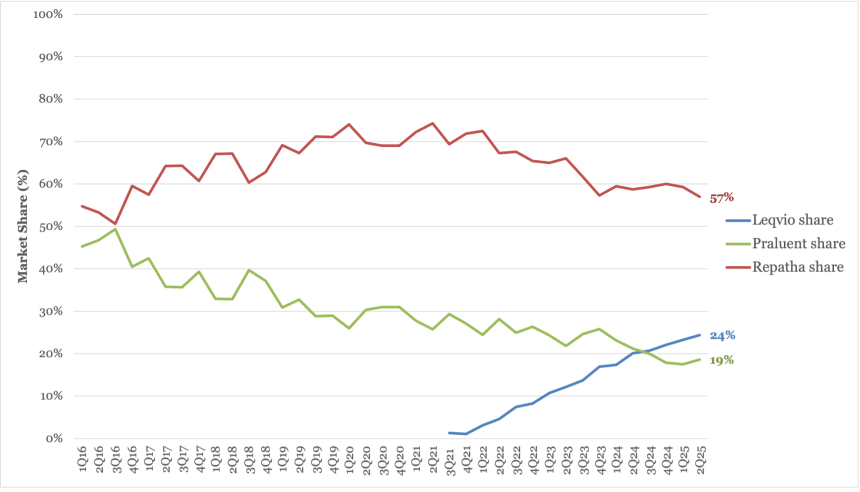
- Amgen’s Repatha (evolocumab) continued to lead the class, with sales totaling $696 million in 2Q25, up 31% from 2Q24 and up 6% sequentially, accounting for 57% of the PCSK9 market. US sales totaled $361 million, up 34% from 2Q24 and up 5% sequentially; OUS sales totaled $335 million, up 28% from 2Q24 and up 15% sequentially.
- In the pipeline, Amgen expects phase 3 results of the VESALIUS-CV (n=12,301) trial, studying Repatha in people at high CV risk without prior MI or stroke, in 2H25. The phase 4 EVOLVE-MI study (n=6,017) also investigates Repatha administered within 10 days of acute MI to reduce the risk of CV events. The trial completed enrollment in 2Q24 and is expected to complete in May 2027.
- Novartis’ infusion-based Leqvio (inclisiran) captured 24% of the market in 2Q25. Leqvio sales totaled $298 million in 2Q25, up 64% from 2Q24 and up 16% sequentially. US sales totaled $138 million, up 47% from 2Q24 and up 9% sequentially, while OUS sales totaled $160 million, up 74% CER from 2Q24 and up 23% sequentially. OUS growth was primarily attributed to continued out-of-pocket market expansion in China, as well as engagement with provider networks, up 34% in priority health systems compared to 2Q24. Leqvio is registered in 106 countries (up from 105 countries in 1Q25) and commercially available in 86 countries (flat from 1Q25). Leqvio was evaluated in several phase 3 trials, with some result presented in 2Q25:
- Following ORION-13 (n=13) and ORION-16 (n=141) trials for adolescents with familial hypercholesterolemia, Novartis will file for approval in 2025.
- In V-INCEPTION (n=400) trial among people with ASCVD and acute coronary syndrome, inclisiran reduced LDL-c by 46% vs. 1.4% increase with standard care.
- V-MONO (n=350) trial found a 47% LDL-c reduction from a baseline of 135 mg/dL with Leqvio, compared to ezetimibe (-11%) or placebo (+1.4%).
- VICTORION-1-PREVENT (n=14,013) of Leqvio on primary prevention of cardiovascular events is expected to complete in April 2029.
- ORION-4 (n=16,124) and VICTORION-2-PREVENT (n=17,004) trials are evaluating Leqvio for secondary prevention of CV events in people with established CVD and are expected to complete in 2026 and 2027, respectively.
- Sales for Regeneron and Sanofi’s Praluent (alirocumab) totaled $227 million in 2Q25, up 18% from 2Q24 and up 17% sequentially, capturing 19% of the market. US revenue, reported by Regeneron, totaled $66 million in 2Q24, up 18% from 2Q24 and up 16% sequentially. OUS revenue, reported by Sanofi totaled $161 million, up 18% from 2Q24 and up 18% sequentially. Growth OUS was attributed to higher sales in the EU, partially offset by lower sales in Rest of World (-18% CER).
- In May 2025, the US District Court for the District of Delaware found that Amgen violated antitrust and tort laws. Amgen created a bundling scheme, leveraging its blockbuster anti-inflammatory drugs Enbrel (etanercept) and Otezla (apremilast) to have pharmacy benefit managers (PBMs) select its PCSK-9 inhibitor Repatha (evolocumab) as an exclusive product and thereby excluding Praluent from the market.
- In the pipeline, Merck completed two of four phase 3 trials for its oral PCSK9 inhibitor enlicitide decanoate (previously called MK-0616). Topline results showed that both CORALreef HeFH (n=303) and CORALreef Addon (n=301) met their primary and key secondary endpoints, demonstrating statistically significant and clinically meaningful reductions in LDL-c in adults with heterozygous familial hypercholesterolemia (HeFH) or those with hypercholesterolemia already on lipid-lowering therapy, respectively. CORALreef Lipids (n=2,760) is expected to complete in August 2025, while CORALreef Outcomes trial (n=14,550) is expected to completed in November 2029.
PCSK9 Inhibitor Sales (1Q16 – 2Q25)
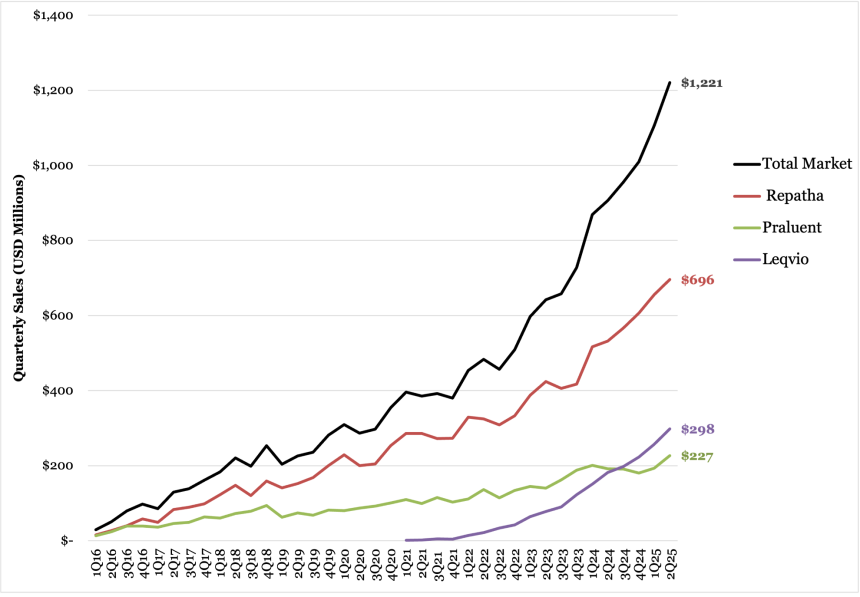
2Q25 PCSK9 Inhibitor Sales
| Revenue (Millions) | YOY Growth | Sequential Growth | Share of Market | |
| Repatha | $696 | +31% | +6% | 57% |
| Praluent | $227 | +18% | +17% | 19% |
| Leqvio | $298 | +64% | +16% | 24% |
| Total | $1,221 | +35% | +13% | -- |
PCSK9 Inhibitor Sales by Geography (1Q17 – 2Q25)
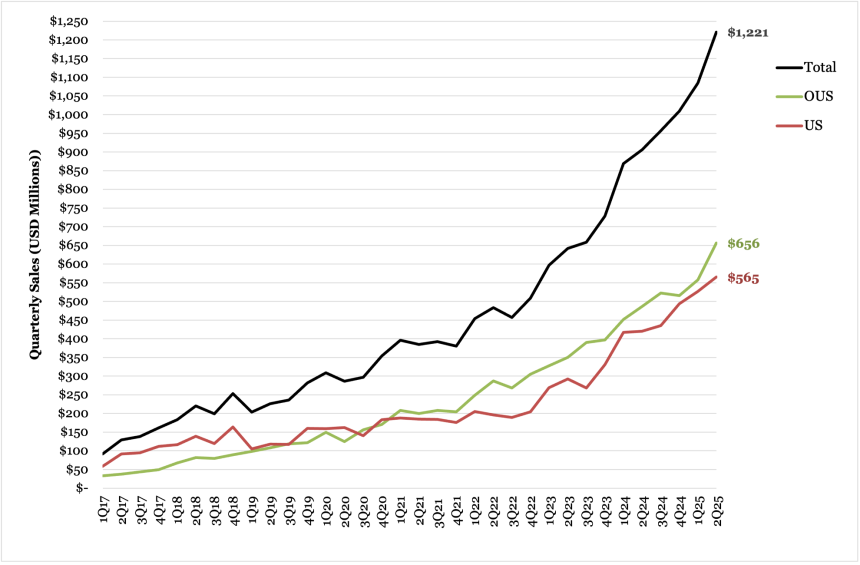
2Q25 PCSK9 Inhibitor Geographic Breakdown
| 2Q25 US Revenue (Millions) | US YOY Growth | US Sequential Growth | 2Q25 OUS Revenue (Millions) | OUS YOY Growth | OUS Sequential Growth | |
| Repatha | $361 | +34% | +5% | $335 | +28% | +15% |
| Praluent | $66 | +18% | +16% | $161 | +9% | +18% |
| Leqvio | $138 | +47% | +9% | $160 | +74% | +23% |
| Total | $565 | +35% | +7% | $656 | +35% | +18% |
PCSK9 Inhibitor market share (1Q16 – 2Q25)
--by Kayla Mathieu, Elizabeth Rose, Nour Khachemoune, Kat Moon, Monica Oxenreiter, and Kelly Close
[1]Lexicon’s dual SGLT-1/SGLT-2 inhibitor, Inpefa (sotagliflozin), is not included in the calculation of this roundup, given that it is not indicated as a diabetes therapy. The FDA approved Inpefa in May 2023 to reduce the risk of cardiovascular death, hospitalization for heart failure, and urgent heart failure visits in two populations: (i) adults with heart failure; or (ii) adults with T2D, chronic kidney disease, and other cardiovascular risk factors. In 2Q25, Inpefa revenue totaled $1.3 million, down 19% from 2Q24 and flat from 1Q25.