Lilly 1Q26 – D+O sales total nearly $16 billion (+71%), driven by GLP-1/GIP Mounjaro and Zepbound sales for diabetes and weight management; new Lilly oral Foundayo uptake to accelerate in 2H26; six “Triple G” retatrutide trial readouts in 2026 –
Executive Highlights
- Lilly presented its 1Q26 update today in a call led by CEO Mr. Dave Ricks, CFO Mr. Lucas Montarce, CSO Dr. Daniel Skovronsky, and President of Lilly Cardiometabolic Health Dr. Kenneth Custer – see the press release, webcast, presentation slides, and financial workbook. We note that it is always terrific to see so many of top management on the Lilly call and this quarterly call was no exception.
- Mounjaro (tirzepatide for T2D) sales totaled $8.6 billion, more than doubling from 1Q25 and up 17% sequentially. US revenue of $4.2 billion rose 60% from 1Q25 and was up 2% sequentially. Outside of the US, where Mounjaro is indicated for both T2D and weight management (except Japan and Canada), sales totaled $4.5 billion, up almost 4x (+274%) from 1Q25 and 36% sequentially. The growth in sales was driven by volume increase, partially offset by a decline in price – we’re glad to see this. Mounjaro captured 51% of incretin-class prescriptions for 1Q26 in the US, according to Lilly, up from 39% in 1Q25 and 48% in 4Q25 – this is up over 30% in a year, a major result for the GLP-1 giant.
- Generic entry ahead will stimulate the obesity market growth. In India, the loss of exclusivity of Novo Nordisk’s semaglutide in March 2026 and generic entry have expanded the obesity market. In fact, Mounjaro’s prescription volume grew by 10% after generic entry, compared to the corresponding period before.
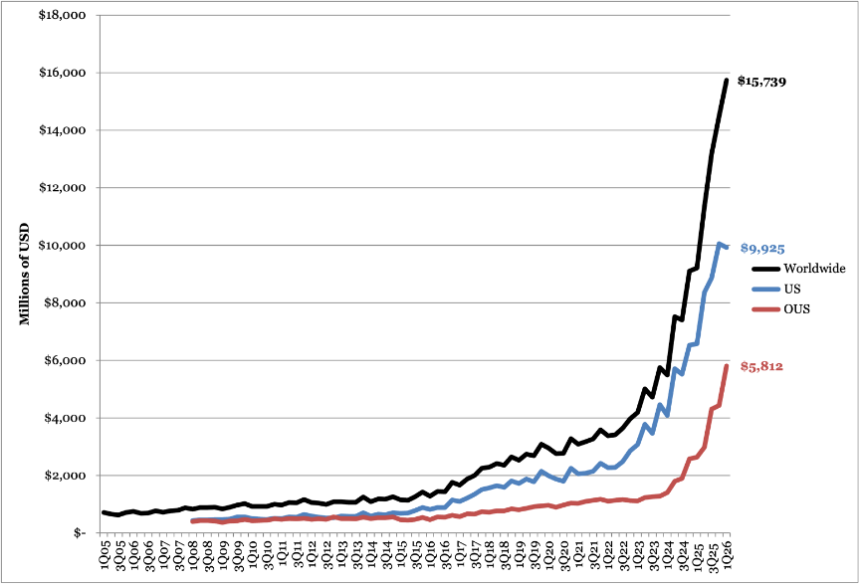
- Sales for Lilly’s diabetes and obesity portfolio totaled $15.8 billion in 1Q26, up 71% from 1Q25 and up 9% sequentially. US revenue totaled just under $10 billion, up 51% from 1Q25 and down 1% sequentially. OUS sales totaled $5.8 billion, up more than 2x from 1Q25 and up a whopping 31% sequentially, reinforcing from our view how very much growth is possible in the years and decades ahead if weight management is truly addressed. Growth in both US and OUS markets reflected volume increases, primarily driven by incretin-based therapies, and, we were glad to hear, was actually partially offset by lower realized prices. US sales represented 63% of global revenue, down from 71% in 1Q25 and from 69% in 4Q25. Lilly’s overall revenue totaled $19.8 billion in 1Q26, with a 2026 revenue guidance of $82-$85 billion, up from $80-83 billion in 4Q25.
- After US sales representing over 70% of total sales in diabetes for all of 2023 and 2024, in 2025, we saw this decline to “high 60s” in the last two quarters of the year. The 63% by our math is a figure not seen since 2016 (!), when US sales represented 62% of the total. The “lower” percentage of revenue coming from the US reflects lower prices for incretins as well as expanding interest in and commitment to incretins by many other countries.
- In 1Q26, Zepbound (tirzepatide for obesity) sales totaled $4.2 billion, up 80% from 1Q25 and down 2% sequentially. The year over year growth reflects increased demand, particularly outside the US and was partially offset by lower realized prices, presumably mostly in the US. For the fifth consecutive quarter, according to Lilly, Zepbound led the obesity market, capturing more than 60% of total prescriptions (TRx). On access, Lilly discussed the CMS and its extention of the Medicare GLP‑1 Bridge Program, which will provide Medicare beneficiaries access to obesity medicines at out-of-pocket costs of up to $50 per month from July 2026 to December 2027. Lots will have to go right on that front to change population health in our view – we hope to see more organizations in the ecosystem engaged in this work. Back on the payment front, in the self-pay channel, Zepbound vials continued to report robust sales, reflecting how much people with lots of disposable income are focused on this field.
- Foundayo (orforglipron) was a key focus of today’s call.
- On the obesity indication, the FDA approved Foundayo in April 2026 for chronic weight management. The product has been available in retail pharmacies and telehealth platforms across the US since April 9. On coverage, two of the three major PBMs will begin covering Foundayo starting mid-May, while Medicare access through the GLP-1 Bridge program will begin on July 1. Notably, over 80% of prescriptions were for patients new to incretin therapies, and over one-third of prescribers had not previously prescribed any oral GLP-1 RA. While management acknowledged that that early uptake has been slower than that of oral Wegovy, it is expected to accelerate in 2H26 as patient access and direct-to-consumer channels expand.
- On T2D, Lilly plans to file Foundayo for T2D in 2Q26, with regulatory action expected by the end of the year. We see this as particularly good news given that so many people in the US and globally with T2D are not yet at their glycemic targets (typically A1C of 7%, CGM metrics of 70% Time in Range for those lucky enough to have CGM to help guide diabetes management) – we think Foundayo will help more people either reach target or identify that they need more intensive medicine and approaches to their glycemic and cardiovascular health.
- Internationally, believe it or not, regulatory reviews of Foundayo for T2D and obesity are ongoing in over 40 countries. The company expects an accelerated global rollout beginning in late 2026 and early 2027.
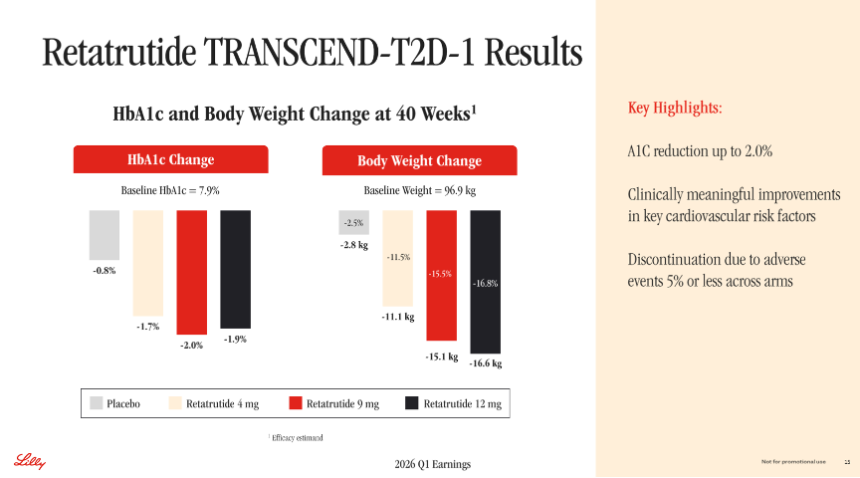
- In the pipeline, , Lilly management discussed its triple GLP-1/GIP/glucagon RA, retatrutide, including phase 3 results from the TRANSCEND-T2D-1 for people with T2D. The topline very impressive results, announced in March 2026, showed that at its highest dose, retatrutide lowered A1c by 1.7–2.0% from a mean baseline of 7.9% at Week 40. Participants also lost average of 17% of their body weight (36.6 lbs) from a baseline of 96.9 kg (214 lbs). Management reiterated optimism that retatrutide can meet the significant need for more effective weight‑loss options in T2D – as a reminder, this was just 40-week data. We do wonder about dosing and how easily it is to get to the highest dose (to say nothing about how to afford the highest dose). Full TRANSCEND‑T2D‑1 results will be presented at the ADA 2026.
1Q26 Financial Results for Lilly’s Major Diabetes and Obesity Products
| Product | 1Q26 Revenue (millions) | YOY Reported Growth | Sequential Reported Growth |
| Mounjaro | $8,662 | +125% | +17% |
| Zepbound | $4,160 | +80% | -2% |
| Jardiance/Glyxambi (royalty for Lilly) | $1,114 | +10% | +45% |
| Trulicity | $919 | -16% | -11% |
| Humalog | $442 | -18% | -16% |
| Basaglar | $206 | +18% | +42% |
| Humulin | $160 | -8% | -11% |
| Tradjenta (royalty for Lilly) | $76 | -1% | -4% |
| Total Diabetes and obesity | $15,739 | +71% | +9% |
Table of Contents
-
Financial Highlights
- 1. Diabetes and obesity portfolio sales totaled $15.8 billion (+71%), driven by continued massive demand for Mounjaro for diabetes and Zepbound for obesity
- 2. Zepbound: Sales total $4.2 billion (+80%), reflecting high US volume growth; continued growth anticipated with extended Medicare access
- 3. Mounjaro: Revenue totals $8.7 billion (up over 2x); generic entry in OUS expected to expand the obesity market
- 4. Foundayo (orforglipron): US approval for weight management in April 2026; international approval expected in late 2026 or early 2027
- 5. Trulicity: Sales total $919 million (-16%) amid increasing competition with Mounjaro and Ozempic
- 6. Jardiance: Sales total $1.1 billion (+10%), including one-time benefit of $250 million; generic dapagliflozin approved and launched
- 7. Humalog: Revenue totals $442 million (-18%); biosimilar competition expected to increase further in coming years
- 8. Basaglar: Sales total $206 million, consistent with previous quarters
- 9. Tradjenta: Revenue totals $76 million (flat), reflecting broader declines in DPP-4 inhibitor market revenue, though not necessarily
- Pipeline Highlights
- Analyst Q&A
- Close Concerns’ Questions
Financial Highlights
1. Diabetes and obesity portfolio sales totaled $15.8 billion (+71%), driven by continued massive demand for Mounjaro for diabetes and Zepbound for obesity
Sales for Lilly’s diabetes and obesity portfolio totaled $15.8 billion in 1Q26, up 71% from 1Q25 and up 9% sequentially. US revenue accounted for 63% of global revenue, slightly down from 71% in 1Q25 and from 69% in 4Q25.
US sales totaled $9.9 billion, up 51% from 1Q25 and down 1% sequentially. Growth was attributed to a 65% increase in volume but was partially offset by a 13% decrease due to lower realized prices for Mounjaro and Zepbound. The two therapies remained the primary growth drivers in the US. For the fifth consecutive quarter, Lilly led the incretin-based therapy market, with Lilly’s medicines capturing 60% of total prescriptions (TRx) – up from 53% in 1Q25 and down from 61% in 4Q25. For T2D, Mounjaro captured 51% of incretin-class prescriptions for 1Q26 in the US, up from 39% in 1Q25 and 48% in 4Q25.
OUS sales totaled $5.8 billion, up over 2x from 1Q25 and up 3% sequentially. Growth reflected a 95% increase in volume and a one-time annual payment of $250 million related to Jardiance and funded by Boehringer Ingelheim, down from 1Q25’s one-time payment of $370 million. This was partially offset by a 25% decrease from lower realized prices. Mounjaro was the main driver of this effect, given its strong uptake in Europe, Asia, and Latin America, as well as the inclusion to China’s National Reimbursed Drug List (NRDL). As a reminder, Mounjaro is indicated for both T2D and chronic weight management in most OUS countries, except for Canada and Japan, where the therapy is only approved for use in T2D.
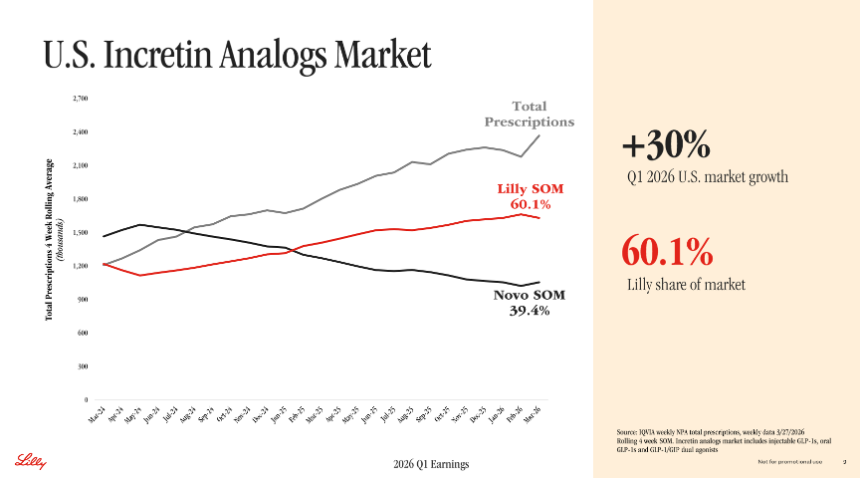
Source: Lilly 1Q26 presentation slides, page 10
Lilly Diabetes Worldwide Financial Results – Past Five Quarters
| Overall Diabetes | 1Q25 | 2Q25 | 3Q25 | 4Q25 | 1Q26 |
| Revenue – USD millions | $9,208 | $11,343 | $13,118 | $14,492 | $15,739 |
| YOY Reported Growth | +68% | +51% | +77 | +59% | +71% |
| Sequential Reported Growth | +1% | +23% | +16% | +11% | +9% |
Lilly Diabetes – 1Q26 Geographic Results
| Overall Diabetes | Revenue – USD millions | YOY Reported Growth | Sequential Reported Growth |
| US | $9,925 | +51% | -1% |
| OUS | $5,812 | +121% | +31% |
Lilly’s Overall Diabetes Sales (1Q05 – 1Q26)
Source: Close Concerns Knowledge Base
2. Zepbound: Sales total $4.2 billion (+80%), reflecting high US volume growth; continued growth anticipated with extended Medicare access
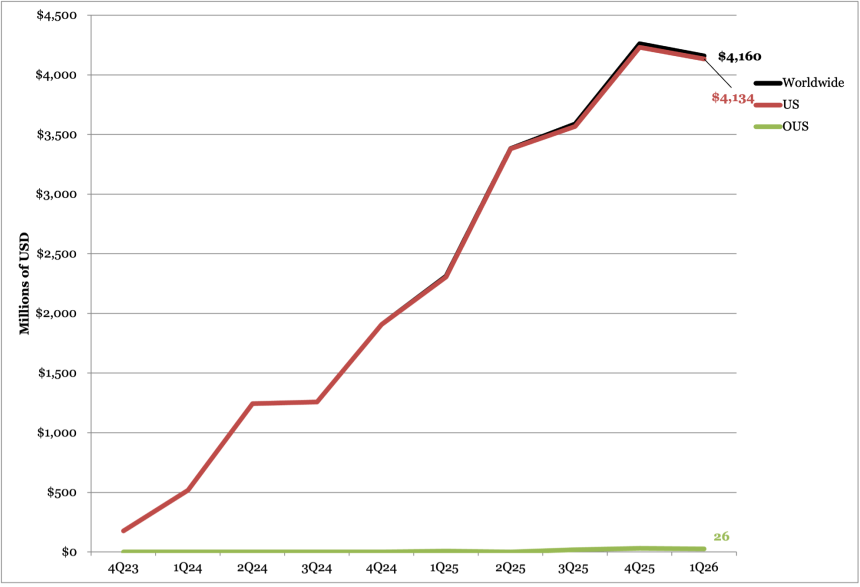
In 1Q26, Zepbound (tirzepatide for obesity) sales totaled $4.2 billion, up 80% from 1Q25 and down 2% sequentially. Recall that Zepbound is currently only commercialized in Canada, Japan, and the US.
US sales totaled $4.1 billion in revenue, comprising over 99% of global sales in 1Q26. Management attributed US sales growth to increased demand, which was partially offset by lower realized prices. Lower realized prices were also partially offset by a one-time adjustment to estimates for rebates and discounts in the quarter. OUS revenue totaled $26 million in 1Q26, down 16% sequentially. For the fifth consecutive quarter, Zepbound led the obesity market, capturing more than 60% of total prescriptions (TRx).
- On access, the Centers for Medicare and Medicaid Services (CMS) extended the Medicare GLP‑1 Bridge Program, which will provide Medicare beneficiaries access to obesity medicines beginning no later than July 1, 2026, through December 2027. Out‑of‑pocket costs are capped at $50 per month.
- In the self-pay channel, management stated that Zepbound vials had a strong quarter of sales. As background, Zepbound vials offer slightly lower prices than auto-injector pens and were made accessible in June 2025 through LillyDirect.
- On the regulatory front, Lilly received FDA approval for its Zepbound KwikPen and multi-use vials in February 2026. While not mentioned on today’s call, the product is now available on LillyDirect and includes four fixed Zepbound doses in a single pen.
- On clinical development, tirzepatide is also being evaluated for T1D, chronic kidney disease, MASLD, and weight maintenance in adolescents with obesity or overweight.
- In today’s call, management discussed the results of the phase 3b TOGETHER‑PsO trial (n=279), which evaluated concomitant treatment with Taltz (ixekizumab) and tirzepatide in adults with psoriasis and obesity. Combination therapy delivered superior outcomes, with 27% of participants achieving both total skin clearance and ≥10% weight loss, compared with <6% on Taltz alone. These topline results demonstrate that incretin-based therapies can bring benefits in immunologic diseases, reinforcing the rationale for ongoing combination trials in Crohn’s disease and ulcerative colitis.
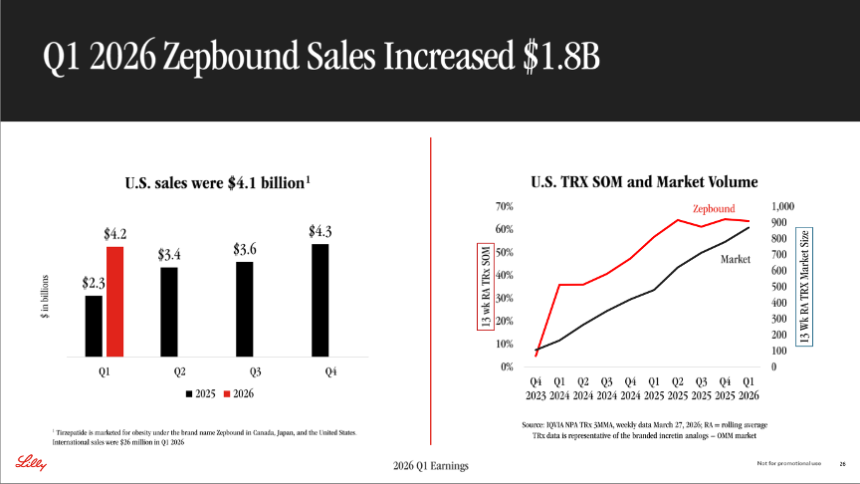
Source: Lilly 1Q26 presentation slides, page 26
Zepbound Financial Results – Past Five Quarters
| Zepbound | 1Q25 | 2Q25 | 3Q25 | 4Q25 | 1Q26 |
| Revenue – USD millions | $2,312 | $3,381 | $3,588 | $4,261 | $4,160 |
| YOY Reported Growth | +347% | +172% | +185% | +123% | +80% |
| Sequential Reported Growth | +21% | +46% | +6% | +19% | -2% |
Zepbound – 1Q26 Geographic Results
| Zepbound | Revenue – USD Millions | YOY Reported Growth | Sequential Reported Growth |
| US | $4,134 | 79% | -2% |
| International | $26 | n/a | -16% |
Zepbound Sales (4Q23-1Q26)
Source: Close Concerns Knowledge Base
3. Mounjaro: Revenue totals $8.7 billion (up over 2x); generic entry in OUS expected to expand the obesity market
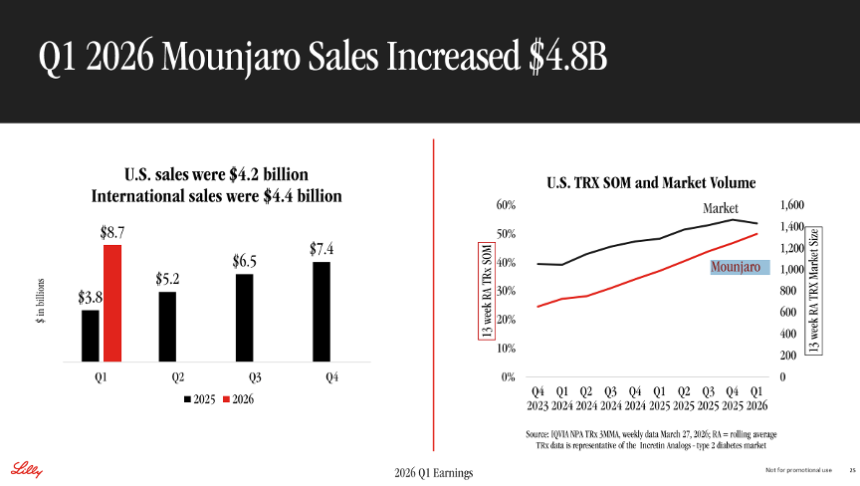
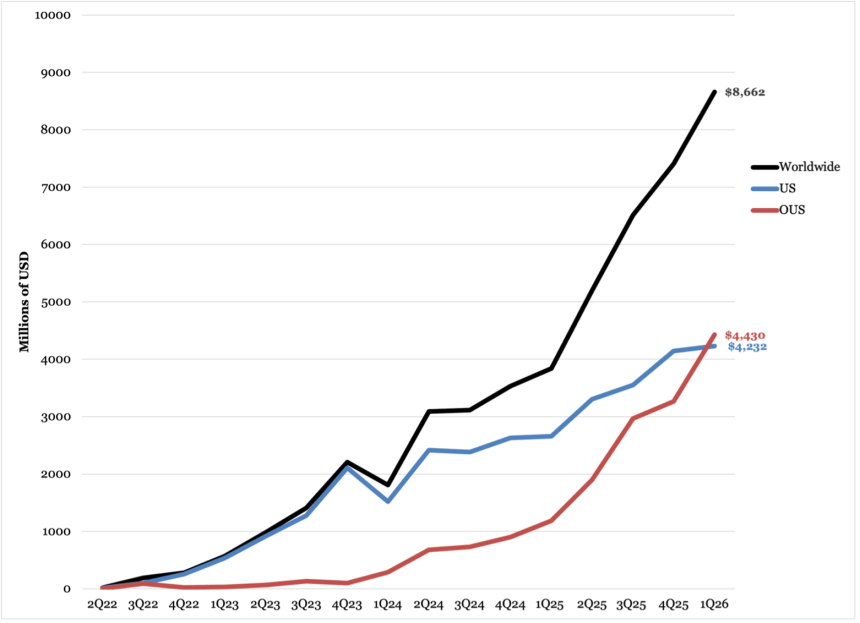
In 1Q26, Mounjaro (tirzepatide for T2D) revenue totaled $8.7 billion, up over 2x from 1Q25 and up 17% sequentially. US sales totaled $4.2 billion, up 59% from 1Q25 and 2% sequentially.
Management attributed US growth to strong demand and one-time adjustment to rebates and discounts, partially offset by lower realized prices. Moreover, Mounjaro continued to expand its market share, capturing 51% (up from 48% in 4Q25) of total incretin-based treatment prescriptions for T2D in the US.
Source: Lilly 1Q26 presentation slides, page 26
Outside of the US, where Mounjaro is indicated for both T2D and weight management (except Japan and Canada), sales totaled $4.5 billion, up almost 4x (+274%) from 1Q25 and 36% sequentially. Sales growth was primarily driven by higher volume and partly offset by lower prices. Management noted the modest positive impact of seasonality on sequential growth, as many patients in Europe tend to take breaks or delay treatment initiation during the holiday season.
For the second quarter, Lilly maintained its leadership of the international incretin-based therapy market, capturing 53% (vs. Novo Nordisk’s 47% market share).
- Mounjaro was fully launched in 55 countries. The uptake has been strong and rapid, including in markets where Mounjaro was launched in 2H25. Management especially noted that the product’s share has risen to 60% in Brazil and Korea. Moreover, management attributed robust revenue growth across various geographies – including Europe (+53%), Japan (+42%), China (+54%), and the rest of the world (+178%) – to Mounjaro’s sales.
- Notably, in China, Mounjaro for T2D was added to the commercial insurance innovative drug list in December 2025. The list guides private health insurers in offering expanded coverage for high-cost, innovative therapies that are too expensive to qualify for inclusion on the national public reimbursement drug list. Lilly said the inclusion has significantly accelerated volume growth in 1Q26, partially offset by a decline in price.
- Generic entry is expected to stimulate the obesity market growth. In India, the loss of exclusivity of semaglutide in March 2026 and generic entry have expanded the obesity market. In fact, Mounjaro’s prescription volume grew by 10% after generic entry, compared to the corresponding period before.
- During Q&A, management said that price reductions in incretin drugs have significantly increased volume. This is because the majority (75%) of Mounjaro sales OUS are out-of-pocket and thus are more sensitive to price changes compared to other pharmaceuticals. Similar trends are seen in US markets, as well, with the Most-Favored-Nation policy and reduced cost of Lilly’s Zepbound vials in 1Q26. Moreover, management said that Lilly can expand Mounjaro’s volume aggressively, given that a year and a half has passed since the tirzepatide shortage was resolved in December 2024. Hence, management urged investors to think of price reductions of Mounjaro differently from other pharmaceuticals.
Mounjaro Worldwide Financial Results – Past Five Quarters
| Mounjaro | 1Q25 | 2Q25 | 3Q25 | 4Q25 | 1Q26 |
| Revenue – USD Millions | $3,842 | $5,198 | $6,515 | $7,409 | $8,662 |
| YOY Reported Growth | +113% | +68% | +109% | +110% | +126% |
| Sequential Reported Growth | +9% | +35% | +25% | +14% | +17% |
Mounjaro – 1Q26 Geographic Results
| Mounjaro | Revenue – USD Millions | YOY Reported Growth | Sequential Reported Growth |
| US | $4,232 | +59% | +2% |
| International | $4,430 | +274% | +36% |
Mounjaro Sales (2Q22-1Q26)
Source: Close Concerns Knowledge Base
4. Foundayo (orforglipron): US approval for weight management in April 2026; international approval expected in late 2026 or early 2027
Foundayo (orforglipron), an oral small molecule GLP-1 RA, was a key focus of today’s call.
On the obesity indication, the FDA approved Foundayo in April 2026 for chronic weight management in people with obesity or overweight and weight-related comorbidities. The product has been broadly available in retail pharmacies across the US since April 9. In addition, over 12 major telehealth platforms now offer Foundayo, contributing ~35% of the launch volume. Management emphasized that Foundayo is Lilly’s first incretin-based therapy to obtain obesity as its initial indication, rather than diabetes. The therapy is differentiated, as it offers GLP-1 RA benefits in a pill form, with the convenience of taking the medication at any time of day without restrictions on food, water, or timing.
- On access, management said that two of the three major PBMs will begin covering Foundayo starting mid-May. Medicare access through the GLP-1 Bridge program will begin on July 1. In the cash channel, Foundayo is available on direct-to-consumer platforms, including LillyDirect and TrumpRx for $149-$299 per month, depending on doses. The lowest dose (orforglipron 0.8 mg) is priced identically to oral Wegovy (oral semaglutide 4.0 mg) at $149/month.
- On early trends of uptake, management said over 20,000 patients have been treated with Foundayo to date, which represents just over three weeks of sales. Importantly, over 80% of prescriptions include patients new to incretin therapies thus far. Moreover, over 8,000 healthcare providers (HCPs) have written a prescription for Foundayo – over one-third of whom had not previously prescribed any oral GLP-1 RA.
- To raise awareness, Lilly launched Foundayo digital advertisement awareness campaigns for healthcare providers (HCP) following approval. Lilly’s salesforce began to promote Foundayo to HCPs in person starting on April 17, with plans to begin sampling in coming weeks (there’s so much again!). On consumers’ end, management said that Lilly will begin full-scale promotion in 3Q26.
- During Q&A, management acknowledged that initial uptake of Foundayo has been slower than that of Novo Nordisk’s oral Wegovy. They explained that Foundayo’s launch includes a completely new molecule and a new brand. Oral Wegovy, they asserted, is indicated as an equivalent to injected Wegovy, which they said (logically, in our view) assisted initial uptake. In 2H26, management expects the uptake to accelerate further as patient access and direct-to-consumer channels expand.
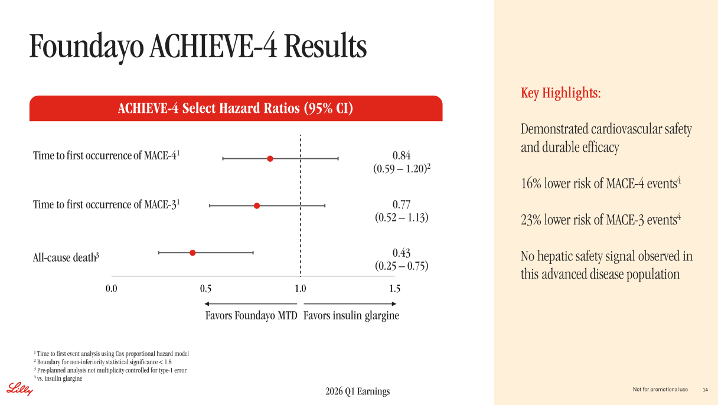
On T2D, Lilly reported topline results of the ACHIEVE-4 trial (n=2,749) earlier this month, which compared the effects of Foundayo to insulin glargine on major adverse cardiovascular event (MACE) in people with T2D, obesity or overweight, and an elevated cardiovascular risk. In the trial, Foundayo conferred a nonsignificant reduced risk (16%) of MACE (HR=0.86; 95% CI: 0.59-1.20), compared to insulin glargine. In a pre‑planned analysis, Foundayo led to a 57% lower risk of all‑cause death (HR=0.43; 95% CI: 0.25-0.75), although this was not controlled for multiplicity. Management said that the ACHIEVE-4 results demonstrate CV benefits of orforglipron, in addition to previously demonstrated benefits on A1c reduction and weight loss. Management said that ACHIEVE-4 was the last trial needed for regulatory filing for T2D in the US. The company plans to file Foundayo for T2D in 2Q26, with regulatory action expected by the end of the year. See our pipeline highlight below for the full list of phase 3 trials of orforglipron.
Source: Lilly 1Q26 presentation, slide 14
Internationally, regulatory reviews of Foundayo for T2D and obesity are ongoing in over 40 countries. The company expects an accelerated global rollout beginning in late 2026 and early 2027. Given that oral GLP-1 RAs for obesity have not yet been introduced OUS, Foundayo has the potential to be the first oral GLP-1 RA in international markets. Management also stressed that manufacturing scalability and access for oral medications far exceed those of injectable drugs.
Beyond obesity and diabetes, management also shared that Foundayo is being investigated in six additional phase 3 programs for other diseases, including ones that are fairly widely known, such as cardiovascular outcomes, peripheral artery disease (PAD), obstructive sleep apnea, and ones that are less known such as osteoarthritis pain, stress urinary incontinence, and even hypertension. As shared in the 4Q25 call, the phase 3 trial for PAD will be initiated this year.
5. Trulicity: Sales total $919 million (-16%) amid increasing competition with Mounjaro and Ozempic
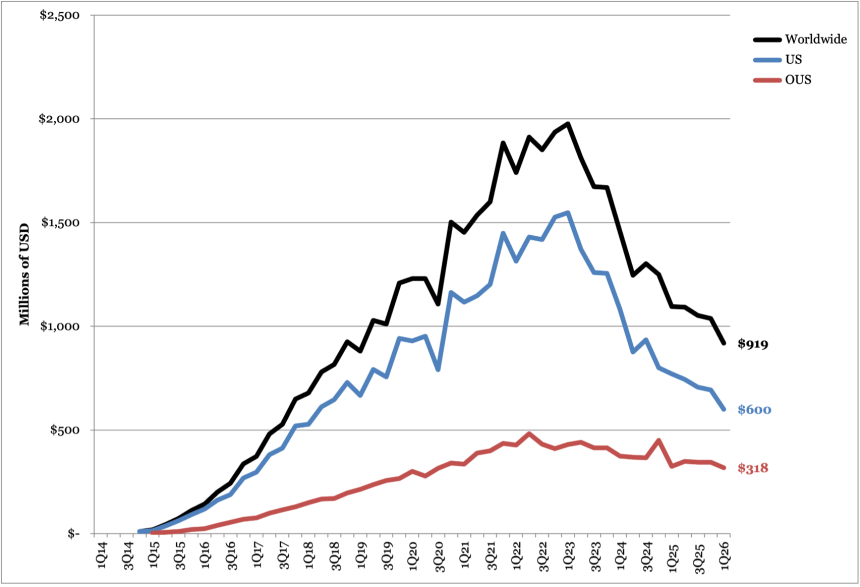
In 1Q26, Trulicity (dulaglutide) revenue totaled $919 million, continuing to decline by 16% from 1Q25 and 11% sequentially. By geography, US sales totaled $600 million, down 22% from 1Q25 and down 13% sequentially. OUS sales totaled $318 million, down 2% from 1Q25 and 8% sequentially. While the call did not mention Trulicity, the downward trend has previously been attributed to competition with newer incretin-based therapies like Mounjaro and Ozempic.
On pricing, Trulicity was included in the third round of the Medicare Drug Price Negotiation Program (MDPNP). Among the 15 drugs selected for negotiation, Trulicity accounted for the highest spending of $4.9 billion between 2024 and 2025. Moreover, under the Most-Favored-Nation agreement, Trulicity will be available at a negotiated list price of $389 per month for Medicare and Medicaid programs, reflecting a 61% reduction from the original list price. In our view, we do wonder, who would ever purchase Trulicity for nearly $400 per month when Foundayo (as just one option) is available for $150 per month. Moreover, even $150 per month is very high for many people, including many people on Medicare and anyone on Medicaid.
Trulicity Worldwide Financial Results – Past Five Quarters
| Trulicity | 1Q25 | 2Q25 | 3Q25 | 4Q25 | 1Q26 |
| Revenue – USD millions | $1,095 | $1,092 | $1,052 | $1,037 | $919 |
| YOY Reported Growth | -25% | -12% | -19% | -17% | -16% |
| Sequential Reported Growth | -12% | flat | -4% | -1% | -11% |
Trulicity – 1Q26 Geographic Results
| Trulicity | Revenue – USD millions | YOY Reported Growth | Sequential Reported Growth |
| US | $600 | -22% | -13% |
| International | $318 | -2% | -8% |
Trulicity Sales (4Q14-1Q26)
Source: Close Concerns Knowledge Base
6. Jardiance: Sales total $1.1 billion (+10%), including one-time benefit of $250 million; generic dapagliflozin approved and launched
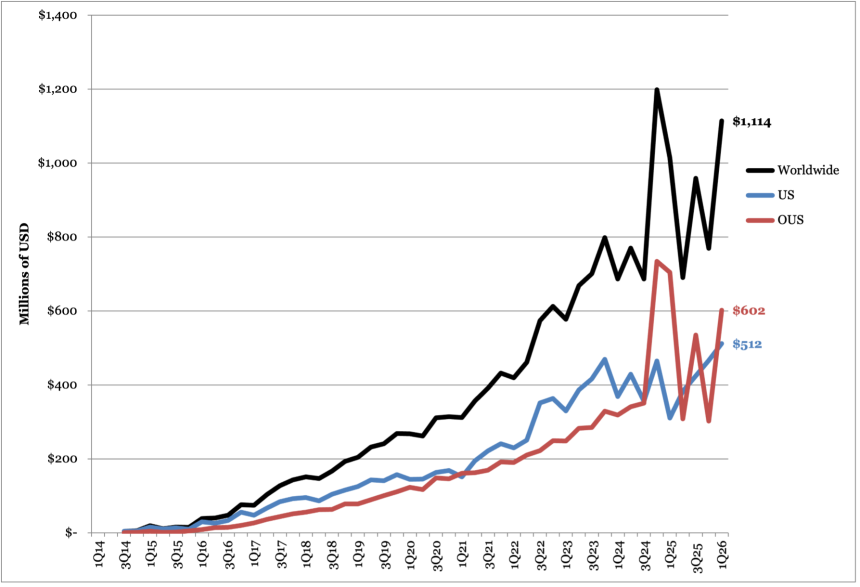
In 1Q26, SGLT-2 inhibitor Jardiance (empagliflozin) sales totaled $1.1 billion, up 10% from 1Q25 and 45% sequentially. US sales totaled $512 million, up 65% from 1Q25 and 10% sequentially. OUS sales totaled $602 million, down 15% from 1Q25 and up nearly 2x sequentially. We note that OUS sales in 1Q26 include $250 million in sales-based milestone payments from Boehringer Ingelheim (BI), compared to $370 million over the corresponding period last year. Excluding the one-time payments, OUS sales increased 34% from 1Q25 and 13% sequentially.
In an exciting move, the FDA approved over a dozen generics of dapagliflozin (AstraZeneca’s Farxiga) in April 2026 for the treatment of T2D and heart failure risk reduction in adults with T2D and cardiovascular disease. Manufacturers include Lupin, Cipla, MSN Laboratories, Sandoz, Teva, and Biocon, among others. Teva and Lupin’s generics have been commercially available since late April. The approvals follow Farxiga’s patent expiration for glycemic management for T2D in October 2025. While Jardiance’s patents for glycemic management and renal protection are protected until 2029 and 2034, respectively, we imagine generic entry will increase competition in the SGLT-2 inhibitor market and potentially lower prices.
Lilly’s Worldwide Jardiance Revenue – Past Five Quarters
| Jardiance | 1Q25 | 2Q25 | 3Q25 | 4Q25 | 1Q26 |
| Lilly Revenue (Lilly+BI est.) – USD Millions | $1,014 ($1,933) | $690 ($2,070) | $959 ($2,877) | $768 ($2,304) | $1,114 ($2,592) |
| YOY Reported Growth | +48% | -10% | +40% | -36% | +10% |
| Sequential Reported Growth | -15% | -32% | +39% | -20% | +45% |
Lilly’s Jardiance – 1Q26 Geographic Results
| Jardiance | Revenue – USD Millions | YOY Reported Growth | Sequential Reported Growth |
| US | $512 | +65% | +10% |
| OUS | $602 | -15% | +99% |
Lilly’s Jardiance Sales (3Q14-1Q26)
Source: Close Concerns Knowledge Base
7. Humalog: Revenue totals $442 million (-18%); biosimilar competition expected to increase further in coming years
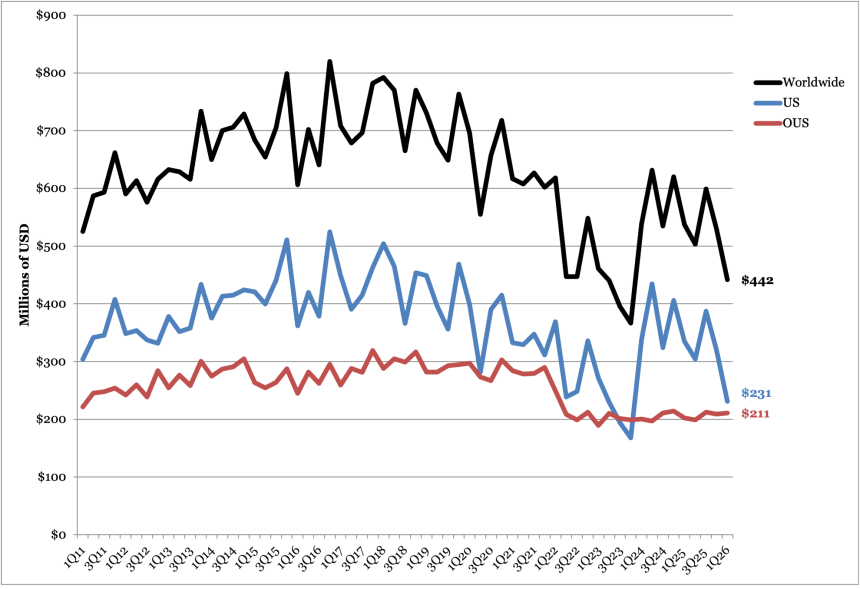
Combined revenue for rapid-acting Humalog (insulin lispro) and generic insulin lispro totaled $442 million in 1Q26, down 18% from 1Q25 and down 16% sequentially. US sales totaled $231 million, down 31% from 1Q25 and down 28% sequentially. OUS sales totaled $211 million, up 4% from 1Q25 and up 31% sequentially. As with previous quarters, we imagine that biosimilar competition will continue to increase and impact sales of all insulins across the market.
Humalog Worldwide Financial Results – Past Five Quarters
| Humalog | 1Q25 | 2Q25 | 3Q25 | 4Q25 | 1Q26 |
| Revenue – USD millions | $537 | $503 | $599 | $529 | $442 |
| YOY Reported Growth | flat | -20% | +12% | -14% | -18% |
| Sequential Reported Growth | -13% | -6% | +19% | -12% | -16% |
Humalog – 1Q26 Geographic Results
| Humalog | Revenue – USD millions | YOY Reported Growth | Sequential Reported Growth |
| US | $231 | -31% | -28% |
| International | $211 | +4% | +1% |
Humalog Sales (1Q11-1Q26)
Source: Close Concerns Knowledge Base
8. Basaglar: Sales total $206 million, consistent with previous quarters
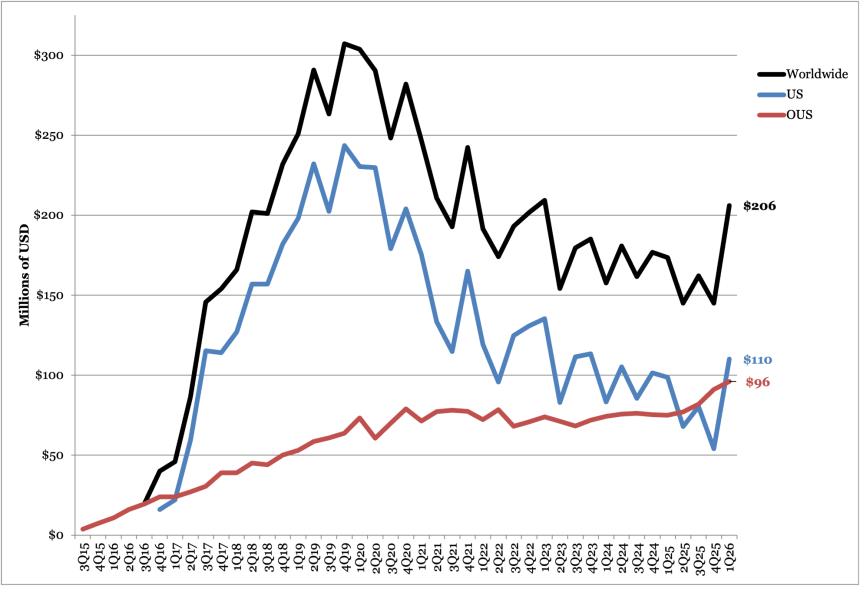
Sales for BI/Lilly’s insulin glargine Basaglar totaled $206 million in 1Q26, up sharply, 19%, from 1Q25 and up 42% sequentially. US sales totaled $110 million, up 11% from 1Q25 and up 104% sequentially. OUS sales totaled $96 million, up 28% from 1Q25 and up 6% sequentially. Of note, Basaglar revenue includes Rezvoglar (insulin glargine-aglr), consistent with previous reports. We are not sure what drove the growth here, and wonder if it was just a timing in some major sales.
While Lilly did does not typically mention Basaglar in its press releases or earnings calls, reflecting the company’s current focus on incretin-based therapies and bigger insulins, we were quite surprised by this result. While in previous quarters, lower sales usually remained relatively consistent with an overall decline in revenue seen in the last four years, as shown in the graph below, that was not true in this quarter. We imagine that this sequential increase may stems from competitive dynamics – we look forward to learning more.
Basaglar Worldwide Financial Results – Past Five Quarters
| Basaglar | 1Q25 | 2Q25 | 3Q25 | 4Q25 | 1Q26 |
| Revenue – USD millions | $174 | $145 | $162 | $145 | $206 |
| YOY Reported Growth | +10% | -20% | flat | -18% | +19% |
| Sequential Reported Growth | -2% | -17% | +12% | -11% | +42% |
Basaglar – 1Q26 Geographic Results
| Basaglar | Revenue – USD millions | YOY Reported Growth | Sequential Reported Growth |
| US | $110 | +11% | +104% |
| International | $96 | +28% | +6% |
Basaglar Sales (3Q15-1Q26)
Source: Close Concerns Knowledge Base
9. Tradjenta: Revenue totals $76 million (flat), reflecting broader declines in DPP-4 inhibitor market revenue, though not necessarily
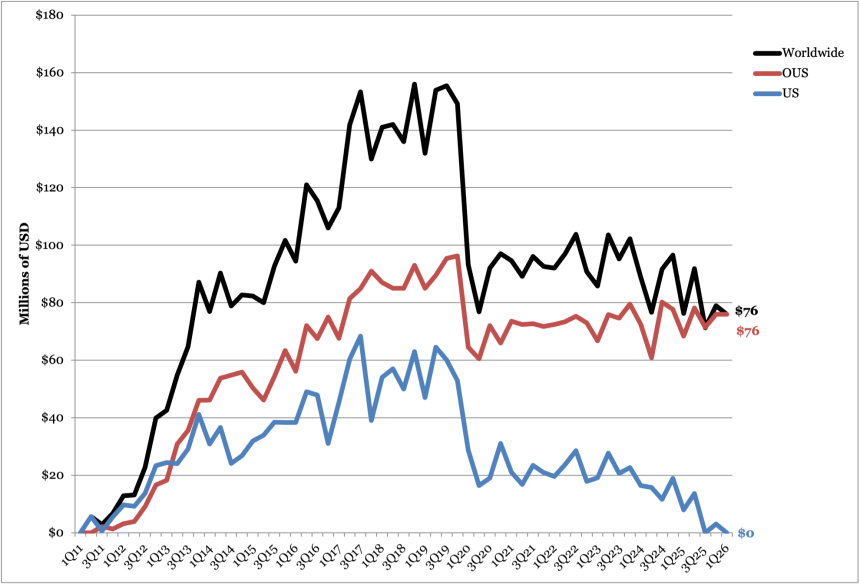
DPP-4 inhibitor Tradjenta revenue totaled $76 million in 1Q26, flat from 1Q25 and down 4% sequentially. OUS sales totaled $76 million, up 11% from 1Q25 and flat sequentially. In 1Q26, Lilly did not report any US sales, as compared to $3 million reported in 4Q25. Lilly’s partner Boehringer Ingelheim, which is responsible for US sales, is a private company and does not publicly report sales. While we’ve said for some time that Tradjenta’s declining sales trajectory is consistent with the broader DPP-4 inhibitor market, we do not necessarily mean fewer people are taking Tradjenta overall, just that pricing is certainly lower. We have heard that plenty of people take DPP-4 inhibitors who have pre-type 2 diabetes, particularly given Novartis’ VERIFY trial results from 2019. Iquivia data would be very instructive.
Tradjenta Worldwide Financial Results – Past Five Quarters
| Tradjenta | 1Q25 | 2Q25 | 3Q25 | 4Q25 | 1Q26 |
| Revenue – USD millions | $76 | $92 | $71 | $79 | $76 |
| YOY Reported Growth | -14% | +20% | -22% | -18% | flat |
| Sequential Reported Growth | -21% | +20% | -22% | +11% | -4% |
Tradjenta – 1Q26 Geographic Results
| Tradjenta | Revenue – USD millions | YOY Reported Growth | Sequential Reported Growth |
| US | N/A | N/A | N/A |
| International | $76 | +11% | flat |
Tradjenta Sales (2Q11-1Q26)
Source: Close Concerns Knowledge Base
Pipeline Highlights
1. Retatrutide: Topline TRANSCEND-T2D-1 trial results, with five additional phase 3 readouts expected in 2026; therapy targets patients with very high baseline BMI
Lilly discussed its triple GLP-1/GIP/glucagon RA, retatrutide, including phase 3 results from the TRANSCEND-T2D-1 (n=537) for people with T2D. The company announced topline results in March 2026. At Week 40, retatrutide lowered A1c by 1.7-2.0% from a mean baseline of 7.9%. Participants on the highest dose lost an average of 17% of their body weight (36.6 lbs) from a baseline of 96.9 kg (214 lbs), with no evidence of plateauing during the treatment period. Management emphasized that adverse events were consistent with other incretin‑based therapies, with discontinuation rates being ≤5% across all arms. They reiterated optimism that retatrutide can meet the significant need for more effective weight‑loss options in T2D and noted that full TRANSCEND‑T2D‑1 results will be presented at the ADA in June.
Source: Lilly’s 1Q26 presentation, slide 15
Lilly plans to submit the results of the core TRIUMPH program in 2026 to support applications for obesity and overweight, obstructive sleep apnea, and osteoarthritis. The next trial readout from the program is the TRIUMPH‑1 trial, anticipated in 2Q26.
- TRIUMPH-1 (n=2,300) assesses retatrutide in people with obesity or overweight and is expected to complete in May 2026.
- TRIUMPH-2 (n=1,000) investigates retatrutide in people with T2D and overweight or obesity and is expected to complete in May 2026.
- TRIUMPH-3 (n=1,800) evaluates retatrutide in people with obesity and established CVD, with study completion expected in May 2026.
- Topline results from the TRIUMPH-4 (n=405), which investigated retatrutide in people with obesity or overweight and osteoarthritis (OA), were announced in December 2025. Participants taking retatrutide 12 mg lost an average of 29% of their body weight at 68 weeks.
In addition to the TRANSCEND-T2D-1 trial, the TRANSCEND program continues to investigate retatrutide in people with T2D.
- TRANSCEND-T2D-2 (n=1,250) evaluates retatrutide compared to semaglutide in people with T2D and inadequate glycemic control with metformin and with or without SGLT-2 inhibitors. The study is expected to complete in January 2027, with primary completion in August 2026.
- TRANSCEND-T2D (n=320) investigates retatrutide in people with T2D and renal impairment with inadequate glycemic control on basal insulin with or without metformin and SGLT-2 inhibitor therapy. The study is expected to complete in October 2026.
- TRANSCEND-T2D-3 (n=320) evaluates retatrutide in people with T2D and moderate or severe renal impairment, with inadequate glycemic management on basal insulin, with or without metformin and/or SGLT-2 inhibitor.
Retatrutide is also in phase 3 trials for high-risk metabolic dysfunction-associated steatotic liver disease (MASLD), chronic low back pain, and cardiovascular/renal outcomes.
On manufacturing, in February 2026, Lilly announced a $3.5 billion investment in a new manufacturing facility in the Lehigh Valley in eastern Pennsylvania. The site will produce weight loss therapies such as tirzepatide and, specifically, retatrutide, once operational in 2031. Lilly’s decision to expand manufacturing in advance of the therapy’s approval further indicates its confidence in this therapy for its future.
2. Orforglipron: Updates on phase 3 trials for T2D or obesity
In addition to the ACHIEVE-4 trial (n=2,749) mentioned above, orforglipron has been evaluated for both obesity and T2D populations.
Phase 3 ATTAIN program:
- ATTAIN‑1 trial (n=3,127) evaluated orforglipron in people with obesity or overweight. Topline results showed that the highest dose achieved 12.4% (27.2 lbs) mean weight loss, compared with 0.9% (2.2 lbs) on placebo.
- ATTAIN‑2 trial assessed orforglipron in people with obesity or overweight with T2D. Topline results reported in August 2025 showed that orforglipron 36 mg confers 11% weight loss (vs. 2% in placebo) and A1c reduction by 1.8% (vs. 0.1%) in adults with obesity and T2D.
- ATTAIN‑MAINTAIN trial evaluated orforglipron for weight maintenance after prior use of injectable GLP‑1 RAs. Topline results announced in December 2025 showed that participants who had previously lost weight on semaglutide or tirzepatide maintained weight remarkably well after switching to orforglipron for 52 weeks, with only 1% weight regain after semaglutide and 6% weight regain after tirzepatide. Across groups, the average weight difference was just 0.9 kg.
Phase 3 ACHIEVE program:
- ACHIEVE-1 compared orforglipron to dapagliflozin in adults with T2D with inadequate glycemic management using metformin. Results were previously presented at ADA 2025 and published simultaneously in NEJM. In the trial, orforglipron demonstrated an A1c reduction of 1.3%-1.6% from a baseline of 8.0%, for the efficacy estimand. Additionally, up to 76% of participants on orforglipron achieved the A1c target of <7.0%, 66% achieved an A1c of ≤6.5%, and 26% achieved <5.7%. At the highest dose of orforglipron (36 mg), participants experienced a mean weight loss of 8% (approximately 16 lbs).
- ACHIEVE-2 compared once-daily orforglipron (3 mg, 12 mg, 36 mg) to a maximum dose of dapagliflozin (10 mg) in adults with inadequately managed T2D on metformin. Orforglipron achieved the primary endpoint, demonstrating a superior A1c reduction from 1.3% to 1.7% across doses, compared to 0.8% with dapagliflozin.
- ACHIEVE-3 compared orforglipron (12 mg and 36 mg) to Rybelsus (oral semaglutide 7 mg and 14 mg) on glycemic reduction and weight loss. Orforglipron demonstrated a 74% relative improvement in weight loss for patients taking orforglipron (9.2%) compared to oral semaglutide (5.3%).
- ACHIEVE-5 was a phase 3 add-on trial for adults with inadequately managed T2D on titrated insulin glargine, with or without metformin and/or SGLT-2 inhibitors. Orforglipron was tested at the three doses (3 mg, 12 mg, 36 mg) against placebo. Orforglipron achieved A1c reduction from 1.5% to 1.9% across doses, compared to 0.8% on placebo.
3. Other diabetes-related candidates
The table below reflects other updates to Lilly’s diabetes-related products in development in alphabetical order. Items highlighted in yellow indicate changes to the pipeline in 1Q26.
| Candidate | Phase | Timeline/Notes |
| Automated Insulin Delivery System/Smart Pens | Not applicable/approved | Connected Care Prefilled Insulin Pen under regulatory review as a new indication or line extension; Lilly signs international agreement with Roche, Glooko, Dexcom, and myDiabby to integrate its connected pen products so that users have flexibility in their analysis platform in May 2021; Lilly signs collaboration and licensing agreement with Welldoc in February 2021; Lilly gains non-exclusive global and exclusive US commercialization rights to Ypsomed’s YpsoPump and future mylife AID system in November 2020; US connected pen approved by FDA in 1Q19 (type 1 and 2); AID system advanced to “phase 2” on 4Q18 call; Feasibility study with Dexcom CGM and in-house pump/closed loop algorithm completed February 2018, initiated December 2017 |
| Bimagrumab (monoclonal antibody against ACVR2B) | Discontinued phase 2 trial in obesity/overweight without T2D | Phase 2 trial discontinued in September 2025; Full results of phase 2 presented at ADA 2025; Phase 2 study initiated in October 2024 for bimagrumab/tirzepatide combination therapy in obesity or overweight without T2D. |
| Brenipatide (injectable dual GLP-1/GIP RA) | Phase 3 (Alcohol use disorder, depressive disorder), phase 2 (asthma), phase 2 (tobacco use disorder), phase 2 (bipolar disorder) | In 1Q26, Lilly initiated a trial evaluating the therapy for major depressive disorder. In 4Q25, Lilly launched additional trials evaluating the therapy for tobacco use disorder and bipolar disorder. In 3Q25, Lilly launched a phase 2 trial for asthma in phase 3 trials for alcohol use disorder (AUD) and AUD with hazardous alcohol use. |
| Eloralintide (amylin agonist long acting) | Phase 3 in obesity; Phase 2 in T2D | Phase 3 study initiated for incretin add-on obesity/overweight, OA knee pain, and OSA plus obesity/overweight Phase 3 study (ENLIGHTEN-2) initiated in 4Q25 for obesity/overweight and T2D; Phase 2 study on combination therapy with tirzepatide in T2D 3Q24; Phase 2 initiated in February 2024; phase 1 initiated March 2022, expected completion January 2024 |
| Jardiance (empagliflozin) in post-myocardial infarction | Phase 3 | EMPACT-MI results presented at ACC 2024, failed to meet primary composite endpoint; Fast Track designation granted by FDA in September 2020 |
| Lepodisiran (siRNA) | Phase 3 | Phase 3 ACCLAIM-Lp(a) trial for reduction of major cardiovascular events in people with high Lp(a) and CVD or at risk of a heart attack or stroke initiated in March 2024; phase 1 results presented at AHA 2023. Completion is expected in March 2029. |
| Mazdutide (GLP-1/glucagon dual agonist, once-weekly oxyntomodulin) | Phase 2 (T2D), phase 2/3 (obesity), phase 2 (alcohol use disorder) | As of 4Q25, Lilly launched a trial evaluating Mazdutide for alcohol use disorder. Positive results for phase 3 GLORY-1 study of dual GLP-1/glucagon receptor agonist mazdutide in Chinese adults with obesity on January 2024; advanced into phase 2 for obesity in 4Q23; Phase 1 trial initiated November 2022, expected completion December 2023; Phase 1b results announced in obesity in October 2022; Positive topline phase 2 results announced July 2022; phase 2 study initiated August 2021 with estimated completion 3Q22; Phase 1 completed in July 2021; China-based Innovent Biologics licensed mazdutide from Lilly in 2019; Advanced into phase 1 in 4Q16; Oxyntomodulin analog under development for type 2 diabetes and NASH; First announced in May 2016 R&D update |
| Muvalaplin (Lp(a) inhibitor) | Phase 3 | Phase 3 initiated in 3Q25 with completion expected in March 2031. Announced plans in 1Q25 to initiate phase 3 trial later in 2025; phase 2 trial initiated in November 2022 |
| Nisotirostide | Phase 2 | Phase 2 announced 2Q25; Phase 1 completed in June 2023 for overweight or obese patients studying tolerability of LY3457263 when used with tirzepatide |
| Oral dual GLP-1/GIP agonist (LY3493269) | Phase 1 | Phase 1 trial initiated March 2023, with expected completion September 2023; Phase 1 trial initiated May 2021, completed in November 2021; Announced in 3Q19 update; Moved to phase 1 in 4Q19 |
| PYY (peptide YY) analog in diabetes | Phase 1 | Phase 1 in obesity initiated November 2022, exp. completion May 2023; Phase 1 study in diabetes initiated June 2022, expected completion September 2023; Added to pipeline in 4Q20 |
| ANGPTL3 siRNA in CVD | Phase 2 | Entered phase 2 development in 3Q22; Phase 1 study completed May 2022; Licensed by Kyttaro Therapeutics in April 2022 to treat ASCVD; Added to pipeline in 4Q20 |
| Long-acting GIPR agonists in diabetes | Phase 1 | Phase 1 initiated June 2022, expected completion October 2023; Phase 1 completions October 2021, November 2021 and December 2021; Added to pipeline in 4Q20 |
| PNPL3 siRNA | Phase 1 (MASH) | Added to pipeline 2Q22; phase 1 study in NAFLD initiated June 2022 with expected completion November 2024 |
| Relaxin-LA in heart failure | Phase 1 | Phase 2 in HFpEF initiated February 2023, with expected primary completion in November 2023; Phase 1 study completed in May 2022; Added to pipeline in 1Q21 |
Lp(a) siRNA in cardiovascular disease (LY 3819469) | Phase 1 | Phase 2 trial initiated October 2022, exp. Primary completion October 2023; Phase 1 completed November 2022 |
GLP-1 receptor non-peptide agonist 2 (GLP-1/NPA 2) (LY3549492) | Phase 2 | Phase 2 trial initiated in 4Q24; Added to pipeline in 2Q24 |
| GIP/GLP-1 co-agonist 3 | Phase 1 | Added to pipeline in 2Q24 |
| PCSK9 Editor | Phase 1 | Phase 1 VERVE-102 trial announced 2Q25 for patients with familial hypercholesterolemia |
| ANGPTL3 Editor | Phase 1 | Phase 1 VERVE-201 trial announced in 2Q25 for patients with refractory hyperlipidemia |
| Beta cell encapsulation therapy for type 1 diabetes | Preclinical | Lilly entered partnership with Sigilon in April 2018; Sigilon will file IND; Afterward, Lilly will lead in-human trials |
Analyst Q&A
On Foundayo
Q (Asad Haider, Goldman Sachs): Going back to Foundayo, I appreciate all the color on early launch dynamics, which is sort of playing out along the lines of your messaging that the initial launch trajectory is going to live below that of oral Wegovy. But then there's going to be an acceleration as we move into the back half of the year. With a few weeks of launch under your belt, you said that 15,000 patients have started taking the drug already. What's your level of confidence in that launch curve framing in the context of the early experience?
A (Ilya Yuffa, Eli Lilly USA President): Sure. Well, first, it is early days, but we're pretty pleased with the trajectory and encouraging first start to launch. Obviously, we just started active sales force promotion just over a week ago, having broad availability in supply channel just two weeks ago.
Really, we're encouraged by the initial leading indicators. And the way that we think about it, there are probably three key factors and catalysts of growth. And those three are; one, growing the familiarity among healthcare providers on the clinical profile Foundayo, building out the access and growing the awareness of Foundayo with consumers. And we're making progress on all three fronts.
And so on HCPs, if you think about the early indicators, we now have over 8,000 prescribers of Foundayo, a third of whom have not previously written an oral GLP-1, and so this is expansive. And the current sentiment so far, what we're hearing is really positive on the overall efficacy and kind of the no-hassle factor on a daily oral GLP-1.
We'll continue on the execution related to HCPs around sampling, continued promotion through our sales force, as well as educational seminars, we're fully in the field with our promotional efforts with HCP. So, good progress there.
On access, we've confirmed commercial access at two of the large PBMs by middle of May. So, just in a couple of weeks. And to the earlier question on Medicare, Medicare access will start at the beginning of July. And so those are the continued catalysts of growth upcoming in the next couple of months. And so we see that as an important unlock and expansion as well.
And then on the third piece, on the consumer front, we now have just over 20,000 patients treated to date, and one important element there is that 80% of those Foundayo prescriptions are new to class. So, this is expensive in bringing new people into being treated for overweight or obese.
We've done a number of aspects already around the direct-to-consumer on digital, on social media, and others. But, obviously, we will continue those efforts on a full scale, direct-to-consumer and TV launch in Q3. It is just to ensure that prescribers have familiarity around the profile of Foundayo before we do that.
Q (Courtney Breen): I know there's been a huge amount of focus on kind of the first few weeks of Foundayo and specifically kind of the launch strategy and activation of the different channels. Perhaps, it would be helpful if you could talk through how this compares to a kind of traditional primary care launch? What things are you accelerating? What things are you holding back and for what reasons, particularly in the context of the fact that you've got extreme amounts of inventory pre-prepared for the launch of this product?
A (Ilya Yuffa, Eli Lilly USA President): Maybe just probably the three elements I discussed earlier are probably the same for all of our primary care launches, where you need to grow the prescriber base and understanding of the profile of the medicine. And that's what we're doing here with Foundayo, building out access and, quite frankly, this is actually gaining access very early in launch, both on the commercial side, having two of the three being activated in the next couple of weeks, and getting Part D, which is usually lags in July, is a faster ramp on access. And so we're excited about that aspect.
The piece that is probably on the primary care side, an important element that many have noted, is around DTC. And we activated from day one in the first week, a number of digital, social media, and out-of-home advertising on the brand itself. But it does take time to build out consumer understanding and awareness of the brand.
The current sentiment, if you follow the total number of impressions and what consumers are saying about the profile of Foundayo, is resonating. So both in the efficacy as well as the overall profile of not having food or water restrictions. And so that element is positive. Now obviously, having a full DTC launch, we're still activating that probably earlier than normal because there is familiarity around the GLP-1. But we do want to take a moment and be disciplined in the approach of making sure that physicians actually understand what Foundayo is before activating fully.
But overall, this is following an accelerated path in primary care. And if I compare -- we've had the opportunity to launch many brands within primary care with Trulicity, with Mounjaro, Zepbound, Jardiance, all of which have gone towards leadership in those categories in a competitive space. So we feel pretty good about all of the actions we're taking, the three key factors, and the pace at which we are activating all three components.
On Zepbound
Q (Umer Raffat, Evercore): I thought I'd spend a quick second on Zepbound's commercial dynamics in the US. And really, what I'm trying to understand is, for example, 1Q, 7 million TRX, and 4.1 billion sales for Zepbound in the US, meaning it's about $580 per prescription. And even if you adjust for some -- the one-time adjustments, it's still about $550 per RX, whereas we understand the cash pay prices to be about 450 or so, and that price is too. I guess what explains that delta, or maybe IMS, is just not capturing some of your online channels.
A (Lucas Montarce, CFO): So, just to highlight, yes and even normalizing by these period adjustments, first of all, again, going back to the initial question on pricing, if you carve out what we agreed on MFN side as well back in November, and then the NRDL access, prices have been relatively stable quarter on quarter. I think it's going back to what we discussed last time about maintaining that price discipline. We continue to see that happening while we continue to grow significantly on the volume side as well. And yes, again, going back to your analysis on the pricing, yes, you have the Lilly direct prices that, as you know, we have adjusted down starting in December. And those prices have been very stable on that front as well. And then the rest basically by difference, you get into the commercial business, mainly that that's the different portion that it gets to that net 550 that you highlighted.
On Mounjaro
Q (Chris Schott, JPMorgan): Thanks so much for the question and congrats on the progress. I just wanted to dig a little bit more into international Mounjaro. And could you just share some of the learnings from? I think it's been a much better expected launch than we had anticipated here. As we think about the ramp going forward and longer-term opportunity, and maybe as part of that, can you just tell us whether we should expect any impact to the ramp from the entry of generic sema in select markets, or is this such an early stage of penetration where it's less relevant?
A (Mr. Patrik Jonsson, Executive VP): You know, when we look at the first quarter, it's truly a strong growth of all our prioritized products across international. But of course, particularly Mounjaro. And now we have fully launched in more than 55 countries. And we have seen a very strong speed of uptake and also a rapid market share gain, also in the market where we launched the second half of 2025. Referring to Brazil and Korea, where we currently have an estimated market share of 60%. And of course, also the China type II and RDL reimbursement. When we look at the generics, we only have a few weeks of data from India. But it seems like it's really stimulating the growth in the overall obesity market. And that includes our product, and the Mounjaro has actually been pulling market share quite nicely. When we look at the Mounjaro prescriptions, they are about 10% higher in recent weeks compared to the period prior to generics entering.
So I think it just underscores that dual agonism trumps single agonism, and moving forward, I think we should expect a very strong, continued year-on-year growth and some sequential growth. We saw in the slide earlier that we have a market share above 53% OUS. And that's an average. And in many international markets, we have a market share along the lines of what we see in the US with Zepbound. And when you get to that level incremental share gain is getting harder.
And of course, we will focus our efforts on patient activation, driving increased penetration in the chronic weight management market, and market growth. And also, secondly, what we have seen during the second half of the year has been some seasonality, mainly driven by the holiday season in Europe, where patients tend to take a holiday -- drug holiday break or actually delay their initiation of the new therapy start. But overall, strong growth across regions seems like generic semaglutide is stimulating market growth. And we continue to do well. We expect a continued strong year-on-year growth, sequential growth driven by patient activation.
On pricing, coverage, and costs
Q (Geoff Meacham, Citi): Investors seem to be acutely focused on pricing in Incretin, with not a lot of emphasis on volume. I know you don't want to get too specific, but can you talk about, at a high level, the margins under a wide range of price scenarios for Lilly, how you see the investments you've already made in, say, manufacturing, and how that adds to the dynamic and what that means in terms of the competitive note?
A (Mr. David Ricks, CEO): Maybe a couple of things to point out now that we're five or six quarters deep into this post-shortage world, and we can really pursue expansion on volume in an aggressive way, I think you can see something, its a little different about the obesity and weight loss category from what we think about in other pharmaceuticals where the barrier is typically more informational, not price sensitivity, but here clearly, because out of pocket nature, 75% of ex- US business for Mounjaro is out of pocket. The US is a meaningful portion as well.
That we see quite expansionary volume, perhaps non-linear to price reductions. Of course, there's a floor on that, and we have sensitivity on our cost structures, et cetera. But, pretty much every time we reduce pricing, we see a pretty large expansion.
You also see built into this, the primary pricing effect in Q1 is actually negotiated outcomes with governments. Both the MFN package we negotiated with the Trump administration. You're cut out-of-pocket costs. You see strong growth like Lilly Zepbound vials really had quite a strong quarter in Q1, with slightly lower prices. And then in China, we negotiated for diabetes access and a meaningful price reduction. But you can see the volume far outstripping the price concession. So kind of a different dynamic. And I think, if investors can think about this category, perhaps unlike other pharmaceutical categories in the past. You know, in terms of margin sensitivity, it remains true that for this category, for us at least, the unit economics are really driven by fixed costs that are either sunk in the past or unmovable, depending on the volume in the present. And as a result, both covering the amortized R&D costs as well as CapEx is a concern from an accounting perspective. But at the margin, we do have latitude. You know that said, we want to invest in future medicines. And I think that's probably the biggest, as we've said before, is we think about long-term operating margin for the company, you know, the X factor, if we have good projects, we won't hesitate to invest in them, whether they be existing medicines, I think you see kind of a record. Load of, Phase three NYLEX at Lilly right now or for new medicines. And we've got a very full Phase 2 and Phase 1 pipeline that we are deploying capital against. So we've got a lot of latitude here, Jeff. And I think this market works a little differently, and we're all sort of just getting used to that. But I think good news for Lilly and our incumbent position.
Q (Alex Hammond, Wolfe Research): On Medicare access, can you walk us through your strategy to activate these patients? And when do you kind of see this playing out in terms of either maybe a 4Q dynamic or more of a 2027 as these patients pull through? And I guess as well, with the attractive price point, how do you think about persistence in this population?
A (Ilya Yuffa, Eli Lilly USA President): Obviously, we're excited about having Part D access, starting to activate for obesity medicines starting in July. In a way that we think about it, there are millions of Part D beneficiaries who are eligible. And so the path to that, with having a long trajectory with a bridge program of not only starting in July, all through 2027, is an important aspect.
Obviously, that will take time to build. We need to have the education across physician based pharmacies as well as the consumer base to understand the full path of different medicines that we have and available for treating obesity. And so that'll be a gradual path in 2026, as it starts. And then continued growth in 2027. And obviously, the $50 month copay is an important element of affordability for seniors.
We've already seen for Zepbound as well as Mounjaro that we've had great persistence overall relative to other chronic conditions. And we continue to see that, obviously, the $50 copay and affordability will only add to that, in addition to all of the health benefits and experiences that people will have over time. So we're excited about expanding access very soon.
Q (James Shin, Deutsche Bank): With bridge extending into 2027, Dave, what's next for the balance? Is Lilly working with stakeholders on revisions to secure longer-term Medicare access? Thank you.
A (Mr. David Ricks, CEO): When we signed the agreement with the administration, we all knew Bridge was going to be put in place because it was a midyear launch. And we had understood at the time that there was a commitment to 2027, if, as a contingency, the Part D plans did not choose to opt in at a certain rate. Of course, we now know they didn't. And maybe that's not so surprising. They operate on margins. There have been other disturbances and market events in the Part D program, for instance, the IP products, et cetera, that have changed their economics. And unfortunately, I guess, not being a part of those discussions, but they couldn't cross with the major players for calendar 2027. So the government is doing what they said, and they're extending the bridge. I think for manufacturers, there are some pros and cons in that. But the fact that there'll be access to the consumers at $50 a month, I think, is a very compelling proposition, as Ilya highlighted before, will drive great persistency -- and in an 18-month window, I think we will start to see population-level health improvements if these are used at scale. That will then set up the 28 discussion.
I would expect the government to lean hard into getting Part D plan participation in 2028 and normalizing obesity care as a standard preventative treatment and something that should be used to treat comorbidities of obesity within the senior population. We may have the evidence to support that as we exit 2027. It may need a little more time, but I think they're going to push to help make that happen. And I think that normalization is overdue in the commercial market. So it will be a good leading indicator for us across the US business. We'll continue to work with the government closely through that period and, of course, try to work with them to activate patients and make sure they can find success on our medicines. So stay tuned, probably more news as we exit 2026 on the actual 2028 plans.
Q (Mohit Bansal): Thank you very much for taking my questions, and congrats on the progress. I just want to touch upon the Employer Connect program that you are embarking upon. So it seems like the insurance -- commercial insurance has been relatively stable year-over-year. So this seems to be the way to grow it, and employers are worried about their costs long term and everything. So I would love to understand what the steps are to convince employers to buy into the Employer Connect program and the mechanics of it?
A (Ilya Yuffa, Eli Lilly USA President): As you mentioned, the overall commercial access has been pretty steady around 50%. And one of the key aspects that we're excited about is having an Employer Connect platform where we work with a number of third parties to actually go out and talk to different employers about the value of covering obesity care. But there are several things that are a little bit different with the Employer Connect program. One is a transparent price that is known to all of the employers and provides the flexibility and design around the employee, employer, and employee contribution towards obesity coverage. And so we do think that this is a positive element to increase the number of employers opting in. Obviously, the selling timeline for making decisions for 2026, 2030 has passed.
So while we are currently having positive conversations and positive feedback from employers around this new platform, that will most likely have a gradual impact in the back half of 2026 and most likely incremental opt-ins for 2027. And then as part of that, obviously, there's more data on real-world evidence. And also components of what employers cover what are the benefits to their employees overall, both in their health and productivity over time. And as that data comes out, that will only reinforce the positive decision to provide coverage for obesity care.
Q (David Risinger, Leerink): Thanks for taking the question. So Dave, I was hoping that you could just frame your vision for employer coverage in the United States. So in the US pharmaceutical business, employer coverage is most important for drugs, particularly drugs that treat various medical conditions beyond cosmetic. And so I understand that you have the employer direct initiative, but I'm just trying to get my head around what you think will happen with regular employer insurance coverage in the coming years, versus coverage that will involve greater cost sharing by participants who engage with Lilly Direct for consumers to pay more out of pocket than they are paying today under regular employer coverage.
A (Ilya Yuffa, Eli Lilly USA President): Obviously, an important factor in, we do think just as a policy matter that obesity and overweight medications should be broadly covered. I think a big step in this journey is actually the July 1 Medicare. There's often spillover benefits into commercial from there, and I think setting a standard that people in America should expect if they've paid into their insurance program or their employer has, that it will cover their health needs.
That said, I think the likely path from here to what I think will ultimately begin to look like other chronic medication markets, like diabetes and hypertension. I think we will get there with this category, but it won't be a straight line. It won't be a straight line. It won't be, kind of everything we want on day one. Why? Because the economists are mentioning it's a very broad disease. 70% of adults are overweight or obese and are potential candidates for these medications.
And it's the last thing in, and we know that, despite the fact that it could be one of the most valuable healthcare interventions available, it's the last one we see. So it's easier to say no to. But we do see progress there.
As Lilly said, Employer Direct is all about creating new options to get to yes with employers’ alternate pathways. We'll continue to publish data. As I'm sure Novo Nordisk will demonstrate that pretty much all of these drugs in this category have had profound effects and are probably cost-effective at their current prices. And of course, prices have been trending down.
So, we'll continue to make progress. I should also say, we have a number of new indications coming. And per Umer's question earlier, that actually is a pretty good unlock for us when we get in directly indicated populations with acute comorbid disease. So, all those things will pull together. And in some future year, we'll look back and say, we got there. But it's going to be more incremental progress quarter-on-quarter. And, we'll keep updating the street with what to expect as we issue our guidance.
On the GLP-1 RA market
Q (Seamus Fernandez, Guggenheim): So really, we just wanted to get a better understanding of how the market, as you see it is starting to segment and could segment going forward more, as you look forward to the potential introduction of retatrutide, amidst the Foundayo launch, where do you see the market really opening up with each of these potential assets reaching forward?
A (Mr. Patrik Jonsson, Executive VP): I think it's reasonable to expect in this large and growing market and opportunity. Obesity, that was -- the number of patients around the world living with overweight or obesity numbering perhaps in the billions, many of them are going to want different types of medicines that are tailored to their individual needs and preferences. We're in early innings in that regard. We're now sort of bringing the third segment, I guess, in. We've had GLP-1 single agonists and then dual agonists, and now oral medicines. But we see many other sort of plausible opportunities to tailor medicines to different groups.
As you noted, retatrutide is one of those ideas which very obviously could play to individuals who are seeking greater weight loss, although I will say we see opportunities for retatrutide elsewhere and across the spectrum of obesity.
Eloralintide, we can position that a few ways based on the phase two data that we've seen. The first of which is that this could be a great medicine for patients seeking a non-GLP-1-based mechanism, perhaps due to the tolerability they've experienced or the tolerability that they're fearful of.
It may also be a good drug that could be added on top of existing incretin therapies to provide incremental weight lowering. But there are many other ideas out there. Lilly's investment in that includes medicines that could be dosed even less frequently.
Perhaps additional metabolic benefits and maybe some that are sort of ultra-long acting using genetic medicine approaches. We see all of these as compelling ideas. And we also feel we're in a leading position in most, if not all of those spaces.
In terms of how the market will ultimately shake out in terms of percentage of use across those different ideas it's hard to prognosticate that. But many of these ideas are tied to common manufacturing platforms. And we're making the investments to support any of them should they prove to be really the most favorable option for managing overweight and obesity?
Close Concerns’ Questions
- What factors have driven new-to-GLP-1 RA class prescriptions for Foundayo?
- How many patients does Lilly expect to shift from injectable GLP-1 RAs to Foundayo?
- How will prescribers and patients differentiate between Foundayo and oral Wegovy?
- How has Lilly clarified to HCPs the discrepancy between approved doses vs. doses evaluated in clinical trials?
- To what extent might Foundayo’s advantage of ease‑of‑use offset its relatively weaker weight‑loss efficacy compared to oral semaglutide?
- How does Lilly expect patient segments dividing between Zepbound vials and the new KwikPen as familiarity and access expand?
- How does Lilly expect dapagliflozin generic entry to impact Jardiance sales?
- How does Lilly see MASLD and MASH evolving as a priority for retatrutide?
-- by Kayla Mathieu, Elizabeth Rose, Kat Moon, Monica Oxenreiter, and Kelly Close