Abbott 4Q25 – Full-year 2025 Diabetes Care revenue of $8 billion (+18%; +16% operationally); non-insulin T2D positioned as potential key growth driver; DGK submitted to FDA for clearance –
Executive Highlights
- CEO Mr. Robert Ford and CFO Mr. Phil Boudreau led Abbott’s 4Q25 financial results this morning (see press release, webcast, infographic).
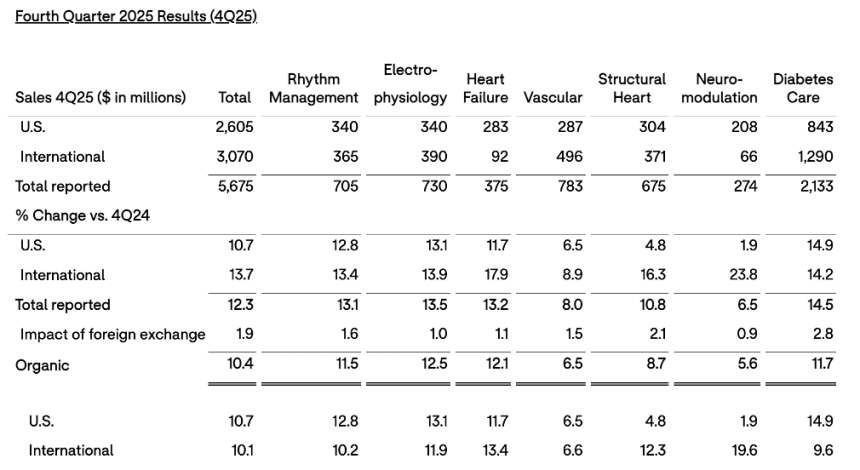
- Diabetes Care generated quarterly revenue of $2.1 billion, up 15% (+12%[1]) from 4Q24 and 4% sequentially. In 4Q25, International Diabetes Care totaled $1.3 billion, up 14% from 4Q24 and up 2% sequentially.
- International revenue of $1.3 billion rose 14% as reported (10%). Growth outside the US sounded strong and balanced across multiple geographies.
- US Diabetes Care totaled $843 million, up 15% from $734 million in 4Q24 and up 6% from $796 million sequentially.
- Full-year 2025 Diabetes Care revenue totaled $8 billion, up 18% (+16%) from 2024. This represents roughly 18% of Abbott’s total 2025 revenue, up from 16% in 2024, 9% in 2020, 5% in 2015, and 4% in 2010 (before the separation of AbbVie). We expect this to be larger over time as ADC begins to leverage AID potential and as “DGK” (dual glucose ketone) launches.
- Full-year 2025 international revenue totaled $4.8 billion, up 15% (+14%) from 2024.
- Full-year 2025 US revenue totaled $3.2 billion, up a striking 21% from 2024. US revenue in 2025 accounted for 40% of global Diabetes Care revenue. After OUS revenue growth took off in 2018, US share has begun to catch up in recent years, increasing from ~25% in 2020 to the high-30s percent over the last few years. Mr. Ford emphasized that 2025 marked the third consecutive year in which CGM revenue increased by more than $1 billion, with full-year CGM sales surpassing $7.5 billion.
- Mr. Ford announced that the company submitted its dual glucose-ketone (DGK) monitor to the FDA for clearance in 4Q25. While we aren’t sure whether the submission occurred early or late in the quarter, launching the new sensor in the US in 2026 certainly seems possible, which would be exciting on many fronts, to multiple populations. Mr. Ford emphasized that in the meantime, the company is working closely with regulators, key opinion leaders, physician groups, and payers, and noted that a differentiated product like DGK can both drive market share gains and expand the sensor market. Among Abbott’s target populations for the sensor, he highlighted intensive insulin users and insulin pump users as well as SGLT-2 users – those at high risk of DKA (“frequent fliers” as they are sometimes called) would also be at the high end of the list. What a boon this approval would be to systems to be able to systemically reduce DKA! We are hopeful and optimistic about this technology.
- Today’s call underscored rising interest in expanding CGM adoption across intensive insulin, basal-only insulin, and non-insulin users internationally. Mr. Ford particularly emphasized the market expansion opportunity among patients with T2D not on insulin, citing several studies showing improvements in A1c and Time in Range with CGM use. This trend is supported by physician organizations such as the ADA, and Mr. Ford said that he expects CMS to issue preliminary language on expanded CGM coverage for non-insulin patients with T2D in the first half of 2026. While we did not hear a new “user” estimate for CGM as we sometimes do in the 4th quarter call, we will be out with our estimate in not too long!
- Much of Abbott’s call today focused on its nutrition business, which reported quarterly sales of $1.9 billion, down 9% from 4Q24 and 10% sequentially. Mr. Ford attributed the decline primarily to pediatric market share losses in the US. Manufacturing costs have risen over the past several years, driving price increases that constrain demand and growth. To reignite volume growth, Abbott has implemented pricing and promotional initiatives and plans to launch eight new products in 2026. While 1H26 will remain challenging according to management, given broader economic conditions, they look for a return to growth for the division in 2H26.
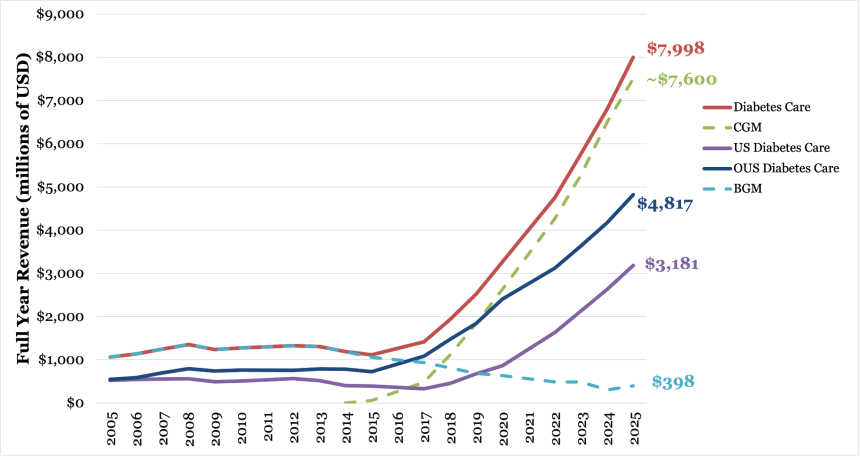
Table of Contents
-
Financial Highlights
- 1. Quarterly Diabetes Care revenue totals $2.1 billion (+15%; +12%); full-year 2025 Diabetes Care revenue totals $8 billion (+18%; +16%)
- 2. International Diabetes Care revenue totals $1.3 billion (+14%; +10%); full-year 2025 revenue totals $4.8 billion, up 15% (+14%)
- 3. US Diabetes Care revenue totals $843 million (15%); full-year 2025 revenue totals $3.2 billion, up 21%
- 4. Abbott issues 2026 total organic sales guidance of 6.5-7.5%
- 5. Abbott works to revamp nutrition business with new product launches; PROTALITY goes unmentioned
- CGM Franchise Highlights
-
Diabetes-Related Analyst Q&A
- On lower guidance related to nutrition and profitability
- On CGM growth and Abbott’s expected position
- On coverage expansion for those with T2D not taking insulin
- On the outlook for diagnostics in China
- On Abbott’s double-digit quarter and market penetration
- On capital allocation and nutrition business recovery
- Close Concerns’ Questions
Financial Highlights
1. Quarterly Diabetes Care revenue totals $2.1 billion (+15%; +12%); full-year 2025 Diabetes Care revenue totals $8 billion (+18%; +16%)
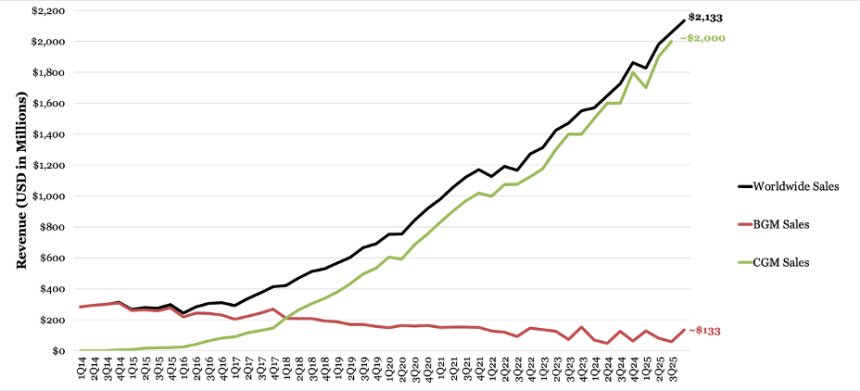
In 4Q25, Abbott Diabetes Care recorded $2.1 billion in sales, up 15% (+12% operationally) from 4Q24 and up 4% sequentially. Full-year 2025 Diabetes Care revenue totaled $8 billion, up 18% (+16% operationally) from 2024. Overall, Abbott’s Diabetes Care business grew $270 million from 4Q24 (from $1.8 billion) and $76 million sequentially (from $2.06 billion). Growth in Abbott’s international Diabetes Care revenue drove 60% of quarterly growth, with the remaining 40% driven by US growth. Mr. Ford highlighted that growth was primarily driven by increasing CGM adoption across patient populations, including intensive insulin, basal-only insulin, and non-insulin using patients with diabetes.
- CGM revenue totaled $2 billion in 4Q25, up 11% from 4Q24 and flat sequentially. Consistent with previous quarters of late, 4Q25 FreeStyle Libre and Lingo accounted for over 95% of total Diabetes Care revenue, with “fingerstick” glucose monitoring a much lower percent of the total. Mr. Ford reiterated that CGM remains one of Abbott’s most durable growth engines, noting that 2025 marked the third consecutive year in which CGM revenue increased by more than $1 billion. Full-year CGM sales surpassed $7.6 billion in 2025.
- We estimate that BGM sales totaled approximately $133 million in 4Q25, more than double 4Q24 and 3Q25 revenue. Full-year 2025 BGM revenue is an estimated $398 million, up 30% from 2024. We note that these estimates are due to rounding in Abbott’s CGM revenue, as the company reports CGM revenue rounded to two figures. In 4Q24 for example, our estimation assumed exactly $1.8 billion in CGM revenue; consequently, the BGM estimates may underestimate, or overestimate, Abbott’s “true” BGM revenue. We’re curious to know, if our estimates are accurate, what drove this growth in sales following several quarters of historical decline, which reflect users transitioning from BGM to CGM and declining price for BGM supplies.
Abbott Quarterly Revenue by Device (1Q14 – 4Q25)
Source: Abbott 4Q25
- Abbott reported a gross margin of just under 53% in 2025. Gross margins have hovered around 50% over the past decade, while operating margins have expanded as Abbott’s business mix has shifted. Net margin has shown greater variability over time, with an elevated level in 2024 driven by one-time items.
Abbott Gross, Operating, and Net Margin Trends (2002-2025)
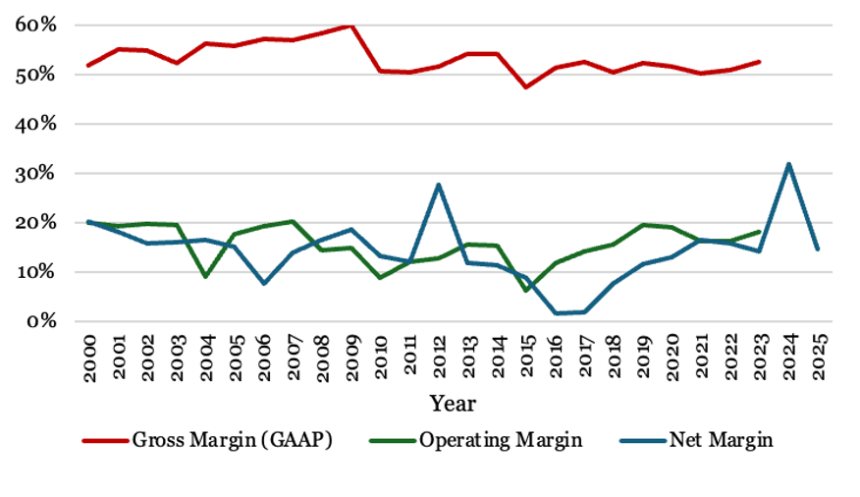
*Margins calculated as GAAP gross profit, operating earnings, and net earnings divided by net sales. 2024 net margin reflects elevated earnings driven by one-time items.
2. International Diabetes Care revenue totals $1.3 billion (+14%; +10%); full-year 2025 revenue totals $4.8 billion, up 15% (+14%)
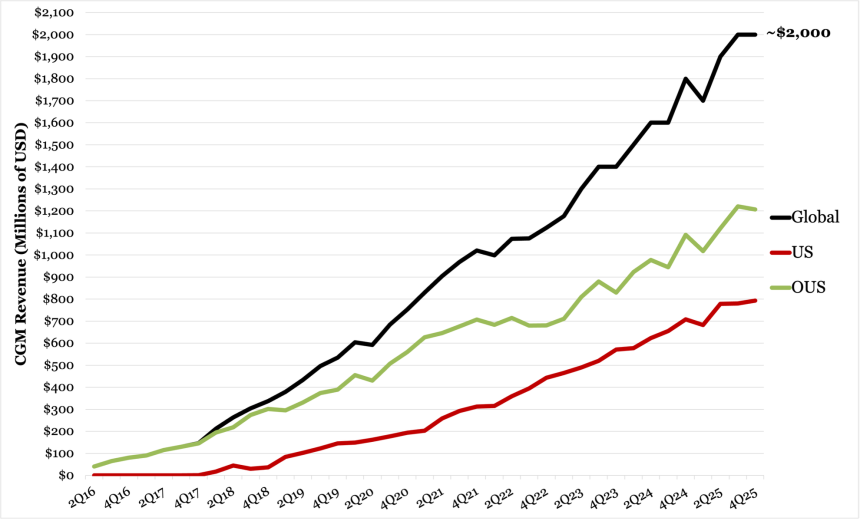
International Diabetes Care totaled $1.3 billion, up 14% from $1.1 billion in 4Q24 and up 2% from $1.3 billion sequentially. Full-year 2025 international revenue totaled $4.8 billion, up 15% (+14%) from 2024. International markets once again represented a major pillar of Diabetes Care performance, supported by favorable reimbursement dynamics in select regions.
- During Q&A, Mr. Ford said that intensive insulin CGM penetration outside the US remains closer to 50%, well below saturation levels, highlighting substantial potential internationally. He emphasized that Abbott’s cost position and manufacturing scale remain critical differentiators in supporting continued international expansion.
- International growth is expected to remain a key contributor to Abbott’s $1 billion annual CGM growth cadence, particularly as adoption continues to expand beyond intensive insulin populations. It goes without saying that international markets represent a meaningful long-term opportunity alongside the US, particularly if Abbott can start to gain footholds in AID. Who will be the best partner there is a major question – Beta Bionics, Insulet, Medtronic, Sequel, and Tandem all have so much to gain here! Unlocking these will be key and we suspect it’s a little more work than might be apparent, but so much upside.
Abbott Quarterly Revenue by Geography (2Q16 – 4Q25)
3. US Diabetes Care revenue totals $843 million (15%); full-year 2025 revenue totals $3.2 billion, up 21%
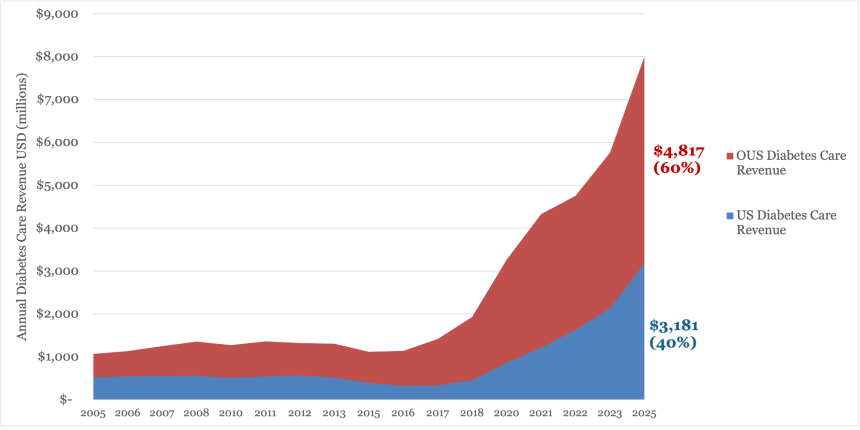
US Diabetes Care totaled $843 million, up 15% from $734 million in 4Q24 and up 6% from $796 million sequentially. This represents roughly 40% of Abbott’s total Diabetes Care revenue, consistent with previous quarters throughout 2025 (39% in 3Q25, 41% in 2Q25, and 41% in 1Q25). Full-year 2025 US revenue totaled $3.2 billion, up 21% from 2024. US Diabetes Care revenue in 2025 also accounted for 40% of global Diabetes Care revenue. After OUS revenue growth took off in 2018, US share has begun to catch up in recent years, increasing from ~25% in 2020 to the high-30s percent over the last few years.
- Mr. Ford said that he expects CGM can continue to grow by roughly $1 billion annually, implying low-to-mid-teens growth in 2026. He emphasized that penetration remains limited in basal-only and non-insulin T2D populations, underscoring significant potential for further growth.
Abbott Share of Diabetes Care Revenue by Geography (2005 – 2025)
4. Abbott issues 2026 total organic sales guidance of 6.5-7.5%
Abbott issued guidance for 2026 total organic sales growth of 6.5-7.5%. Mr. Ford framed the outlook as balanced, reflecting continued strength across MedTech, including Diabetes Care. Abbott guided 2026 also adjusted earnings per share (EPS) of $5.55-$5.80, representing roughly 10% growth at the midpoint.
- Mr. Ford emphasized that the slightly lower guidance than consensus reflects its Nutrition business, where volume growth is expected to remain challenged in 1H26 before returning to growth in the second half (see more below). He said that this dynamic represents what he termed a “strategic reset” rather than underlying weakness across the company’s broader product portfolio.
- Abbott’s core growth sectors, which include Diabetes Care, cardiovascular, electrophysiology, and established pharmaceuticals, are expected to sustain high-single-digit to low-teens growth, supported by ongoing product launches and continued investment in innovation.
5. Abbott works to revamp nutrition business with new product launches; PROTALITY goes unmentioned
Much of Abbott’s call today focused on its nutrition business, which reported quarterly sales of $1.9 billion, down 9% from 4Q24 and 10% sequentially. In full-year 2025, the nutrition business recorded revenue of $8.4 billion, flat from 2024. Mr. Ford attributed the decline primarily to market share losses in the US pediatrics segment. He noted that manufacturing costs have risen over the past several years, driving price increases that constrained demand and growth.
Abbott has implemented pricing and promotional initiatives and plans to launch eight new products in 2026. On the call, Mr. Ford highlighted two recent product launches: a version of Glucerna with one gram of sugar and a version of Ensure with 42 grams of protein. There were no updates on Abbott’s PROTALITY nutritional brand, which intends to support muscle mass preservation during weight loss. While Mr. Ford said Abbott “could have gone nine more months as is,” he emphasized that the timing was right to make changes as quickly as possible. He added that 1H26 will remain challenging given broader economic conditions, but expects a return to growth in 2H26, citing encouraging early indicators. During the Q&A, when asked how Abbott determined its new nutrition pricing was appropriate, Mr. Ford said the company completed testing in the US and internationally. US results, he said, indicate the changes can drive rapid improvements in the profitability profile.
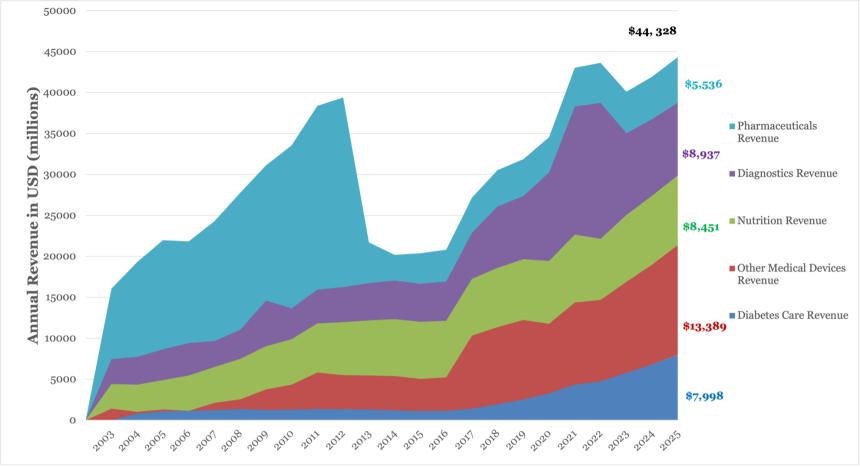
Overall, Abbott’s nutrition division accounted for 19% of the company’s global sales in 2025, consistent with its share in 2024 and 2023. Meanwhile, the company’s Diabetes Care revenue accounted for a similar share of overall revenue in 2025 – 18% – but has increased in recent years, from 16% in 2024, 14% in 2023, and 11% in 2022. As Abbott evolves its nutrition division and its medical device business continues to grow, we are interested to see how revenue share evolves.
Abbott’s Annual Revenue by Division (2003 – 2025)
CGM Franchise Highlights
1. Diabetes pipeline: DGK submitted to the FDA for clearance in 4Q25
Mr. Ford announced that the company submitted its dual glucose-ketone (DGK) monitor to the FDA for clearance in 4Q25. While it is not clear whether the submission occurred early or late in the quarter, this appears consistent with Abbott’s expected timeline to launch the new sensor in the US in 2026. Mr. Ford emphasized that in the meantime, the company is working closely with regulators, key opinion leaders, physician groups, and payers. He also referenced the international expert recommendations on continuous ketone monitoring for people with diabetes published in The Lancet Diabetes & Endocrinology in December 2025, which highlight the importance of CKM to address a major gap in diabetes care and offer recommendations on its applications.
Mr. Ford noted that a differentiated product like DGK can both drive market share gains and expand the overall market. Among Abbott’s target populations for the sensor, he highlighted intensive insulin users and insulin pump users, reflecting growing attentionat conferences and scientific meetings on the sensor’s potential to detect early ketone elevations following undetected pump suspension or occlusion. He also listed SGLT-2 inhibitor users as key target populations, noting that only about one in six of the roughly six million eligible users in the US currently use a CGM. Previously, Abbott and several key opinion leaders have highlighted the technology as potentially enabling safer SGLT-2 inhibitor class for use in T1D, by identifying euglycemic DKA earlier.
2. Mr. Ford touts growth opportunity across intensive insulin, basal-only insulin, and non-insulin users globally
Today’s call underscored rising interest in expanding CGM adoption across intensive insulin, basal-only insulin, and non-insulin users internationally. Mr. Ford cited growing momentum from patient advocacy groups and healthcare systems to promote CGM use across all diabetes populations. Mr. Ford indicated that part of Abbott’s larger investment strategy is to focus on high-growth sectors like diabetes care, in part to support these initiatives increasing adoption.
- Mr. Ford particularly emphasized the market expansion opportunity among people with T2D not on insulin,citing several studies showing improvements in A1c and Time in Range with CGM use. This trend is supported by physician organizations such as the ADA, which notably expanded eligibility in the 2026 Standards of Care to include individuals on non-insulin therapies that may cause hypoglycemia and for any diabetes treatment where CGM helps in management – a shift from the 2025 Standards of Care, which advised healthcare providers to “consider” CGM in adults with T2D on non-insulin therapy. Mr. Ford also stressed the importance of continued investment in populations with higher existing penetration, such as intensive insulin users, noting that these international markets remain only ~50% penetrated.
- Additionally, Mr. Ford said he expects CMS to issue preliminary language on expanded CGM coverage for patients with T2D not using insulin in the first half of 2026. He characterized this as a significant opportunity for Abbott in the US and noted that CMS and HHS have increasingly highlighted the value of CGM, even among patients not using insulin or other diabetes medications. While implementation could take longer due to the required 90-day public comment period and 60-day evaluation period, Mr. Ford reiterated that Abbott “will be 150% ready to execute” from both a manufacturing and primary care engagement standpoint once coverage expands.
3. While unmentioned, Abbott broadens scope of Lingo availability in the US
Lingo was not mentioned in today’s prepared remarks or in Q&A. The OTC CGM was launched in the US in September 2024 for individuals 18 years or older not on insulin therapy. As of 4Q24, Mr. Ford discussed plans to eventually expand the launch of Lingo in the US and explore additional international markets beyond the United Kingdom. Abbott has not provided any userbase updates in past quarters or today.
In recent months, however, Abbott has broadened Lingo’s US availability. In December, the company announced Android compatibility, expanding beyond iOS devices alone, and in January launched Lingo on Withings’ connected health platform. Abbott also expanded brick-and-mortar distribution in 4Q25, adding Walmart in October and Walgreens in December. Previously, Lingo was available only through hellolingo.com and Amazon. We hope to hear more on uptake across these channels in 2026.
Diabetes-Related Analyst Q&A
On lower guidance related to nutrition and profitability
Q (Larry Biegelsen, Wells Fargo): Can you talk about what's changed since the last call and how you're thinking about the year playing out from a cadence standpoint? I assume you would expect growth to accelerate through the year, given your comments on nutrition and some of the launches.
Mr. Ford: Thanks, Larry. I think if I remember you, you’re the one who asked that question back in October. And when I answered that question, I think consensus was 7.5% top line, EPS was 10%. So today we guided the midpoint at 7% on top line, 10% on the bottom. So midpoint here is 0.5% lower than what was consensus. And, but other than that nothing's really changed.
The EPS is in line with consensus, expecting healthy margin expansions. I'm sure we're going to talk a lot about the pipeline, which is either on target or ahead of schedule, and certain products, balance sheets in great shape, feel good about us closing exact. So the half point change on the top line is, as you pointed out, is really the change in the near-term outlook I'd say of our nutrition business, you saw in our quarter and our Q4, we had a negative quarter.
And as I said in my comments, there's a component of this business. It's a healthcare driven product portfolio, but there's a component of it and a dynamic of it that is very much aligned with Consumer Packaged Goods. And I'd say, the challenge is that CPG businesses have been facing are pretty well known following pandemic pretty significant surge in costs between 2022 and 2024 to offset that, I think we all went ahead and tried to mitigate it with price increases that obviously drove top line, but more importantly, I would say, improved or didn't allow the economics and the profitability of the businesses to deteriorate.
If you look at our profitability in that business, 2024, 2025, where it was back in 2022, it had that impact. But the higher prices, though, have resulted now in what I see as kind of suppressing demand and lowering the volume growth and the pressure in the volume growth accelerated I'd say, as we move throughout Q4 and consumers became increasingly more price sensitive. So as I said in my comment, it's not a sustainable path. You'll get down into the spiral if you keep increasing prices, you'll keep on driving volume down.
So we could have – listen, I could have we could have gone a couple more quarters, maybe nine, nine more months doing this. But it would not be sustainable. And at some point, something fundamentally has to change here. And I just felt that the longer, the longer we took to make this change, the more painful it would be if I look at the strength of the portfolio right now and the growth, all the growth prospects we have, the ability to add a whole new growth vertical. I just thought that the timing was right to do this and do this as quickly as possible to get through it.
So we began implementing price promotion initiatives that are going to help invigorate growth. I think early signs right now, Larry, are encouraging. Obviously, we're going to have to keep monitoring that. And then we're also launching a lot of new products to be able to kind of support that volume growth.
We haven't had to reallocate R&D resources to be able to do that. And this is a business that operates around 2%, 2.2% of R&D. So we just reallocated within that budget to focus on new product development. So we'll have a couple quarters here where growth and nutrition is going to be challenged.
And then in the second half, we'll return to positive growth. And I got confidence in the team that's in place today that we can execute this transition back to more of a volume base, more of a volume-driven growth business. If you look at what we did back in 2022, when we had the supply disruption, it took us about nine to 12 months to get our share back. I don't think it's going to take that long. So, I think it's about a six-month process here of re- shifting that, and that's really what's creating, I would say, well, part of it, what's creating a little bit of this, first half, second half dynamic in our growth forecast.
But outside of that, Larry, versus where we were in October, nothing has really changed. In fact, I'd say a significant majority of the company here is either maintaining high single digit top line growth or low teens growth, or they're accelerating their growth versus 2025.
Whether it's our cardiovascular franchise, our diabetes products, EPD, our pharma business, we're going to be lapping the core diagnostic headwinds that we faced last year. If you remember, we had about $1 billion of headwind that we faced last year, in our diagnostic business, whether it was COVID and the China challenges, that's mostly going to be behind us. We're going to be adding another high growth vertical with Exact Sciences.
So I think there's a lot to like here. I think there's a lot of growth here. And while we know we've got some work to do in nutrition, I can guarantee you that we're not distracted by that from all the great opportunities that we have here. So like I said, I think we've got a good setup for 2026, a lot of accelerating growth as we progress through the year.
Q (Danielle Antalffy, UBS): Thanks so much for taking the question and Robert, just two questions for you on Nutrition. Appreciate all that you're saying about the strategy there going forward. But I guess first part of the question is, what gives you confidence that these are the right prices that you're landing at today to drive that volume increase like did you guys do -- global. So, I imagine it differs by market.
And then the second question is now -- and tell me if I'm wrong here, but presumably Nutrition has a different profitability profile and maybe talk about whether -- how it changes your view about how this fits into the entire Abbott portfolio? Thank you so much.
Mr. Ford: Sure. Regarding the pricing, so we did some pricing work just before Thanksgiving in time for what usually is a pretty busy kind of retail activity. And so we did different testing here in the United States. We did different testing internationally also, we got the results back on the U.S. side pretty quickly. You get to see the impact pretty quickly.
And like I said in the comments, I think the early signs are encouraging. But I also said, hey, we got to keep monitoring this. You got to keep monitoring it for the consumer. You got to keep monitoring it for competitive activities, but I think right now, based on what we have, I think we've kind of called it right. And regarding kind of allocating expenses, listen, we don't have a cookie-cutter approach across all the businesses. It always depends on momentum, opportunity, the balance of the short and the long-term. And so we take a very kind of detailed view in terms of how we're allocating.
Yes, the profitability has improved in this business. I'd say it's probably from a profile perspective, going to be in line with what it was in 2025. We've obviously got to make some adjustments in our spend level and learn how to spend a little bit better, and we did that also in Q4, shifting some of the focus from kind of marketing and brand to a little bit more kind of price and promotion, at least for these next six months. And that way, we're able to at least kind of maintain a kind of steady profile over here.
On CGM growth and Abbott’s expected position
Q (Robbie Marcus, JPMorgan): Robert, last week, when we were talking, you said you expect CGM to continue the track higher at about $1 billion a year. That would put 2026 somewhere in the low to mid-teens. Is that the right way to think about CGM growth next year? And maybe if you just want to give your updated thoughts on market growth and Abbott's position there? And then I have a follow-up.
Mr. Ford: There's all this debate that I read about that the market is slowing. And I get if you're just looking at percentages and that's how you base yourself off it, then I guess if it's that myopic, then I think, okay, I understand the conclusion. But I don't consider growing $1 billion every single year and doing it four years in a row to be slowing down here, Robbie. I think the math will work out to what you just kind of highlighted there in the kind of low-teens.
But I think there's got a lot -- still a lot of opportunity for penetration in this, both from a market perspective, but then also from our opportunity, our ability to drive market share and market expansion. I think that if you look at across all three patient groups, whether it's the intensive insulin user, the basal insulin user and the non-insulin user, all of those areas, still, there's so much penetration to be able to have here.
And you can see across the world, not just in the United States, but across the world, a lot of movement, whether it's patient groups, health care systems that are looking to expand the use and the adoption of the technology into all these patient segments. I know the US gets a lot of attention, and it's an important market, and there's a lot of great opportunities for us there in terms of the non-insulin user reimbursement opportunity.
I continue to see, I continue to see nice progress in this process. There seems to be a lot of support to do this. And the data that we've shown, like we've published three studies already that show that this patient segment also benefits with lower A1c, greater time in range, all the things that have driven kind of reimbursement in the other segments. So I think that this is a very strong opportunity for us here in the US. And we'll see how it plays out.
I think we'll see some language in the first half and then how it all plays out with comment periods. This, Robbie, there's comment periods, there's all of this. So I'm not baking that into my guidance, but I can tell you, we will be 150% ready to execute, whether it's having manufacturing capacity and having the scale and the position in primary care -- on the primary care side, which is where that will probably play out more, we'll be ready.
So that provides an opportunity to outperform that consensus forecast. I think on the intensive insulin user side, I still think there's penetration to be had and adoption to be had, especially in international markets. I think that's only about 50% penetrated. So I think there's still a lot of opportunity to do the work that we're doing there.
Obviously, scale and cost matter in the international markets, and I think we've got that position set. And then as you look at what I think is more specific to us, the opportunity to bring in a very differentiated product to look at market share shift in a segment that I'd say we're probably a little bit underrepresented from a market share perspective, which is on the “pumper side” (AID) with the launch of our DGK sensor. I think that's going to provide us a great opportunity.
I'm not going to try and pinpoint the exact quarter here, Robbie, when we get approval, we'll issue the press release and we'll be out. But we've been working hard already concomitantly with the regulatory process with KOLs, with physician groups, with payers, and I think there was an article that came out in The Lancet in January, talking about, beginning of this year, talking about the importance of measuring continuously ketones, as DKA is still a – still a major care gap here for people with diabetes. So I think you've got a big opportunity here with this product for market share conversion.
I think one of the surprising things for me in this, as we started to really double click on these patient segments is, we talked about the SGLT-2 population. So we did some analysis in the US. You got about six million SGLT-2 users in the US. And if you cross-reference their usage of CGM, through all the databases, only about one million of those six million are on CGMs. So I think there's an – I think there's going to be an opportunity here also to kind of create market expansion with this product. So not just share, capture, but also market expansion.
So this market is still very robust. It's becoming larger. So I get the lower – big numbers kind of lowers those percentages. But if you just look at it from a penetration perspective, Robbie, there's still so much to do in all these segments and different geographies that we're still very excited and making big investments.
Whether it's in sales and marketing, clinical, R&D and manufacturing, because we still think that this is still, I'm not going to say it's the first or second inning, but we're far away from being from the seventh inning on this one. So I think there's still a lot of opportunity here. And we're in a good position.
Q (Robbie Marcus, JPMorgan): Great. Maybe just a quick follow-up. It's great to see you are still able to do double-digit EPS growth in 2026. I would imagine that's coming through the top line and margin expansion. How should we think about the magnitude of margin expansion and the drivers of it? Thank you.
Mr. Ford: I’ll let Phil take that.
Mr. Boudreau: Yes. Thanks, Rob. I couldn't be more proud of what the team accomplished in 2025. As Robert outlined, overcoming uncertainties, volatilities and whatnot to still drive margin expansion. And that commitment to the execution and excellence there maintains in 2026.
Expect to do more of the same focus on the things that are strategically aligned and the execution here to where we continue to look at a 50 to 70 basis point improvement and operating margins every year. And that's kind of what we've got built into this and fully expect we'll do that through both gross margin expansion as we've done. But continue to gain leverage in the P&L where appropriate. So that's kind of how we've constructed that double-digit earnings.
On coverage expansion for those with T2D not taking insulin
Q (Matt Taylor, Jefferies): Great. Thanks. And maybe I could just ask a follow-up on diabetes. You talked about some optimism for the outlook for the market and specifically around the non-insulin type 2 coverage. We've seen the guidelines change, and so we definitely see a potential for that coverage to expand significantly. You mentioned you've seen some progress in the process. And I guess I was wondering how you think that could play out in the first half of the year? What forms the new coverage could take or any other thoughts that you had on that?
Mr. Ford: Listen, I don't want to get ahead of myself. What I can tell you is, listen, there's definitely support. There's support from the ADA, there's support from other physician groups, okay? And there's support because the clinical data is backing that support up, right?
I mentioned that we've got three studies that we did with that patient segment, and it shows this improved A1c and this better time in range. So I think the support is backed up by clinical evidence. And you've got a US HHS and CMS that sees the value of this type of technology, sees the value of being proactive in managing your health even if you're not taking medications or you're not taking insulin, bringing this type of technology improves outcomes. So you have a receptive CMS, let's call it like that.
Like I said, I think you're going to see some sort of language, Matt, first half, okay? But I know how these things go. We've gone through them so many different times in different parts of the product. Language will come out, then there will be a 90-day comment period, and then there will be a 60-day period to be able to evaluate it. And right now, could that be a different process? There could be a different process. It could be a much shorter comment period. It could be a much shorter implementation timeline because there is this support and desire to bring this to more people.
But like I said, I'm not going to bake that in just yet, but I am being prepared. I mean the team is prepared. I mean if it happened next week, I'd tell you they'd be prepared. So we're doing a lot of work there. I think the key aspect as you think about that expansion is that it's going to happen predominantly in primary care. So how well are you set up, how well is your sales force deployed? How well is your integration into the health care systems with Epic and other -- so that's going to be an important part.
And outside of that, I think we should just be, I think, very -- I'm very enthusiastic that this will happen. Whether it happens in the second quarter, the third quarter, for me, like I'm thinking about this, this is going to be a huge opportunity for this market, not just in the US but globally for years and years to come. So let's just get it right.
On the outlook for diagnostics in China
Q (Matt Taylor, Jefferies): I wanted to start with Diagnostics and see if you could unpack some of the dynamics there a little bit more. You touched on the China headwinds in VBP and mentioned some smaller programs or categories there. What's the outlook like for Diagnostics in China? It does seem like the rest of the world is doing fairly well. But what do you foresee for China growth this year and next in Diagnostics?
Mr. Ford: Well, specifically in diagnostics, like I said, I think we've gone through what I would consider the bulk of our VBP based on the strength and the market share we have in the different assays. The way they're going about this is they're just looking at categories of assays and then kind of implementing it. And the first two were the ones that we had over 40%, 45% market share in those markets. So we kind of felt that pretty significantly.
I think the next big area of VBP is going to be in the -- on the -- just your regular kind of Core Lab oncology testing, and we have very little market share over there. So listen, we put a new management team in place there, put our most experienced commercial person that is driving that business. We've done a lot of work there between working with our distributors, segmenting the market, looking at our product portfolio, looking at different types of product offerings, new product offering versus legacy product offering.
So I think the teams have done a really good job there. And my expectation with that business going forward is, listen, I'm not expecting big growth out of it. All I need for it is to be pretty stable. And it being stable, I get to have the other parts of the portfolio that are accelerating.
Our US businesses has actually done better than what it's done in the past. So we're capturing market share over there. Our Latin America business is doing better than what it's done in the past, capturing market share there. Our European businesses continue to grow. We've got a good position over there. So I'd say the outlook of that business is we will be, I'd say, mid-single-digit growth this year versus kind of where we were in 2025. And if you remove China, again, this is a full year view. If you remove China, then you're in that kind of 7% to 8% kind of range. So I don't like doing that, Matt, because China is part of our business. So -- but you'll see an acceleration even with China just because it's a little bit more stable versus where it was last year.
On Abbott’s double-digit quarter and market penetration
Q (Vijay Kumar, Evercore ISI): Thanks for taking my question. My first one on maybe on the product side of your – like you mentioned, another double-digit quarter. Just curious and where are we from a penetration standpoint, what innings are we in? And how durable is this double-digit growth in a category that's pacemakers are low single digit growth category, and you guys are doing double-digits?
Mr. Ford: Sure. Well, I made some comments about – we look at this, Rhythm Management, $10 billion market as actually an opportunity to grow, so we have been making our investments. There obviously is a big driver of that, but we're making investments in other areas of the portfolio to kind of be able to support our ability to take market share and grow at a differentiated rate here.
To your question on penetration. Listen, the global low voltage or pacing segment market is around $5 billion, whatever, 4.8 to 5.2 depending on what you're looking at, but let's just call it $5 billion. I'd say AVEIR is about 10% of that right now.
So early innings here for us for sure, and as I said previously, when we began this process, I wasn't interested in just getting a flash in the pan sales growth for, like, a year or six quarters. So we really worked hard and the team did an incredible job to really establish a new standard of care, and get physicians trained at a different type of implant.
So what we're seeing here is really nice growth in places that a year, year and a half ago, we began the training process, and really seeing strong penetration there. If you look at, just single chamber, I think right now the US single chamber pacing, which is about 15% of the total market, that's about 50% penetrated.
So there's still a long opportunity here in the US and quite frankly, globally too. So, I think the team has done an incredible job here where we've launched new products, we'll continue to launch new products in this space. And we think that this is the next standard and CRM is these devices that are communicating with each other. That can be implanted transfemoral, and don't use leads.
The clinical evidence, in terms of what they're able to deliver is pretty impressive right now. So, I think it's – I think we've got a lot of investment here that will support this type of differentiated growth rate.
Q (Vijay Kumar, Evercore ISI): That's helpful, Robert. And my follow-up on, or I guess the second question is, on cap allocation. Any updated thoughts? And exact deal closed timing, dilution; I think you mentioned $0.20, when you think about that your leverage levels, it's still close deal, it'll still be pretty modest. You still have capacity.
I'm curious, when you think about M&A versus divestitures of spin-offs, MedTech right now seems to be – spin- off, seems to be at the flavor of the season. I'm curious how you're thinking about those decisions?
Mr. Ford: Well, you put a lot into that one there, Vijay. Let me let me see if I can unpack that. I think from a capital allocation perspective, I've always been pretty consistent with our approach. I don't have a formula that x-percent goes here, y-percent goes there. We are committed to a growing dividend and we did that again for 2026 when we announced our dividend back in December.
So we're growing our dividend. But outside of that we'll allocate our capital in terms of what we believe is the best balance between short-term and long-term for our shareholders, where we can create value.
Regarding M&A, listen, my focus right now is integration, closing Exact Science and integration. That's going to be my primary focus. I think post-close; our gross debt to EBITDA ratio will be around 2.7 times. So to your point, we still have plenty of capacity. But I think in the near-term I'd say, focus on integrating Exact Sciences. And if there's opportunities for us to add, there'll probably be more tuck-in type size deals to take advantage of.
Regarding the status right now of Exact, I think we're making a great progress towards closing, it submitted. We've submitted all of our, required clearances over here. There's a shareholder vote on the 20th of February. So right now, I'm not changing any assumptions regarding timing of close, or kind of EPS impact. And as we integrate the business, then we'll go updating it as we go along. But right now, there's no change in terms of timing and in terms of dilution.
So, I read your note last night, Vijay. I thought that you would have been asking a question about multi-cancer early detection and the opportunity that exists. I largely agree with your report. I think this is going to be another great opportunity for us. And it's one that as we looked at the deal, it says, okay, greater reimbursement of this type of test will really make this a very, very large segment.
I think the way I see this is the same way that we have our -- a lipid panel test every year, the same way that we do a cardiometabolic panel or a white and red blood count panel every year after a certain age, I believe that if the product is right and performs right and it's priced the right way, I just envision this being that type of test. So, I think that if that becomes the case, I think your forecast is way under called even on the upper side. But -- okay.
On capital allocation and nutrition business recovery
Q (Josh Jennings, TD Cowen): Hi. Good morning. Thanks for taking the questions. Just keep it to one. And on capital allocation -- sorry to circle back, but I think the focus for your team, Robert, has been to kind of look at inorganic ads for the devices and diagnostics franchises that played out in the -- with the exact acquisition. I mean, is should we be thinking that that remains the focus or is the nutrition recovery -- can you -- can that business get back to mid single-digit growth without any business of external business development initiatives? Thanks for taking the question.
Mr. Ford: Sure. Yeah. Listen, I'd say the capital allocation regarding M&A and kind of our focus, is you know, is going to be in those two areas, right? MedTech and Diagnostics is where we see is where we see an opportunity. I don't consider a need for inorganic, you know, in our nutrition business to execute the strategy that I just described, which is to place a lot more emphasis on volume growth, I think we've got the right products, the right brands, and the right teams in place to be able to kind of do that. We think the biggest investment that we're making is, you know, we're seeing the impact of that now, which is, you know, addressing kind of, you know, price points and doing it. Comprehensively, across the world so that we, you know, we can get everything, kind of reignited back to volume growth. So, I'd say, that's the focus is MedTech and Diagnostics. So, I don't think anything changes there.
So, I'll just close here with, a few comments. Listen, we've got, I think we delivered a pretty strong year. In 2025, obviously, there were challenges. There'll always be challenges. We delivered on our original EPS target of double digit, healthy margin expansion. I think I've spent some time on this call talking about our pipeline and how we think about our pipeline and ensuring that we have a nice cadence of pipeline going forward. Not just what we're launching this year, but what we're investing in this year so that we can be ready to launch in 2027 and 2028.
So I think the pipeline has been very productive. And we took a very important strategic step to shape Abbott for the future with the announcement of the Exact Science acquisition. I think that's going to add a whole new growth vertical for Abbott. And, I think that, cancer diagnostics is going to be a very important clinical and medical need for society, for global society. So I think we're going to be well positioned there. And I feel good about the timing and everything that we put in place there.
So as we transition to 2026, I think I highlighted here we've got a lot of businesses that are going to sustain what I would consider pretty differentiated growth rates, high single digits teens, and we can support those with the investments we made and the product launches that we've got.
And then we've got some large businesses, that are going to have some inflection points and some acceleration, whether it's Core Lab or, or even our Electrophysiology business here. So, I feel good about what we've got put in and what we've laid out here in terms of our plan. Obviously, we strive to do better than that and there's opportunities to do better than that. But I think as we sit here in January, this is a good starting point.
Close Concerns’ Questions
- How is Abbott engaging with primary care providers to promote CGM access and adoption for people with T2D not on insulin therapy?
- What types of nutrition products does the company expect to launch in 2026?
- When in 2026 does Abbott expect the DGK (dual glucose ketone) sensor to launch, and what are the company’s expectations for initial uptake? What will education look like across various stakeholder groups (e.g., different clinician and patient populations)?
- How has Lingo adoption evolved as Abbott has expanded methods of access to the technology in the US? What reorder rate from customers has Abbott seen thus far?
- How has demand for Abbott’s BGMs fluctuated in the US and internationally?
- In what types of nutrition products is Abbott most interested in launching in 2026?
-- by Riya Chatterjee, Paul Moon, Jeremy Alkire, Nour Khachemoune, Monica Oxenreiter, and
[1] Operational growth is shown in parentheses