Meta-analysis of AID use in T2D shows significant glycemic benefits –
Findings support stronger guideline recommendations and accelerating adoption in T2D
Diabetes Care just published “Automated Insulin Delivery Systems in Type 2 Diabetes Mellitus: A Systematic Review and Meta-analysis” evaluating the use of AID systems in T2D, led by a distinguished group of researchers, including Dr. Larissa Hespanhol (Federal University of Campina Grande, Campina Grande, Paraíba, Brazil), Dr. Rodolfo Galindo (University of Miami), and Dr. Marconi Abreu (University of Texas Southwestern). The analysis included nine studies[1] (n=1,530) — three randomized controlled trials (RCTs) and six observational studies — published between 2023 and March 2025, providing a comprehensive update on AID use in this population to date. Across studies, AID use was associated with significant improvements in glycemic management, including greater Time in Range (TIR), less hyperglycemia, and less hypoglycemia, supporting broader adoption in people with T2D.
Table of Contents
- Meta-analysis finds AID use associated with significant improvements in glycemic management
- Authors offer perspective on how these AID systems perform in T2D
- Call for strengthened recommendations on AID in T2D management
- Three AID systems commercially available for T2D, driving adoption
- Industry-wide shift to a pay-as-you-go model through the pharmacy channel could catalyze further uptake
- Close Concerns’ Questions
Meta-analysis finds AID use associated with significant improvements in glycemic management
The nine studies evaluated multiple AID systems, including:
- Tandem t:slim X2 with either Control-IQ or Control-IQ+ (four studies);
- Insulet’s Omnipod 5 (two studies);
- MiniMed’s 780G (two studies);
- Diabeloop’s DBLG1 (one study); and
- Medtrum A7 (one study).
Across the included studies, AID use consistently led to meaningful improvements in glycemic management. Most notably, individuals spent substantially more time within the target glucose range, with TIR increasing by 16% on average. Notably, such improvement reflected significant reductions in hyperglycemia – Time above Range (TAR) fell by 15.9%, on average – including a nearly 10% drop in time spent at very high glucose levels (>250 mg/dL). At the same time, hypoglycemia was rare, and there was a small but statistically significant reduction in Time below Range (TBR).
Figure 1: Overall and Study-Specific Glycemic Improvements with AID
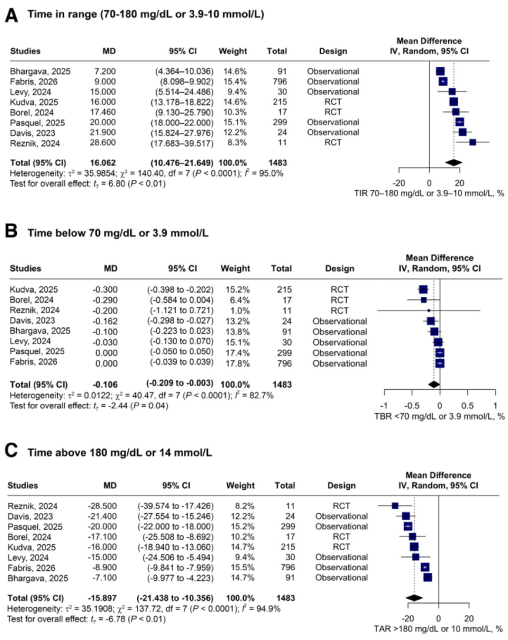
Source: Diabetes Care, “Automated Insulin Delivery Systems in Type 2 Diabetes Mellitus: A Systematic Review and Meta-analysis,” Dr. Larissa Hespanhol et al.
These improvements translated into clinically meaningful changes in traditional glycemic management metrics as well. Mean A1c declined by 1.3% from a baseline of approximately 8.3% (baseline values ranged from 7.9% to 9.4% across studies included), and mean glucose levels dropped by over 20 mg/dL from nearly 192 mg/dL at baseline (values ranged from 180 to 223 mg/dL). Importantly, these gains were achieved without any increase in body weight, BMI, or total daily insulin dose. Taken together, the findings suggest that AID systems enable better glycemic management by delivering insulin more effectively and precisely.
Authors offer perspective on how these AID systems perform in T2D
The authors noted that the benefits of AID in T2D appear to be particularly pronounced. Compared to results typically seen in T1D, the magnitude of glycemic improvement in this analysis was larger and more consistent across both daytime and overnight periods. They suggest this may reflect a lack of optimized baseline management with greater room for improvement in people with T2D, as well as differences in underlying disease physiology.
Compared directly with standard insulin therapy, AID systems increased TIR by approximately 15%, driven primarily by reductions in hyperglycemia, without increasing hypoglycemia risk.
Although some differences were observed across individual systems, the overall pattern of benefit was consistent. While we do not support comparing results unless head to head trials are used, we mention for readers a few things we noticed:
- Insulet’s Omnipod 5 demonstrated the greatest improvements (+20% TIR);
- Tandem’s t:slim X2 with Control-IQ+ had the next best improvements (+16%) and
- MiniMed’s 780G (+7% TIR).
All systems conferred meaningful benefit, reinforcing the conclusion that the primary advantage lies in the automated insulin delivery approach itself rather than in device-specific features.
Call for strengthened recommendations on AID in T2D management
The authors said that these findings have important implications for clinical practice and guidelines. The authors concluded that the evidence supports broader adoption of AID systems in T2D, a position that aligns with recent guideline updates from the ADA. The 2026 Standards of Care now designate AID systems as the preferred insulin delivery method for all people with T1D, as well as for individuals with T2D using MDI, insulin pumps, or sensor-augmented pump therapy. The guidelines further recommend offering AID to adults with T2D on insulin based on patient and provider preferences and suggest considering AID even for those on basal insulin who are not meeting glycemic targets.
Three AID systems commercially available for T2D, driving adoption
This shift in guidance comes alongside growing regulatory and commercial momentum. Three AID systems are now cleared in the US for use in adults with T2D:
- Insulet’s Omnipod 5 (August 2024);
- Tandem’s Control-IQ+ (February 2025); and
- MiniMed’s 780G (September 2025).
These approvals were supported by impressive pivotal trials, namely Tandem’s 2IQP and Insulet’s SECURE-T2D (both included in the meta-analysis) and have accelerated adoption following a period of widespread off-label use.
Early commercial data reflect this momentum from multiple manufacturers:
- Insulet reported that T2D accounted for more than 40% of new patient starts in the US in 4Q25, up from over 25% at the time of FDA clearance;
- Tandem has also cited increased shipments following its full T2D launch; and
- Newly-public MiniMed has also secured CE-Mark approval in Europe, though it has shared limited T2D-specific uptake data.
Even companies without a formal T2D indication are seeing meaningful use in this population — for example, Beta Bionics reported that approximately 25-30% of new users in 4Q25 had T2D and has expressed interest in pursuing a regulatory indication. We think this pump is particularly well-suited to many with T2D – it’s easy to use and can be used quickly by many who may just look like they are reading a daily news brief on a smartphone.
Industry-wide shift to a pay-as-you-go model through the pharmacy channel could catalyze further uptake
Looking ahead, changes in how these systems are accessed may further accelerate adoption. A broader industry shift toward pharmacy channel “pay-as-you-go” models is lowering barriers to entry by reducing upfront costs[2] and eliminating long-term DME warranty commitments. This approach has already demonstrated success for systems like Insulet’s Omnipod 5 and is likely to play a key role in driving continued growth in AID use among people with T2D.
| Insulet’s Omnipod 5 | In 2015, Insulet first offered its insulin pumps through a pay-as-you-go model. Omnipod 5 was available through the pharmacy channel upon its launch in August 2022, which has contributed to its strong market share (49%). Omnipod 5 is currently available at ~48,000 pharmacies nationwide, per the company’s 4Q25 report. |
| Tandem’s t:slim X2 and Mobi | The company’s Mobi insulin pump has been available through the pharmacy channel since 3Q24. In the company’s most recent report, management said that PBM coverage has now reached ~80% of US lives covered, supported by contracts with all major PBMs. In September, Tandem also initiated sales of t:slim X2 supplies through the pharmacy channel. In 4Q25, Tandem extensively outlined a structural transition beginning in late 1Q26 to a pay-as-you-go (PayGo) model through the pharmacy channel in the US, in which Tandem pumps will be distributed with $0 upfront cost and revenue will shift toward recurring pharmacy reimbursement. Approximately 20% of pump shipments are expected to go through Tandem’s PayGo model in 2026, with as many as 80% flowing through the model three years from now. |
| Beta Bionics’ iLet | Beta Bionics’s iLet is currently available through the pharmacy channel, which now generates ~30% of the company’s revenue and continues to increase quarter-over-quarter. |
| Sequel’s twiist | Prior to the pump’s launch in July 2025, Sequel confirmed plans to launch twiist through the pharmacy channel. The pump is currently rolling out. |
| MiniMed’s MiniMed 780G | MiniMed 780G became the fifth AID system in the US available via a pay-as-you-go model through the pharmacy channel in January 2026. |
Close Concerns’ Questions
- How sustainable are the observed glycemic improvements with AID beyond the six to 24-week follow-up period?
- To what extent does pharmacy channel access accelerate AID adoption among people with T2D?
- Are there certain system- or algorithm-specific features that are most likely to drive incremental improvements in outcomes?
-- by Jeremy Alkire, Riya Chatterjee, Monica Oxenreiter, and Kelly Close
[1] The nine studies include the following: (i) Davis et al., 2023; (ii) Caklili et al., 2024; (iii) Pasquel et al., 2025; (iv) Bhargava et al., 2025; (v) Kudva et al., 2025; (vi) Reznik et al., 2024; (vii) Borel et al., 2024; (viii) Levy et al., 2024; and (ix) Fabris et al., 2026.
[2]Sequel (twiist): Durable AID pump; pump hardware (estimated $4,000-$7,000 upfront) with infusion set and CGM costs producing higher costs consistent with durable AID platforms.
The company has previously noted that the system is available for no charge to get started ($0 for the initial pump and all of the supplies - with the exception of the CGM - for a month - including 10 disposable cassettes and 10 infusion sets) and for those with insurance coverage, most will pay $50 or less a month thereafter for all of their supplies (cassettes, infusion sets, syringes, wipes etc - again the exception being the CGM).
Beta Bionics (iLet): Durable AID system; hardware (estimated $6,000-$7,000 upfront) with recurring supply and CGM costs placing total cost in the higher AID range.
Tandem (t:slim X2): Durable AID system; hardware (estimated $4,000-$8,000 upfront) with infusion set, cartridge, and CGM costs producing higher costs comparable to other AID platforms.
Medtronic (MiniMed 780G): Durable AID system; hardware (estimated $5,000-$8,500 upfront) with ongoing supply and CGM costs, comparable to other durable AID platforms.