ADA 2026 Day #1 Highlights –
Executive Highlights
- The 86th ADA Scientific Sessions struck an interesting tone today in New Orleans. In the day’s keynote address, NIH Senior Advisor Dr. Rick Woychik (who filled in for NIH Director Dr. Jayanta "Jay" Bhattacharya who cancelled unexpectedly) outlined the NIH’s “Make America Healthy Again” strategy (or in his words, “agenda”) and defended proposed federal grant reforms that have sparked significant concern within the research (and broader) community. During a candid fireside chat, ADA CSMO Dr. Rita Kalyani pressed Dr. Woychik on controversial proposals that could increase political oversight of grant funding, ongoing grant cancellations, workforce reductions, and proposed NIH budget cuts, arguing that these changes threaten biomedical research and innovation. While the audience clearly supported Dr. Kalyani’s stance (supporting some of her more direct questions with loud rounds of cheers), the responses to the questions failed to address the elephant in the room: huge changes have been decided, and researchers will need to adjust.
- In diabetes technology, lots happened on Friday.
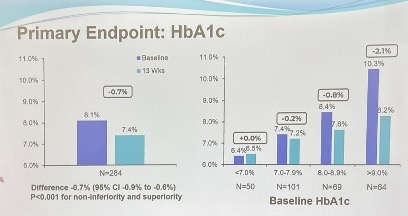
- Sequel’s twiist AID system delivered strong glycemic improvements in adults with insulin-treated T2D, with Dr. Carol Levy (Mount Sinai) leading a great discussion. Twiist that it lowered A1c by 0.7 percentage points (from 8.1% to 7.4%) and increased Time in Range (TIR) from 57% to 73% over 13 weeks, with very low hypoglycemia and no severe hypoglycemic events.
- Dr. Lori Laffel (Joslin Diabetes Center) presented Insulet’s next-generation Omnipod 6 algorithm, which features a lower 100 mg/dL glucose target, enhanced automation, and increased automated insulin delivery. The system demonstrated significantly greater TIR and Time in Tight Range compared to Omnipod 5 across most age groups with T1D and in adults with T2D.
- In diabetes therapy, Novo Nordisk’s dual GLP-1/amylin receptor agonist zenagamtide (amycretin) delivered impressive dose-dependent improvements in both glycemia and weight in adults with T2D. In a phase 2 trial, the highest dose achieved a placebo-adjusted A1c reduction of 1.56 percentage points, up to 91% TIR, and 14.6% weight loss at 36 weeks, with no apparent weight-loss plateau. Structure Therapeutics’ oral small-molecule GLP-1 RA aleniglipron also produced up to 12% placebo-adjusted weight loss at 36 weeks in another study, with no evidence of a plateau and encouraging improvements in A1c, blood pressure, and inflammatory markers. Elsewhere, full phase 2 data for Roche’s dual GLP-1/GIP agonist acmopatide (CT-868) demonstrated meaningful cardiometabolic benefits in adults with T1D, including placebo-adjusted A1c reduction (about 0.3%), 6.7% weight loss, improved TIR, lower insulin requirements, and reductions in blood pressure, though Roche ultimately announced that it has discontinued the program.
- In diabetes big picture, a lively debate between Prof. Stephanie Amiel (King’s College London, UK) and Dr. Irl Hirsch (University of Washington) highlighted growing recognition that while level 1 hypoglycemia (<70 mg/dL) may be biologically benign, it carries substantial psychological, emotional, and quality-of-life burdens for people with diabetes. Elsewhere, the ADA’s Pathway to Stop Diabetes Symposium showcased the next generation of diabetes researchers, with presentations spanning precision prevention, circadian biology, and culturally tailored nutrition. Dr. Marie-France Hivert (Harvard University) emphasized precision prevention beginning before birth through GDM interventions, while Dr. Chelsea Hepler (University of Michigan) highlighted circadian disruption as a key driver of metabolic disease. Dr. Tinashe Chikowore (Harvard University) demonstrated how AI and proteomics may help identify healthy dietary patterns across diverse global populations, reinforcing the idea that “healthy eating is universal, but not uniform.”
See our day-by-day preview for more on what’s to come.
Table of Contents
-
Diabetes Big Picture
- 1. Contentious fireside chat between ADA’s CSMO Dr. Rita Kalyani and NIH’s Dr. Rick Woychik on NIH’s MAHA strategy, funding delays, and new proposal to subject federal grant reviews to greater political control
- 2. Debate: Prof. Stephanie Amiel and Dr. Irl Hirsch on the significance of level 1 hypoglycemia
- 3. Pathway to Stop Diabetes symposium highlights promising research across prevention, metabolic disease, and global diets
- 4. Which biomarkers matter? Prof. Naveed Sattar encourages clinicians to “think simple” and prioritize traditional cardiovascular risk factors in T2D
-
Diabetes Technology
- 5. Single-arm trial with Sequel twiist demonstrates A1c reduction of 0.7 percentage points to 7.4% and TIR of 73% in adults with T2D
- 6. STRIVE trial with next-generation Omnipod 6 algorithm demonstrates significantly greater TIR and TITR at nearly all ages in T1D and T2D
- 7. AIDING RCT subgroup analysis demonstrates substantial glycemic improvement in inpatient adults with diabetes and advanced kidney disease with AID use
- 8. Drs. Jennifer Sherr and Jeremy Pettus tackle the value of CKM for the masses
- 9. ADA consensus panel unveils new clinical decision algorithm to identify and treat elevated ketone levels
- 10. Dr. Dessi Zaharieva discusses the association of negative premeal net insulin on board with postprandial excursions during AID use
-
Diabetes Therapy
- 11. Highest dose of zenagamtide (amycretin) confers placebo-adjusted A1c reduction by 1.6% in people with T2D in phase 2 results
- 12. Full results of the phase 2b ACCESS trial: Oral small molecule GLP-1 RA aleniglipron confers up to 12% weight loss in people with overweight or obesity
- 13. SURPASS‑CVOT substudy finds no signal of early diabetic retinopathy worsening with tirzepatide versus dulaglutide
- 14. Full results of phase 2 trial of dual GLP-1/GIP RA acmopatide (CT-868) in T1D; Roche discontinues program
- 15. The major cause of insulin resistance is insulin: An argument to decrease exogenous insulin to treat cardio-renal metabolic syndrome
- 16. Meeting the needs of older adults with T1D: Unique considerations, pharmacotherapies, and care transitions
- 17. Dual GLP-1/GIP RA HDM1005 demonstrates up to 13% weight loss at Week 22 in people with obesity
- 18. Preventing T1D: Safety of repeated dosing for SAB-142, a human anti-thymocyte immunoglobulin
- 19. ADA Presidents’ select abstract: Time to minimal residual C-peptide as an endpoint for recent-onset T1D
- 20. Make new friends, but keep the old? Updates on insulin therapy in pregnancy
Diabetes Big Picture
1. Contentious fireside chat between ADA’s CSMO Dr. Rita Kalyani and NIH’s Dr. Rick Woychik on NIH’s MAHA strategy, funding delays, and new proposal to subject federal grant reviews to greater political control
Dr. Rick Woychik (NIH) delivered the opening keynote of ADA 2026, followed by a fireside chat with the ADA’s CSMO Dr. Rita Kalyani on how the NIH’s “Make America Healthy Again” (MAHA) strategy may advance diabetes research. Dr. Woychik replaced NIH Director Dr. Jay Bhattacharya, who had a last-minute conflict. Dr. Woychik serves as Senior Advisor for NIH’s MAHA strategy, stating that he is in “total synchrony” with Dr. Bhattacharya’s “MAHA agenda.” Based on audience reactions to statements from Dr. Woychik and Dr. Kalyani, it would appear that the audience is not quite in lockstep with Drs. Woychik and Bhattacharya.
- Dr. Kalyani pressed Dr. Woychik on a recent 412-page rule proposal from the Office of Management and Budget (OMB) that would overhaul federal grant reviews. The proposed rule is open for public comment through July 13. As of today, there are already more than 6,500 public comments. The proposal includes provisions, among others: (i) relegating scientific peer review boards to merely “advisory” roles with political appointees (i.e., non-scientists) possessing final oversight; (ii) permitting grant terminations at any time and for any reason; (iii) mandating strict limitations on use of funds for conference attendance and publication; (iv) implementing restrictions on public communications; and (v) requiring funding proposals to “demonstrably advance the President’s policy priorities.” For more, see this summary of the proposed rule.
- Dr. Kalyani said the ADA is “extremely concerned” about the proposed rule. Two days ago, the ADA issued a statement, which said this rule “politicizes federal financial assistance and creates uncertainty for the biomedical research community.” The ADA also argued “empowering [political appointees] with the authority to terminate grants based on vague performance measures” could impede innovative diabetes research. Given these concerns, Dr. Kalyani asked Dr. Woychik to explain how the NIH would implement this rule, if approved.
- Dr. Woychik claimed this proposed rule does not significantly differ from funding precedent at the NIH, citing his previous experience serving on study sections – panels of about 20 scientific peer reviewers who evaluate and score the merit of grant proposals. (These panels make funding recommendations to the NIH but do not decide which proposals receive funding.) Dr. Woychik said many proposals are not funded strictly according to study sections’ recommendations, suggesting that “high-risk, high-reward” proposals with lower scores could still receive funding if they address a research priority. Dr. Kalyani then asked Dr. Woychik to state whether her understanding was correct that the proposed rule would permit non-scientists to make funding decisions outside study sections; however, Dr. Woychik evaded the question, simply stating that the proposed rule is open for public comment and he “cannot tell people what to do.”
- Dr. Woychik added that Dr. Bhattacharya aims to give the directors of the NIH’s 27 Institutes and Centers (IC) “more influence” in funding decisions. However, in February 2026, 16 ICs lacked permanent directors – per NBC News, all but two of these vacant positions opened during President Donald Trump’s second term. As of June 5, 2026, 14 ICs still have acting directors. Except the director of the National Cancer Institute (who is appointed by the US President), IC directors are appointed by the Secretary of Health and Human Services (currently Mr. Robert F. Kennedy, Jr.) and report directly to Dr. Bhattacharya. Dr. Woychik emphasized that IC directors are “directly accountable” to Dr. Bhattacharya and acknowledged his influence in leadership decisions.
- Dr. Kalyani raised the scientific community’s concerns on funding delays and cancellations. She cited testimony during a US Senate Appropriations Subcommittee hearing in May attended by Dr. Bhattacharya, in which some Senators argued that current NIH policies are a “deliberate erosion of research institutions” and that the Trump administration “has thrown the NIH into chaos.” She also highlighted that the NIH has eliminated about one-quarter of its workforce and prematurely cancelled grants prior to completion, disrupting thousands of projects. In early 2025 alone, the NIH terminated nearly 2,300 active research grants, constituting $2.5 billion in funding. According to a study published in PNAS, these cancellations disproportionately affected women and early-career researchers. Dr. Kalyani asked Dr. Woychik to explain how this funding turmoil may impact diabetes research.
- Dr. Woychik said the scientific field must acknowledge that it’s in “a changing environment,” stating that Dr. Bhattacharya has “different priorities” than previous NIH directors. Since US Congress allocates the NIH budget for each fiscal year, he claimed that Dr. Bhattacharya has been working with lawmakers to ensure the NIH receives adequate funding. He highlighted that the NIH received a 1% increase in funding for FY 2026 compared to FY 2025. He did not mention that the Trump administration originally proposed a 40% reduction ($20 billion) in the NIH’s budget for FY 2026 and consolidating the 27 ICs into eight, which was rebuked by Congress.
- Moreover, the Trump administration has proposed a 12% reduction ($4.8 billion) in the NIH budget for FY 2027. Dr. Kalyani said that this budget includes a $169 million reduction in funding for the National Institute of Diabetes and Digestive and Kidney Diseases (NIDDK). She asked Dr. Woychik how this budget reduction can be reconciled with Dr. Bhattacharya’s Senate testimony that the NIH seeks to better target the root causes of chronic disease. Dr. Woychik again evaded the question, vaguely telling the audience to “pay attention to what’s happening in Congress” as there’s a lot of support for the NIH.
- Dr. Kalyani said funding statistics indicate this is an “unprecedented” research environment,” and scientists are struggling to see “a way forward” for their research. Dr. Woychik said the diabetes community has driven significant progress in treatment, yet much “unfinished business” remains. To work through the funding issues, he said scientists should “stay focused on gold standard science” – to which Dr. Kalyani asked how this differs from research currently being conducted at the NIH, which Dr. Woychik evaded and repeated that “the work NIH supports is gold standard science.”
2. Debate: Prof. Stephanie Amiel and Dr. Irl Hirsch on the significance of level 1 hypoglycemia
Prof. Stephanie Amiel (King’s College London, UK) and Dr. Irl Hirsch (University of Washington) engaged in an entertaining and nuanced debate on level 1 hypoglycemia. The overall debate title was “Level 1 hypoglycemia: Does it really matter?” with Prof. Amiel responding in the affirmative and Dr. Hirsch in the negative. An audience vote prior to their presentations showed that slightly more individuals felt that level 1 hypoglycemia does indeed matter, though the room was mostly divided.
- Prof. Amiel and Dr. Hirsch offered complementary perspectives. Taking the stage first, Prof. Amiel maintained that level 1 hypoglycemia is a “cause for concern,” focusing her discussion on its harmful effects. Meanwhile, Dr. Hirsch took the stance that level 1 hypoglycemia is a “matter of course,” highlighting that it is common even in people without diabetes. He also said that level 1 hypoglycemia is not something that we are able to eliminate in yet, pointing out that even when people with diabetes are using the latest technologies such as AID, they still experience hypoglycemia.
- Both agreed that level 1 hypoglycemia is biomedically harmless, though it has negative psychological and emotional effects. Prof. Amiel opened her presentation with a picture of a gift for Dr. Hirsch. Inside contained an empty plate, representing her point that, from a medical perspective, “there is no such thing as level 1 hypoglycemia.” To illustrate her point, she reviewed how the widely recognized diabetes cutoff of <70 mg/dL was determined through two small clamp studies in healthy individuals from the 1980s and 90s. Dr. Hirsch also highlighted that EEG studies investigating the effects of level 1 hypoglycemia on the brain are inconsistent.
- Level 1 hypoglycemia becomes a concern for both Prof. Amiel and Dr. Hirsch when considering the effects that the number <70 mg/dL itself has on people with diabetes. Prof. Amiel pointed out that the number serves as an alert value for people with diabetes. She shared that Breakthrough T1D’s Dr. Aaron Kowalski helped her fully realize that level 1 hypoglycemia is a major inconvenience for people with diabetes because it means that an individual needs to stop what they are doing and take corrective action. Indeed, findings from the Hypo-RESOLVE project have shown that awareness of hypoglycemia has negative effects on multiple domains of daily functioning (e.g., poorer sleep quality, heightened worry and anxiety). Relatedly, Dr. Hirsch said that lack of awareness of level 1 hypoglycemia is also harmful.
- Following both presentations, a repoll of the audience showed greater agreement that level 1 hypoglycemia matters.
3. Pathway to Stop Diabetes symposium highlights promising research across prevention, metabolic disease, and global diets
Directly following Friday’s Welcome and Keynote Address, Dr. Marlon Pragnell (ADA) introduced the Pathway to Stop Diabetes Symposium at ADA 2026. Dr. Pragnell explained that the ADA established the program of the same name to invest in the most promising early scientists in the field of diabetes research – those who will lead the field’s next wave of discovery. These young leaders are shaping overall pathways to prevention and seeking better treatments and cures. The program provides support to researchers, pairings with world-class mentors, creates conditions for breakthrough research, and enhances academic skills. The ADA has selected 50 pathway awardees for this year under the direction of Dr. Christopher Newgard (Duke University) and Dr. Louis Philipson (University of Chicago). We were so fortunate to hear from award recipients Drs. Marie-France Hivert (Harvard University), Chelsea Hepler (University of Michigan), and Tinashe Chikowore (Harvard University) to open the 86th Scientific Sessions.
- In her talk, “Can we stop diabetes before it begins?”, Dr. Hivert discussed precision prevention of diabetes across the life course. Dr. Hivert’s research builds on the developmental origins of health and disease (DOHaD) theory, which proposes that exposures in the womb have the potential to impact long-term health. Her team focused on gestational diabetes by studying epigenetic markers underlying the theory. She noted that the prevalence of T2D in younger women entering their reproductive years doubled from 1990 to 2019, accelerating diabetes from one generation to the next and motivating her work.
- As part of the Precision Medicine Diabetes Initiative, Dr. Hivert discussed the promise of this approach to gestational diabetes. These include predictions of which patients will develop T2D, when this will occur, and what lifestyle components they will most likely respond to. However, challenges arise when creating programs that aim to stop diabetes before it begins, such as: (i) incompatibility of funding structures with early life prevention studies; (ii) inaccessibility of accessing healthy foods due to the current food environment; and (iii) distrust in doctors and researchers. Currently, Dr. Hivert is working with Health Families Massachusetts to address these challenges head-on. Since Fall 2025, she has worked on a full nutrition intervention that is built on partnerships with community members and organizations such as the USDA’s Women, Infants, and Children program (WIC) and the Greater Boston Food Bank. She is looking forward to the clustered randomized trials that are planned all across Massachusetts.
- Dr. Hepler discussed how disrupted circadian rhythms drive metabolic disease. She began with the idea of a biological clock that many organisms share – a popular, scientific understanding of circadian rhythms. For example, plants open and close their leaves for photosynthesis to align with the sun and continue the same pattern even when kept in the dark. Biological clocks, from plants to humans, are internal and anticipate the cycles seen in our 24-hour world. In humans, the digestive system prepares to eat even before one’s first bite in response to natural rhythms. Mechanistically, activator proteins turn on different aspects of digestion throughout the day in feedback loops. Changes to this natural rhythm can have serious consequences.
- Dr. Hepler described longstanding research finding that lean individuals tend to eat within a 12-hour window each day, while people who are overweight have an extended eating window of about 16 hours. Mouse models have further demonstrated that mutating the biological clock of organisms leads the body to lose its preparation for nutrients, leading to obesity, cancer, metabolic disease, and cardiovascular disease in many cases. In 2018, Sutton et al. demonstrated that eating within a six-hour window each day improves metabolic health even without changing quantities or diet, resulting in A1c reductions of 1.5-2%.
- Dr. Hepler’s work investigates the mechanism of this observation to mimic and expand the benefits. She explored genes encoding part of the circadian clock, finding that obesity specifically impairs the PER2 circadian gene. This leads to increased inflammation and decreased mitochondrial function, connecting mealtimes with systemic physical impact. Dr. Hepler’s work explores the idea of aligned feeding, which leverages the biological clock to ensure high PER2 expression, leading to reduced inflammation and improved mitochondrial function. The field still needs to better understand how circadian disruption rewires metabolism, why timing changes metabolic outcomes, how modern life uncouples behavior from biological rhythms, and how circadian biology can be harnessed therapeutically. Only then can the field prevent and treat metabolic disease.
- Dr. Chikowore works to leverage proteomics and AI to optimize global diets. Previous work in Nature has found that 70% of incident diabetes cases from 1990 to 2018 are associated with suboptimal diets in 184 countries. Clearly, strategies for diet optimization are required for global diabetes prevention, but global diets cannot be optimized using European quality metrics alone. Popular healthy diets such as the DASH, Mediterranean, and AHEI are biased towards European standards for health, but these do not apply to all populations. In a study of African heritage diets versus western diets, the traditional diet lowered patient inflammation biomarkers in just two weeks. Clearly, “healthy eating is universal, but not uniform” said Dr. Chikowore.
- The contradiction between diabetes incidence and the many different types of healthy global diets leads to a need for closer investigation of diet. Dr. Chikowore leverages AI to uncover nutrient patterns across a broad range of global diets. He uses food frequency questionnaires to conduct principal coordinate axis analyses of nutrient patterns, to find patterns in proteomic signatures. Then, protective nutrient patterns can be identified that are generalizable across ancestries, and effect size can be correlated. Finally, culturally sensitive recommendations can be created such as cultural food databases, diet optimization algorithm, and mobile apps with sensitive meal recommendations. Overall, this will improve quality of life for patients while acknowledging the benefit of traditional diets from a more global perspective.
4. Which biomarkers matter? Prof. Naveed Sattar encourages clinicians to “think simple” and prioritize traditional cardiovascular risk factors in T2D
Prof. Naveed Sattar (University of Glasgow, UK) surveyed the utility of several cardiovascular risk factors. While new biomarkers continue to emerge, Prof. Sattar emphasized that clinicians should aggressively measure traditional risk factors, including A1c, lipids, systolic blood pressure, and eGFR, to most effectively estimate cardiovascular risk. He highlighted two ongoing trials – the iDiabetes and TARTAN-HF trials – that will provide greater insight into the usefulness and potential cost-effectiveness of several emerging cardiac biomarkers for T2D compared to existing biomarkers.
- Prof. Sattar said clinicians should “think simple” when evaluating cardiovascular risk, sharing his thoughts on the clinical applicability for several biomarkers.
- Age of diabetes onset. Prof. Sattar characterized diagnosis age as a major risk factor, stating T2D before 40 years old is a “completely different disease” than T2D that manifests in elderly individuals. He cited data associating diagnosis at 30 years old with loss of 14 healthy life years – compared to roughly one year for diagnosis at 70 years old – due to decades of excess weight and glycemic exposure, increasing lifetime risk for CVD. To combat elevated cardiovascular risk, in the UK, Prof. Sattar said clinical guidelines are being updated in many countries to promote earlier incretin therapies that also yield meaningful weight loss as a first-line therapy to most individuals living with obesity and diagnosed with T2D before 40 years old.
- BMI. Prof. Sattar acknowledged that obesity increases risk for many cardiometabolic disorders, emphasizing that weight loss is essential to manage multiple cardiovascular risk factors. He noted propensity to ectopic fat (triglycerides stored in non-adipose tissue) accumulation varies between ethnicities, with South Asians predisposed to faster ectopic fat development and thus accelerated T2D risk. Beyond incretin therapy to drive weight loss, Prof. Sattar also said clinicians should emphasize increased physical activity since other biomarkers, such as A1c, triglycerides, and ALT, tend to decrease alongside weight loss.
- Cystatin C. Prof. Sattar said several UK hospitals have or will soon adopt cystatin C as a more robust biomarker for kidney function beyond creatinine, citing data showing improved risk prediction in measuring cystatin C compared to creatinine alone.
- Cardiac biomarkers. Prof. Sattar argued that general screening for troponin may not be cost-effective because screening of 408-473 people is necessary to prevent one additional cardiovascular event. Additionally, he disagreed with guidelines recommending annual NT-proBNP screening, similarly suggesting that universal screening is not proven as yet to be cost-effective. Rather, he suggested that a two-step process may be the way to go – e.g. screening individuals with a risk score first and only measuring NT-proBNP in those at elevated risk. He also positioned Lp(a) screening only for a select populations in which LDL levels are higher than anticipated, with the need for more work on const effectiveness of screening approach.
- Prof. Sattar said proteomic, genetic, and holistic risk factor assessments are promising, but still possess major translation challenges. He mentioned the SomaScan proteomic platform, which can measure thousands of proteins within one biological sample, has significant potential to assist risk identification for multiple outcomes beyond the usual cardiometabolic disorders, including cognitive decline.
Diabetes Technology
5. Single-arm trial with Sequel twiist demonstrates A1c reduction of 0.7 percentage points to 7.4% and TIR of 73% in adults with T2D
Dr. Carol Levy (Mount Sinai) presented results from a single-arm trial (n=307) evaluating the use of the Sequel twiist AID system in adults with T2D using insulin. The study assessed glycemic and safety outcomes after 13 weeks of use, ultimately demonstrating that the system was safe and conferred significant improvements to A1c, Time in Range (TIR), and other CGM-derived metrics. twiist is currently FDA-cleared for use by people with T1D ages six years and older. twiist includes the DEKA insulin pump and the DEKA Loop algorithm, which is based on the FDA cleared Tidepool Loop and is currently compatible with FreeStyle Libre 3 Plus and Eversense 365.
- Methods. The study was conducted at 30 sites across the US. Participants had T2D for at least six months, and could simultaneously be using non-insulin glucose-lowering or weight reduction medications, provided they were on a stable dose and did not have dose changes during the study. Pump settings were set by site staff based on pre-study insulin delivery regimens and CGM data. The initial correction range was based on baseline mean glucose, ranging from 110 mg/dL for mean glucose <155 mg/dL and 175 mg/dL for ≥230 mg/dL. After three weeks without safety concerns, the correction range was lowered, with a lowest possible setting of 87-97 mg/dL. Over 90% of participants of participants completed the study (n=286), with a median time of twiist use of 95%.
- The study enrolled a diverse patient population. Participants had a mean age of 58 years and were relatively diverse – two-thirds were white, one-quarter were Black, and 13% were Hispanic. Almost half were female. Nearly three-quarters (73%) were on a basal-bolus insulin regiment, one-quarter (24%) were on basal only insulin, and very few were using premix insulin (2%) or a pump without automated delivery (0.6%). Most had used CGM before enrolling (84%). Many also used adjunct therapies: over half were using GLP-1 RAs (56%), one-third were using SGLT-2 inhibitors (37%), and 23% were using both.
- Participants experienced a significant reduction in A1c, dropping from 8.1% at baseline[1] to 7.4% at 13 weeks (p<0.001 for non-inferiority and superiority). The proportion of those achieving target A1c <7.0% increased from 18% to 30%, and Dr. Levy said that significant improvements those started from much higher baseline A1c led to an increase in those achieving A1c <7.5% from 37% to 57%. Over half saw a ≥0.5% reduction from their baseline A1c. Reductions were also broadband across adjunct therapy use, with Dr. Levy noting that those not using an adjunct therapy had higher baseline A1c and subsequently greater mean reduction. Furthermore, A1c reductions were consistent across characteristics including age, sex, total daily dose, BMI, C-peptide, and more.
A1c Change at 13 Weeks by Baseline A1c
A1c Change at 13 Weeks by Adjunct Therapy Use
Therapy | Mean Baseline A1c | Mean A1c at 13 Weeks | Average A1c Reduction |
None | 9.2% | 7.7% | -1.4% |
Metformin Only | 8.5% | 7.4% | -1.0% |
GLP-1 RA | 7.9% | 7.3% | -0.6% |
SGLT-2 inhibitor | 8.4% | 7.7% | -0.7% |
GLP-1 RA + SGLT-2 inhibitor | 7.7% | 7.2% | -0.5% |
- Mean TIR also improved at 13 weeks, increasing from 57% at baseline to 73% (p<0.001). Unsurprisingly, improvements were greatest among those with the lowest baseline TIR. As with other AID systems, most of the improvement was observed at Day 1 and remained relatively stable thereafter. Mean glucose remained lower than baseline at all time points during the day. Mean Time above Range fell from 42% to 27% (p<0.001), and Time >250 mg/dL fell from 13% to 5% (p<0.001). Time below Range was low at baseline (0.66%) and fell further with AID use to 0.36% (p<0.001 for both non-inferiority and superiority), and Time <54 mg/dL remained at 0.02% (p<0.001 for non-inferiority).
- In other secondary outcomes, the total daily dose of participants on a basal-bolus regimen fell from 91.5 units to 72.2 units, while the total daily dose of those on basal-only insulin remained relatively stable. Weight gain was minimal (increasing from 99.7 kg to 100.9 kg), with a smaller increase of 0.5 kg observed in participants taking GLP-1 RAs.
- Furthermore, twiist use in T2D was demonstrated to be safe, with no reports of severe hypoglycemia during the study and just one DKA event.
6. STRIVE trial with next-generation Omnipod 6 algorithm demonstrates significantly greater TIR and TITR at nearly all ages in T1D and T2D
Dr. Lori Laffel (Joslin Diabetes Center) presented results from the STRIVE trial (n=132) assessing the safety and efficacy of Insulet’s next-generation Omnipod 6 algorithm compared to the first-generation Omnipod 5 system in people with T1D and T2D. She explained that the Omnipod 6 algorithm features: (i) a lower glucose target of 100 mg/dL; (ii) updates to keep users in automated mode with fewer interruptions; and (iii) an adaptive automated rate that delivers up to 50% more automated insulin when needed. Insulet aims to launch Omnipod 6 in 2027. Notably, the first two of these three enhancements were launched earlier this week to current Omnipod 5 users in the US. However, the comparison group of Omnipod 5 users in this study did not have access to any of these enhancements at the time of the trial.
- Methods. STRIVE is a randomized crossover trial that was conducted across 11 sites in the US. Participants had previously used Omnipod 5 for at least three months, with the 110 mg/dL target used for ≥30% of time if aged ≤13 years and ≥50% of time if aged 14-70 years for two weeks prior to the trial screening. Participants were initially randomized 1:1 to either continued Omnipod 5 use with the 110 mg/dL target or Omnipod 6 use with the 100 mg/dL target for four weeks. They then switched to the other system for another four weeks of use.
- Baseline characteristics. Most participants had T1D (n=99), with a mean age of 19 years[2], baseline A1c of 6.9%, and total daily insulin dose of 0.8 units/kg/day. Participants with T2D (n=34) had a mean age of 56 years, baseline A1c of 7.3%, and total daily insulin dose of 0.6 units/kg/day.
- Omnipod 6 met the non-inferiority margin for all of its safety and efficacy outcomes. Overall, TIR was 73% with Omnipod 6 versus 70% with Omnipod 5, TBR was 2.0% versus 1.7%, and Time <54 mg/dL was 0.3% versus 0.34%. Mean glucose was also lower (151 versus 158 mg/dL). There were also no episodes of severe hypoglycemia, DKA, or hyperosmolar hyperglycemic state.
- Participants with T2D and with T1D aged six years and older saw significant increases in TIR and Time in Tight Range (70-140 mg/dL) with Omnipod 6 (p<0.05). The TIR and TITR increases in those with T1D aged <6 years were not significant. Dr. Laffel also noted that Omnipod 6 increased the amount of insulin delivered via automation compared to Omnipod 5.
TIR and TITR Differences Between Omnipod 5 (OP5) and Omnipod 6 (OP6)
| Group | TIR with OP5 | TIR with OP6 | Mean TIR Difference | TITR with OP5 | TITR with OP6 | Mean TITR Difference |
| T1D, 2 to <6 years | 67% | 68% | +1.3% | 47% | 49% | +1.8% |
| T1D, 6 to <14 years | 67% | 71% | +3.6% | 46% | 51% | +5.5% |
| T1D, ≥14 years | 73% | 77% | +4.1% | 47% | 54% | +7.4% |
| T2D | 73% | 76% | +2.5% | 43% | 48% | +5.7% |
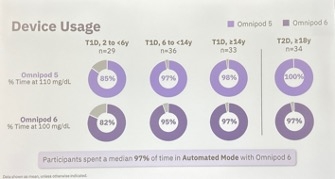
- Participants spent a median of 97% of time in automated mode with Omnipod 6. Participants with T2D and T1D aged ≥6 years spent on average about this amount of time at the 100 mg/dL with Omnipod 6, though this was slightly lower than those staying at the 110 mg/dL target with Omnipod 5 use. Unsurprisingly, those <6 years spent slightly less time at these target glucose settings.
- Participants also had the option of participating in a post-crossover, bolus optional phase with Omnipod 6 at the 100 mg/dL target. This phase lasted four weeks in those aged 2-13 years and six weeks in those aged 14-70 years, during which they were requested to bolus three or fewer times a day. In practice, mean number of boluses per day decreased from 5.4 to 3.2 in those with T1D and from 3.7 to 2.5 in those with T2D, with total daily insulin remaining about the same. TIR remained about the same as with initial Omnipod 6 use, decreasing from 77% to 76% when optionally bolusing in those aged ≥14 years with T1D and from 76% to 74% in those with T2D. TITR trends were similar, remaining at 54% when switching to the bolus optional phase in those aged ≥14 years with T1D and decreasing from 48% to 46% in those with T2D.
7. AIDING RCT subgroup analysis demonstrates substantial glycemic improvement in inpatient adults with diabetes and advanced kidney disease with AID use
During this ADA Presidents’ Select abstract presentation, Dr. Tugce Akcan (Stanford University) presented a subgroup analysis from the Automated Insulin Delivery for INpatients with DysGlycemia (AIDING) RCT (NCT06418880) investigating how AID use may improve glycemic management among hospitalized adults with diabetes and advanced CKD (eGFR ≤30 mL/min/1.73 m²). She explained that this trial followed a 2023 feasibility study in insulin-using patients with diabetes in the hospital setting (n=18). In the study, patients achieved a mean Time in Range (TIR) of 68% without any severe hypoglycemia or DKA events. The findings from this subgroup analysis of the AIDING trial demonstrate that glycemic benefits from AID extend to those with advanced CKD in the hospital setting as well.
- Methods. This analysis drew from a subgroup of the AIDING RCT, consisting of 27 hospitalized adults with diabetes and eGFR ≤30 mL/min/1.73 m2. The full trial consisted of 130 patients across three academic medical centers in the US. In the control arm, participants were managed with basal-bolus MDI and Dexcom G7. In the intervention arm, participants received Omnipod 5 with Dexcom G7 alongside nurse-delivered meal boluses. This subgroup received the same protocol, devices, and monitoring as those in the broader trial. Participants were followed for up to 10 days or until hospital discharge.
- Baseline characteristics. Participants had a baseline mean A1c of 8.2% in the control cohort and 7.3% in the treatment cohort, which Dr. Akcan said was not a statistically significant difference. Most had T2D (86% in the treatment arm and 77% in the control arm), and several were on dialysis (57% in the treatment arm and 31% in the control arm). They had a mean age of about 60 years, 44% were female, and over half were Black.
- AID use was found to be safe in this inpatient population. The CGMs used were validated for accuracy every 12 hours and triggered alarms at glucose levels <80 mg/dL and >300 mg/dL, with glucose <70 mg/dL treated per hospital protocol. No severe adverse events occurred. Hypoglycemia exposure was minimal in both groups, with mean Time below Range (<70 mg/dL) of 0.32% and 0.11% for the control and treatment groups, respectively. Mean Time <54 mg/dL was 0.09% for the control group and none for the treatment group.
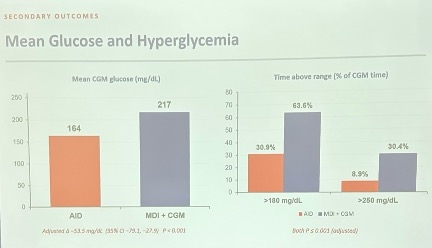
- AID use was associated with significantly greater glycemic management compared to control. Mean TIR with AID use was nearly double that with MDI and CGM (68.6% versus 36.3%), leading to an adjusted difference of 25.7 percentage points (CI: 13.5% to 37.9%; p=0.001). Improvements were observed at Day 1 and generally maintained over the course of the stay and were greater than with MDI at each time point during the day. Mean Time above Range was also significantly lower (p≤0.001) in participants on AID compared to MDI for both >180 mg/dL (30.9% versus 63.6%) and >250 mg/dL (8.9% versus 30.4%, respectively). Additionally, mean glucose was 53 mg/dL lower with AID use (164 mg/dL) compared to control (217 mg/dL; CI: -79.1 to -27.9; p<0.001).
8. Drs. Jennifer Sherr and Jeremy Pettus tackle the value of CKM for the masses
In this stirring debate, Dr. Jennifer Sherr (Yale University) and Dr. Jeremy Pettus (UCSD) tackled a hot topic: whether continuous ketone monitoring (CKM) is ready for wide-spread use. The debate centered on whether CKM represents the next major advance in preventing diabetic ketoacidosis (DKA) or if the technology is too nascent to be introduced – asking if the diabetes community is adequately prepared to interpret and act on the data it generates. Both speakers agreed that DKA remains a significant clinical problem despite substantial advances in diabetes technology. However, they differed sharply on whether CKM can meaningfully reduce DKA risk and improve patient outcomes. Dr. Sherr argued that CKM offers a transformative opportunity for earlier detection and intervention, whereas Dr. Pettus said that the new data and unfamiliar metrics associated with the technology may create more confusion than benefit for many patients. The lively and engaging debate highlighted both the promise and the practical challenges of integrating a novel device into routine diabetes care.
- Dr. Sherr made the case that DKA remains an urgent and unresolved problem in diabetes management. Drawing on international registry data, she noted that although A1c levels have improved over time and CGM use has increased dramatically in the last decade, DKA rates have remained relatively stable. This suggests that current technologies are insufficient to eliminate this complication. She emphasized that DKA continues to account for the vast majority of diabetes-related hospitalizations among youth and imposes substantial healthcare costs. Dr. Sherr also said that existing ketone testing methods are cumbersome, inconvenient, and underutilized by both patients and providers, creating missed opportunities for early intervention. In contrast, CKM enables the passive, continuous measurement of beta-hydroxybutyrate, allowing elevated ketones to be detected before symptoms develop. Citing early studies and real-world examples, she suggested that timely awareness of rising ketone levels could prompt corrective action, potentially preventing progression to DKA and reducing hospitalizations.
- Dr. Pettus approached the topic from a deliberately skeptical perspective. In fact, he told the audience to pretend he was not himself, but rather someone “who does not believe in CKM” and questioned whether CKM is ready for widespread adoption. While acknowledging the technology’s theoretical benefits, he argued that more data are not inherently valuable for patients unless they are easily understood and actionable. Dr. Pettus highlighted widespread uncertainty among healthcare professionals regarding normal ketone levels and appropriate intervention thresholds, suggesting that patients would face even greater difficulties interpreting CKM data. He questioned how many individuals currently use discrete ketone monitoring in their day-to-day management – and whether there was any value in providing continuous data for a metric people do not widely use in discrete form. Dr. Pettus also stressed that the individuals most likely to experience DKA often face challenges such as high A1c levels, missed insulin doses, limited healthcare access, or psychosocial barriers, making them less likely to engage with an additional wearable device like a CKM. Ultimately, he maintained that CKM risks increasing patient anxiety, clinic workload, and healthcare costs without clear evidence that it will substantially reduce DKA incidence across the broader diabetes population.
- Speaking off the cuff for her rebuttal, Dr. Sherr argued that the field can draw lessons from the successful rollout of CGM, emphasizing that most users would not need to continuously monitor ketone values but rather respond to alerts when intervention is needed. Dr. Pettus countered by emphasizing that clinicians still lack consensus on concerning ketone thresholds and appropriate responses. Despite these disagreements, both speakers ultimately acknowledged the potential value of CKM and agreed that education, standardized protocols, and further evidence will be essential to its success. The debate concluded on an optimistic note, with audience Q&A reflecting a shared belief that innovation must begin somewhere, even if the path toward broad adoption is likely to be iterative and, at times, messy.
9. ADA consensus panel unveils new clinical decision algorithm to identify and treat elevated ketone levels
A packed panel discussion on the identification, monitoring, and management of elevated ketones closed ADA Day #1. Dr. Guillermo Umpierrez (Emory University) opened the symposium by presenting concerning trends in DKA hospitalization rates. Globally, DKA rates are increasing in children and adults with T1D and T2D. According to CDC’s 2026 National Diabetes Statistics Report, 10.4 per 1,000 adults with diabetes experienced a hyperglycemic crisis requiring hospitalization in 2021. Readmittance also remains an issue, with one in eight DKA patients being hospitalized again within 30 days. Additionally, although risk of DKA remains higher in people with T1D, it is rising in those with T2D due to usage of SGLT-2 inhibitors. Given these concerning trends, Dr. Viral Shah (Indiana University) discussed the ADA’s efforts to develop actionable clinical guidance for patients, while Dr. Eden Miller (Diabetes and Obesity Care) addressed how continuous ketone monitoring (CKM) could mitigate DKA risk.
- Dr. Shah unveiled a clinical decision algorithm (CDA) developed by an ADA consensus team. The CDA did not encompass: (i) pregnancy (due to the unique pathophysiology of DKA and limited evidence); (ii) SGLT-2 inhibitor-related euglycemic DKA (noting that ketone management principles are similar to the STOP DKA protocol); and (iii) mixed disorders and hyperglycemic ketosis due to cannabis hyperemesis syndrome (HK-CHS). Dr. Shah said the pending commercialization of Abbott’s dual glucose-ketone monitor motivated this CDA to provide people with diabetes and clinicians with actionable, simple guidance to address elevated ketone levels and prevent DKA. He said the ADA consensus panel sought to align well with an alternative CKM consensus statement published in The Lancet Diabetes and Endocrinology earlier this year to minimize confusion. The CDA comprised five clinical steps.
- Step 1: All individuals at risk for elevated ketones should receive education on ketone monitoring and treatment. Dr. Shah emphasized education should be provided regardless of ketone assessment method. If individuals are not using CKM, proceed to Step 2. If individuals are using CKM, proceed to Step 3.
- Step 2: Assess if current symptoms, if any, warrant ketone measurement. Factors indicating the need to evaluate ketone levels include, but are not limited to: (i) significantly elevated glucose levels (>250 mg/dL); (ii) nausea or vomiting; (iii) heavy or rapid breathing; and (iv) confusion and fatigue.
- Step 3: Evaluate ketone levels with CKM, capillary tests, or urine strips.
- Step 4: Determine if ketones are elevated. The CDA includes color-coded guidance to assist with identification and aligns with the previous CKM consensus. The chart defines ketone levels according to the method of measurement, including diagrams to help with interpretation of urinary tests.
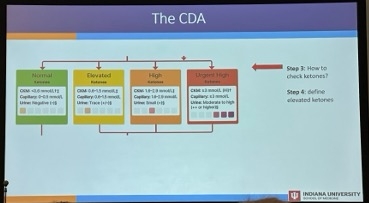
- Step 5: Manage ketone levels accordingly. Dr. Shah noted the CDA aims to empower people with diabetes to manage their ketone levels themselves if they have the appropriate resources to do so, providing practical guidance according to glucose levels. Dr. Shah said the consensus group chose a glucose level 250 mg/dL as the benchmark to delineate treatment recommendations to minimize unnecessary testing and maintain simplicity. If individuals do not have the resources to manage ketones themselves or do not have successful resolution of elevated ketones, they are advised to seek treatment at the emergency department.
- Dr. Miller emphasized that everyone at risk for elevated ketones needs a personalized plan to manage rising levels. She said that CKM offers a real-time, proactive solution to improve the accessibility of ketone monitoring and intervene early, stating that clinicians must embrace the technology in order to revamp clinical guidance as necessary according to the real-world data gathered from implementation. Furthermore, she called on endocrinologists to teach primary care physicians to be experts in ketone monitoring, rather than dismissing the technology as too complicated for primary care. By embracing CKM and involving the entire care team, Dr. Miller stressed there is substantial opportunity to empower people with diabetes to identify and respond to elevated ketone levels to reduce DKA risk.
10. Dr. Dessi Zaharieva discusses the association of negative premeal net insulin on board with postprandial excursions during AID use
Dr. Dessi Zaharieva (Stanford University) presented on a novel variation of a metric, premeal netIOB, and its association with postprandial excursions during AID use in adults with T1D (n=141). To begin, Dr. Zaharieva explained the differences between traditional insulin on board (IOB) metrics and net insulin on board (netIOB). Traditional IOB tracks just bolus insulin that is actively circulating about three to six hours after a dose, not accounting for the basal changes that were made by the AID algorithm. NetIOB is the sum of all insulin action, measured as the bolus IOB minus any basal deviations from the scheduled rate. She explained that netIOB can be negative when a pump is suspended or basal insulin is reduced below the scheduled rate, making patients insulin-deficient before a meal. The real-world study she presented aimed to evaluate whether premeal netIOB is associated with postprandial glycemic outcomes in AID users.
- The study analyzed over 8,000 meal events with about 27 days of CGM coverage per userusing data from the T1DEXI dataset. Meals were categorized as small (≤21 grams of carbohydrates), medium (21-49 grams of carbohydrates), or large (≥50 grams of carbohydrates). NetIOB was categorized as negative at values <-0.5 units, neutral between -0.5 and 0.5 units, or positive at values >0.5 units. Adverse outcomes were defined as: (i) postprandial glucose rise >80 mg/dL compared to one’s premeal baseline within three hours of eating; (ii) peak glucose >250 mg/dL within three hours of a meal; or (iii) prolonged postprandial hyperglycemia with excessive total glucose exposure above baseline (AUC >100).
- Premeal netIOB correlated with postprandial excursions. When meals were small, there were no significant differences in adverse outcomes between netIOB groups (ranging from 47%-49%). However, negative netIOB was associated with more adverse outcomes than when netIOB was positive (48% versus 43%; p<0.001) and when netIOB was neutral (48% versus 45%; p<0.05). When meals were large, all comparisons of adverse outcome rates by netIOB were significant (53% when negative, 46% when neutral, and 38% when positive). Those with negative premeal netIOB had an about 24 mg/dL greater glucose spike than those with positive netIOB. In sum, the statistical significance of premeal netIOB differences increases with meal size, with negative premeal netIOB associated with larger postprandial glucose spikes and higher adverse outcome rates. Looking ahead, Dr. Zaharieva said that the study’s researchers will evaluate TIR and Time above Range over a longer period of time (24 hours) and reanalyze the data after normalizing total daily dose. When asked on the metrics’ clinical applications if disclosed to users, Dr. Zaharieva said a large part will come with education. For example, if users see negative netIOB when sitting down for breakfast, bolusing more could account for their lower overnight insulin delivery and minimize postprandial spikes.
- Dr. Zaharieva also applied these findings to exercise. She said that premeal negative netIOB might occur in adults who exercise after work but before dinner, as setting a higher target for exercise may result in less afternoon insulin delivery, leading a post-exercise meal to trigger a larger postprandial spike. She also offered another example in children who disconnect or suspend their AID system to swim, as that leads to net negative insulin activity and higher subsequent post-meal glycemic excursions.
Diabetes Therapy
11. Highest dose of zenagamtide (amycretin) confers placebo-adjusted A1c reduction by 1.6% in people with T2D in phase 2 results
In this Friday evening industry symposium, Dr. Pablo Mora (UT Southwestern) shared results of a phase 2 study (n=262) of once-weekly injectable zenagamtide (amycretin) for adults with T2D inadequately controlled on metformin. The results were released in a poster abstract; see accompanying press release from Novo Nordisk. As background, zenagamtide is a first-in-class, unimolecular, peptide GLP-1/amylin RA. The trial met its primary and secondary endpoints, and findings support the initiation of a phase 3 development program of zenagamtide for adults with T2D in 2H26.
- Baseline characteristics and study design. The study evaluated six doses of zenagamtide: (i) 0.4 mg; (ii) 1.5 mg; (iii) 5 mg; (iv) 10 mg; (v) 20 mg; and (vi) 40 mg. At baseline, participants were 66% male and on average 57 years old, had a mean body weight of 99 kg (219 lbs), and a mean A1c of 7.8% (ranging from 7.0%-10.0%). 40% of patients were taking an SGLT-2 inhibitor. The trial used a fixed-dose-escalation trial design (see below). If the planned treatment dose was not tolerated, treatment was permanently discontinued.
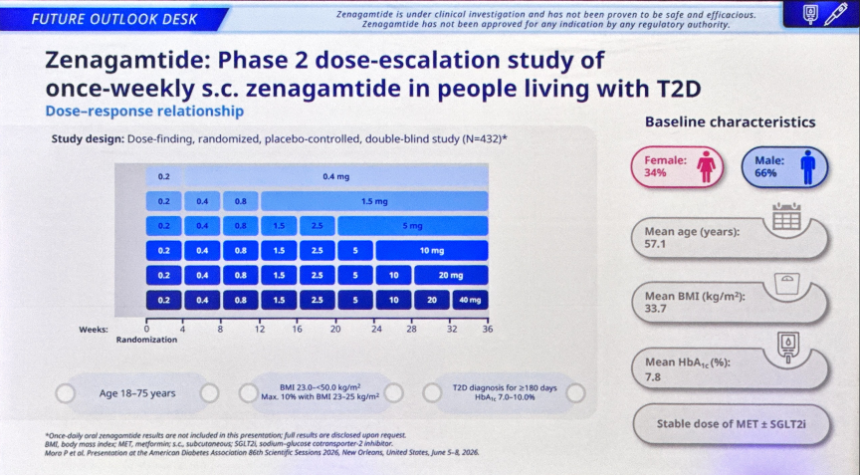
- The primary endpoint was the change in A1c from baseline to Week 36. Key secondary endpoints included changes from baseline to Week 36 in Time in Range, body weight, systolic blood pressure, C-reactive protein, lipids, and the number of adverse events (AEs) from baseline to end of trial.
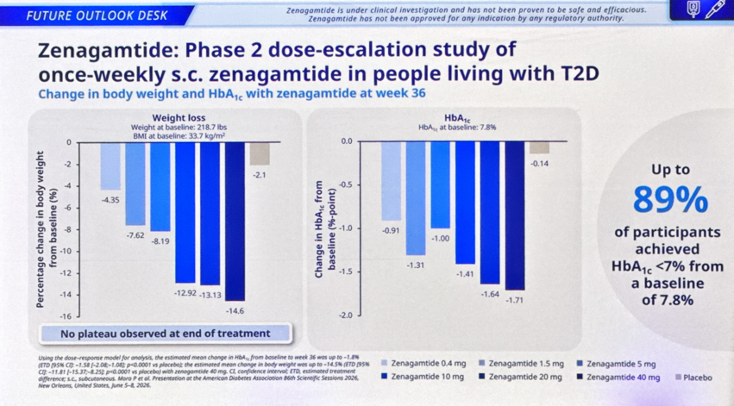
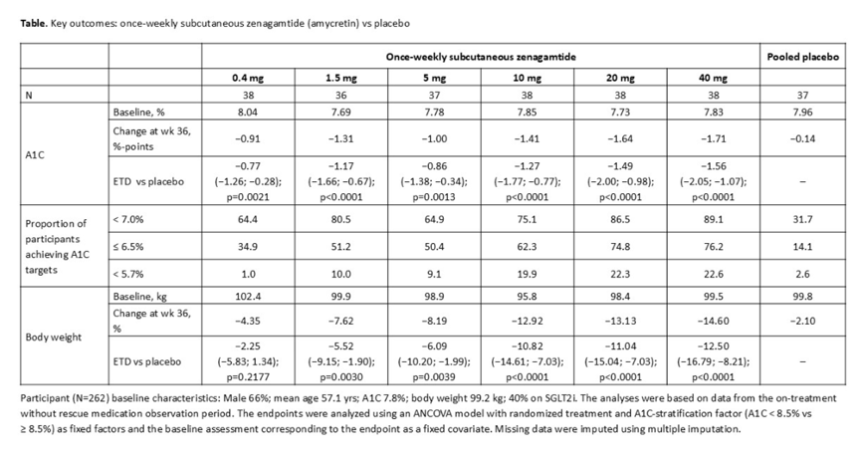
- Results. The phase 2 study showed dose-dependent and significant change in A1c from baseline to Week 36 in all doses of zenagamtide compared to placebo. At Week 36, the estimated treatment difference in A1c from placebo was -1.56 percentage points at the highest dose. Up to 89% of patients on zenagamtide achieved A1c levels below 7.0%, while up to 76% achieved levels at or below 6.5% (see below).
- In secondary endpoints, the proportion of Time in Range (70-180 mg/dL) was above the internationally recommended target of >70% across all zenagamtide doses, and up to 91% in patients taking zenagamtide 40 mg. Participants taking zenagamtide 40 mg also saw a mean body weight reduction of up to 14.6% from a baseline body weight of 219 lbs, compared to 2% in placebo. No apparent weight loss plateau was observed at Week 36 with the “higher doses” of zenagamtide.
- The most common adverse events were gastrointestinal of mild to moderate severity. The safety and tolerability profile was consistent with other incretin and amylin-based therapies.
- Drs. Louise Aronne (Weill Cornell Medicine) and Domenica Rubino (Washington Center for Weight Management & Research) praised the potential of the therapy. Dr. Aronne characterized zenagamtide to have “GLP-1 and amylin effect in one molecule” with a “phenomenal effect.” Dr. Rubino said the era is “quite exciting” for providers and patients. During Q&A, Dr. Rubino also shared that Novo Nordisk does not plan to do a head-to-head comparison trial with CagriSema and confirmed that phase 3 is planned for later this year.
12. Full results of the phase 2b ACCESS trial: Oral small molecule GLP-1 RA aleniglipron confers up to 12% weight loss in people with overweight or obesity
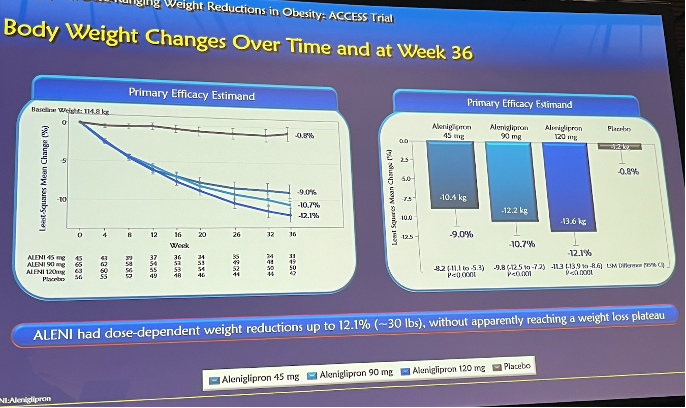
In a jam-packed symposium, Dr. Julio Rosenstock (University of Texas) presented results of the phase 2b ACCESS trial (n=230), which evaluated Structure Therapeutics’ oral small molecule GLP-1 RA aleniglipron in people with overweight or obesity with at least one weight-related comorbidity. The results were simultaneously published in Nature Medicine. Dr. Rosenstock explained that aleniglipron is a potent, highly selective, and ß-arrestin-biased small-molecule GLP-1 RA. It is designed to be taken once daily with no food restrictions. Moreover, the molecule does not have chiral centers, which makes manufacturing simper. Previously, in the phase 2 ACCESS II trial (n=82), aleniglipron demonstrated up to 16.3% weight loss at Week 44 in people with obesity and weight-related comorbidity.
- Study design and baseline characteristics. The 36-week ACCESS trial compared aleniglipron 45 mg, 90 mg, and 120 mg to placebo in terms of weight loss, cardiometabolic effects, and safety and tolerability profile. Following the study completion, participants (n=151) were invited to join an open-label extension trial.
- At baseline, participants were 50 years old, with 54% being female. The majority was white (84%), followed by Black (10%). On average, participants had a baseline body weight of 115 kg (254 lbs), BMI of 40 kg/m2, A1c of 5.6%, and blood pressure of 125/81 mmHg.
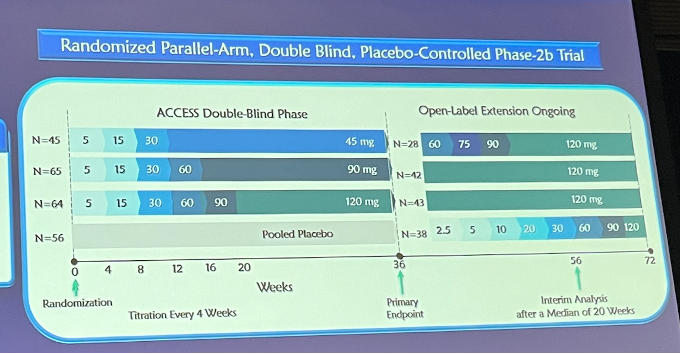
- Results. At Week 36, aleniglipron conferred dose-dependent weight loss up to 12% (vs. 0.8% with placebo), with no signs of plateau. Moreover, a greater proportion of people on aleniglipron achieved weight loss thresholds of ≥5% (86% vs. 23% on placebo), ≥10% (70% vs. 7%), and 15% (38% vs. 1%). On cardiometabolic outcomes, aleniglipron led to greater reductions in A1c (0.36 vs. 0.01 percentage points), systolic blood pressure (9 vs. 1.5 mmHg), and hsCRP (46% vs. 7%), compared to placebo. On the other hand, consistent with other incretin-based therapies, heart rate rose dose-dependently by up to 2.2 beats per minute, compared to placebo, which decreased by 1.2 beats per minute. In an open-label extension study, aleniglipron has further led to 16% weight loss from a baseline of 117 kg (258 lbs) at Week 52.
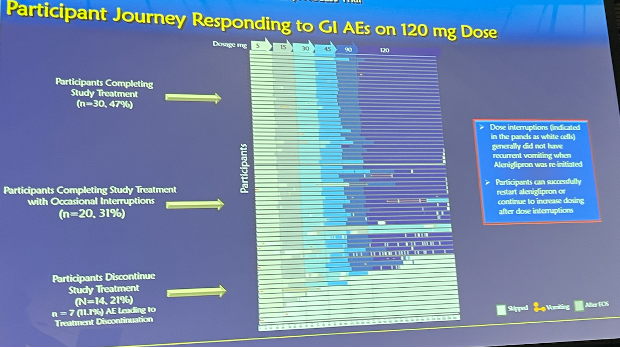
- Safety and tolerability. Overall, a higher percentage (92%) of the aleniglipron group experienced treatment-emergent adverse events, compared to the placebo group (79%). GI side effects were most common, led by nausea (71% with aleniglipron 45 mg vs. 21% with placebo), vomiting (40% vs. 5%), diarrhea (42% vs. 23%), and constipation (40% vs. 14%). In addition, participants taking aleniglipron were more likely to discontinue treatment (13%, 8%, and 5% with aleniglipron 45 mg, 60 mg, and 120 mg vs. 1% with placebo) due to GI events. More specifically, 47% completed treatment successfully, while 31% experienced interruptions, and 21% discontinued treatment. Encouragingly, Dr. Rosenstock noted that the GI events mostly occurred at the beginning of the treatment, and that when treatments were interrupted, participants generally were able to restart the treatment without recurrent vomiting. There were no notable hepatic safety signals.
13. SURPASS‑CVOT substudy finds no signal of early diabetic retinopathy worsening with tirzepatide versus dulaglutide
In this oral presentation, Dr. David D’Alessio (Duke University) shared findings from a prespecified SURPASS‑CVOT substudy, examining whether the substantial glucose‑lowering achieved with tirzepatide versus dulaglutide affects retinal outcomes in people with long‑standing T2D at high risk for developing diabetic retinopathy (DR). The study was designed to directly address long‑standing concerns about worsening of DR when chronic hyperglycemia is corrected rapidly. Dr. D’Alessio emphasized that tirzepatide produces some of the most rapid and substantial A1c reductions seen in clinical practice, making retinal safety a critical question in people with long‑standing T2D.
- Study design and baseline characteristics. The substudy enrolled 920 participants with established cardiovascular disease and either existing DR or elevated risk for progression, randomized to tirzepatide (up to 15 mg weekly) or dulaglutide (1.5 mg weekly). Retinal status was assessed using standardized fundus photography at baseline and 12 months, using a modified Early Treatment Diabetic Retinopathy Study (ETDRS) scale. Dr. D’Alessio described this as a semi‑quantitative system that ranks retinopathy severity from no DR to proliferative disease. It also enables detection of clinically meaningful worsening of DR, defined as a ≥2‑step increase on the scale. The primary endpoint was ≥2‑step ETDRS progression or need for DR treatment over 36 months, with secondary endpoints including time to first DR progression and sustained visual acuity loss. Baseline characteristics reflected a population at substantial risk, with a mean A1c of 8.7%, nearly 20 years of diabetes duration, and more than 75% having DR.
- Results. Tirzepatide produced a 2.18 percentage-point A1c reduction at six months vs. a 1.28 percentage-point reduction with dulaglutide, yet retinal outcomes remained stable and comparable between groups. Rates of ≥2‑step ETDRS progression were similar, with no statistically significant differences between treatments, and time‑to‑event curves overlapped throughout the 36‑month follow‑up. DR‑related interventions, including photocoagulation, intravitreal anti‑VEGF therapy, vitrectomy, and vitreous hemorrhage, occurred at low and comparable rates across both arms. Sustained visual acuity loss of ≥3 lines was rare and did not differ between tirzepatide and dulaglutide. Mean ETDRS scores remained stable in participants without baseline DR, and although small increases were observed in those with baseline DR, these changes were gradual and aligned with the natural history of long‑standing disease rather than treatment‑related acceleration. Importantly, Dr. D’Alessio emphasized that there was no correlation between the magnitude of A1c reduction and changes in ETDRS score, and stratifying participants by >2.0% vs. ≤2.0% A1c reduction did not reveal any differential risk in either treatment group.
- Implications. Dr. D’Alessio underscored that these findings are particularly meaningful given the concern that rapid correction of hyperglycemia can precipitate early worsening of diabetic retinopathy. Given tirzepatide’s ability to lower A1c rapidly, the absence of any signal of early worsening is clinically meaningful. The lack of association between the magnitude of A1c reduction and changes in ETDRS score further supports that tirzepatide’s potency does not translate into retinal vulnerability, compared to dulaglutide, even in a cohort with long diabetes duration, high baseline A1c, and a high prevalence of existing DR. We are curious how these retinal outcomes differ between tirzepatide and placebo or other drug classes like metformin, insulin, or SGLT-2 inhibitors.
14. Full results of phase 2 trial of dual GLP-1/GIP RA acmopatide (CT-868) in T1D; Roche discontinues program
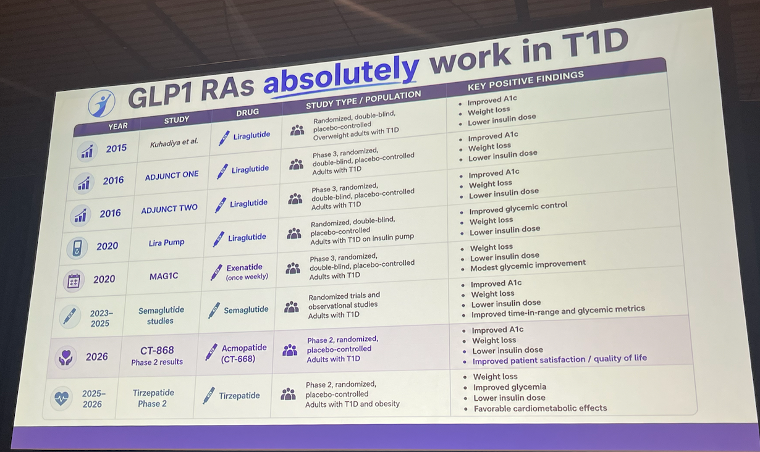
In this well-attended afternoon symposium, Dr. Klara Klein (UNC Chapel Hill) and Dr. Jeremy Pettus (UCSD) presented the full results of the phase 2 trial (n=111), which evaluated dual GLP-1/GIP RA acmopatide (CT-868) in people with T1D. Most people with T1D do not meet glycemic targets with insulin alone and face significant cardiovascular (CV) risks. Given that people with T1D face similar obesity prevalence as the general population, and excess adiposity further contributes to CV risks, incretin-based therapies have the potential to improve cardiometabolic health in people with T1D. Acmopatide is a first-in-class, once-daily dual GLP-1/GIP RA designed specifically as an adjunctive-to-insulin therapy for T1D. In the phase 2 trial, acmopatide demonstrated a statistically significant reduction in A1c by 0.3 percentage points, along with 6.7% weight loss, 15% lower insulin requirement, 3-5 mmHg lower blood pressure, and improved patient satisfaction. However, Dr. Pettus announced that Roche has discontinued the program, reversing its decision in 4Q25 to initiate a phase 3 trial this year.
- Trial design and baseline characteristics. The trial evaluated acmopatide 1.8 mg, 4.1 mg, 6.6 mg, and placebo among adults with T1D and BMI ≥27 kg/m2. The primary endpoint was the change in A1c from baseline at Week 16, and key secondary endpoints included weight loss efficacy and change in total daily insulin dose.
- At baseline, participants were 41 years old, with 63% being female. Mean body weight was 98 kg (216 lbs), BMI was 34 kg/m2, A1c was 7.5%, and diabetes duration was over two decades. Approximately one-third was on an AID, while a third was on a non-AID pump system, and the final third was on MDI.
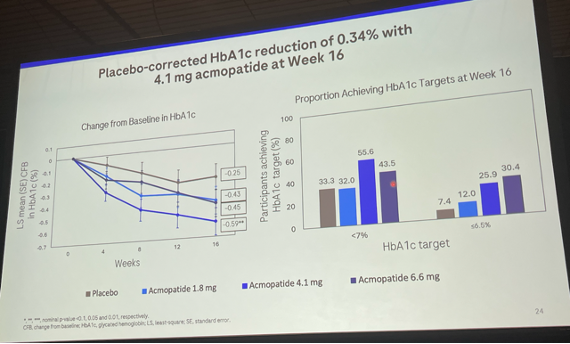
- Results. At Week 16, acmopatide conferred up to a 0.59 percentage point reduction in A1c (vs. 0.25 percentage points on placebo). Moreover, a greater proportion of participants on acmopatide (up to 56% vs. 33% on placebo) achieved an A1c target of <7.0% (see figure below). Dr. Pettus said that a placebo-adjusted 0.3 percentage point reduction in A1c is clinically significant and has led to approvals of diabetes technology like AID systems. Moreover, A1c reduction in people with T1D should not be compared directly to that in T2D, as T1D is complicated by lower insulin requirements when compared to T2D.
- On CGM metrics, Time in Range (TIR) increased by up to 5.9% (one hour and 25 minutes) compared to placebo from a baseline of ~60%. Time below Range (TBR; 54-70 mg/dL) lowered by up to 0.2% (3 minutes) compared to placebo from a baseline of ~1.5%.
- Hypoglycemia risks were similar across the treatment and placebo groups. More specifically, similar proportions of participants (77-82%) achieved the ADA-recommended hypoglycemia target of TBR <70 mg/dL for less than 4%.
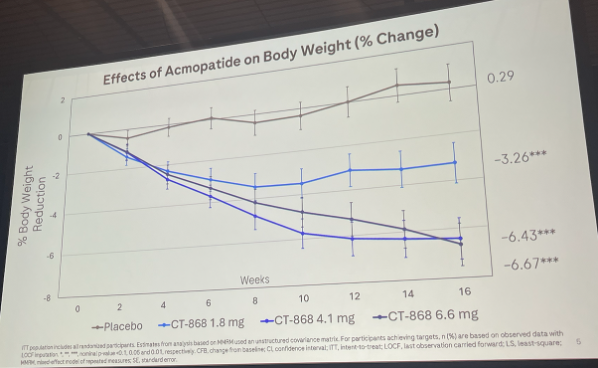
- Acmopatide led to significant weight loss by up to 6.7% from a baseline of 98 kg (216 lbs), compared to 0.29% gain with placebo. Dr. Pettus said that this means patients lost ~15 lbs over 16 weeks, which is significant. Furthermore, greater proportions of the acmopatide group (63% and 11%) achieved ≥5% and ≥10% weight loss, respectively, compared to placebo (7.4% vs. none).
- Total insulin units decreased by up to 15% from baseline, compared to the placebo.
- Systolic and diastolic blood pressure lowered by up to 8.4 mmHg and 2.6 mmHg, respectively.
- On safety and tolerability, approximately half of the participants on acmopatide experienced nausea, compared to 7% in the placebo group. Likewise, the treatment group had higher rates of gastrointestinal events, such as constipation (up to 35% vs. 10%), vomiting (44% vs. none), decreased appetite (33% vs. 14%), and diarrhea (33% vs. 7%). Dr. Pettus hypothesized that people with T1D may be more sensitive to the GI effects of incretin-based therapies. While hypoglycemia was more common among the acmopatide group (28% vs. 7%), there was no severe hypoglycemia or DKA event across the study.
- Despite the glycemic, weight loss, and cardiovascular benefits, Roche discontinued the development of acmopatide into phase 3. While a bittersweet outcome, Dr. Pettus said this study confirms the benefits of incretin-based therapies in T1D (see figure below) and underscores the need for metabolic therapies in diabetes management. He looks forward to the results of the pivotal phase 3 SURPASS T1D-1 trial (n=905) later this year, which could lead to the approval of tirzepatide for T1D. Finally, Dr. Pettus said that coordinated effort is needed to make GLP-1 RAs safe, effective, and accessible for people with T1D. This includes educating clinicians and patients, developing a safe and unique titration scheme – especially with insulin dose reduction – and improving the tolerability profile.
15. The major cause of insulin resistance is insulin: An argument to decrease exogenous insulin to treat cardio-renal metabolic syndrome
In this rousing presentation, Dr. Philipp Scherer (UT Southwestern) argued that insulin itself causes insulin resistance. In what he described as “not [his] usual roadshow,” Dr. Scherer focused on the adipocyte as the central cause of cardio-renal metabolic syndrome associated with T2D. From his perspective, the key to improving glycemic control, and complications like MASH, HFpEF, sleep apnea, osteoarthritis, CKD, and neurodegenerative diseases is weight loss – with benefits largely conferred through adipocyte remodeling and improved insulin sensitivity. As weight is reduced, adipocytes transition from an insulin‑resistant, disease‑promoting state to a metabolically “happy” state that supports systemic health, a process he framed as “metabolic flexibility.” He concluded that the adipocyte is “not only the cause of a lot of problems, it’s also the solution that we’re looking for.” Improvements in insulin sensitivity at the adipocyte level are sufficient to drive systemic benefit.
- To substantiate his claims from a preclinical point of view, Dr. Scherer presented extensive mouse models using PTEN (phosphatase and tensin homolog), an enzyme that terminates insulin signaling. Systemic, adipocyte‑specific deletion of PTEN significantly enhanced systemic insulin sensitivity, demonstrated by improved oral glucose tolerance and strikingly low insulin levels during OGTT. Deletion of PTEN specifically in subcutaneous adipocytes was sufficient to reproduce systemic benefits. Conversely, the expression of a hyperactive PTEN in adipose tissue caused systemic insulin resistance, underscoring that isolated changes in adipocyte insulin sensitivity alone are sufficient to significantly alter whole‑body metabolism.
- Of note, PTEN is also a critical tumor suppressor gene in humans. Inhibiting its activity triggers rampant cell division and survival signaling, conferring a massive risk of new cancers or promoting the growth of existing ones. However, its selective inhibition has been temporarily aimed to promote tissue repair in humans. Still, no PTEN inhibitor to date has earned regulatory approval in humans.
- “The major cause of insulin resistance is insulin.” Dr. Scherer again supported his perspective with preclinical findings. Within a separate, insulin-limiting mouse model, his group established insulin as the rate-limiting agent by preventing a rise in insulin during nutrient intake while maintaining glucose tolerance. Despite lower overall insulin concentrations, glucose uptake remained consistent. Insulin tolerance tests and clamp studies demonstrated improved insulin sensitivity in the model. Making insulin rate‑limiting then produced livers that were “exceedingly happy”: free of steatosis, transcriptionally downregulated for de novo lipogenesis genes, and more insulin‑sensitive overall.
- In Dr. Scherer’s view, although exogenous insulin is life‑saving and indispensable for many patients, pharmacologic‑level insulin exposure is inherently “toxic:” it promotes insulin resistance, steatosis, and weight gain over time. He argued that preclinical data from his lab and others point to a potential therapeutic tactic: decreasing ligand availability to enhance receptor sensitivity. Drawing a parallel to leptin biology, he argued for a “less is more” philosophy that likely applies to insulin – provided that glycemic control can be preserved through other mechanisms (e.g. weight loss or GLP-1 RAs).
16. Meeting the needs of older adults with T1D: Unique considerations, pharmacotherapies, and care transitions
Reflecting on the growing prevalence of T1D, panelists addressed the field’s readiness to meet the needs of older adults with T1D. Dr. Richard Pratley (Advent Health) kicked off the symposium by focusing on the growing population of older adults with T1D and the unique needs they face due to the heterogeneous nature of the disease. Then, Dr. Elena Toschi (Joslin Diabetes Center) took the stage to discuss pharmacotherapies for older adults with T1D. Dr. Naushira Pandya (Nova Southeastern) concluded the symposium by highlighting her experience as a geriatrician and spoke on care transitions for older adults with T1D, including the use of technology, in assisted living or nursing homes.
- Dr. Pratley on the unique needs of older adults with T1D. Dr. Pratley highlighted the heterogeneity of diabetes in older adults, including disease duration, pathophysiology, comorbidities/complications, glycemic targets, and management strategies. He referred to a 2018 study that explains the differences in the genetic basis of childhood-onset compared to adult-onset T1D. Older adults usually have attenuation of HLA haplotypes associated with T1D, less positivity for multiple autoantibodies, and more often C-peptide and GAD65 positivity. Dr. Pratley also explained barriers to setting glycemic targets in older adults, including variable life expectancies, clinical differences, and a lack of evidence from large clinical trials. He therefore emphasized the importance of shared decision-making, with goals individualized on critical factors, such as comorbidities and patient preferences. Diabetes management in older adults is especially challenging due to the intersection of diabetes and geriatric syndromes – he encouraged careful consideration of polypharmacy, cognitive impairments, bone health, chronic pain, and other physiological changes.
- Dr. Pratley elaborated on the WISDM study, which studied the use of CGM in older adults with T1D. Results showed that the use of CGM led to improvements in glycemic management and a 90% decrease in hypoglycemic events. Dr. Pratley also spoke on the AIDE study, which investigated the use of AID in older adults with T1D and showed that older adults could use a hybrid closed loop to improve glycemic management and reduce hypoglycemic events, without significant adverse events.
- In T2D and CKD, Dr. Pratley said the field has made significant progress, with a pillarized approach of the four treatment classes (i.e., RAS inhibitors, SGLT-2 inhibitors, finerenone, semaglutide). On the other hand, for the past three decades, there have been no new approved treatments for people with T1D and CKD. Most recently, however, the phase 3 FINE-ONE trial showed the efficacy of Bayer’s Kerendia (finerenone) in people with CKD and T1D, with finerenone reducing uACR over six months. Reflecting on the results from the FINE-ONE trial and the FDA’s ongoing review of finerenone for CKD and T1D, Dr. Pratley shared optimism that the field is making progress in the T1D space.
- Dr. Toschi on pharmacotherapy. She explained the balance of insulin treatment in older adults with T1D, considering both hypoglycemia and hyperglycemia. Over the past few years, treatment priorities have shifted from strict glycemic management toward safe and preventative efforts of reducing hypoglycemia. Beyond achieving glycemic targets, the four M’s (i.e., what matters most, medications, mentation, mobility) and four S’s (i.e., signs/symptoms, shared decision making, set/reset goals, simpler/safer treatment) represent key frameworks for individualized care on risk management, rather than fixed treatment approaches. To address challenges with T1D treatment, Dr. Toschi shared a simplification approach:
- Avoid problem-solving. Patients should avoid carbohydrate counting or correction factors. Instead, patients should use fixed doses for small or large meals, with a fixed correction dose only during mealtimes.
- Decrease treatment burden. Patients should be advised to avoid correction doses between meals, for snacks, or at bedtime. If possible, caregivers should support monitoring, injecting, or providing reminders for insulin doses.
- Emphasis on “non-reactive behavior.” Patients should avoid high CGM alerts to avoid reactive insulin doses. Yet, they should also avoid a low CGM alert to avoid even mild hypoglycemic events.
- Dr. Pandya on care transitions. There’s currently a lack of published data on the prevalence of T1D in nursing homes in the US or those in other countries. Furthermore, until 2025, there were no clinical guidelines on the care of those in assisted living or nursing homes. Challenges across these settings include clinicians and staff being unaware of T1D diagnosis, unfamiliarity with technological devices (e.g., CGM, insulin pumps, AID), and even critical conditions like DKA onset.
- Dr. Pandya shared results from a 2025 survey distributed to long-term care practitioners. In response to whether their facilities have a policy for T1D management, 38% said “not sure,” 31% said “no,” and 31% said “yes.” Furthermore, in response to the proportion of people with T1D in their facility with a CGM, 55% said “none,” 23% said “very low,” 13% said “moderate,” 6% said “low,” and 3% said “common.” Given these responses, Dr. Pandya stressed the opportunity to improve education across care homes and the benefits of facilities with standardized policies.
- Some risk factors for adverse outcomes during care transitions for people with T1D include: (i) increased risk of hypoglycemia; (ii) increasing comorbidities and complications; (iii) limited health literacy and challenges with technology; (iv) cognitive impairment; (v) lack of family or caretakers; and (vi) changes in preferences. Dr. Pandya reviewed the ADA recommendations for effective care transitions, including structured discharge planning, communication between HCPs, and review of treatments (both new and old), among many other considerations.
- While there are several benefits of technology in older people with diabetes, various challenges contribute to the underutilization. Dr. Pandya encouraged a structured approach, which starts with identifying people with T1D. Then, there should be preparedness across facilities, with clear diagnoses in medical records and collaboration among clinical teams. Healthcare providers should further support patients in reviewing their medical history and complications with a review of medications, self-management, as well as assessment of hypoglycemia awareness and the use of CGM, AID, or smart pens.
17. Dual GLP-1/GIP RA HDM1005 demonstrates up to 13% weight loss at Week 22 in people with obesity
In a packed hall, Dr. Junfang Xu (Huadong Medicine, China) presented results from a phase 2 trial (n=243) of HDM1005, a once-weekly injectable dual GLP-1/GIP RA, in people with obesity and without diabetes. Dr. Xu explained that HDM1005 has threefold greater GLP-1 receptor agonistic potency compared to tirzepatide and has exhibited promising weight loss effects in phase 1 trials.
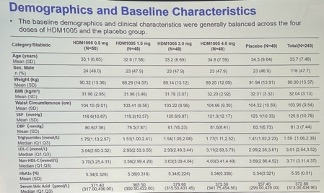
- Study design and baseline characteristics. In the 22-week trial, participants were randomized to HDM1005 0.5 mg, 1 mg, 2 mg, and 4 mg, or placebo. Doses were gradually increased until participants reached their max dose. The primary endpoint was weight loss efficacy, and secondary endpoints included cardiometabolic parameters and the tolerability profile. Nearly all (99.2%) completed the study.
- At baseline, participants were an average of 34 years old, with 48% being female. Mean weight was 90 kg (198 lbs), BMI was 32 kg/m2, and A1c was 5.3%. On cardiometabolic markers, participants had a mean blood pressure of 121/81 mmHg, triglycerides of 1.6 mmol/L, and LDL-c of 3.0 mmol/L.
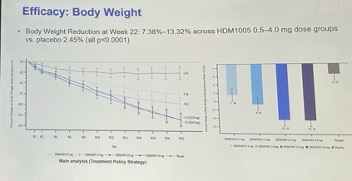
- Results. At Week 22, HDM1005 conferred dose-dependent weight loss up to 13%, compared to 2.5% for the placebo group (see figure below). In addition, a significantly greater proportion of participants on HDM1005 (75% vs. 6%) achieved ≥10% weight loss, compared to placebo. HDM1005 also improved cardiometabolic markers, including reductions in systolic blood pressure by 10 mmHg (vs. 2 mmHg with placebo), triglycerides by 27% (vs. 9%), LDL-c by 12% (vs. 3%), and A1c by 0.42 percentage-points (vs. flat).
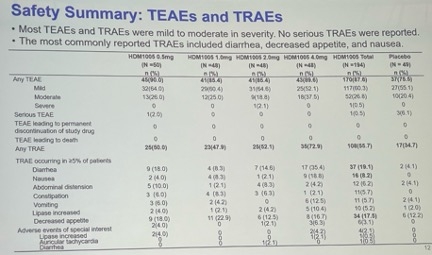
- Safety. As commonly seen with other GLP-1 RAs, the most frequent adverse events were GI-related, such as diarrhea, nausea, and decreased appetite. Dr. Xu clarified that most treatment-emergent adverse events (TEAEs) were mild to moderate, and there were no reports of serious TEAE. Notably, there was no discontinuation due to TEAEs.
- Looking forward, Dr. Xu said a multicenter 52-week phase 3 trial (n=825) is ongoing for HDM1005 in patients with overweight and obesity, with results expected by the end of the year. During Q&A, Dr. Xu also said it will evaluate higher doses of HDM1005 against tirzepatide in another study.
18. Preventing T1D: Safety of repeated dosing for SAB-142, a human anti-thymocyte immunoglobulin
An innovative afternoon presentation featured new data for SAB-142 and seeks to delay T1D progression. The disease-modifying immunotherapy is a fully human anti‑thymocyte immunoglobulin. SAB-142 is being investigated for the delay of T1D progression by preventing the immune system from attacking insulin-producing pancreatic beta cells. Dr. Christoph Bausch (SAB Biotherapeutics) began by discussing the clinical need for SAB-142: there is no currently approved therapy to halt the progression of new-onset Stage 3 T1D. Rabbit anti-thymocyte globulin (ATG) has shown efficacy for preserving C-peptide and reducing A1c values, but it has demonstrated safety issues when used in humans. Dr. Bausch and collaborators sought to evaluate fully human SAB-142 for the concerns seen with rabbit ATG, namely serum sickness, an immune hypersensitivity reaction, and immunogenicity that prevents re-dosing.
- The phase 1 trial is a randomized, double-blind, placebo-controlled study to evaluate the safety, tolerability, pharmacokinetics, and pharmacodynamics of SAB-142 in patients with and without T1D. The therapy was administered intravenously as an ascending dose up to 4.5 mg/kg. A re-dosing cohort was included to evaluate the proposed six-month dosing regimen that was the main focus of these data.
- Strong safety and efficacy data were demonstrated with the use of SAB-142. In the T1D cohort, all four patients receiving SAB-142 (2.5 mg/kg) showed C-peptide preservation through 120 days and three of the four even had enhanced C-peptide. Time in Range (TIR) improved from 73% at baseline to 85% by the end of the study and insulin doses decreased over time in the SAB-142 group. The majority of adverse events were mild, associated with one-to-two-day infusions, and resolved by the end of the first week. No deaths or drug-related serious adverse events occurred, and no adverse events led to withdrawal. Dr. Bausch discussed the lack of serum sickness and low immunogenicity seen with SAB-142, two positives that render the therapy “substantially less immunogenic than rabbit ATG or teplizumab.”
- In terms of redosing, the pharmacokinetic profile of SAB-142 showed that systemic exposure after redosing was comparable to what was observed in the single-dose cohort at the same dose. Exposure was consistent even across redosing. Redosing also caused a transient increase in cytokines similar to the initial dose.
- In all, phase 1 results demonstrate favorable safety and immunogenicity for SAB-142 with long-term dosing potential. Based on these data, Dr. Bausch said that SAB-142 advanced to the phase 2b SAFEGUARD study (n=159) for patients aged 5-40 years within 100 days of Stage 3 T1D diagnosis. This study is actively enrolling.
19. ADA Presidents’ select abstract: Time to minimal residual C-peptide as an endpoint for recent-onset T1D
This afternoon session spotlighted the ADA Presidents’ select abstract by Dr. Samuel Shangwu Wu (University of South Florida), who presented on the use of minimal residual C-peptide (TMRCP) as an efficacy endpoint for recent-onset T1D immunotherapy trials. Dr. Wu explained that T1D intervention trials focus on understanding the preservation of residual beta cell function through measures like the mixed meal tolerance test or the mean area under the curve of C-peptide levels. Yet, these measures do not infer a longitudinal trajectory of treatments and fail to incorporate detection limits. Therefore, Dr. Wu and his team incorporated TMRCP to address the limitations, defining it as the time until C-peptide declines to a prespecified minimal residual level (c) to represent functional loss of beta cell secretory capacity.
- Background on the use of TMRCP. Dr. Wu and his team sought to address the following objectives: (i) understand how C-peptide trajectories can be used to define endpoints; (ii) identify how to incorporate minimum residual threshold and assay detection; and (iii) determine how to make inferences when C-peptide levels are measured on a varied schedule. They chose c=0.03 nmol/L based on results from a 2021 study, which reported significantly fewer hypoglycemic events among C-peptide levels greater than 0.03 nmol/L.
- Data sources for integration of TMRCP. The study incorporated TMRCP across six trials conducted by TrialNet in people with recent-onset T1D. During Q&A, Dr. Wu clarified that Sanofi’s Tzield (teplizumab) was not included in this study, given its indication to delay stage 3 T1D. The following six trials were included in the assessment:
- TN02 trial, which studied mycophenolate mofetil (MMF) alone and MMF in combination with daclizumab (DZB);
- TN05 trial, which studied rituximab;
- TN08 trial, which studied glutamic acid decarboxylase (GAD) alum in two or three doses;
- TN09 trial, which studied abatacept;
- TN14 trial, which studied canakinumab; and
- TN19 trial, which studied low-dose anti-thymocyte globulin (ATG) and ATG in combination with granulocyte colony-stimulating factor (GCSF).
- Results on the efficacy of TMRCP. Results across the six trials showed that TMRCP was significantly prolonged in treatment groups with rituximab (128 vs. 84 months; p=0.03), abatacept (92 vs. 70 months; p=0.003), and ATG (137 vs. 58 months; p=0.0003). Results also showed that every one-year increase in age was associated with a decrease in the hazard ratio by 6% to 10%. Interestingly, there was no significant genetic effect on TMRCP.
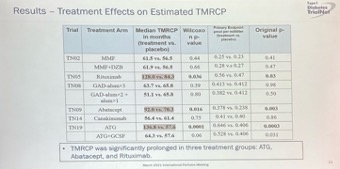
- Additional investigation of TMRCP. The study also examined different values of c, which represent the minimal residual C-peptide level. No significant differences between treatment and control groups were observed when the study employed values ranging from c=0.02 nmol/L to c=0.05 nmol/L.
- Future outlook. Dr. Wu emphasized that future work should compare estimated TMRCP from models with observed values from long-term follow-up studies. He suggested that these results would further position TMRCP as an alternative endpoint for T1D intervention studies.
20. Make new friends, but keep the old? Updates on insulin therapy in pregnancy
An afternoon panel discussion featured impassioned discussion around improving insulin use in pregnancy. Glycemic management during pregnancy is complicated due to rapid changes in physiology and the subsequent need for specific pregnancy glucose targets. The ADA recommends glucose targets of 100 mg/dL in early pregnancy and 81-90 mg/dL from 16 to 20 weeks onward – significantly lower than the targets set by most patients who are not pregnant. The use of insulin during pregnancy is the standard of care for patients and offers challenges that continue to evolve over time.
- Dr. Lene Ringholm (Rigshospitalet University Hospital Copenhagen, Denmark) argued that faster, rather than longer-acting, insulins are essential to meeting patient needs during pregnancy. Dr. Ringholm began by discussing Fiasp, an insulin aspart with a faster onset of action compared to Novolog that could potentially benefit pregnant women with diabetes. The CopenFast trial (n=216) included women with T1D or T2D randomized to Fiasp or Novolog in early pregnancy and showed that the two groups had similar A1c values, insulin doses, and pregnancy outcomes. However, only one patient randomized to Fiasp reported severe hypoglycemia compared to seven women randomized to Novolog. In a pre-planned secondary analysis of women with T1D, severe hypoglycemia rate was lower among women randomized to Fiasp compared to women randomized to Novolog. Dr. Ringholm therefore argued that women with T1D at risk of severe hypoglycemia can be offered Fiasp before and during pregnancy.
- Dr. Ringholm also discussed insulin degludec, an ultra-long-acting (>42 hours) insulin analog with an improved pharmacological profile compared to other basal insulin analogs. Data from the EXPECT trial with 92 women randomized to degludec and 96 women to detemir, a long-acting insulin, in early pregnancy showed similar glycemic control, hypoglycemia rate, and pregnancy outcomes. However, women randomized to degludec experienced numerically higher rates of preeclampsia (14%) and preterm delivery (34%) compared to women randomized to detemir.
- Dr. Amy Valent (Oregon Health & Science University) discussed the versatility of inhaled insulin and its potential applications for diabetes in pregnancy. While not formally investigated in pregnancy, inhaled insulin can offer versatility, creating options to tailor glucose management. The term “diabetes in pregnancy” includes far more phenotypes at risk of hyperglycemia than what may be initially expected, including T1D, T2D, MODY, GDM, and complications of cystic fibrosis and bariatric surgery. Each of these etiologies for hyperglycemia requires a different management approach, again supporting the need for alternative insulins.
- Dr. Valent demonstrated the rapid absorption of inhaled insulin using data from MannKind’s Afrezza, the only inhaled option currently available in the US. The large surface area of the lungs allows for rapid systemic absorption, peaking at 12-15 minutes versus 45-60 minutes for rapid-acting insulin. In non-pregnant patients, the therapy improved postprandial hyperglycemia, reduced instances of hypoglycemia, and limited weight gain compared to injected insulin. However, very limited data specific to pregnancy are currently available, particularly for optimal dosing and rates of severe hypoglycemia.
- Dr. Carol Levy (Mount Sinai Hospital) discussed the benefits, considerations, and limitations of AID use during pregnancies with diabetes. Dr. Levy began by addressing the challenges for pregnant patients with diabetes including health risks for both the mother and fetus, risk of hypoglycemia while avoiding hyperglycemia due to tighter glycemic targets, and changes in insulin needs throughout gestation. Dr. Levy then discussed the use of various AID systems for pregnancy and specific advantages for each:
- The CamAPS FX algorithm is approved in the US; however, the associated insulin pump (YpsoPump) has not yet received approval. CamAPS FX can be used with faster aspart and lispro-aabc insulins. Compared with standard of care (SOC), women using CamAPS FX achieved a Time in Range (TIR) of 47%, compared with 11% among those receiving SOC.
- MiniMed 780G, currently approved in the US and EU for pregnant women and compatible with faster aspart and lispro-aabc, requires user boluses and has no formal protocol for the entry of “fake carbs.” Dr. Levy queried how to optimize meal delivery based on the nature of meals. The CRISTAL Trial featured 43 patients assigned to MiniMed 780G and 46 to SOC, with a mean proportion of TIR of 66.5% in the HCL group compared to 63.2% in the standard insulin therapy group (p=0.17).
- Tandem’s Control-IQ. A trial of 91 randomized women with T1D in early pregnancy revealed that time in pregnancy-specific glucose range was 65.4% as opposed to 50.3% with SOC. In April 2026, the company’s updated Control-IQ+ algorithm became the first FDA-cleared algorithm for pregnancy in the US.
- Sequel’s twiist was presented using two case studies involving pregnant patients who transitioned to this AID system during pregnancy. Case one involved transitioning from Insulet’s Omnipod 5 to twiist during the third trimester, resulting in an increase in TIR from 41% in the first trimester to 74% in the third trimester. Case two involved transitioning from Tandem’s t:slim X2 to twiist during the second trimester, with TIR increasing from 58% to 67%.
-- Jeremy Alkire, Kayla Cao, Andrew Goyette, Nour Khachemoune, Daniel Lee, Kayla Mathieu, Milenka Men, Caroline Metz, Kat Moon, Allie Platt, Elizabeth Rose, Ben Wyler, Elaine Young, Monica Oxenreiter, and Kelly Close