JPM 2026 Day #4 Highlights –
Executive Highlights
- The 44th Annual JP Morgan Healthcare Conference at the Westin St. Francis was full of insights and business updates, from disease-modifying therapies for T1D and non-incretin obesity candidates to generics and biosimilars. JPM has truly been wonderous, where we were able to hear how companies like Lilly, Novo Nordisk, Pfizer, and Dexcom envision the future of diabetes and obesity care. We were also honored to attend keynote talks by JPMorgan CEO Mr. Jamie Dimon, head of CMS Dr. Mehmet Oz, and FDA Commissioner Dr. Marty Makary on the broader government and political changes and their impact on the healthcare industry. In case you missed it, see our coverage for Day #1, Day #2, and Day #3!
- In tech, companies highlighted digital health platforms and drug delivery systems.
- Virta Health discussed the company’s outlook for the future, promising clinical data, and its goal of reversing metabolic disease in one billion people. Virta uses individualized nutrition overseen by providers to address this problem, which is delivered by its care platform and tailored use of AI. On GLP-1 RAs, Virta can help support weight management with GLP-1 RAs before, during, and after use of the therapies for the “best return on investment.”
- Ypsomed has transitioned to a pure-play injection device business (spanning autoinjectors, pen injectors, and wearable large-volume injectors). Mr. Künzli highlighted four trends underpinning Ypsomed’s growth through fiscal year 2029/30: (i) therapies continuing to shift from hospital settings to the home; (ii) a broader move from oral to injectable treatments; (iii) increasing volume of biosimilars; and (iv) the strength of the incretin markets.
- In therapy, presentations spanned T1D-modifying therapies, adjunct-to-insulin therapies for T1D, and obesity candidates.
- Lexicon Pharmaceuticals highlighted clinical and commercial development of SGLT-1/2 inhibitor sotagliflozin, DPN candidate pilavapadin, and oral non-incretin obesity candidate LX9851. As a major update, Lexicon met with the FDA, which confirmed that the STENO1 (n=200) trial is sufficient to support NDA resubmission of Zynquista for T1D. For pilavapadin, an AAK1 inhibitor, Lexicon is seeking a partner to launch phase 3 trials for diabetic peripheral neuropathy.
- SAB Bio shared updates on SAB-142, a human anti-thymocyte immunoglobulin (hATG), currently evaluated as a disease-modifying therapy for T1D in the phase 2b SAFEGUARD study (n=159). SAB-142’s mechanism of action is analogous to rabbit ATG (rATG), which exhausts immune cells and preserves beta cell function. Moreover, as a fully human globulin, SAB-142 does not cause serum sickness and can be re-dosed. SAB Bio expects to deliver topline data in 2H27.
- Esperion offers nexletol (bempedoic acid) and nexlizet (bempedoic acid/ezetimibe) for LDL-cholesterol reduction. CEO Mr. Sheldon Koenig believes bempedoic acid will be included in updated US lipid-lowering guidelines by the end of February, following new ESC guidelines published in September. The treatment paradigm shift toward combination therapy is analogous to hypertension and T2D management, which involve multiple therapies.
- Biocon Group presented its approach to communicable diseases and diabetes through its generics and biosimilar business. The first interchangeable insulin aspart, Kirsty, launched in the US in September 2025 and in the rest of the world. In the GLP-1 RA arena, Ladiazyl and Lobezyl (generic liraglutide) have launched in the UK and select EU markets and have been filed in the US. Generic semaglutide has been filed in Canada, Brazil, the US, and in other select markets.
- In big picture, several panel discussions focused the growing strength of Chinese biotechnology and expanding patient market in Asia. One session highlighted the increasing partnerships between Chinese and Western companies and the future medical focuses of the Chinese companies represented on the panel. Another discussed strategies to expand US pharmaceutical companies’ outreach to the growing patient bases in Asia, as well as the role of the US government in supporting in these developing markets.
Table of Contents
- Diabetes Technology
-
Diabetes Therapy
- 3. Lexicon Pharmaceuticals: Dr. Mike Exton highlights SGLT-1/2 inhibitor sotagliflozin, pilavapadin for DPN, and non-incretin obesity candidate
- 4. SAB Bio: Mr. Samuel Reich on differentiating features of SAB-142 as a disease modifying therapy for T1D
- 5. Esperion: Updated US lipid-lowering guidelines to include bempedoic acid offering; international expansions; combination therapy
- 6. Biocon: Addressing global non-communicable diseases like diabetes; generics and biosimilar business restructuring
- Diabetes Big Picture
Diabetes Technology
1. Virta Health: Tailwinds from GLP-1 RAs; combining the platform with pharmacotherapy for sustained weight loss and metabolic benefit
Virta Health CEO Mr. Sami Inkinen discussed the company’s outlook for the future, promising clinical data, and its goal of reversing metabolic disease in one billion people. Mr. Inkinen said that metabolic disease is a one-trillion-dollar problem and that modern disease management simply maintains the problem, not solves it. He said that 10+ related conditions including T2D, poor sleep, depression, high blood pressure, inflammation, musculoskeletal pain, obesity, fatty liver disease, cardiovascular disease, and kidney disease are all merely symptoms of an underlying cause: metabolic disease, which affects 93% of Americans. Virta uses individualized nutrition overseen by providers to address this problem, which is delivered by its care platform and tailored use of AI.
- Mr. Inkinen said that Virta’s platform outperforms pharmacotherapies with double the adherence of GLP-1 RAs. He presented a timeline of Virta’s outcomes evaluated in trials. In 2017, he said that Virta demonstrated the potential to reverse diabetes and eliminate the use of medications through the use of its platform. 62% of users had a reversal of T2D with 80% having a reduction to insulin usage. In 2018, Virta also demonstrated positive outcomes for the reversal of hypertension, leading to a 10-year reduction in cardiovascular disease risk of 12%. In 2020, participants in Virta’s clinical trial averaged 13% weight loss which was sustained without the use of pharmacotherapy.
- In 2024, Virta demonstrated is potential to serve as a GLP-1 RA “off-ramp” for sustained weight loss for those who cannot or prefer not to use GLP-1 RAs long term. For background, a 2022 extension of the STEP 1 trial found that participants regained one-third of their body weight one year after discontinuing the use of semaglutide 2.4 mg. Mr. Inkinen said that Virta has submitted a publication that is currently in review and expected to be published this year, if accepted. The work found that Virta’s platform reduced strokes and heart attacks (as assessed by three-point MACE) by 54%, approximately 1-2.5 times better than GLP-1 RAs. When assessing new onset of MACE-3, Virta found that incidence rates were 9.3 events per 1,000 person years in the control group, compared to 4.1 in Virta users. Mr. Inkinen also said that Virta’s platform reduced mortality by 50%. We look forward to further detail on this work including study size and duration.
- Mr. Inkinen devoted significant time to GLP-1 RAs and how they compare to Virta’s platform. He made it clear that Virta does not offer any form of medication through its platform but said that GLP-1 RAs and their popularity still serve as an incremental tail wind for Virta. Virta can help support weight management with GLP-1 RAs before, during, and after use of the therapies for the “best return on investment,” said Mr. Inkinen. When using Virta one year after discontinuing GLP-1 RAs, users maintained 12.1% body weight loss. Using Virta drug-free nutrition alone with no medication demonstrated 13% body weight loss over 12 months. Mr. Inkinen highlighted the cost effectiveness of this option compared to pharmacotherapy in particular. Through Virta’s unique approach to diet, the company copes to solve “the biggest health epidemic of our generation: metabolic disease.”
2. Ypsomed: CFO Mr. Samuel Künzli reviews product launches and global manufacturing expansion in 2025; one billion unit manufacturing capacity targeted for 2030
Ypsomed CFO Mr. Samuel Künzli helped close out JPM 2026 with a presentation outlining the company’s transition to a pure-play injection device business (spanning autoinjectors, pen injectors, and wearable large-volume injectors) and its outlook through fiscal year 2029/30. Mr. Künzli highlighted four trends underpinning Ypsomed’s growth: (i) therapies continuing to shift from hospital settings to the home; (ii) a broader move from oral to injectable treatments; (iii) expanding access to biosimilars, which is increasing device volumes; and (iv) the strength of the obesity and incretin markets, which predominantly rely on injectable delivery.
- Mr. Künzli also highlighted several notable product launches in 2025. Ypsomed introduced three new platforms – two pen injectors and one autoinjector – each incorporating eco-friendly plastics that reduce CO₂ emissions during production and feature designs that allow disassembly and recycling. Additionally, multiple partners launched therapies that rely on Ypsomed devices, including mazdutide in China using Ypsomed’s autoinjector, an Alzheimer’s therapy using YpsoMate 2.25 mL, and an autoimmune therapy in Japan. He reiterated the breadth and diversity of Ypsomed’s customer base, noting that no single customer (out of more than 130) accounts for more than 15% of sales, and that approximately 30 customers are incretin-focused. Overall, Ypsomed devices support more than 70 approved therapies across multiple therapeutic areas.
- The presentation also covered Ypsomed’s global manufacturing expansion. The company held a topping-out ceremony for its Schwerin 2 facility in October 2025, began production in Changzhou, China, in June 2025, and accelerated plans to expand into the US with a retrofitted facility in Holly Springs, expected to open in 4Q27. Collectively, these investments intend to support capacity of up to one billion devices annually by 2030. Mr. Künzli also reviewed Ypsomed’s CHF 1.5 billion multi-site investment program: the company invested CHF 200 million in fixed assets last fiscal year and expects to invest slightly more than CHF 250 million in the current fiscal year. Given construction timelines and ramp-up periods, full use of a manufacturing facility typically occurs roughly five years after initial investment. Approximately CHF 400 million of the total investment will be co-financed by pharmaceutical partners.
- Finally, Mr. Künzli reviewed Ypsomed’s financial performance and outlook. The company delivered a 24% revenue compound annual growth rate (CAGR) over the past five fiscal years, reaching approximately CHF 500 million, and expects to grow around 20% to roughly CHF 600 million in FY25/26. Diabetes has been a key growth driver, and UnoPen and the YpsoMate 1 mL and 2.25 mL autoinjectors have contributed most significantly. In the last fiscal year, approximately 20% of revenue came from project revenue, with the remainder from commercial sales. Ypsomed typically operates under long-term customer contracts of around 10 years, aligned with the lifecycle of launched drugs.
- While the company expects negative cash flow through FY27/28, Mr. Künzli emphasized that Ypsomed can finance its obligations through its own balance sheet. By FY29/30, commercial sales expected to grow at a ~20% CAGR, while the more “volatile” project business is expected to remain stable or grow modestly. He also reiterated that Ypsomed has exited contract manufacturing for pens and plans to phase out remaining contract manufacturing related to the Diabetes Care business sold to TecMed in 2025 over the next three to five years.
Diabetes Therapy
3. Lexicon Pharmaceuticals: Dr. Mike Exton highlights SGLT-1/2 inhibitor sotagliflozin, pilavapadin for DPN, and non-incretin obesity candidate
CEO Dr. Mike Exton discussed Lexicon Pharmaceuticals’s clinical pipeline spanning cardiometabolic diseases and diabetic peripheral neuropathy (DPN). He first explained that Lexicon was founded in 1995 as a genetically informed drug discovery company. From ~5,000 genes identified in the Genome5000 project, the company developed multiple drug candidates, two of which have been approved. Lexicon also continues to advance novel targeted therapies, such as: (i) sotagliflozin for hypertrophic cardiomyopathy (HCM) and T1D; (ii) pilavapadin for DPN; and (iii) LX9851 for obesity and weight management. The company has $125 million in cash and cash equivalents with a runway into 2027.
- Dual SGLT-1/2 inhibitor sotagliflozin is currently approved for heart failure under the brand name Inpefa. In the US, where Lexicon removed all commercial operations as of November 2024, Dr. Exton said that Lexicon’s virtual salesforce team continues to support patients. Outside the US and EU, its partner Viatris secured approval in UAE for worsening heart failure and filed for regulatory approval in Saudi Arabia, Canada, Australia, New Zealand, Mexico, and Malaysia. Dr. Exton also highlighted additional indications that Lexicon is pursuing:
- HCM. Sotagliflozin is currently being evaluated in the phase 3 SONATA-HCM trial (n=500). Lexicon has initiated all trial sites and aims to complete enrollment in 1H26, with topline data expected in 1Q27. Dr. Exton explained that the dual inhibition of SGLT-1 and SGLT-2 allows sotagliflozin to target both obstructive (due to outflow tract obstruction) and non-obstructive HCM (due to altered metabolism) by directly modifying cellular energetics in the heart. Moreover, he believes that the once-daily dosing and safety profile position sotagliflozin to be a potential first-line agent for HCM.
- T1D. Under the brand name Zynquista, sotagliflozin is also being evaluated as an adjunct-to-insulin therapy for glycemic management in people with T1D. Dr. Exton said that a Type D meeting with the FDA confirmed that the STENO1 (n=200) trial is sufficient to support NDA resubmission. Lexicon estimates that resubmission and regulatory decision will occur in 2026.
- The STENO1 trial (n=200) is an open-label study that evaluates the cardiovascular effects of several interventions in adults with T1D. The trial was initiated in July 2024 and is expected to complete in July 2029.
- LX9851 is an oral non-incretin candidate that inhibits Acyl-CoA Synthetase 5 (ACSL5) and is being evaluated for weight management. In March 2025, Novo Nordisk entered an exclusive licensing agreement to develop and commercialize LX9851. Consistent with its 3Q25 update, Lexicon completed all IND-enabling studies and delivered results to Novo Nordisk in 2025, achieving the initial requirements for a $10 million milestone payment. Dr. Exton said that the company has the potential to achieve an additional $20 million in milestone payments in 2026. Preclinical data have shown potential benefits for lipid lowering and MASH.
- Pilavapadin is an oral non-opioid AAK1 inhibitor (LX9211) being evaluated for adults with moderate-to-severe DPN. At EASD 2025, Lexicon announced results of the phase 2b PROGRESS trial, which showed an early separation in pain scores between pilavapadin and placebo. Dr. Exton said that Lexicon is now seeking a partner to conduct phase 3 trials. He also highlighted several legislative initiatives to support non-opioid innovations in chronic pain. These include the Alternatives to PAIN Act, aimed at improving access to non-opioid medications for Medicare Part D beneficiaries, and the FDA’s draft guidance from September 2025 on non-opioid analgesics for chronic pain.
4. SAB Bio: Mr. Samuel Reich on differentiating features of SAB-142 as a disease modifying therapy for T1D
In this morning session, CEO Mr. Samuel Reich highlighted updates on SAB-142, a disease-modifying therapy for T1D currently evaluated in a phase 2b SAFEGUARD study (n=159). Mr. Reich began by characterizing T1D as a multi-billion market opportunity, with 64,000 new patients diagnosed with stage 3 T1D each year. Even with insulin treatment, T1D is a serious, chronic burden, underscoring the need for more medications that can address the underlying causes of the disease rather than the symptoms alone.
- SAB-142 is a human anti-thymocyte immunoglobulin (hATG), with potential to be best-in-class disease-modifying therapy for delaying T1D onset and progression. It is produced via SAB Bio’s Tc Bovine platform, in which genetically engineered cows are designed to generate human antibodies upon being immunized with target disease antigens. SAB-142’s mechanism of action is analogous to rabbit ATG (rATG), which targets multiple immune cells like T-lymphocytes involved in destroying pancreatic beta cells. For example, in START, TN-19, and MELD-ATG studies, rATG was associated with beta cell preservation and improved C-peptide and A1c. Moreover, as a fully human molecule, SAB-142 has low or no immunogenicity. This allows SAB-142 to have better safety profile (e.g., no serum sickness) and to be re-dosed safely, which is critical for a chronic disease like T1D.
- Indeed, a phase 1 study (n=68) confirmed that SAB-142 is not immunogenic, leads to sustained T-cell exhaustion, and can be re-dosed twice each year. Notably, Mr. Reich pointed that repeat dosing of SAB-142 led to the same levels of T-cell exhaustion, followed by full recovery, suggesting the efficacy remains consistent.
- Mr. Reich further listed differentiating factors of SAB-142 from other treatments like Sanofi’s Tzield and Thymoglobulin (rATG). See figure below for the full comparison. In addition to the lack of serum sickness, he pointed to regulatory T cell preservation (which reduces autoimmunity). The dosing regimen of two days in outpatient setting is also more manageable than 12-day regimen for Tzield. Finally, the ability to re-dose also allows sustained beta cell preservation over the course of a chronic disease.
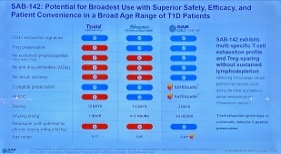
- Currently, SAB-142 is evaluated in a registrational phase 2b SAFEGUARD study (n=159) for pediatric, adolescent, and adult patients (ages 5-40 years) with new onset stage 3 T1D (diagnosed within 100 days, baseline C-peptide ≥200 pmol/L). The primary endpoint will be C-peptide level, and secondary endpoints include A1c, CGM metrics, insulin use, and safety. The trial is currently enrolling participants at multiple centers worldwide, including the US, EU, UK, Australia, and New Zealand – with the first participant dosed in December 2025. Looking forward, SAB Bio aims to complete enrollment of the SAFEGUARD study by the end of 2026 and deliver topline data in 2H27. Currently, the company has cash and cash equivalents of $144 million as of December 31, 2025, with projected runway through 2028. SAB Bio will also evaluate the efficacy of SAB-142 in: (i) stage 3 T1D maintenance; (ii) delaying the onset of stage 3 T1D in people with stage 2 T1D; and (iii) maintenance for those who underwent islet cell transplantation. Beyond T1D, SAB Bio plans to test the drug for other autoimmune diseases, like celiac disease, scleroderma, polymyositis, and dermatomyositis.
5. Esperion: Updated US lipid-lowering guidelines to include bempedoic acid offering; international expansions; combination therapy
Esperion CEO Mr. Sheldon Koenig presented the company’s approach to expansion, profitability, and its bempedoic acid portfolio. He began by saying that Esperion is in a strong financial position, with a strong balance sheet, durable cash flows, and an attractive profit and loss profile. He said that the company will reach sustainable profitability in 2026. Esperion’s current offerings are nexletol (bempedoic acid) and nexlizet (bempedoic acid/ezetimibe). Bempedoic acid is an ATP citrate lyase inhibitor that reduces low-density lipoprotein (LDL) cholesterol levels. It was first approved in the US in February 2020 and offers therapeutic opportunity for patients unwilling or unable to take statins, as well as for use in combination therapy. Mr. Koenig discussed Esperion’s impressive international reach, pipeline, and scientific approach.
- Esperion plans to strengthen and expand the bempedoic acid franchise beyond nexletol and nexlizet. Mr. Koenig identified six major catalysts that will drive growth for Esperion in 2026 and beyond. Most prominently, bempedoic acid is expected to be included in updated US lipid-lowering guidelines by the end of February. This will follow guidelines released by the European Society of Cardiology (ESC) in September 2025, which recommend bempedoic acid in patients who are unable to take statin therapy to achieve their LDL-C goals. Market exclusivity is also expected in 2026, as well as further commercial investment, an oral triple combination therapy, international expansion, and improved gross margins.
- On the updated US lipid-lowering guidelines, Mr. Koenig drew parallels to the treatment of hypertension and of T2D, where combination therapy is now the standard of care after years of having one leading therapy. He said that the management of high cholesterol will now move towards combination therapy including bempedoic acid based on key outcome study data. In a March 2023 study published in NEJM (n= 13,970), bempedoic acid reduced the incidence of myocardial infarction by approximately 14% and incidence of coronary revascularization by 19%.
- Preclinical development continues for Esperion’s triple combination therapies, which include bempedoic acid, ezetimibe, and statin therapy (atorvastatin or rosuvastatin). The company first announced the oral triple combination in 4Q24, positioning it as a next-generation option for LDL-c lowering.
- Mr. Koenig highlighted Esperion’s partner-led international expansion, asking the audience to think of the company as a global franchise. Esperion’s bempedoic acid franchise is currently approved in 41 countries. In Europe, Asia, and South America, Daiichi Sankyo is leading the expansion efforts, with over 600,000 patients treated to date. In Japan, Esperion launched in December 2025 in partnership with Otsuka. The company plans to work with Neopharm Israel to expand to the nation in 1H26, and with CSL Seqirus to seek approvals in Australia and New Zealand, which are expected in 4Q26. In Canada, Esperion has partnered with HLS therapeutics and expects approval in 2026.
- Mr. Koenig also said that the company is also seeking portfolio growth through partnerships, with key areas of focus in cardiometabolic health, kidney disease, diabetes, and rare and orphan diseases. He said that Esperion will not seek any very large acquisitions and will instead pursue strategic acquisitions that are immediately accretive. Mr. Koenig also spoke of “activating” consumers in 2025 with plans to continue this in 2026 – Esperion has launched publicity buttons reading, “Can’t take a Statin? Make NEXLIZET Happen!” as well as non-skippable ads on streaming platforms. Mr. Koenig said that most consumers have not attempted to skip the ads, which he framed as a positive sign for therapeutic awareness.
6. Biocon: Addressing global non-communicable diseases like diabetes; generics and biosimilar business restructuring
Biocon Group CEO Mr. Shreehas Tambe presented the company’s approach to non-communicable diseases and diabetes in particular. Mr. Tambe said that the Biocon Group is a global biopharmaceutical company consisting four arms. Biocon Biologics, which develops biosimilars, represents 62% of revenue and has the goal of expanding access to affordable, lifesaving biotherapeutics. Biocon, the company’s generics business, forms 17% of total revenue. Syngene, the group’s research arm, represents 21% of revenue with a market cap of $2.9 billion. Finally, Bicara develops novel biologics and is NASDAQ-listed with a market cap of $1.1 billion.
Mr. Tambe emphasized Biocon Group’s history of improving access to life-saving therapeutics. In 2004, the company launched India’s first recombined human insulin, and in 2021 commercialized the first interchangeable insulin glargine in the US. In 2024, the company expanded to the ocular complication arena, receiving the first US FDA approval for biosimilar aflibercept for the treatment of eye diseases such as AMD and DME. In 2025, the company received approval and commercialized the first interchangeable insulin aspart in the US and has also offered a number of essential oncology therapies.
- Biocon Group plans to help address a shift in global disease burden from communicable to non-communicable diseases. Mr. Tambe said that Biocon has seen a significant change in global need since the 1990s. Non-communicable disease such as cancer, diabetes, musculoskeletal, and autoimmune diseases now form a very significant portion of global disease burden that Biocon plans to address. He pointed to a number of the company’s current biosimilars and generics, such as the approved therapies glargine U100, liraglutide, aspart, dapagliflozin, and recombinant human insulin for diabetes and obesity as an example of Biocon’s work on this front. In company’s pipeline for diabetes care, Mr. Tambe identified semaglutide, tirzepatide, and glargine U100. When combined with the company’s offerings in oncology and immunology, these therapies will address over 60% of global disease burden, he said. The company hopes to serve one-in-five of all people taking insulin specifically.
- Biocon Group will combine its generics and biosimilar businesses into one entity. Current companies Biocon and Biocon Biologics will become one under “Biocon,” biosimilars, insulins, peptides, and complex generics. Mr. Tambe said that this will help the businesses maximize research & development, manufacturing, and commercialization. The move will also allow Biocon to cross-leverage aspects of its portfolio and commercial infrastructure.
- Mr. Tambe said that Biocon hopes to build upon its strong launch momentum going into 2026. In the US, wave one of the first interchangeable insulin aspart, Kirsty, launched in September 2025, and the therapy has already launched in the rest of the world. In the GLP-1 RA arena, Ladiazyl and Lobezyl (generic liraglutide) have launched in the UK and select EU markets and have been filed in the US. Generic semaglutide has been filed in Canada, Brazil, the US, and in other select markets. With these anticipated approvals and its business restructuring, Biocon Group hopes to begin to address the rise in non-communicable diseases.
Diabetes Big Picture
7. Technology and strategy to capture Asia’s growing patient markets
Mr. Edward Booty (reach52), Ms. Janet Dorling (Gilead Sciences), Mr. Siddhartha Goyal (Nivi), Ms. Nafisa Jiwani (US International Development Finance Corporation [DFC]), and Ms. Natasha Sunderji (Accenture) discussed strategies to expand US pharmaceutical outreach to the growing Asian patient markets. The panel emphasized several commonalities in developing Asian markets, such as the need for pooled procurement, the importance of digital technology in outreach, and the role of the US government in supporting investments in these developing markets.
- The panel identified pooled procurement as a strategy to make treatment more accessible to developing markets, referencing the increased cost of adapting to national regulations and importing medication from the US or Europe. Ms. Jiwani discussed the strategy’s past success, especially in sub-Saharan Africa during the COVID-19 pandemic, and how the US government is now seeing a similar opportunity in Asia. Mr. Booty said combining multiple smaller markets into one large market through companies like reach52 allows for more affordable bulk pricing for pharmaceuticals and makes individual medications more affordable. Moreover, by navigating different import routes, developing markets – which are typically given a premium – can access cheaper European or American market prices.
- The panel also discussed the importance of digital technologies in international outreach. Mr. Goyal emphasized the value of the direct-to-consumer model in a market without comprehensive insurance systems. He said the best outreach strategy involves engaging consumers through pre-existing messaging platforms like WhatsApp.
- On the role of the US government in investing in Asian markets, panelists identified three main areas for US DFC’s investments: (i) health services and infrastructure; (ii) manufacturing and supply chain; and (iii) health and technology. Ms. Jiwani noted that the government only funds businesses with clear plans, rather than ideas. Therefore, any company seeking US DFC’s investments for its work in Asia must establish a clear plan for profit to be considered favorably.
8. The growing strength of Chinese biotechnology: Gaining trust and partnership
Dr. Ting Xu (Alphamab Oncology), Dr. Jing Song Wang (Harbour Biotech), Dr. Andrea Wang-Gillam (Jacobio Pharmaceuticals), Mr. Tony Liu (Abelzeta Pharmaceuticals), and Ms. Jane Wu (JP Morgan China) discussed emerging biotechnological development in China. The panel discussed the increasing trust and partnership of Chinese and Western biotechnology, the qualifications of researchers and workers of Chinese biotechnology companies, and the future medical focuses of the Chinese companies represented on the panel.
- Speakers discussed the growing trust and partnership between China and the west around biotechnology. Dr. Wang-Gillam noted that while previously the authenticity and quality of clinical research and data coming from China may have been questioned, there is now very little question of its validity. She commented that the speed and quality of Chinese research is being upheld by the supportive ecosystem of the Chinese FDA-equivalent and its drug-development infrastructure, not by concerns of improper procedures.
- The panel also discussed the numerous biotechnology and pharmaceutical deals and agreements made between Western and Chinese companies. Dr. Wang cited a recent multi-year deal between Harbour and AstraZeneca involving both economic and scientific collaboration. Mr. Liu similarly brought up deals made by Abelzeta with J&J and AstraZeneca as proof of expanding trust in Chinese research and development.
- The panel then fielded a question of where their workers and researchers studied. Multiple panelists, including Dr. Wang and Mr. Liu, revealed a growing trend of locally trained employees, with most chemists training in China, though much international experience is also present in upper management. Dr. Wang-Gillam claimed that the talent of Jacobio, which is US-based, originates from “all over the world,” but that it was fairly US-centric.
- The panel also discussed the future medical initiatives of their represented companies. Dr. Xu mentioned that Alphamab would continue focusing on safer Antibody-Drug Conjugates. Describing it as an “improved version of chemotherapy,” he pledged that they would consider quality of life during treatment development. Dr. Wang-Gillam stated that while her primary interest is oncology, the industry’s interest is also expanding quickly in chronic and metabolic diseases, along with pertinent government investments.
-- by Paul Moon, Jeremy Alkire, Nour Khachemoune, Kat Moon, Monica Oxenreiter, and Kelly Close