4Q25 and 2025 Industry Roundup – Diabetes market reaches $115B in 2025 as CGM and AID continue double-digit growth with new product launches and coverage expansions; GLP-1 RAs demonstrate continued strength and increasing options –
Executive Highlights
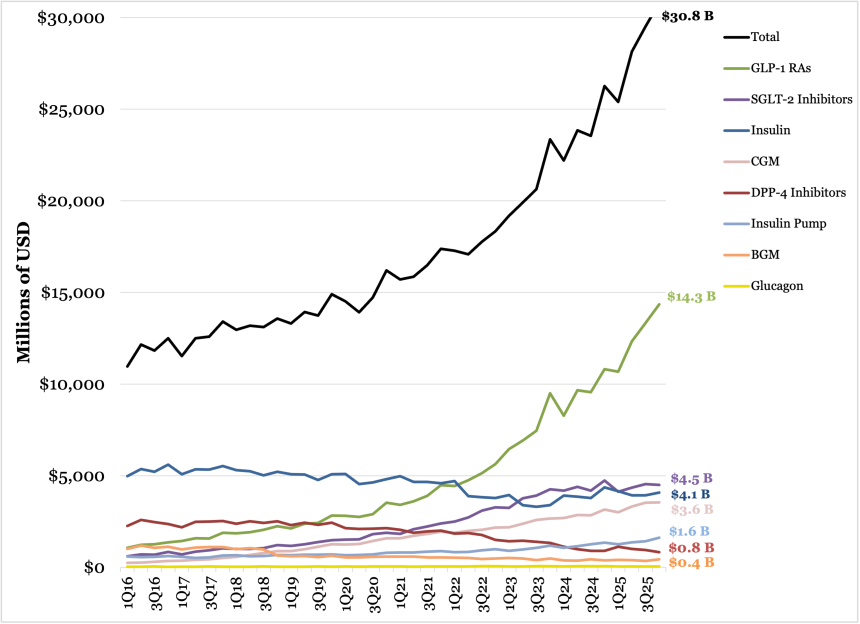
- 4Q25 and 2025 overall diabetes revenue totaled $31 billion and $115 billion, respectively. 4Q25 revenue rose 17% from 4Q24 and 4% sequentially, while 2025 revenue grew by 20% from 2024.
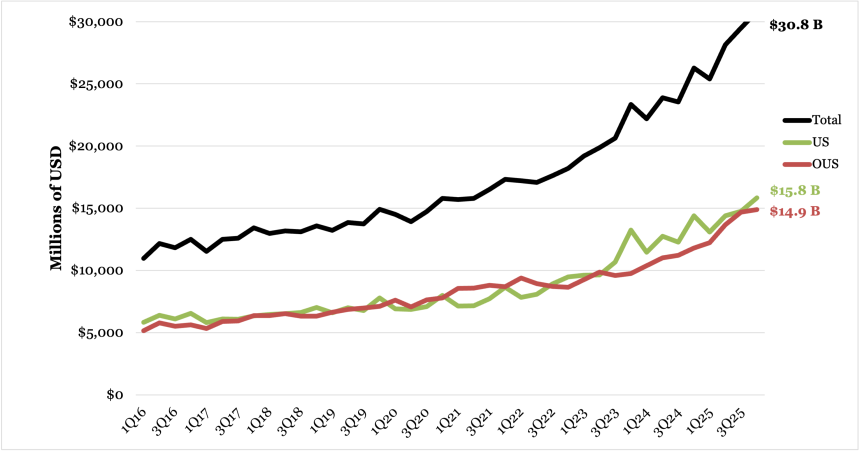
- In the US, we saw $16 billion in 4Q25 sales, up 10% from 3Q25 and 7% sequentially. OUS, revenue was $15 billion, up 26% and 2% sequentially.
- For 2025, US revenue led with $57 billion, up 12%, compared to OUS revenue of $54 billion, up 20%.
- Unsurprisingly, in 2025, GLP-1 RAs comprised 70% of the total diabetes market, followed by CGMs (11%) and insulin pumps (4.8%).
- Diabetes therapy revenue totaled $88 billion in 2025, up 14% from 2024. 4Q25 revenue totaled $24 billion, up 14% from 4Q24, largely driven by international growth (+25%), and up 4% from 3Q25. GLP-1 RA sales again led growth, which totaled $51 billion in 2025, up 32% from 2024, and $14 billion in 4Q25, up 33% from 4Q24 and 8% sequentially. SGLT-2 inhibitors were the next best-selling class, totaling $18 billion in 2025 (+1% from 2024) and $4 billion in 4Q25 (-5% from 4Q24; -1% sequentially). Insulin rounded out the top three, totaling $16 billion in 2025 (flat from 2024) and $4 billion in 4Q25 (-7% from 4Q24; +4% sequentially). DPP-4 came in just behind insulin, totaling $4 billion in 2025 (+2% from 2024) and $834 million for 4Q25, down 7% from 4Q24 and down 12% sequentially.
- Diabetes GLP-1/Multi-Incretin Agonists ($14.3 billion, +33%): The revenue totaled $14.3 billion, up 33% from 4Q24 and up 8% sequentially. Since 2006, GLP-1 RAs have generated a cumulative revenue of more than $213 billion, including $151 billion in US sales and $62 billion in OUS sales. By geography, 4Q25 sales totaled $8.7 billion in the US, up 12% from 4Q24 and up 10% sequentially, and $5.6 billion OUS, up 86% from 4Q24 and up 4% sequentially. In 2025, GLP-1 RA sales totaled over $50 billion, up nearly 32% or $13 billion from the previous year. For the third quarter in a row, Lilly’s Mounjaro (tirzepatide for diabetes) led the market, capturing 52% of total 4Q25 sales (up from 33% in 4Q24). Novo Nordisk followed with 34% market share (down from 45% in 4Q24). Despite the class’s extraordinary scale, real‑world penetration remains far from saturated, indicating more opportunities for market growth in the US and OUS.
- SGLT-2 inhibitors ($4.5 billion, -5%): Sales for the second-leading therapy class totaled nearly $4.5 billion, down 5% from 4Q24 and down 1% sequentially. By geography, US sales totaled $1.9 billion, up 2% from 4Q24, and OUS sales totaled $2.6 billion, down 9% from 4Q24. OUS sales represented roughly 57% of the total market. In 2025, SGLT-2 inhibitor sales totaled $17.5 billion, up 1% from 2024. In 4Q25, Jardiance led the market with 51% market share, with Farxiga at 46% and Steglatro at 3%.
- Insulin ($4.1 billion, -7%): Global sales totaled $4.1 billion in 4Q25, trailing just behind SLGT-2 inhibitor revenue and down 7% from 4Q24 and up 4% sequentially. By geography, US revenue totaled $1.6 billion, down 20% from 4Q24 and up 1% sequentially, and OUS revenue totaled $2.5 billion, up 3% from 4Q24 and 5% sequentially. In 2025, insulin sales totaled $16 billion, flat from 2024. The flat trajectory likely reflects greater pricing and competitive pressures for insulin therapies. Since 2006, insulin has generated $344 billion in cumulative revenue.
- Basal insulin sales totaled nearly $1.9 billion (+3%, +3% Q/Q). US sales totaled $607 million (-14%, +2% Q/Q), and OUS sales totaled $1.3 billion (+13%, +3% Q/Q). In 2025, revenue totaled $7.4 billion, up 5% from 2024.
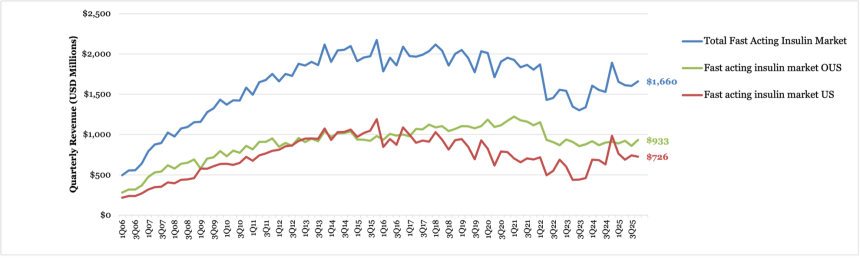
- Rapid-acting insulin sales totaled $1.7 billion (-11%, +5% Q/Q). US sales totaled $749 million (-24%, +1% Q/Q) and OUS sales totaled $933 million (+3%, +9% Q/Q). In 2025, rapid-acting insulin sales totaled $6.6 billion, down 1% from 2024.
- Human insulin sales totaled $386 million (-29%, flat Q/Q). US sales totaled $179 million (-27%, -9% Q/Q) and OUS sales totaled $207 million (-30%, +9% Q/Q). In 2025, human insulin sales totaled $1.5 billion, down 20% from 2024.
- Basal insulin/GLP-1 fixed ratio combinations contributed $141 million to the insulin market (+16%, +14% Q/Q). In the US, basal/GLP-1 RA sales totaled $29 million (+82%, +89% Q/Q), and OUS sales totaled $112 million (+6%, +3% sequentially). In 2025, the sales totaled $515 million, up 15% from 2024.
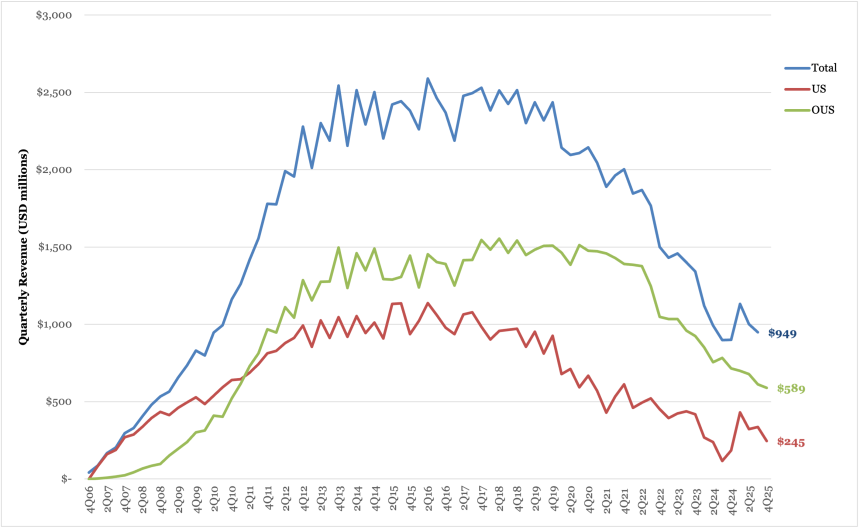
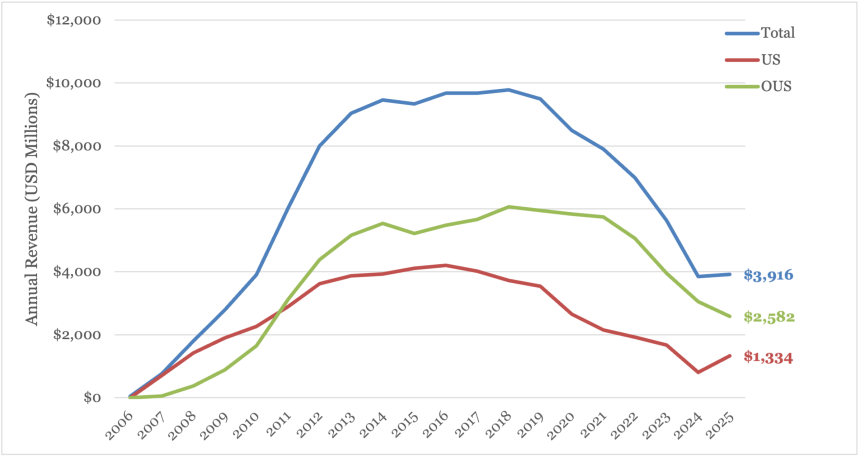
- DPP-4 Inhibitors ($834 million, -7%): Sales for the therapeutic class totaled $834 million for the quarter, down 7% from 4Q24 and down 12% sequentially. US revenue was $245 million (+33%, -27% sequentially) and OUS revenue totaled $589 million (-18%, -4% sequentially). In 2025, DPP-4 inhibitor sales totaled $3.9 billion, up 3% from 2024. Sales for Merck’s Januvia franchise totaled $2.5 billion (+12%), while Lilly and BI’s Tradjenta totaled $884 million (-10%) and Novartis’s Galvus had sales totaling $487 million (-19%).
- The global obesity market totaled $7.8 billion, up 56% from 4Q24 and up 13% sequentially. In 2025, obesity medication sales totaled $26 billion, up a remarkable 82% from 2024. US sales totaled $6.4 billion in 4Q25, up 52% from 4Q24 and up 15% sequentially, and $22 billion (+95%) in 2025. OUS sales totaled $1.4 billion, up 82% from 4Q24 and up 3% sequentially, and totaled $4.8 billion (+94%) in 2025. Since 2006, the obesity market has generated $57 billion in cumulative revenue – 2025 sales represented nearly half of all-time sales. Lilly’s Zepbound (tirzepatide for obesity) outperformed Novo Nordisk’s Wegovy (semaglutide for obesity) by both revenue and prescription numbers.
- Diabetes technology revenue totaled $5.6 billion in 4Q25, up a robust 15% from 4Q24 and up 5% sequentially, also a very strong result. Full-year 2025 diabetes technology revenue exceeded $20 billion for the first time ever, up 15% over the previous year. Growth was broad across CGM and AID, in the US and internationally.
Diabetes Technology Revenue (1Q06 – 4Q25)[1]
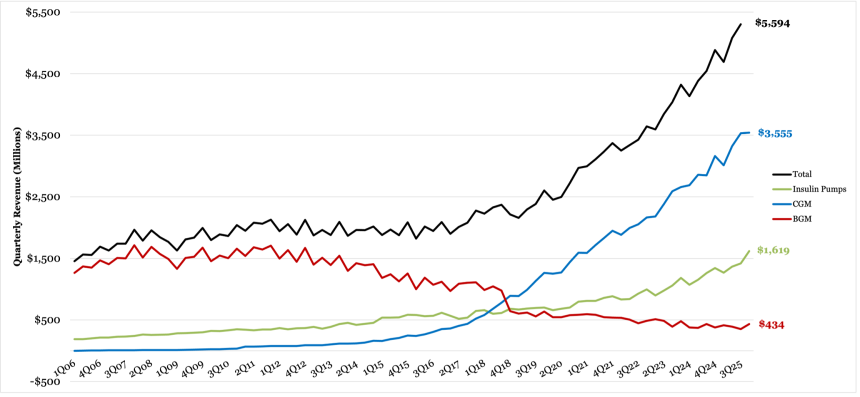
- CGM revenue in 4Q25 matched a record 3Q25, growing 12% and ~$400 million from 4Q24. Full-year 2025 revenue totaled a record $13.4 billion, up 16% (nearly $2 billion). Strong growth across the US and outside the US and across multiple companies was attributed to new global product launches and expansions outside the US. By geography, quarterly US and OUS sales both came in at approximately $1.8 billion each, with comparable growth rates as well. US sales rose 12% from 4Q24 and 2% sequentially, similar to international growth at 13% from 4Q24, though outside the US, revenue fell 1% sequentially.
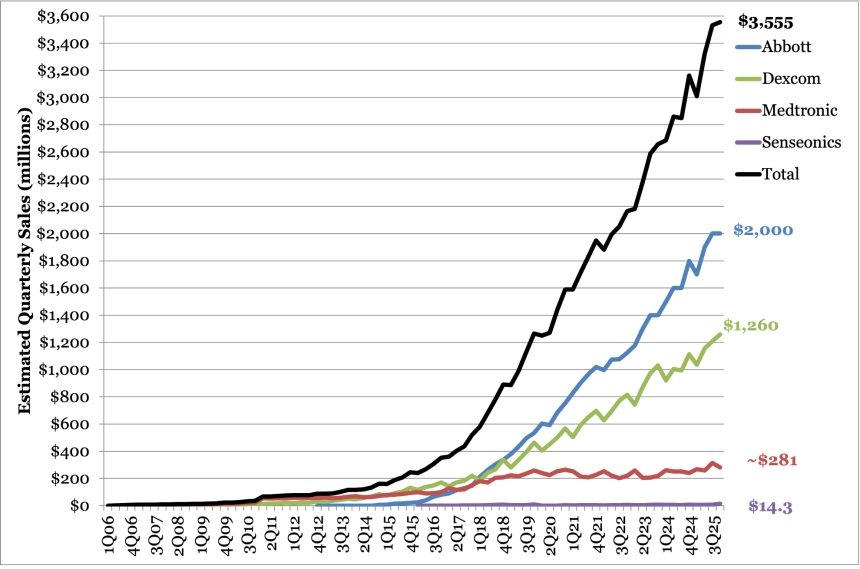
- Global CGM users approached 12 million users by the end of 2025 by our estimates, up 14% from 2024. As it has since mid-2023, Abbott led a majority (51%, up $200 million) of revenue growth. This was followed by Dexcom (37% of growth, up $145 million), MiniMed (11%, up ~$40 million), and Senseonics (1%, up $6 million).
- Insulin pumps/AID revenue hit $1.6 billion in 4Q25, up nearly $280 million and 21%, driven by accelerating T2D uptake, expanding pharmacy access, and momentum in multiple geographies outside the US. US pump revenue totaled nearly $1 billion, up 20% ($160 million) from 4Q24 and 18% sequentially, while OUS pump revenue totaled $653 million, up 21% (~$115 million) from 4Q24 and up 9% sequentially.
- Insulet led most of the quarter’s growth (64%, up ~$200 million), followed by Medtronic (20%, up ~$60 million), Tandem (12%, up ~$40 million), and Beta Bionics (4%, up $12 million).
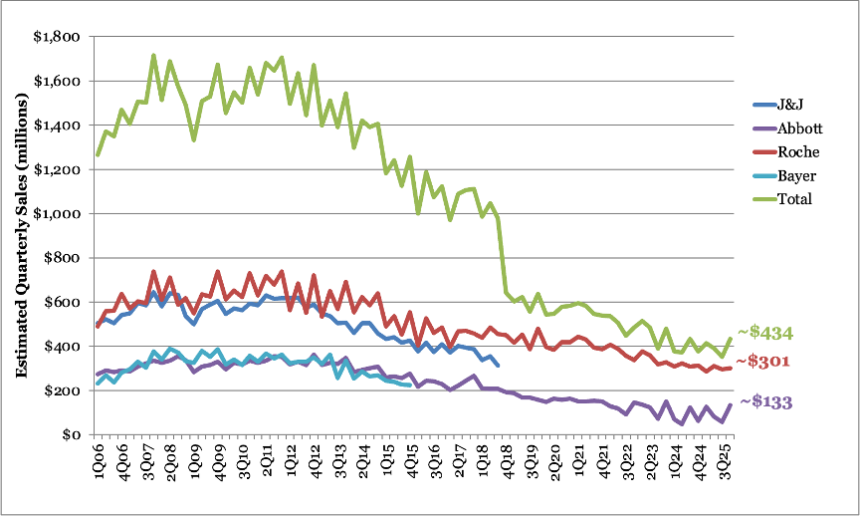
- BGM revenue, $434 million, up 15% quarterly and 23% sequentially, countering the historical downward trend and reflecting continued demand across global markets. For Abbott and Roche, the two BGM companies that we follow that are public, we estimate 4Q25 US sales of about $100 million, up nearly 30% annually and up approximately 15% sequentially, while we estimate OUS sales totaled approximately $335 million, up 12% from 4Q24 and 18% sequentially.
Table of Contents
Overall Diabetes Market
Graph 1: Aggregate Market Sales by Category (1Q06 – 4Q25)
Graph 2: Aggregate Market Sales by Geography (1Q16 – 4Q25)
Diabetes Technology
Continuous Glucose Monitoring
Strong CGM growth continued in 2025, driven by new product launches globally and international coverage expansions.
- In 4Q25, CGM revenue totaled $3.6 billion, up 12% from 4Q24 and flat sequentially, matching 3Q25’s record quarter. Ongoing annual growth partly reflected increasing CGM adoption among people with T2D. As CGM coverage expands, we’re curious to see how revenue and user growth evolve in the coming year, particularly with the availability of two over-the-counter (OTC) CGMs, Stelo and Lingo, in the US, not on insulin. While commentary has been limited on the extent of Lingo uptake, Dexcom closed 2025 with $130 million in full-year Stelo revenue and more than 500,000 users of the device. As the company reports it holds a “strong majority share” of the OTC CGM market, this amounts to fewer than one million people using this technology over the counter, leaving plenty of runway for future growth.
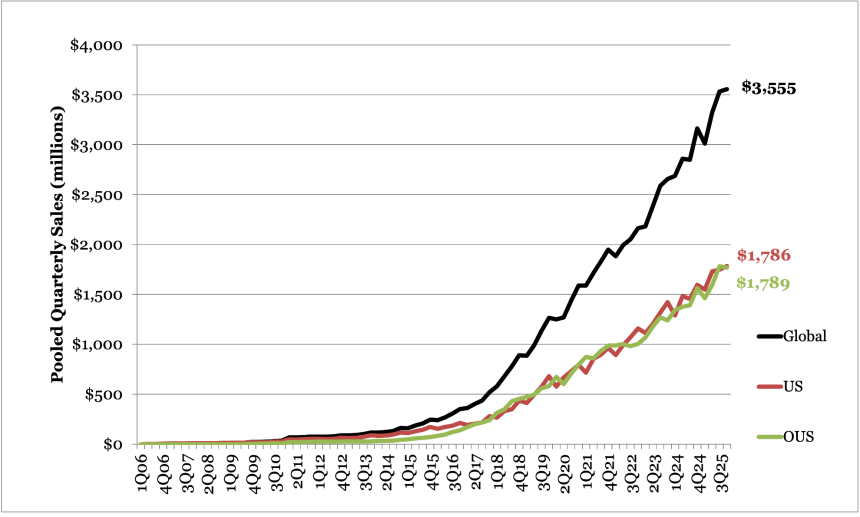
- By geography, US and OUS sales again came at approximately the same level, each totaling $1.8 billion in 4Q25. US sales increased 12% from 4Q24 and 2% sequentially, and international sales grew at a similar rate year over year – up 13% from 4Q24 – though fell 1% sequentially. We are always very interested in what percentage of users are international, given that the revenue split remains roughly even, implying that international users represent a meaningfully larger group (as average prices are higher in the US, this implies there are more users outside the US). While US and international CGM revenue have been approximately equivalent for the last three years, we remain interested in how OTC systems will affect long-term revenue dynamics, considering that about 100 million Americans with prediabetes now have ready access to CGM. Abbott and Dexcom are expanding distribution models to provide more convenient access to these devices, including Amazon availability for both Lingo and Stelo and several brick-and-mortar chains from which people can buy Lingo in the US, including Walmart and Walgreens.
- Full-year CGM revenue totaled a record $13.4 billion, up 16% from 2024. US sales totaled $6.8 billion, up 17% from 2024, effectively similar with international sales of $6.6 billion and 16% growth from 2024. While 2024 saw international growth slightly outpace US growth for the first time in several years, 2025 saw a return to growth patterns that have been more common since 2015, as Dexcom largely resolved its supply chain problems reported in 2H24. From our model that dates to the early 2000s, the total to-date CGM market revenue reached nearly ~$80 billion at the end of 2025.
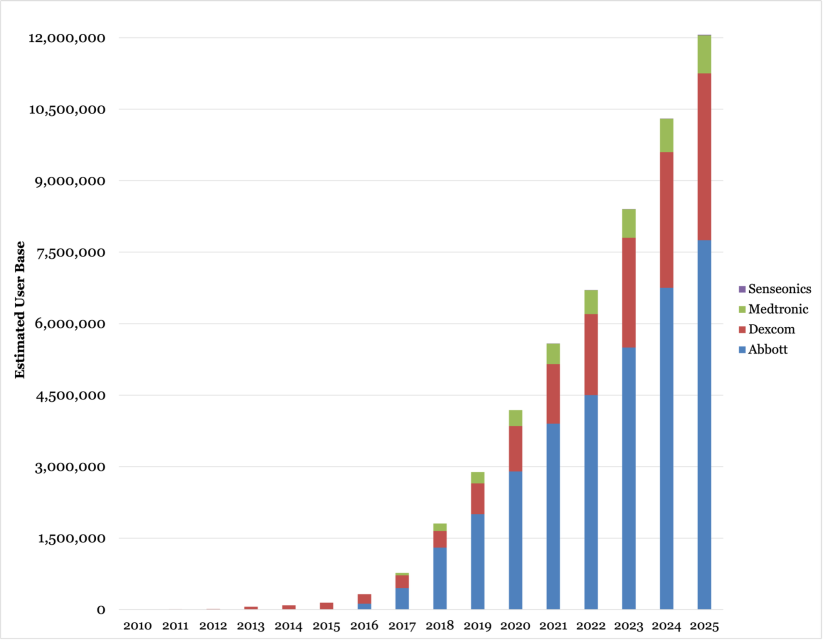
- CGM users and revenue now appear to be growing at similar rates. At the end of 2025, we estimate the global CGM user base is approaching 12 million users, with an estimated nearly 7.75 million using FreeStyle Libre, and ~800,000 using MiniMed CGM. In 4Q25, Dexcom said that over 3.5 million are now using Dexcom CGM, and Senseonics noted its userbase had more than doubled from 2024, indicating more than 12,000 using Senseonics CGM. This puts the global user base up by nearly 1.5 million people from the end of 2024, representing 14% growth in users.
- Global market share continues to mirror historic trends.
- Abbott leads with FreeStyle Libre revenue of $2 billion (+11%), constituting 56% of market share by revenue – Abbott’s market share by revenue has exceeded 50% for five years and remained relatively consistent in the mid- to high- 50 percent. US and international revenue both grew at double-digit rates: 11% and 12%, respectively.
- Dexcom recorded $1.3 billion in revenue (+13%) – the company has now notched seven quarters with revenue over $1.0 billion as it has expanded internationally and achieved greater US reimbursement. Dexcom’s market share by revenue remained stable at 35%. International revenue growth (18%) was significantly higher than US revenue growth (11%).
- We estimated Medtronic’s 4Q25 CGM revenue totaled ~$281 million (+13%), representing its usual ~8% of the market. We estimated OUS revenue growth outpacing US growth of 20% and 12%, respectively, as the former saw the launch of the Simplera CGM product line several quarters before the US.
- Senseonics recorded $14.3 million in 4Q25 revenue, up 72% from 4Q24 and 77% sequentially – reflecting the early success of the US launch of Eversense 365 and demand for its integration with Sequel twiist. US revenue nearly doubled from 4Q24 (+95%) and sequentially (+89%). International revenue grew much slower, 5% from 4Q24 and 29% sequentially, as Eversense 365 will begin to roll out in Europe in mid-2026.
Quarterly reports: Abbott 4Q25, Dexcom 4Q25, Medtronic 4Q25, Senseonics 4Q25
CGM Sales by Geography (1Q06 – 4Q25)
CGM Sales by Company (1Q06 – 4Q25)
Estimated CGM User Base (2010 – 2025)
Revenue Roundup Table: CGM Market (4Q25)
| Company | Revenue (millions) | YOY Change | Sequential Change |
| Abbott | $2,000 | +11% | flat |
| Dexcom | $1,259 | +13% | +4% |
| Medtronic (est.) | $281 | +17% | -10% |
| Senseonics | $14 | +72% | +77% |
| Total | $3,555 | +12% | +1% |
Estimated CGM Market Share by User Base and Revenue (4Q25)
| Company | Userbase | Market Share (by userbase) | Revenue (millions) | Market Share (by revenue) |
| Abbott | ~7,750,000 | 65% | $2,000 | 56% |
| Dexcom | 3,500,000 | 29% | $1,259 | 36% |
| Medtronic (est.) | ~800,000 | 7% | $281 | 8% |
| Senseonics | ~12,000 | <1% | $14 | <1% |
| Total | ~12,000,000 | -- | $3,555 | -- |
Revenue Roundup Table: CGM Market (2025)
| Company | Full-year Revenue (millions) | YOY Change | Market Share (by revenue) |
| Abbott | $7,600 | +17% | 57% |
| Dexcom | $4,662 | +16% | 35% |
| Medtronic (est.) | $1,123 | +12% | 8% |
| Senseonics | $35 | +57% | <1% |
| Total | $13,420 | +16% | -- |
Insulin pumps and AID
Insulin pump revenue in 4Q25 totaled $1.6 billion, up 21% from 4Q24 and 14% sequentially, continuing a trend of strong pump growth observed in recent years. By geography, US pump revenue totaled $966 million, up 20% from 4Q24 and 18% sequentially, while OUS pump revenue totaled $653 million, up 21% from 4Q24 and up 9% sequentially. US sales drove most (59%) of the growth, consistent with last quarter and 4Q24.
- In 4Q25, Insulet led worldwide pump growth (64%), followed by Medtronic (20%), Tandem (12%), and Beta Bionics (4%). Insulet has been the dominant growth driver since Omnipod 5’s US launch in 2Q22, and it drove further growth through its international launches of Omnipod 5 and accelerating T2D adoption in the US. Full-year 2025 revenue totaled a record $5.7 billion, up an impressive 17% from 2024. Growth was balanced across US (+17%) and OUS (+18%) geographies.
- Insulet maintained its market share by revenue (48%) lead for the 13th consecutive quarter. Growth reflected sustained global demand for Omnipod 5, with over 85% of new customer starts coming from MDI and over 40% from T2D in 4Q25. This is up significantly from roughly 25% at the time of FDA clearance. International revenue growth was particularly strong in the quarter (+51% from 4Q24, +6% sequentially), supported by strong uptake in established European markets and recent launches in Canada and Australia. Omnipod 5 now available in 19 countries. US revenue growth was also strong, at 28% from 4Q24 and 14% sequentially.
- Medtronic held an estimated 32% market share, relatively consistent with 4Q24 and 3Q25. Growth was primarily driven by international markets where MiniMed 780 adoption has been supported by strong Simplera Sync rollout. In the US, momentum was supported by strong early adoption of both Simplera Sync and the Abbott-partnered Instinct.
- Tandem took 18% of the market, consistent with previous quarters and supported by steady US revenue growth and continued momentum with Control-IQ+. Renewals and new users transitioning from MDI, which represented roughly two-thirds of new customers, contributed to growth this quarter. In 4Q25, Tandem also initiated the full launch of Control-IQ+ for people with T2D in the US, contributing to sequential shipment growth and setting the company up well for growth in 2026.
- Beta Bionics held 2% market share, consistent with 4Q24 and 3Q25. The company reported nearly 5,600 new iLet starts, with 69% of new users transitioning from MDI. The company’s installed userbase surpassed 35,000 users by the end of 2025, more than doubling from 2024. Adoption through the pharmacy channel continues to increase, with roughly one-third of new starts reimbursed through pharmacy in 4Q25.
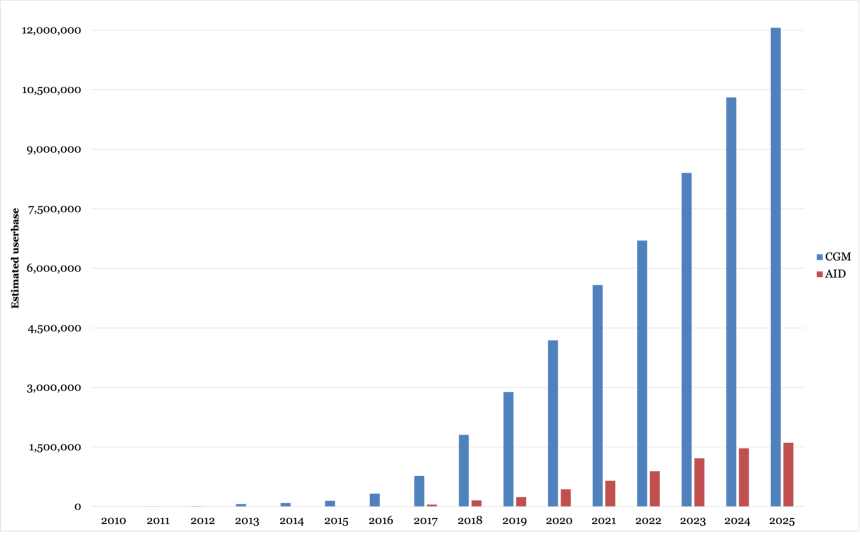
- Supported by strong global and company-specific growth, we estimate the global AID userbase now totals over 1.5 million. Medtronic last reported that it serves more than 640,000 global pump users (as of October 2025) and Beta Bionics reported in 4Q25 that it has more than 35,000 iLet users. Furthermore, we estimate that Insulet has reached mid-400,000 Omnipod 5 users and Tandem mid-300,000 Control-IQ users.
- Consequently, we estimate the ratio of AID to CGM users – which we call the “Aaron Ratio” after Breakthrough T1D CEO Dr. Aaron Kowalski for his efforts to make AID a reality – to be ~13% in 2025, consistent with 2024 and 2023. The ADA Standards of Care encourage HCPs to consider AID at diagnosis for appropriate individuals, including significantly strengthened recommendations for use in adults with T2D and the removal of several qualifying factors, which we believe is driving much greater early adoption. As we watch CGM adoption accelerate as the technology reaches more people with T2D not on insulin therapy, we are happy to see insulin pumps and AID reach more who are on MDI and expand the category at a similar rate.
Estimated Aaron Ration (2010 – 2025)
- In pipeline updates, several companies continued to advance next-generation hardware, sensor operability, and algorithm automation.
- Beta Bionics continued advancing both its Mint patch pump and bihormonal iLet system. In 4Q25, the company completed its first in-human feasibility study for its glucagon system in New Zealand, reporting that no concerning safety signals have been identified. Another feasibility study is planned for 1H26 ahead of the launch of pivotal trials. The company’s commentary on its Mint patch pump was more limited, though it reiterated that the pump remains on track for a 2027 commercial launch.
- Insulet advanced several software updates, initiating a limited release of Omnipod 5 integration with FreeStyle Libre 3 Plus, with a broader launch planned in 1H26. Algorithm enhancements, including a 100 mg/dL glucose target and improved responsiveness, are also expected to roll out in 2026. The company completed enrollment for the STRIVE trial evaluating SmartAdjust 2.0, with results expected at ADA 2026, and continues work toward a fully closed-loop system through the EVOLUTION program.
- The FDA recently cleared MiniMed’s next-generation durable pump MiniMed Flex, which will be roughly half the size of the current pump and primarily smartphone-controlled. Its patch pump MiniMed Fit remains targeted for FDA submission in fall 2026. In automation, MiniMed initiated a US pivotal trial for its third-generation fully closed-loop algorithm, Vivera, which aims to eliminate carbohydrate counting, and shared data from its feasibility studies in adults and adolescents at ATTD 2026.
- Tandem continued advancing both sensor interoperability and new pump hardware. The company expects to launch three major updates in 2Q26, including (i) FreeStyle Libre 3 Plus integration with Mobi; (ii) Dexcom G7 15 Day integration; and (iii) international expansion of the Mobi pump. Tandem also reiterated plans to file a FDA 510(k) for Mobi Tubeless in 2Q26, with a targeted 2H26 launch, marking its entry into the patch pump category. Longer term, Tandem continues development of a fully closed-loop system in partnership with the University of Virginia, targeting an FDA filing in 2027.
Quarterly reports: Insulet 4Q25, Medtronic F3Q26, Tandem 4Q25, Beta Bionics 4Q25
Insulin Pump and Delivery Sales by Geography (1Q06 – 4Q25)
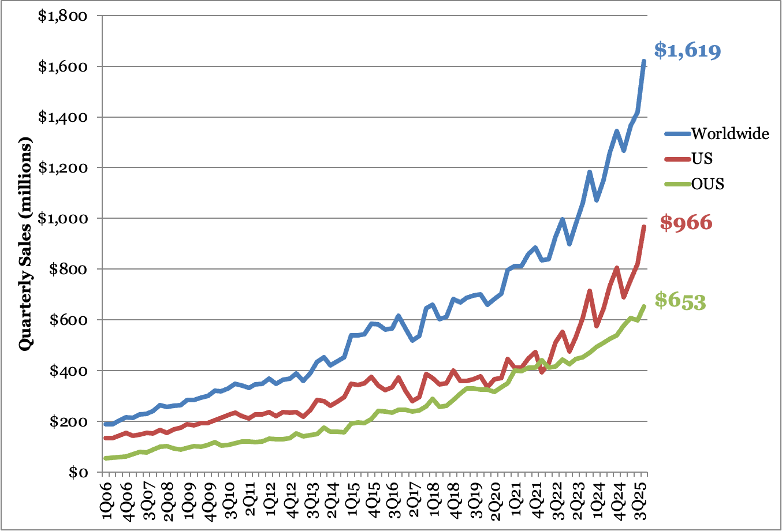
Insulin Pump and Delivery Sales by Company (1Q06 – 4Q25)
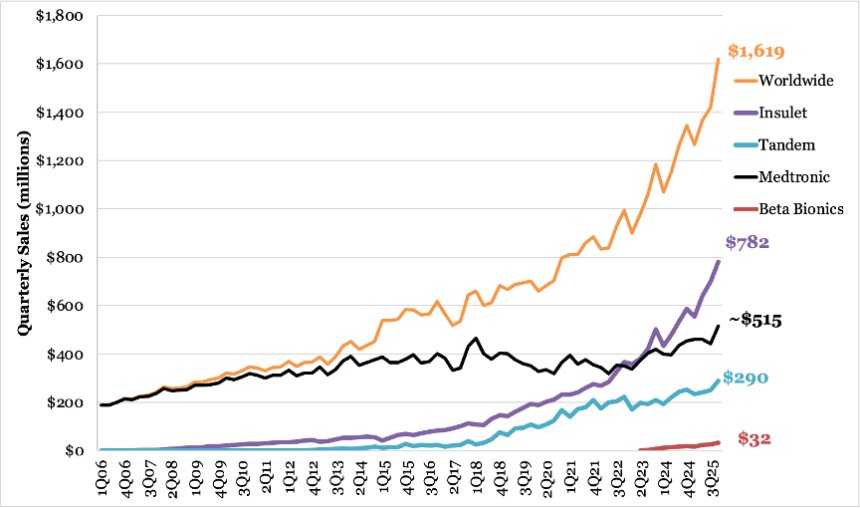
Revenue Roundup Table: Insulin Pump Market (4Q25)[1]
4Q25 | Revenue (millions) | YOY Change | Sequential Change | Market Share (by revenue) |
Insulet | $782 | +31% | +11% | 48% |
Medtronic (est.) | $515 | +13% | +17% | 32% |
Tandem | $290 | +15% | +17% | 18% |
Beta Bionics | $32 | +57% | +18% | 2% |
Total | $1,619 | +21% | +14% | -- |
Blood Glucose Monitors and “Other”
For the two remaining public companies in the BGM market, Abbott and Roche, we estimated that combined 4Q25 revenue totaled $434 million, up 15% from 4Q24 and 23% sequentially. We estimate that US sales totaled $101 million, up 26% from 4Q24 and 42% sequentially, while international sales totaled $333 million, up 12% from 4Q24 and 18% sequentially.
- For Abbott, we estimate BGM sales totaled $133 million in 4Q25. Roche no longer reports standalone Diabetes Care sales after merging this business into the Near Patient Care segment within its Diagnostics division in 2024. However, Roche reported that its BGM business declined 2% from 4Q24, enabling us to estimate ~$301 million in sales, down 3% sequentially.
- In recent quarters, BGM revenue has stabilized. Historical category decline was reflective of: (i) increasing CGM coverage and uptake among a broader population, such as T2D; and (ii) negative pricing trends. We presume this stabilization of BGM revenue reflects the continued demand for BGM amidst rising global diabetes rates, despite continual pressure from increasing CGM uptake among a broader population and negative pricing trends.
- As always, we note that it is difficult to gauge the full size of the market and its dynamics because: (i) Roche no longer reports Diabetes Care revenue; (ii) Abbott reports CGM and overall glucose monitoring revenue to just two digits, requiring estimation of its BGM revenue; and (iii) many major BGM companies are now private – e.g., LifeScan (formerly part of J&J), Ascensia (formerly part of Bayer), i-SENS (acquirer of AgaMatrix), etc. According to our model, to-date BGM market revenue among publicly reporting companies exceeds $100 billion since 2006, which, of course, understates true revenue in this ecosystem.
In 4Q25, the “Other” diabetes technology category totaled $263 million. This category includes embecta’s revenue of $261 million (-0.3%) and Insulet’s non-diabetes Omnipod revenue of $2 million (-83%). We no longer include revenue from NeuroMetrix following electroCore’s acquisition of most of NeuroMetrix’s assets in December 2024, including Quell (its neurostimulator indicated for the relief of fibromyalgia and lower-extremity chronic pain) but excluding DPNCheck (its diagnostic rapid point-of-care test for detecting peripheral neuropathy).
Quarterly reports: Abbott 4Q25, Roche 4Q25, embecta 4Q25, Insulet 4Q25
Total BGM Market (1Q06 – 4Q25)
Diabetes Therapy
Diabetes GLP-1 RAs
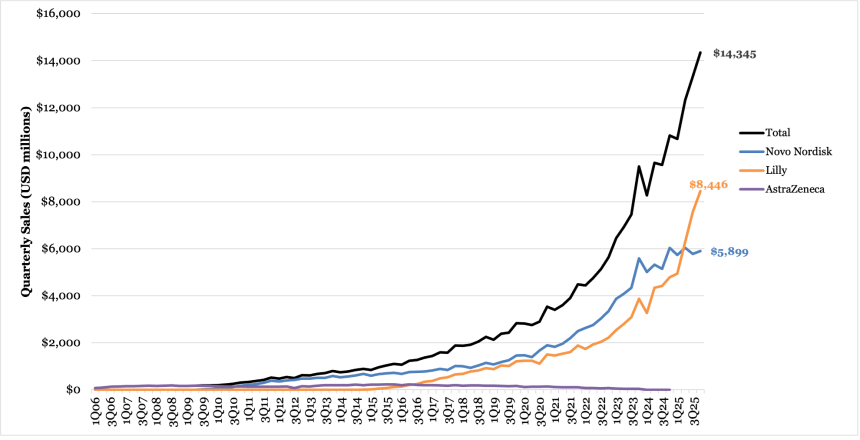
In 4Q25, the revenue for diabetes GLP-1 and multi-incretin agonists totaled $14.3 billion, up 33% from 4Q24 and up 8% sequentially. Since 2006, GLP-1 RAs have generated a cumulative revenue of more than $213 billion, including $151 billion in US sales and $62 billion in OUS sales. By geography, 4Q25 sales totaled $8.7 billion in the US, up 12% from 4Q24 and up 10% sequentially, and $5.6 billion OUS, up 86% from 4Q24 and up 4% sequentially.
For the third quarter in a row, Lilly’s Mounjaro (tirzepatide for diabetes) led the market, surpassing Novo Nordisk’s Ozempic (semaglutide for diabetes) and capturing 52% of total 4Q25 sales (up from 33% in 4Q24). Novo Nordisk followed with 34% market share (down from 45% in 4Q24).
In 2025, GLP-1 RA sales totaled over $50 billion, up nearly 32% or $13 billion from the previous year. US sales represented the majority of the GLP-1 RA revenue at nearly $32 billion, up 14%, while OUS sales totaled just under $19 billion, up 79%.
- Lilly’s Mounjaro, a dual GIP/GLP-1 RA, totaled $7.4 billion in 4Q25, up over 2x and up 14% sequentially. For the third quarter in a row, Mounjaro led the diabetes GLP-1 RA market – capturing 52% of global sales, as well as 55% of new-to-brand Rx (NBRx) by the end of 4Q25. In comparison, Mounjaro captured 45% of TRx and 54% of NBRx in 3Q25 and 37% and 44%, respectively, in 4Q24. In 4Q25, the company said that it completed the international launch of Mounjaro in 55 countries across all major markets. Mounjaro is currently reimbursed for T2D in nine countries, with China being the latest market to join.
- In clinical development, the phase 3 SURPASS CVOT trial (n=13,299), evaluating Mounjaro against Trulicity (dulaglutide) in people with T2D and established CVD, delivered its full readout at EASD 2025. Findings showed an eight-percentage point reduction in MACE risk for those taking Mounjaro compared with Trulicity.
- Trulicity sales continued in a downward trend in 4Q25, totaling $1 billion globally, down 17% from 4Q24 and down 1% sequentially. By geography, US sales totaled $693 million, down 13% from 4Q24 and down 2% sequentially. OUS sales totaled $344 million, down 24% from 4Q24 and flat sequentially. Previously in 4Q24, Lilly attributed the decline to competitive dynamics with newer medicines like Mounjaro. Moreover, in January 2026, Trulicity was announced as one of the 15 drugs included in the third cycle of negotiations from the Medicare Drug Price Negotiation Program (MDPNP). The therapy will be covered under Medicare Part D, with a negotiated list price of $389/month (representing a 61% decrease from its current list price) starting in 2028. As background, Medicare expenditures for Trulicity totaled $4.9 billion in 2024-2025.
- Novo Nordisk’s Ozempic totaled $5 billion, up 4% from 4Q24 and 4% sequentially. In the US, Ozempic’s weekly prescriptions totaled ~610,000 units in 4Q25, down from 670,000 in 3Q25. Since 2Q25, Mounjaro has exceeded semaglutide in both new-to-brand and total prescriptions. In August 2025, the company launched a cash option for Ozempic to improve uptake in the cash channel. At $499 per month for eligible self-paying patients, this price reflects a 50% reduction from the list price of ~$1,000/month and applies to all three Ozempic auto-injector doses (0.5 mg, 1 mg, and 2 mg). In addition, Ozempic and Rybelsus are set to cost ~$277 per month starting in 2027 under MDPNP, while MFN pricing sets the drugs at $245 per month starting in mid-2026.
- Rybelsus (oral GLP-1 RA) sales totaled $834 million in 4Q25, down 23% from 4Q24 and down 3% sequentially. US sales totaled $343 million, down 24% and up 10% sequentially, and OUS sales totaled $491 million, down 15%, and up 10% sequentially. In its 2025 annual report, the company noted that Rybelsus sales have been impacted by shifting priorities towards other GLP-1 RA treatments.
- Victoza (liraglutide) totaled $63 million, down 70% CER from 4Q24 and down 40% sequentially. Declines driven by increased uptake of once-weekly GLP-1 RA, as well as the multiple launches of generic liraglutide.
- In the pipeline, Lilly continued to make progress in the development of orforglipron (once-daily, oral, small molecule GLP-1 RA). In 4Q25, the company submitted orforglipron to the FDA for the management of obesity and received FDA approval in April 2026. Regulatory filing for the management of T2D in the US and EU is expected in 2026. Novo Nordisk submitted CagriSema (a once-weekly injection of fixed combination cagrilintide 2.4 mg and semaglutide 2.4 mg) for FDA approval in December 2025 based on the phase 3b REDEFINE 1 (n=3,417) and REDEFINE 2 trials (n=1,206). Amgen continues to advance its GLP-1 RA/GIP receptor antagonist MariTide in six global phase 3 studies, including in the recently initiated MARITIME-CV trial in adults living with established ASCVD and obesity or overweight. Other candidates in the pipeline include GLP-1/glucagon dual RA (such as Altimmune’s pemvidutide and BI/Zealand’s survodutide), GLP-1/GLP-2 RA (Zealand’s dapiglutide), GLP-1/amylin analog (Novo Nordisk’s oral amycretin), and subcutaneous and oral GLP-1/GIP RA (Viking’s VK2735). For a full breakdown of what’s to come, see our GLP-1/multi-incretin agonist competitive landscape here.
- AstraZeneca no longer reports revenue for Byetta as of 1Q22 or Bydureon as of 1Q24. Even so, AstraZeneca remains invested in treatments for obesity and/or T2D and is running several phase 2b trials for oral GLP-1 RA (AZD 5004), dual GLP-1/glucagon RA (AZD9550), and long-acting once-weekly amylin (AZD6234).
- Despite the class’s extraordinary sales growth, real‑world penetration remains far from saturated, indicating more opportunities for market growth in the US and OUS. While nearly half of adults diagnosed with obesity report using GLP-1 RAs, uptake is substantially lower in other high-risk groups – 29% among those with heart disease and just 23% among adults diagnosed as overweight or with obesity – in the past five years. These gaps make clear that substantial growth potential remains, which we imagine could be supported by expanded coverage, greater awareness, and improved tolerability profile potentially through moderate titration schemes.
GLP-1 Agonist Total Sales (1Q06 – 4Q25)
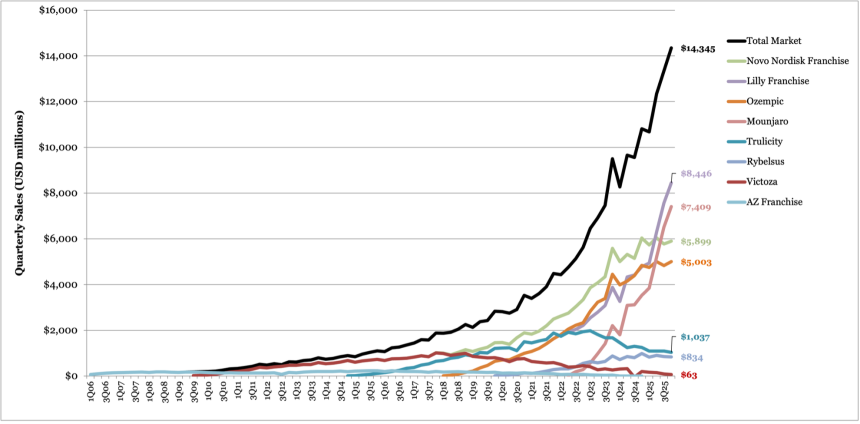
GLP-1 Agonist Sales by Company (1Q06-4Q25)
4Q25 GLP-1 Agonist Sales
| Revenue (Millions) | Growth | Sequential Growth | Share of Market | |
| Ozempic | $5,003 | +1% | +4% | 34% |
| Mounjaro | $7,409 | +110% | +14% | 52% |
| Trulicity | $1,037 | -17% | -1% | 7% |
| Rybelsus | $834 | -19% | -3% | 6% |
| Victoza | $63 | -70% | 27% | 1% |
| Total | $14,345 | +33% | +8% | -- |
*This total does not include sales for AstraZeneca’s Bydureon, which were not disclosed for the first time in 1Q24.
2025 GLP-1 Agonist Sales
| Revenue (Millions) | Growth (CER) | Share of Market | |
| Ozempic | $19,586 | +6% (+10%) | 39% |
| Mounjaro | $22,965 | +99% | 45% |
| Trulicity | $4,276 | -19% | 8% |
| Rybelsus | $3,405 | -5% (-2%) | 7% |
| Victoza | $461 | +45% (+43%) | 1% |
| Total | $50,693 | +32% | -- |
GLP-1 Agonist Sales by Geography (1Q06-4Q25)
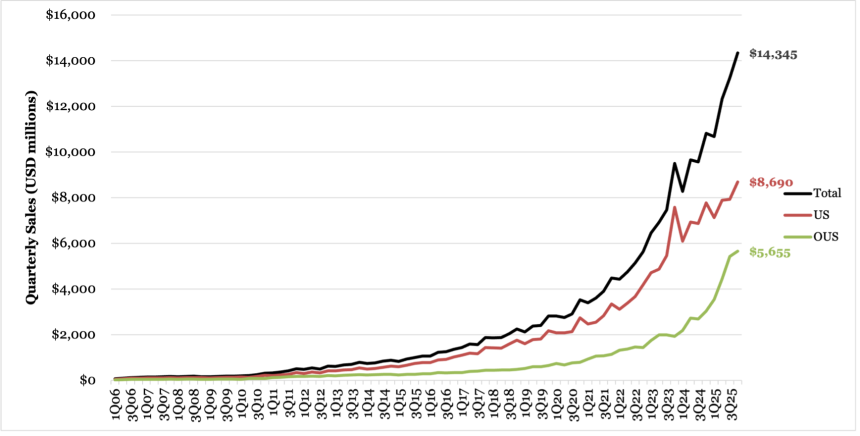
4Q25 GLP-1 Agonist Geographic Breakdown
| 4Q25 US Revenue (Millions) | US Growth (CER) | US Sequential Growth | 4Q25 OUS Revenue (Millions) | OUS Growth | OUS Sequential Growth | |
| Ozempic | $3,514 | +1% (-2%) | +5% | $1,489 | +9% (+8%) | flat |
| Mounjaro | $4,143 | +58% | +17% | $3,267 | +263% | +10% |
| Trulicity | $693 | -13% | -2% | $344 | -24% | flat |
| Rybelsus | $342 | -30% (-24%) | +10% | $491 | -18% (-15%) | -10% |
| Victoza | $-2 | -102% (-100%) | -68% | $64 (DKK 0.5) | -53% (-52%) | -34% |
| Total | $8,690 | +12% | +10% | $5,655 | +86% | +4% |
2025 GLP-1 Agonist Geographic Breakdown
| 2025 US Revenue (Millions) | US Growth | 2025 OUS Revenue (Millions) | OUS Growth | |
| Ozempic | $13,633 | +3% | $5,953 | +41% |
| Mounjaro | $13,650 | +53% | $9,315 | +260% |
| Trulicity | $2,914 | -21% | $1,362 | -13% |
| Rybelsus | $1,360 | -15% | $2,045 | +15% |
| Victoza | $71 | -73% | $384 | -28% |
| Total | $31,628 | +14% | $19,060 | +79% |
SGLT-2 Inhibitors
In 4Q25, SGLT-2 inhibitor sales totaled nearly $4.5 billion, down 5% from 4Q24 and down 1% sequentially. By geography, US sales totaled $1.9 billion, up 2% from 4Q24, and OUS sales totaled $2.6 billion, down 9% from 4Q24. OUS sales represented roughly 57% of the total market.
In 2025, SGLT-2 inhibitor sales totaled $17.5 billion, up 1% from 2024. By geography, US sales totaled $6.6 billion, down 1%, and OUS sales totaled $10.9 billion, down 6%. Sales of Lilly’s Jardiance totaled $8.5 billion (-9%), while AZ’s Farxiga totaled $8.4 billion (+9%), and Merck’s Steglatro sales totaled $530 million (-4%).
SGLT-2 inhibitors have accumulated just under $97 billion in cumulative revenue since we began tracking the SGLT-2 market in 2013 following Farxiga’s EU approval in November 2012. In 4Q25, Jardiance captured 51% market share, with Farxiga at 46% and Steglatro at 3%.
- By product, BI/Lilly's Jardiance (empagliflozin) continued to lead the class with $2.3 billion in sales in 4Q25, down 36% from 4Q24 and down 20% sequentially. US sales totaled $466 million, flat from 4Q24 and up 10% sequentially. OUS sales totaled $302 million, down 59% from 4Q24 and up 44% sequentially.
- AstraZeneca's Farxiga (empagliflozin) followed with $2.1 billion in sales in 4Q25, up 6% from 4Q24 and up 10% sequentially. In 2025, the therapy’s sales totaled $8.4 billion, up 9% from 2024. In each quarter of 2025, Farxiga exceeded $2 billion in sales. US sales totaled $486 million, up 3% CER from 4Q24 and up 10% sequentially. OUS sales, which comprised 76% of global revenue, totaled $1.6 billion, up 7% CER from 4Q24 and down 7% sequentially. In the US, annual revenue totaled $1.7 billion (-1%) and OUS revenue totaled $6.7 billion (+12%).
- Management attributed this modest growth to strong demand in Europe and in emerging markets ex‑China, partially offset by the loss of exclusivity in the UK and temporary volume-based procurement stocking in China. While revenues in the US, Japan, and China are expected to decline in 2026, AZ anticipates strong demand growth to continue in Europe and in emerging markets.
- Sales for Merck's Steglatro (ertugliflozin) totaled $130 million, up 32% from 4Q24 and down 1% sequentially.
- 4Q25 marked the twelfth quarter since J&J stopped reporting Invokana (canagliflozin) revenue, and we officially stopped estimating sales starting in 1Q24. From 2013 to 2022, when sales were reported, Invokana sales totaled $7.9 billion. One of the patents for Invokana’s three indications expired April 11, 2025, according to the FDA’s Orange Book, including for T2D, the reduction of MACE in people with T2D, and the reduction of end-stage kidney disease in people with chronic kidney disease and T2D. Based on these changes to exclusivity, the generic launch of Invokana is expected on November 11, 2031.
- Since April 2023, Mark Cuban Cost Plus Drug Company has sold Invokana. While initially priced at $235/month, the drug is now offered at $535/month, slightly lower than the drug’s retail price of $584-669/month.
- Access to SGLT‑2 inhibitors is expected to improve as generic versions roll out over the coming years. This shift is especially important given evidence that most eligible patients still do not receive these therapies. In November 2023, the FDA tentatively approved Lupin’s generic dapagliflozin and canagliflozin, which are anticipated to launch once the branded products lose exclusivity.
- AstraZeneca’s patent for Farxiga’s indication for glycemic management in people with T2D, as well as in combination with exenatide, expired on October 4, 2025. Farxiga’s method of use patents for CKD extend as far as October 4, 2029, with additional renal patents extending through April 1, 2041, and July 18, 2039. Patent protections related to cardiovascular indications, including risk reduction for hospitalization due to heart failure, are expected to expire on September 9, 2040. Additionally, since January 2024, AZ has partnered with Prasco to sell an authorized generic version of dapagliflozin.
- Jardiance’s compound patent will expire in 2029 in the US and in Europe, and in 2030 in Japan. Given that Jardiance has multiple indications (including for glycemic management, heart health, and kidney health), the therapy will remain protected under patent for the treatment of people with T2D and renal impairment until April 2034.
- Steglatro’s patent is set to expire in 2030 in the US and in 2029 in the EU, China, and Japan. Although the therapy is currently only indicated for glycemic management, a phase 3 trial investigating Steglatro for youth with T2D was completed in April 2025. This is only the second study of an SGLT-2 inhibitor in the pediatric population, with the other being a phase 3 trial investigating AZ’s Farxiga in youth and young adults (aged 10-24 years) in The Lancet in April 2022. In future updates, we are curious if Merck will present data and seek regulatory approval for an indication that includes children.
More broadly, we continue to monitor how this class may be used by people with T1D, given that CKD affects an estimated 20-40% of this population and approved therapies remain scarce. While DKA risk has historically limited SGLT-2 inhibitor use in T1D, adjunctive strategies and emerging technologies such as Abbott’s CGM‑CKM system in development may eventually expand safe access.
4Q25 SGLT-2 Inhibitor Sales
| Global Revenue (Millions) | Global YOY Growth | Global Sequential Growth | Global Share of Market | |
| Jardiance (estimated Lilly+BI) | $768 ($2,304) | -36% | -20% | 51% |
| Farxiga | $2,060 | +6% | +10% | 46% |
| Steglatro (est.) | $130 | +32% | -1% | 3% |
| Total | $4,494 | -4% | -12% | -- |
2025 SGLT-2 Inhibitor Sales
2025 Revenue (Millions) | Growth | Share of Market | |
| Jardiance (estimated Lilly+BI) | $8,584 | +3% | 51% |
| Farxiga | $8,401 | +6% | 46% |
| Steglatro (est.) | $530 | +32% | 3% |
| Total | $17,515 | -1% | -- |
SGLT-2 Inhibitor Sales by Geography (1Q13-4Q25)
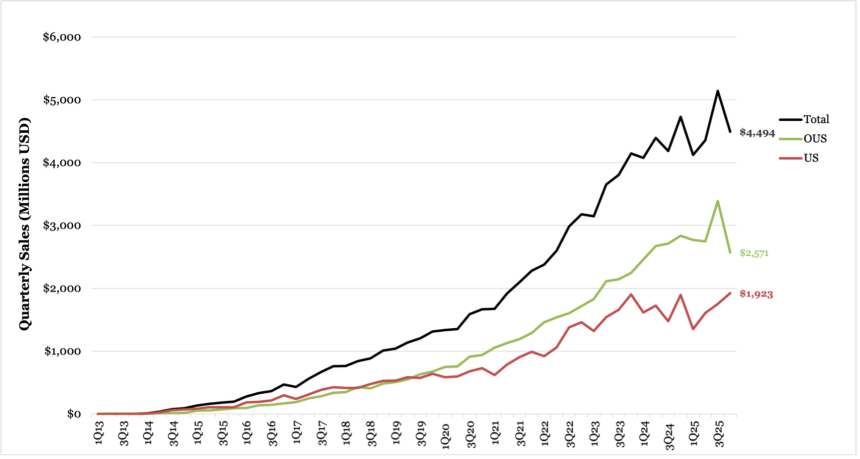
SGLT-2 Inhibitor Sales by Geography (2013-2025)
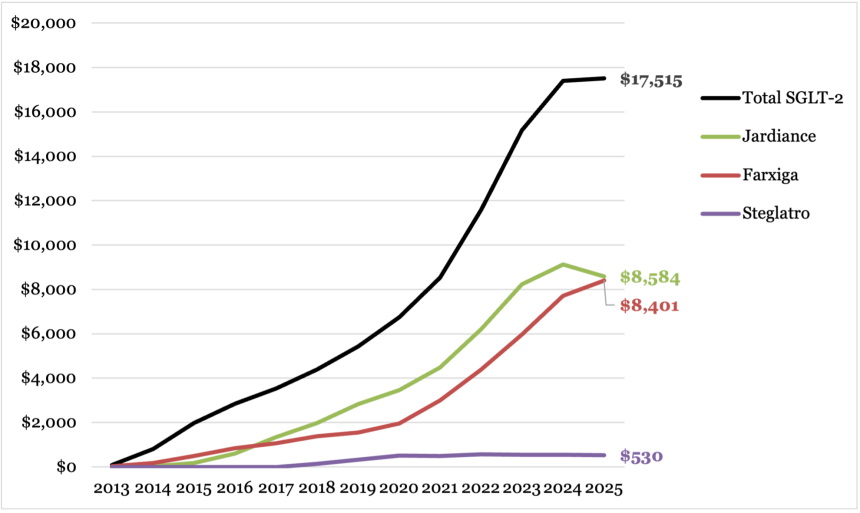
4Q25 SGLT-2 Inhibitor Geography Breakdown
| 4Q25 US Revenue (Millions) | US YOY Growth | US Sequential Growth | 4Q25 OUS Revenue (Millions) | OUS YOY Growth | OUS Sequential Growth | |
| Jardiance (Lilly+BI estimated revenue) | $466 ($1,398) | flat | +10% | $302 ($906) | -59% | +44% |
| Farxiga | $486 | +3% | +10% | $1,573 | +7% | -7% |
| Steglatro (est.) | $39 | +32% | -1% | $91 | -32% | -1% |
| Total | $1,923 | +1% | +10% | $2,570 | -% | -24% |
Insulin
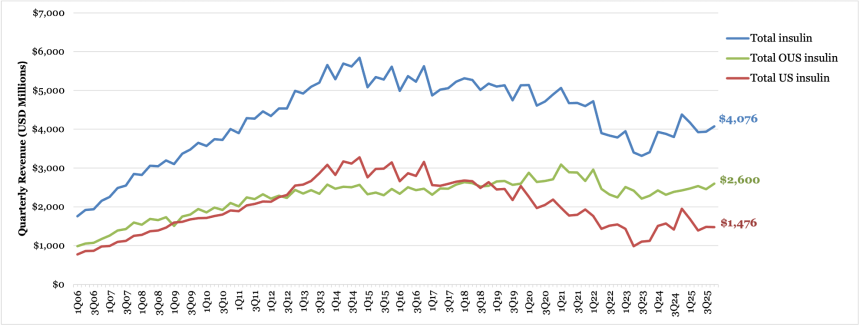
Global insulin sales totaled $4.1 billion in 4Q25, down 7% from 4Q24 and up 4% sequentially. By geography, US revenue totaled $1.6 billion, down 20% from 4Q24 and up 1% sequentially, and OUS revenue totaled $2.5 billion, up 3% from 4Q24 and 5% sequentially. In 2025, insulin sales totaled $16 billion, flat from 2024. The flat trajectory likely reflects greater pricing and competitive pressures for insulin therapies. With the Part D Senior Savings Model launched in 2020 and the Inflation Reduction Act of 2023, Medicare beneficiaries have seen a 56% drop in insulin out‑of‑pocket costs. Moreover, in addition, biosimilars are capturing market share, adding to the competitive pressure. Nonetheless, insulin has generated a whopping $344 billion in cumulative revenue since 2006.
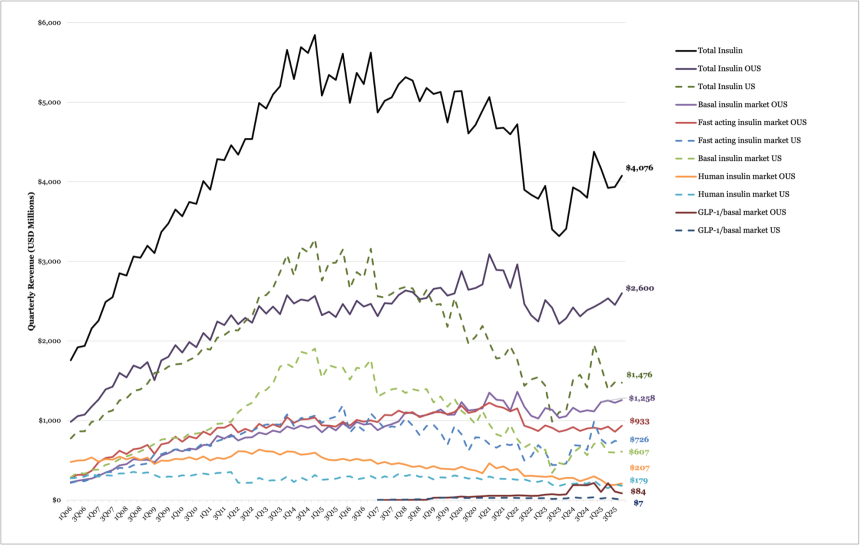
- Basal insulin sales totaled nearly $1.9 billion (+3%, +3% Q/Q). US sales totaled $607 million (-14%, +2% Q/Q), and OUS sales totaled $1.3 billion (+13%, +3% Q/Q). Next-generation basal insulins, which include Toujeo, Tresiba, and Ryzodeg[1], totaled $1.0 billion (+22%, +9% Q/Q), while traditional basal insulins, including Lantus, Levemir, and Basaglar, totaled $846 million (-14%, -5% Q/Q). In 2025, revenue totaled $7.4 billion, up 5% from 2024.
- Rapid-acting insulin sales totaled $1.7 billion (-11%, +5% Q/Q). US sales totaled $749 million (-24%, +1% Q/Q) and OUS sales totaled $933 million (+3%, +9% Q/Q). Next-generation rapid-acting insulins, which include NovoMix, Apidra, Admelog, Fiasp, Afrezza, and Ryzodeg, totaled $518 million (+13%, +13% Q/Q). Traditional rapid-acting insulins – Novolog and Humalog – totaled $1.2 billion (-19%, +2% Q/Q). In 2025, rapid-acting insulin sales totaled $6.6 billion, down 1% from 2024.
- Human insulin sales totaled $386 million (-29%, flat Q/Q). US sales totaled $179 million (-27%, -9% Q/Q) and OUS sales totaled $207 million (-30%, +9% Q/Q). In 2025, human insulin sales totaled $1.5 billion, down 20% from 2024.
- Basal insulin/GLP-1 fixed ratio combinations contributed $141 million to the insulin market (+16%, +14% Q/Q). In the US, basal/GLP-1 RA sales totaled $29 million (+82%, +89% Q/Q), and OUS sales totaled $112 million (+6%, +3% sequentially). In 2025, the sales totaled $515 million, up 15% from 2024. We calculated the basal/GLP-1 RA contribution to the insulin market as 50% of the total sales for the class (with the other 50% contributing to the GLP-1 RA market).
In 4Q25, Novo Nordisk’s insulin portfolio captured 49% of global insulin sales, followed by Lilly (26%) and Sanofi (26%). These percent shares have remained generally consistent since 2006. In 4Q24, Novo Nordisk captured 50%, while Lilly and Sanofi’s insulin portfolios captured 29% and 21%, respectively.
The inclusion of basal insulin Fiasp and NovoLog in the Medicare Drug Price Negotiation Program (MDPNP), with discounted prices (down 75% to $199/month), took effect on January 1, 2026. We are curious to see how this may affect Novo Nordisk’s revenue and market share throughout 2026 and beyond. Moreover, the Most-Favored-Nation negotiation included Novo Nordisk’s NovoLog and Tresiba, which are now sold at a monthly list price of $35 to Medicaid/Medicare, down from ~$140 (down 75%) and $508 per month (down 93%), respectively. Sanofi’s insulins are also accessible on TrumpRx for $35 per month, down 65-93% from the original list price.
Insulin Market 4Q25 Category Breakdown
| 4Q25 Revenue (Millions) | YOY Growth | Sequential Growth | |
| Basal | $1,865 | +3% | +3% |
| “Next Gen” Basal | $1,019 | +22% | +9% |
| “Traditional” Basal | $846 | -14% | -5% |
| Rapid-acting | $1,683 | -11% | +5% |
| “Next Gen” Rapid-acting | $518 | +13% | +13% |
| “Traditional” Rapid-acting | $1,165 | -19% | +2% |
| Human | $386 | -29% | flat |
| Basal/GLP-1 | $141 | +16% | +14% |
| Total Insulin | $4,075 | -7% | +4% |
Insulin Market 2025 Category Breakdown
| 2025 Revenue (Millions) | YOY Growth | |
| Basal | $7,418 | +5% |
| “Next Gen” Basal | $3,951 | +21% |
| “Traditional” Basal | $3,467 | -9% |
| Rapid-acting | $6,551 | -1% |
| “Next Gen” Rapid-acting | $1,955 | +5% |
| “Traditional” Rapid-acting | $4,596 | -3% |
| Human | $1,546 | -20% |
| Basal/GLP-1 | $515 | +15% |
| Total Insulin | $16,030 | flat |
Overall Insulin Sales by Category (1Q06-4Q25)
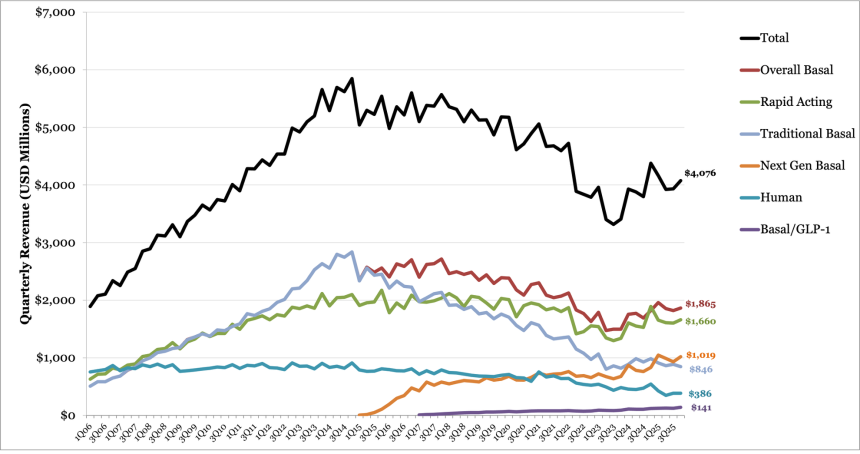
Insulin Market 4Q25 Growth Geographic Breakdown
| 4Q25 US Revenue (Millions) | US YOY Growth | US Sequential Growth | 4Q25 OUS Revenue (Millions) | OUS YOY Growth | OUS Sequential Growth | |
| Basal | $607 | -14% | +2% | $1,258 | +13% | +3% |
| “Next-Gen” Basal | $266 | +28% | +41% | $754 | +20% | +1% |
| “Traditional” Basal | $342 | -31% | -16% | $504 | +4% | +5% |
| Rapid-acting | $749 | -24% | +1% | $933 | +3% | +9% |
| “Next-Gen” Rapid-acting | $148 | +62% | +20% | $370 | flat | +11% |
| “Traditional” Rapid-acting | $600 | -33% | -3% | $563 | +4% | +7% |
| Human | $179 | -27% | -9% | $207 | -30% | +9% |
| Basal /GLP-1 | $29 | +82% | +89% | $112 | +6% | +3% |
| Total | $1,565 | -20% | +1% | $2,510 | +3% | +5% |
Insulin Market 2025 Geographic Breakdown
| 2025 US Revenue (Millions) | US YOY Growth | 2025 OUS Revenue (Millions) | OUS YOY Growth | |
| Basal | $2,506 | -1% | $4,912 | +9% |
| “Next-Gen” Basal | $990 | +36% | $2,961 | +17% |
| “Traditional” Basal | $1,516 | -16% | $1,951 | -2% |
| Rapid-acting | $2,945 | -2% | $3,604 | Flat |
| “Next-Gen” Rapid-acting | $498 | +33% | $1,457 | -2% |
| “Traditional” Rapid-acting | $2,447 | -7% | $2,148 | +1% |
| Human | $699 | -20% | $838 | -21% |
| Basal/GLP-1 | $79 | +29% | $436 | +12% |
| Total | $6,230 | -4% | $9,790 | +2% |
Overall Insulin Sales by Geography (1Q06 – 4Q25)
Overall Insulin Sales by Geography and Category (1Q06 – 4Q25)
Basal Insulin
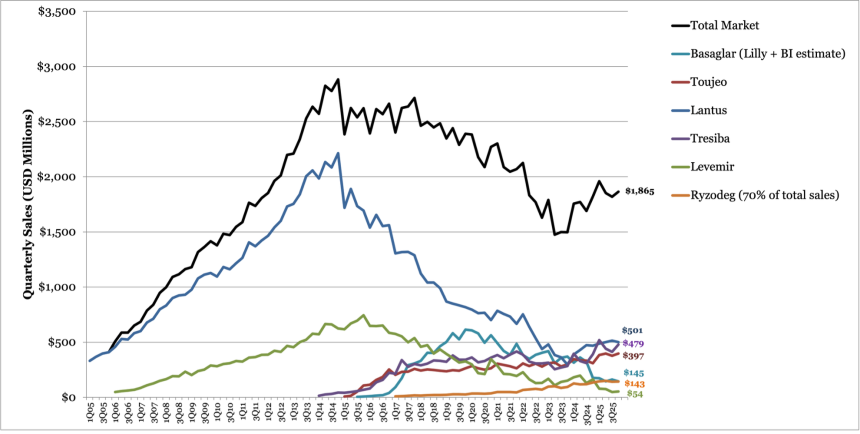
The basal insulin market totaled $1.9 billion in 4Q25 (+3%, +3% Q/Q) and $7.4 billion in 2025 (+5%). By geography, US sales totaled $607 million (-14%, +2% Q/Q) in 4Q25 and $2.5 billion (-1%) in 2025. OUS sales totaled $1.3 billion (+13%, +3% Q/Q) in 4Q25 and $4.9 billion (+9%) in 2025. Next generation basal insulins totaled $1.0 billion (+22%, +9% Q/Q) and $4.0 billion (+21%) in 4Q25 and 2025, respectively. Traditional basal insulins totaled $846 million (-14%, -5% Q/Q) in 4Q25 and $3.5 billion (-9%) in 2025. Since 1Q06, basal insulin sales have totaled $153 billion in cumulative revenue.
- Sales for Sanofi’s Lantus totaled $501 million in 4Q25, up 1% CER from 3Q24 and down 4% sequentially, continuing its trend of steady growth. Sales in the US totaled $238 million (+12% CER, -7% Q/Q) and OUS sales totaled $263 million (-11%, -2% Q/Q). Since 2Q24, Lantus sales in the US have increased by volume due to the unavailability of a competing medicine. While not detailed by Sanofi, Novo Nordisk’s Levemir (insulin detemir) was discontinued in the US in December 2024.
- Sales for Novo Nordisk’s next-generation basal insulin Tresiba totaled $479 million, up 18% CER from 4Q24 and up 16% sequentially. US sales totaled $195 million, up 41% CER and up 57% sequentially. OUS sales totaled $284 million, up 6% CER and down 2% sequentially. In 2025, Tresiba sales totaled $1.9 billion, up 26% CER from 2024. Tresiba growth remains strong following Levemir’s December 2024 discontinuation in the US.
- Importantly, Novo Nordisk entered into an agreement with the US government to reduce drug prices in 2024 and 2025. With its Most Favored Nation deal signed in November 2025, Novo Nordisk is expected to provide NovoLog and Tresiba for a $35 per-month supply starting in 2026. Given that the volume of insulin use in the Medicare population will not significantly increase, we imagine the new prices may lower the revenue in future quarters.
- Sales for Sanofi’s next-generation basal insulin Toujeo totaled $397 million in 4Q25, growing 19% CER from 4Q24 and down 5% sequentially. Sales in the US totaled $71 million, up 41% CER YOY and 7% sequentially. International sales totaled $327 million, up 12% CER YOY and 3% sequentially. Sanofi attributed growth to increased sales in the Rest of World (+22%), where Toujeo continues to increase its share of the basal insulin market. In 2025, sales totaled $1.5 billion, up 14% from 2024.
- Notably, Sanofi announced a $35/month price cap for all of its insulins (Toujeo, Lantus, and Soliqua) in the US, regardless of insurance status, in September 2025. The company’s price cap announcement builds on previous expansions of its patient affordability program, Insulins Valyou Savings Program, which began as a $99/month offer to uninsured people with diabetes in June 2022.
- 4Q25 sales for Novo Nordisk’s traditional basal insulin Levemir totaled $54 million, down 69% YOY but up 10% sequentially. As background, Novo Nordisk announced it would discontinue Levemir in the US in November 2023 due to constraints, formulary losses, and availability of alternative options. Levemir’s full brand discontinuation, including its vial form, went into effect on December 31, 2024. Levemir will also be discontinued in the UK by the end of 2026. Customer demand is expected to normalize in 2026 as windfall sales diminish.
- Novo Nordisk’s once-weekly basal insulin icodec, Awiqli, sales totaled $23 million in 4Q25, up 5% sequentially. In the first full year since commercialization in June 2024, sales totaled $64 million. Awiqli is approved in more than a dozen countries, including Canada, the EU, Japan, Australia, and Switzerland for both T1D and T2D, and in China for T2D.
- In the US, Novo Nordisk announced its resubmission of the Biologics License Application (BLA) for Awiqli in people with T2D to the FDA in September 2025. This submission followed a CRL in July 2024, which raised concerns about Awiqli’s T1D indication. The resubmission is supported by the phase 3 ONWARDS program, which demonstrated robust A1c reductions with no significant increase in clinically significant hypoglycemia in people with T2D, compared to glargine or degludec. The FDA approved the therapy in March 2026.
- In 3Q25, Lilly submitted its once-weekly insulin efsitora alfa for regulatory approval for T2D in the US. This submission was based on the phase 3 QWINT program, which compared efsitora alfa to insulin glargine and insulin degludec. Full results of the QWINT-1, 3, and 4 trials were announced at ADA 2025, while QWINT-2 and 5 followed at EASD 2024. The QWINT-1 trial demonstrated non-inferior A1c reduction (1.3%) compared to insulin glargine (1.3%). The QWINT-3 trial also showed non-inferior A1c reduction (7.2%) compared to insulin degludec (7.3%) from a baseline of 7.8%. For QWINT-4, no significant difference was seen in A1c reduction by insulin efsitora alfa (1.07%) or insulin glargine (1.07%). Notably, Lilly also submitted insulin efsitora alfa for regulatory approval in the EU in 2Q25. The company has not shared an expected decision timeline for insulin efsitora alfa for either region.
4Q25 Basal Insulin Sales
| 4Q25 Revenue (Millions) | YOY Growth | Sequential Growth | Share of Market | |
| Basaglar (BI + Lilly estimate) | $145 | -18% | -11% | 16% |
| Toujeo | $397 | +29% | +5% | 21% |
| Lantus | $501 | +7% | -2% | 27% |
| Tresiba | $479 | +23% | +16% | 26% |
| Levemir | $54 | -67% | -27% | 3% |
| Ryzodeg | $143 | +6% | +1% | 7% |
| Total | $1,865 | +3% | +3% | -- |
2025 Basal Insulin Sales
| 2025 Revenue (Millions) | YOY Growth | Share of Market | |
| Basaglar (BI + Lilly estimate) | $626 | -8% | 17% |
| Toujeo | $1,520 | +14% | 21% |
| Lantus | $1,958 | +11% | 26% |
| Tresiba | $1,851 | +29% | 25% |
| Levemir | $257 | -62% | 4% |
| Ryzodeg | $580 | +16% | 7% |
| Total | $7,418 | +5% | -- |
Basal Insulin Sales (1Q05 – 4Q25)
Basal Insulin Sales 4Q25 Geographic Breakdown
| 4Q25 US Revenue (Millions) | US YOY Growth | US Sequential Growth | 4Q25 OUS Revenue (Millions) | OUS YOY Growth | OUS Sequential Growth | |
| Basaglar (BI + Lilly estimate) | $54 | -47% | -33% | $91 | +21% | +11% |
| Toujeo | $71 | +44% | +9% | $327 | +26% | +5% |
| Lantus | $238 | +15% | -5% | $263 | flat | flat |
| Tresiba | $195 | +23% | +57% | $284 | +22% | -1% |
| Levemir | -- | -105% | -- | $59 | -20% | +12% |
| Ryzodeg | -- | N/A | -- | $143 | +6% | +1% |
| Total | $607 | -14% | +2% | $1,258 | +13% | +3% |
Basal Insulin Sales 2025 Geographic Breakdown
| 2025 US Revenue (Millions) | US YOY Growth | 2025 OUS Revenue (Millions) | OUS YOY Growth | |
| Basaglar (BI + Lilly estimate) | $301 | -20% | $325 | +8% |
| Lantus | $913 | +32% | $1,045 | -2% |
| Toujeo | $271 | +16% | $1,249 | +14% |
| Tresiba | $719 | +45% | $1,132 | +20% |
| Levemir | -- | -100% | $256 | -18% |
| Ryzodeg | -- | N/A | $580 | +16% |
| Total | $2,506 | -1% | $4,911 | +9% |
Rapid-acting insulin
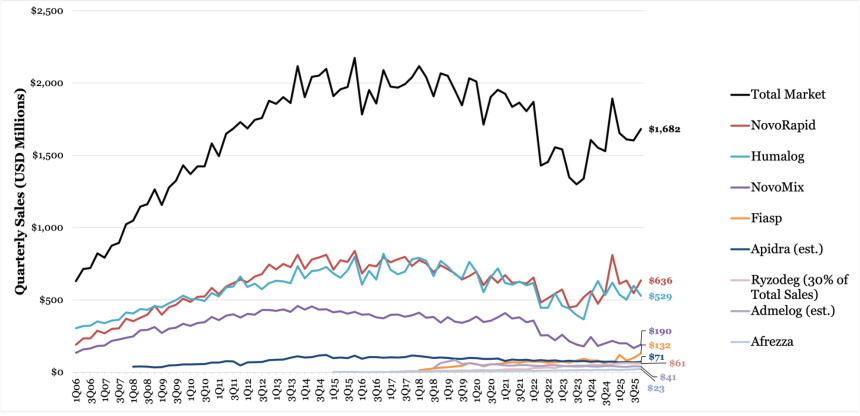
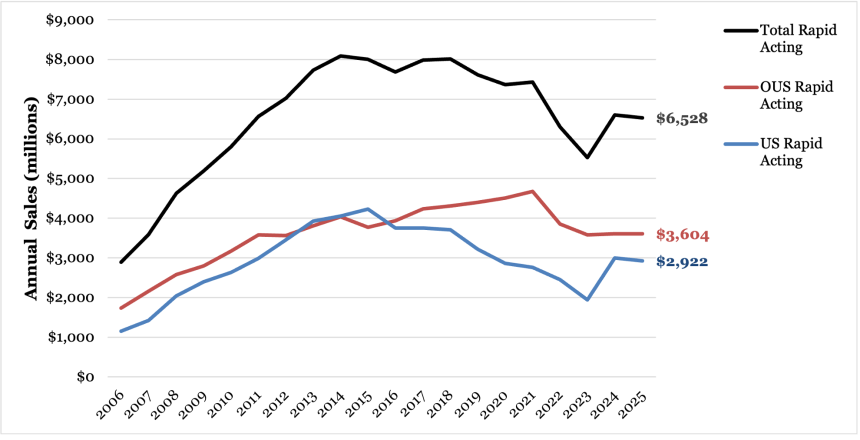
The rapid-acting insulin market totaled $1.6 billion in 4Q25, down 11% from 4Q24 and up 5% sequentially. US sales totaled $749 million, down 24% from 4Q24 and up 1% sequentially, while OUS sales totaled $933 million, up 3% from 4Q24 and 9% sequentially. Revenue in 2025 was $6.6 billion, down 1% from 2024. Sales are continuing to expand following a decline from 2021 to 2024, likely due to higher realized prices. Since 2006, rapid-acting insulin sales have totaled $131 billion in cumulative revenue.
- Novo Nordisk’s NovoLog continued to lead the class, totaling $636 million in 4Q25, down 24% from 4Q24 and 16% sequentially. By geography, US revenue was $281 million, down 42% from 4Q24 and up 21% sequentially, and OUS sales totaled $354 million, down 3% from 4Q24 and up 13%. In 2025, NovoLog sales totaled $2.4 billion, down 2% CER from 2024. NovoLog 37% of the rapid-acting insulin market in 2025, consistent with previous years.
- We are curious about how government programs for insulin prices, such as the Medicare Drug Price Negotiation Program (MDPNP) and the Most-Favored-Nation policies, will impact revenues in the coming years. Notably, Novo Nordisk’s rapid-acting insulins NovoLog and Fiasp faced a 66-79% cut from the list price since January 2026 via the first round of MDPNP.
- Lilly’s Humalog and generic insulin lispro sales totaled $529 million in 4Q25, down 14% from 4Q24 and down 12% sequentially. By geography, sales totaled $319 million in the US, down 21% from 4Q24 and down 18% sequentially, while OUS sales totaled $209 million, down 2% from 4Q24 and down 2% sequentially. 2025 sales totaled $2.2 billion, down 7% from 2024, and captured 33% of the market.
- Revenue of MannKind’s inhaled insulin Afrezza totaled $23 million, up 25% from 4Q24 and up 24% sequentially, capturing 1% of the market. Full-year 2025 revenue totaled $74.6 million, up 17% from 2024. Growth was primarily driven by increased prescribing among clinicians caring for those with T1D. The company expects the ADA Standards of Care 2026 to drive further growth, as it positions inhaled insulin as an option equivalent to injectable insulin or AID. On pediatric indications, the FDA accepted Afrezza’s supplemental Biologics License Application (sBLA) in 3Q25 and expects to respond by the PDUFA date of May 29, 2026.
4Q25 Rapid-Acting Insulin Sales
| Revenue (Millions) | Growth | Sequential Growth | Share of Market | |
| NovoLog | $636 | -22% | +16% | 38% |
| Humalog | $529 | -15% | -12% | 31% |
| NovoMix | $190 | -12% | +13% | 11% |
| Fiasp | $132 | +168% | -62% | 8% |
| Apidra (est.) | $71 | -5% | +4% | 4% |
| Ryzodeg | $61 | +6% | -5% | 4% |
| Admelog (est.) | $41 | -5% | -2% | 2% |
| Afrezza | $23 | +25% | +24% | 1% |
| Total | $1,683 | -11% | +5% | -- |
*Ryzodeg revenue is split 70/30 between basal insulin/rapid-acting insulin. Revenue for Admelog and Apidra are estimated using Sanofi’s “other diabetes” portfolio and the US vs. OUS revenue ratio from 4Q20.
2025 Rapid-Acting Insulin Sales
| Revenue (Millions) | Growth | Share of Market | |
| NovoLog | $2,427 | 1% | 37% |
| NovoMix | $759 | -11% | 12% |
| Humalog | $2,168 | -7% | 33% |
| Fiasp | $433 | +60% | 7% |
| Apidra (est.) | $281 | -5% | 4% |
| Ryzodeg | $249 | +16% | 4% |
| Admelog (est.) | $159 | -5% | 2% |
| Afrezza | $75 | +16% | 1% |
| Total | $6,551 | -1% | -- |
Rapid-Acting Insulin Sales (1Q06 – 4Q25)
4Q25 Rapid-Acting Insulin Sales Geographic Breakdown
| 4Q25 US Revenue (Millions) | US Growth | US Sequential Growth | 4Q25 OUS Revenue (Millions) | OUS Growth | OUS Sequential Growth | |
| NovoLog | $281 | -42% | +21% | $354 | +9% | +13% |
| NovoMix | $24 | -41% | +1% | $167 | -6% | +15% |
| Humalog | $319 | -21% | -2% | $209 | -18% | -1% |
| Apidra (est.) | $7 | -5% | +4% | $64 | -5% | +4% |
| Admelog (est.) | $37 | -5% | -2% | $4 | -5% | -5% |
| Fiasp | $58 | +57% | +8% | $74 | +18% | +8% |
| Afrezza | $23 | +25% | +24% | --** | --** | --** |
| Ryzodeg | -- | -- | -- | $61 | +6% | -5% |
| Total | $749 | -24% | +1% | $933 | +3% | +9% |
**MannKind’s Afrezza is marketed in Brazil, following approval in June 2019, but the company does not break out Afrezza revenue in Brazil. The vast majority of Afrezza’s revenue is thought to come from the US, so we have not listed OUS revenue here.
2025 Rapid-Acting Insulin Sales Geographic Breakdown
| 2025 US Revenue (Millions) | US Growth | 2025 OUS Revenue (Millions) | OUS Growth | |
| NovoLog | $1,102 | -1% | $1,325 | +2% |
| NovoMix | $87 | -7% | $671 | -11% |
| Humalog | $1,345 | -10% | $822 | flat |
| Apidra (est.) | $28 | -5% | $253 | -5% |
| Admelog (est.) | $143 | -5% | $16 | -5% |
| Fiasp | $165 | +337% | $268 | +15% |
| Afrezza | $75 | +16% | --** | --** |
| Ryzodeg | -- | -- | $249 | +16% |
| Total | $2,945 | -2% | $3,604 | flat |
**MannKind’s Afrezza is marketed in Brazil, following approval in June 2019, but the company does not break out Afrezza revenue in Brazil. The vast majority of Afrezza’s revenue is thought to come from the US, so we have not listed OUS revenue here.
Rapid-Acting Insulin Sales by Geography (1Q06 – 4Q25)
Rapid-Acting Insulin Sales by Geography, Annually (2006 – 2025)
Basal Insulin/GLP-1 Fixed Ratio Combination
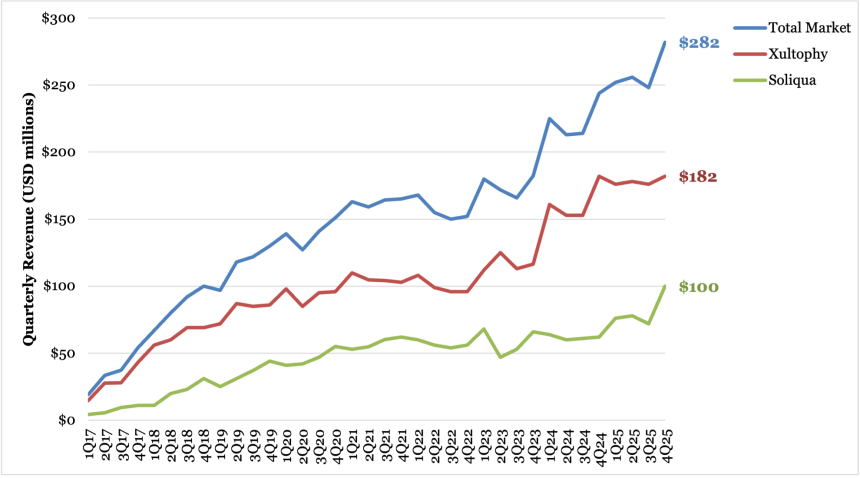
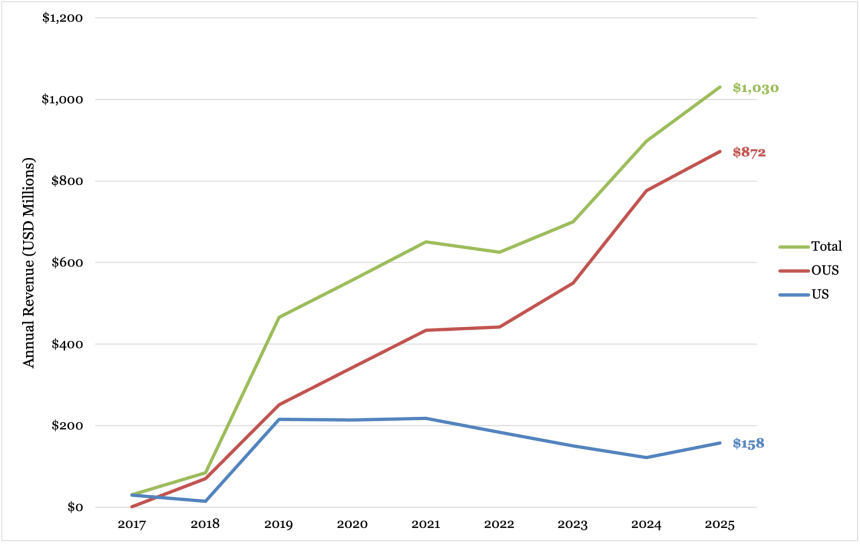
In 4Q25, sales for basal insulin/GLP-1 RA fixed ratio combination, which includes Novo Nordisk’s Xultophy (degludec/liraglutide) and Sanofi’s Soliqua (glargine/lixisenatide), totaled $282 million, up 16% from 4Q24 and up 14% sequentially. By geography, US sales totaled $58 million (+82%, -47% Q/Q), while OUS sales totaled $224 million (+6%, +3% Q/Q). In 2025, revenue for these fixed ratio basal/GLP-1 combinations totaled $1.0 billion (+15%), including US sales of $158 million (+29%) and OUS sales of $872 million (+12%). Xultophy continued to lead the market, capturing 64% in 4Q25, down from 71% in 3Q25 and 75% in 4Q24.
- This fixed-dose therapy could be highly beneficial for the right population. Combination therapy can help minimize side effects, such as weight gain, seen with insulin therapy, improve glycemic levels, and support treatment adherence. In the phase 4 SOLI-SWITCH study (n=162), presented at ATTD 2025, Soliqua lowered A1c by 1.2 percentage points from a mean baseline of 8.5% at 24 weeks. Moreover, 38% of participants achieved an A1c <7.0% and saw a median weight reduction of 0.9 kg (2 lbs).
4Q25 Basal Insulin/GLP-1 Receptor Agonist Combination Sales
| Revenue (Millions) | Growth | Sequential Growth | Share of Market | |
| Soliqua | $100 | +63% | +38% | 36% |
| Xultophy | $182 | flat | +3% | 64% |
| Total | $282 | +16% | +14% | -- |
2025 Basal Insulin/GLP-1 Receptor Agonist Combination Sales
| 2025 Revenue (Millions) | Growth | Share of Market | |
| Soliqua | $318 | +30% | 31% |
| Xultophy | $712 | +9% | 69% |
| Total | $1030 | +15% | -- |
Basal Insulin/GLP-1 Receptor Agonist Combination Sales (1Q17 – 4Q25)
4Q25 Basal Insulin/GLP-1 Receptor Agonist Combination Geographic Breakdown
| 4Q25 US Revenue (Millions) | US Growth | US Sequential Growth | 4Q25 OUS Revenue (Millions) | OUS Growth | OUS Sequential Growth | |
| Soliqua | $44 | +108% | +98% | $56 | +39% | +11% |
| Xultophy | $14 | +33% | +66% | $168 | -2% | -114% |
| Total | $58 | +82% | -47% | $224 | +6% | +3% |
2025 Basal Insulin/GLP-1 Receptor Agonist Combination Geographic Breakdown
| 2025 US Revenue (millions) | US Growth | 2025 OUS Revenue (millions) | OUS Growth | |
| Soliqua | $114 | +39% | $206 | +25% |
| Xultophy | $56 | +9% | $666 | +9% |
| Total | $158 | +29% | $872 | +12% |
Basal Insulin/GLP-1 Receptor Agonist Combination Geographic Breakdown (1Q17 – 4Q25)
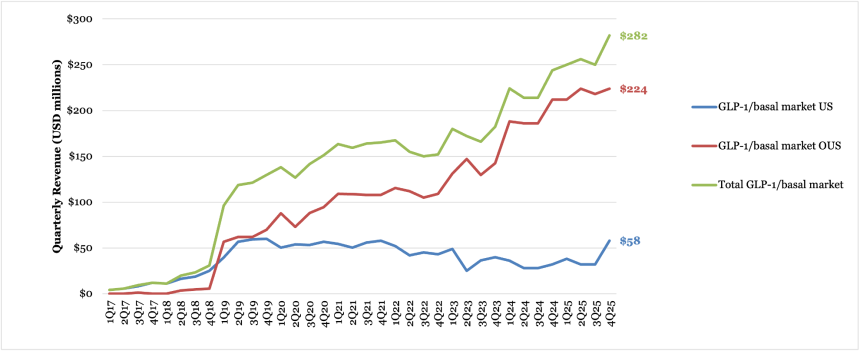
Basal Insulin/GLP-1 Receptor Agonist Combination Geographic Breakdown (2017 – 2025)
DPP-4 Inhibitors
In 4Q25, DPP-4 inhibitor sales totaled $834 million, down 7% from 4Q24and down 12% sequentially. US revenue was $245 million (+33%, -27% sequentially) and OUS revenue totaled $589 million (-18%, -4% sequentially). Overall declines in DPP-4 inhibitor sales are typically attributed to competition from other oral agents, such as SGLT-2 inhibitors, which are recommended by the ADA as a first-line therapy for people with diabetes and comorbidity risks. In a recent survey from dQ&A (n=2,796), just 9% of patients with T2D on oral diabetes therapies were currently taking a DPP-4 inhibitor.
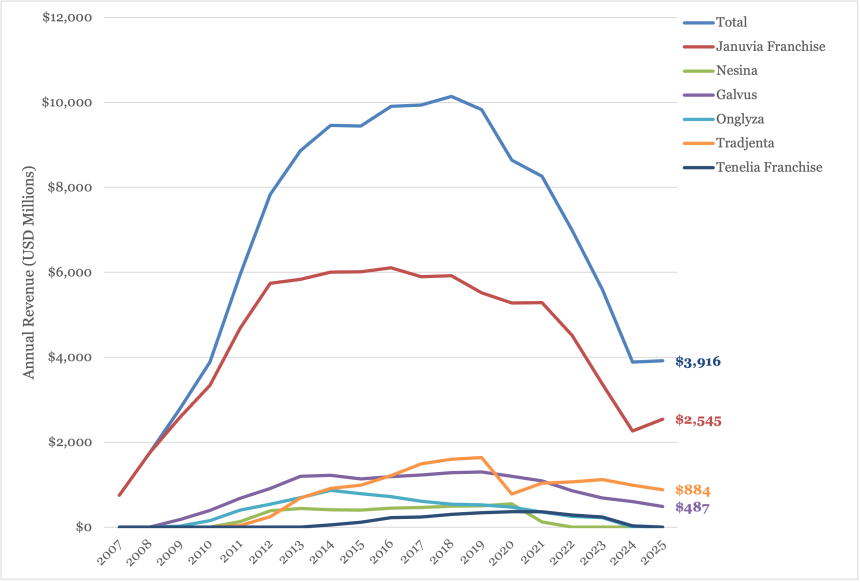
In 2025, DPP-4 inhibitor sales totaled $3.9 billion, up 3% from 2024. By geography, US sales totaled $1.3 billion, up 66%, and OUS sales totaled $2.6 billion, down 15%. Sales for Merck’s Januvia franchise totaled $2.5 billion (+12%), while Lilly and BI’s Tradjenta totaled $884 million (-10%) and Novartis’ Galvus had sales totaling $487 million (-19%).
- Merck’s Januvia franchise, which includes Januvia (sitagliptin) and Janumet (fixed-dose sitagliptin + metformin), continued to hold the greatest DPP-4 inhibitor market share in the field, steady at 65% for 2025. The Januvia franchise totaled $501 million in 4Q25, up 3% from 4Q24 but down 20% sequentially. US sales totaled $237 million, up 80% from 4Q24 but down 29% sequentially. OUS sales totaled $264 million, down 26% from 4Q24 and down 9% sequentially.
- The increase in US sales from 4Q24 continues to be influenced by higher net pricing, even amid overall declines in the DPP-4 inhibitor market. Management has attributed sequential declines to competition from other oral agents. Merck expects a continued revenue headwind of ~$2.5 billion in generic competition for Januvia. Generic versions of Januvia/Janumet are expected to enter the US market in May of this year following patent expiration in China and Europe.
- BI/Lilly’s estimated revenue for Tradjenta totaled $219 million in 4Q25 (-18%, +11% Q/Q), capturing 26% of market share, a slight increase from previous quarters. $8 million in US sales were reported this quarter. OUS sales totaled $211 million, down 2% from 4Q24 but up 6% sequentially.
- Novartis’s Galvus (vidagliptin), which is only available in internationally, followed Tradjenta with sales of $114 million (-21%, -10% Q/Q) and 14% market share. Management attributed the decline to continued generic competition following patent expiration in 2019.
- For other therapies, recall that Daiichi Sankyo stopped reporting sales of DPP-4 inhibitors Tenelia (teneligliptin) in 3Q24, and AstraZeneca permanently discontinued Onglyza (saxagliptin) in March 2023 due to a “business decision,” presumably related to now-resolved lawsuits and patent expirations in 2023. Patents for Galvus, Onglyza, and Tradjenta expired in 2019, 2023, and 2025, respectively, with more patent expirations expected in the next few years.
We continue to believe that DPP-4 inhibitors have an important role in diabetes management and perhaps even in diabetes prevention for select populations. In the VERIFY trial, early combination therapy with a DPP-4 inhibitor and metformin led to 26 more months with an A1c value ≤7.0% compared to metformin monotherapy.
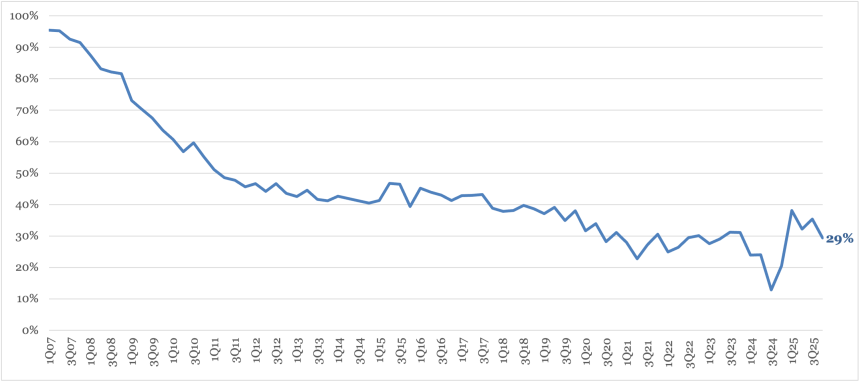
- Despite the increasing number of generic compounds in international markets, OUS revenue continues to make up most of DPP-4 inhibitor revenue. In 4Q25, US revenue comprised roughly 29% of the overall market, a slight increase from 21% in 3Q25. See the graph below.
4Q25 DPP-4 Inhibitor Sales
| 4Q25 Revenue (Millions) | Growth | Sequential Growth | Share of Market | |
| Merck’s Januvia Franchise | $501 | +3% | -20% | 60% |
| Tradjenta (estimated Lilly + BI) | $219 | -18% | +11% | 26% |
| Novartis’s Galvus | $114 | -21% | -10% | 14% |
| Total | $834 | -7% | -12% | -- |
2025 DPP-4 Inhibitor Sales
| 2025 Revenue (Millions) | Growth | Share of Market | |
| Merck’s Januvia Franchise | $2,545 | +12% | 65% |
| Tradjenta (estimated Lilly + BI) | $884 | -10% | 23% |
| Novartis’s Galvus | $487 | -19% | 12% |
| Total | $3,916 | +2% | -- |
DPP-4 Inhibitor Total Sales by Company (4Q06 – 4Q25)
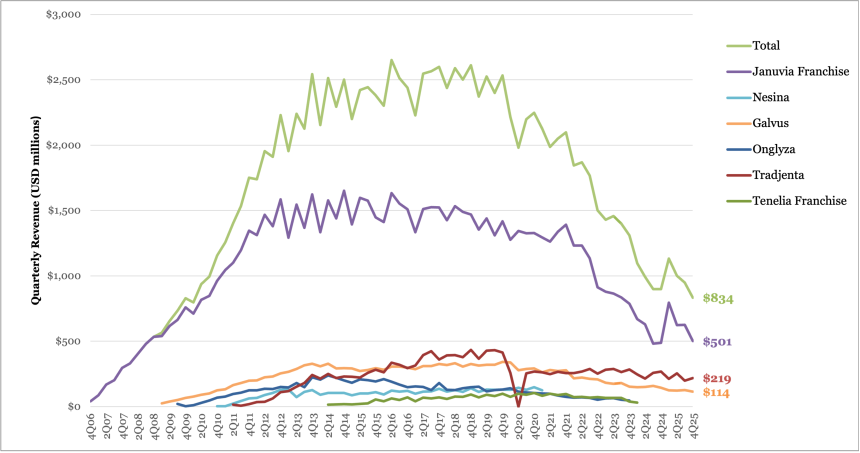
Onglyza is no longer included in our graph as AZ stopped reporting revenue in 1Q24. Recall that onglyza was discontinued in the US in March 2023.
DPP-4 Inhibitor Total Sales by Company (2006 – 2025)
4Q25 DPP-4 Inhibitor Geographic Breakdown
| 4Q25 US Revenue (Millions) | US Growth | US Sequential Growth | 4Q25 OUS Revenue (Millions) | OUS Growth | OUS Sequential Growth | |
| Merck’s Januvia Franchise | $237 | +80% | -29% | $264 | -26% | -9% |
| Tradjenta (estimated Lilly + BI) | $8 | -84% | -- | $211 | -2% | +6% |
| Novartis’s Galvus | $0 | -- | -- | $114 | -21% | -10% |
| Total | $245 | +33% | -27% | $589 | -18% | -4% |
2025 DPP-4 Inhibitor Geographic Breakdown
| 2025 US Revenue (Millions) | US Growth | 2025 OUS Revenue (Millions) | OUS Growth | |
| Merck’s Januvia Franchise | $1,266 | +101% | $1,278 | -22% |
| Tradjenta (estimated Lilly + BI) | $68 | -61% | $817 | +1% |
| Novartis’s Galvus | $0 | -- | $487 | -19% |
| Total | $1,334 | +66% | $2,582 | -15% |
DPP-4 Inhibitor Sales by Geography (4Q06 – 4Q25)
DPP-4 Inhibitor Sales by Geography (2006 – 2025)
Obesity
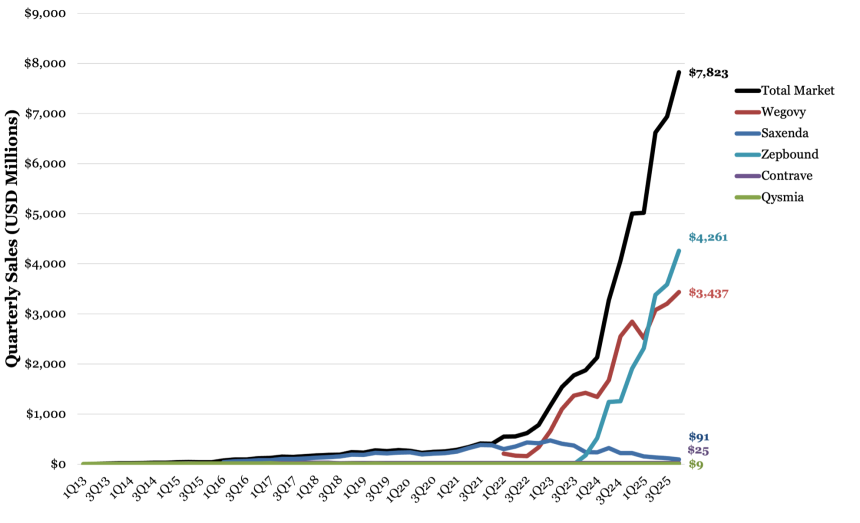
In 4Q25, the obesity market totaled over $7.8 billion, up 56% from 4Q24 and up 13% sequentially. In 2025, obesity medication sales totaled $26 billion, up a remarkable 82% from 2024. US sales totaled $6.4 billion in 4Q25, up 52% from 4Q24 and up 15% sequentially, and $22 billion (+95%) in 2025. OUS sales totaled $1.4 billion, up 82% from 4Q24 and up 3% sequentially, and totaled $4.8 billion (+94%) in 2025. Since 2006, the obesity market has generated $57.1 billion in cumulative revenue – 2025 sales represented nearly half of all-time sales.
- For the first year, Lilly’s Zepbound (tirzepatide for obesity) outperformed Novo Nordisk’s Wegovy (semaglutide for obesity) by both revenue and prescription numbers. Zepbound sales totaled $4.3 billion in 4Q25, up over 2x from 4Q24 and up 19% sequentially, capturing 65% of total prescriptions (TRx) and 69% of new-to-brand prescriptions (NBRx) at the end of 4Q25. This differed slightly compared to 63% of TRx and 71% of NBRx at the end of 3Q25. In 2025, Zepbound sales rose an incredible 175% from 2024, totaling $14 billion. Since its approval in November 2023 and US launch in 4Q23, Zepbound sales recorded $15.1 billion in cumulative revenue. In its third quarter of availability in OUS markets, sales for Zepbound totaled $31 million, up 57% from 3Q25. Zepbound is currently only commercialized in Canada, Japan, and the US.
- In terms of insurance, Zepbound previously experienced a slight decrease in TRx following CVS Caremark’s July 2025 decision to select Novo Nordisk’s Wegovy as its preferred GLP-1 RA for obesity in its template formularies. Nevertheless, the increase in NBRx reflects continued demand for Zepbound despite coverage shifts over the quarter.
- In the self-pay channel, Zepbound vials totaled about one-third of new patient obesity medication prescriptions in 4Q25. For background, LillyDirect was launched in the US in January 2024 to provide a direct home delivery service for prescription medications for diabetes, obesity, and migraines. The platform reached its one-millionth patient in 4Q25. Zepbound vials were made accessible in June 2025 through LillyDirect’s Self Pay Pharmacy Solutions and the Zepbound Self Pay Journey Program and are the platform’s most popular offering. With the launch of 12.5 mg and 15 mg doses of Zepbound vials in June 2025, patients who refill within 45 days of their first order can access Zepbound at $349/month for 2.5 mg and $499/month for subsequent doses (5 mg, 7.5 mg, 10 mg, 12.5 mg, and 15 mg).
- Wegovy (semaglutide for obesity) captured 44% of the obesity market in 4Q25. Wegovy’s market share decreased from 46% in 3Q25 due to Lilly’s Zepbound gradually capturing a greater portion of the market. In the US, Wegovy has around 233,000 weekly prescriptions (down from 270,000 in 3Q25 and 280,000 in 2Q25), which is approximately half of Lilly’s tirzepatide prescriptions for the same time period (469,000). 4Q25 continues Wegovy’s market share decline over recent quarters: 46% in 2Q25, 50% in 1Q25, 57% in 4Q24, and 51% in 2Q24. In terms of sales, Wegovy revenue totaled $3.4 billion in 4Q25, up 17% CER from 4Q24 and up 7% sequentially. By geography, US sales totaled $2.2 billion, down 2% CER from 4Q24 and up 10% sequentially. OUS sales totaled $1.3 billion, up 77% CER from 4Q24 and up 4% sequentially. In 2025, Wegovy sales totaled $12 billion, up 41% CER from 2024.
- In the cash channel, Novo Nordisk lowered the self-pay price of Wegovy in November 2025 to $349 per month, down from $499 per month. The lower price has increased Wegovy’s uptake in the cash channel, which comprises ~30% of total weekly prescriptions. On a national level, under the Most Favored Nation agreement, Wegovy and Wegovy pill will be offered at $350 and $150 per month, respectively, on TrumpRx, the US government’s direct-to-consumer platform.
- In terms of insurance, by mid-year, Wegovy will be included in Medicare Part D via the Center for Medicare and Medicaid Innovation (CMMI) pilot under the Most Favored Nation agreement. Specifically, Medicare patients will be able to access Ozempic (semaglutide for T2D) and Wegovy (semaglutide for obesity) for $245/month with a co-pay of $50 per month. Under the Medicare Drug Price Negotiation Program, Ozempic, Rybelsus, and Wegovy will face a 71% cut to list prices, down from ~$950 per month in 2024 to ~$274 in 2027. Medicare Part D reimbursement will be beneficial starting mid-year 2026, while larger effects will be seen in 2027.
- As background, Wegovy is covered for about 55 million people with obesity in the US, as announced in 3Q25. In addition, more than 10 million people are estimated to have coverage through Medicaid, which includes people with obesity and weight-related comorbidities like cardiovascular disease. However, due to increased healthcare expenditures, several states including California, North Carolina, Pennsylvania, Connecticut, and Michigan, recently announced plans to end or scale back coverage of Wegovy. In October 2025, Novo Nordisk announced that it has lobbied to maintain Medicaid reimbursement for Wegovy across 14 US states.
- On accessibility, Novo Nordisk notably increased options for both the insured and cash channels in 2025. NovoCare Pharmacy, which launched in March 2025, is a direct-to-patient platform that offers Wegovy single-dose pens for $499/month for cash-paying patients. Novo Nordisk also announced partnerships with telehealth platforms including Ro and LifeMD in April 2025, as well as GoodRx and Costco to further expand access.
- Oral Wegovy launched in January 2026 at over 70,000 pharmacies and telehealth platforms as the only oral GLP-1 RA for obesity following its FDA approval in December 2025. Further, Amazon announced that the therapy is available on its digital pharmacy platform Amazon Pharmacy, adding options for convenient access to this new formulation. In 4Q25, management reported impressive uptake in the first three weeks of its launch: in the week ending January 23, there were ~50,000 total weekly prescriptions, ~45,000 of which were through self-pay channel, where the drugs cost $149-$299 per month. While still early, the speed of uptake is significantly steeper compared to that of injectable Wegovy and Zepbound.
- For background, oral Wegovy received FDA approval in December 2025 for weight loss based on findings from the phase 3 OASIS-4 (n=307) and SELECT trials (n=17,604). In OASIS-4, oral semaglutide 25 mg conferred up to 14% weight loss compared to 2% with placebo. In the SELECT trial, injectable semaglutide 2.4 mg reduced major adverse CV event (MACE) risk by 20% at Week 104 in people with obesity, or who were overweight but without diabetes.
- The use of generic semaglutide has been a larger focus this year. Novo Nordisk’s semaglutide lost its exclusivity in Canada on January 4th, 2026. Given that its patent, which granted Novo Nordisk exclusive rights to manufacture and sell semaglutide in Canada, lapsed in 2020, generic companies like Sandoz and Hims & Hers can now file for regulatory approval for generics.
- Saxenda sales totaled $91 million, down 62% CER from 4Q24 and down 23% sequentially. US sales totaled -$1 million (representing a loss), down 100% CER from 4Q24 and down 99% sequentially. OUS sales totaled $92 million, down 13% CER from 4Q24 and down 12% sequentially. In 2025, sales totaled $497 million, down 52% CER from 2024.
- In the pipeline, several obesity candidates continue to advance. In January 2026, Novo Nordisk announced positive topline results from the phase 3 REIMAGINE 2 trial (n=2,728) evaluating CagriSema (a fixed-dose combination of semaglutide 2.4 mg and cagrilintide 2.4 mg) in adults with T2D inadequately controlled on metformin with or without SGLT-2 inhibitors. At Week 68, CagriSema demonstrated a superior A1c reduction of 1.91 percentage points (versus 1.76 percentage points with semaglutide 2.4 mg alone) from a mean baseline of 8.2%. While a 10% differential in A1c values was positive, the 34% weight loss seen with CagriSema was very striking. This follows the results from the REIMAGINE 3 trial (n=274) from 4Q24, in which CagriSema demonstrated a 2.3 percentage point reduction in A1c, as well as a 12% reduction in body weight, in people with T2D on once-daily basal insulin with or without metformin.
- For people with obesity, Novo Nordisk submitted a New Drug Application (NDA) to the FDA in December 2025 for CagriSema. The therapy is proposed as an adjunct to lifestyle intervention for the management of long-term weight loss in adults who are overweight or have obesity and at least one weight-related comorbid condition. Notably, results from the phase 3b REDEFINE 4 trial (n=809) comparing CagriSema versus tirzepatide 15 mg in adults with obesity are expected in 1H26.
- For high-dose semaglutide (7.2 mg), Novo Nordisk filed with the FDA for approval in people with obesity under the CNPV pilot program in November 2025. The therapy was approved following 4Q25 reporting. In the EU, both high-dose semaglutide (7.2 mg) and its single-dose-device formulation for obesity have been submitted to regulatory authorities in July and October 2025, with decisions expected in early 2026 and 2H26, respectively. Excitingly, in January 2026, the UK’s MHRA approved the 7.2 mg dose of Wegovy for adults with obesity, which will be delivered as three injections of semaglutide 2.4 mg. All submissions were based on the results of the STEP UP (n=1,407) and STEP UP T2D (n=512) program presented at ADA 2025, in which semaglutide 7.2 mg achieved up to 21% weight loss across several trials.
- Lilly’s orforglipron showed exciting promise in 4Q25 and 2025, as demonstrated by Dr. Skovronsky’s discussion of topline results from the ATTAIN-MAINTAIN study announced in December 2025. The phase 3 ATTAIN-MAINTAIN trial (n=376) studied orforglipron for weight maintenance after the use of injectable GLP-1 RAs. Participants were either overweight or had obesity (BMI >25.0 kg/m2) and had multiple weight-related comorbidities. For patients initiating semaglutide treatment at the start of the SURMOUNT-5 trial, the mean starting weight was 250 lbs, which dropped over 15% to 209 lbs over 72 weeks. After switching to orforglipron for 52 weeks, the mean body weight was 211 lbs, reflecting just a 1% body weight gain. For patients who started tirzepatide in the SURMOUNT-5 trial, the mean body weight was 255 lbs, dropping 22% to 200 lbs over 72 weeks. After 52 weeks on orforglipron, the mean weight was also 211 pounds, representing a 6% body weight gain. Full results are expected at an upcoming scientific meeting and the therapy has since been approved in the US under the brand name Foundayo.
- Significant progress on retatrutide, Lilly’s triple GLP-1/GIP/glucagon RA candidate, is planned for 2026. Six additional phase 3 trial readouts are planned, including the remainder of the TRIUMPH obesity program and the TRANSCEND T2D program. This will include readouts for the TRIUMPH 1/2/3 trials and TRANSCEND 1/2/3.
- Topline results for the phase 3 TRIUMPH-4 (n=405) trial were announced in December 2025. The study was the first of the TRIUMPH program to complete and investigated retatrutide in people with obesity or overweight and osteoarthritis (OA). Participants taking retatrutide 12 mg lost an average of 29% of their body weight at 68 weeks. While many patients do not need to lose such a high percentage of their weight, retatrutide is framed to target people with higher baseline BMIs or helping patients with more severe obesity-related comorbidities. Interestingly, a proportion of patients with lower baseline BMIs discontinued treatment during TRIUMPH-4 due to perceived excessive weight loss, further emphasizing the therapy’s efficacy.
- Outside of Novo Nordisk and Lilly, Innovent Biologics’ dual GLP-1/glucagon RA mazdutide (4 mg and 6 mg) was approved in China for weight management in June 2025. BI/Zealand continues to evaluate dual glucagon/GLP-1 RA survodutide in phase 3 SYNCRHONIZE program. SYNCHRONIZE-1 (n=727) and SYNCHRONIZE-2 trials (n=756) for people with overweight or obesity without or with T2D, respectively, are on track to complete in February and April 2026, with topline results expected in 1H26. Findings are expected to support survodutide’s first regulatory submissions for 2027.
- A growing number of candidates also target improved weight‑loss quality by limiting lean‑mass loss. Regeneron is continuing to evaluate trevogrumab (anti‑GDF8/anti‑myostatin), alone or together with garetosmab (anti‑activin A), for weight loss quality in people with obesity, when combined with Novo Nordisk’s semaglutide (GLP‑1 RA). The ongoing phase 2 COURAGE trial (n=1,005) has transitioned to a 26-week maintenance phase, where semaglutide will be discontinued to evaluate the efficacy of trevogrumab on weight maintenance. At EASD 2025, Regeneron shared an analysis from the COURAGE trial, which demonstrated that that trevogrumab, with or without garetosmab, preserved about 50-80% of the lean mass typically lost with semaglutide alone. Scholar Rock’s apitegromab (promyostatin and latent myostatin inhibitor) reduced lean mass loss by 55% at Week 24, compared to tirzepatide alone, in people with overweight or obesity in the phase 2 EMBRAZE trial (n=87) announced in June 2025, but no new updates were given in 2H25.
4Q25 Anti-Obesity Medication Sales
| Revenue (Millions) | YOY Reported Growth | Sequential Reported Growth | Share of Market | |
| Wegovy | $3,437 | +21% | +7% | 44% |
| Zepbound | $4,261 | +123% | +19% | 54% |
| Saxenda | $91 | -59% | -23% | 1% |
| Contrave (est.) | $25 | N/A | N/A | Flat |
| Qsymia (est.) | $9 | N/A | N/A | Flat |
| Total (est.) | $7,823 | +56% | +13% | -- |
Obesity Medication Total Sales by Quarter (1Q13 – 4Q25)
Annual Obesity Medication Total Sales (2013 – 2025)
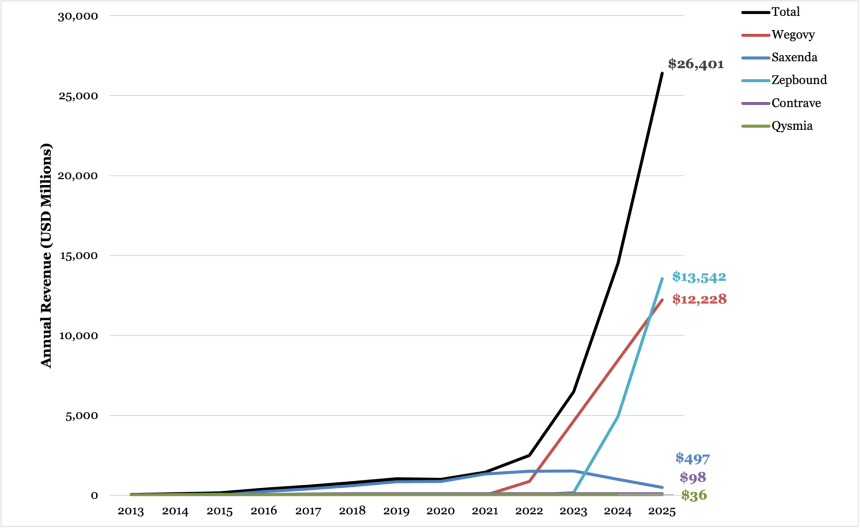
Overall Obesity Market 2025 Breakdown
| 2025 Revenue (Millions) | YOY Reported Growth | Share of Market | |
| Wegovy | $12,228 | +45% | 46% |
| Saxenda | $497 | -51% | 2% |
| Zepbound | $13,542 | +175% | 51% |
| Contrave (est.) | $98 | N/A | Flat |
| Qsymia (est.) | $36 | N/A | Flat |
| Total (est.) | $26,401 | +82% | -- |
4Q25 Obesity Medication Geographic Breakdown
| 4Q25 US Revenue (Millions) | US YOY Reported Growth | US Sequential Growth | 4Q25 OUS Revenue (Millions) | OUS YOY Reported Growth | OUS Sequential Growth | |
| Wegovy | $2,164 | -3% | +10% | $1,273 | +110% | +4% |
| Zepbound | $$4,231 | +122% | +19% | $31 | N/A | +57% |
| Saxenda | -- | -- | -- | $92 | -43% | -11% |
| Contrave (est.) | $25 | N/A | N/A | -- | -- | -- |
| Qsymia (est.) | $9 | N/A | N/A | -- | -- | -- |
| Total (est.) | $6,428 | +52% | +15% | $1,396 | +82% | +3% |
Obesity Medication Geographic Sales (1Q17 – 4Q25)
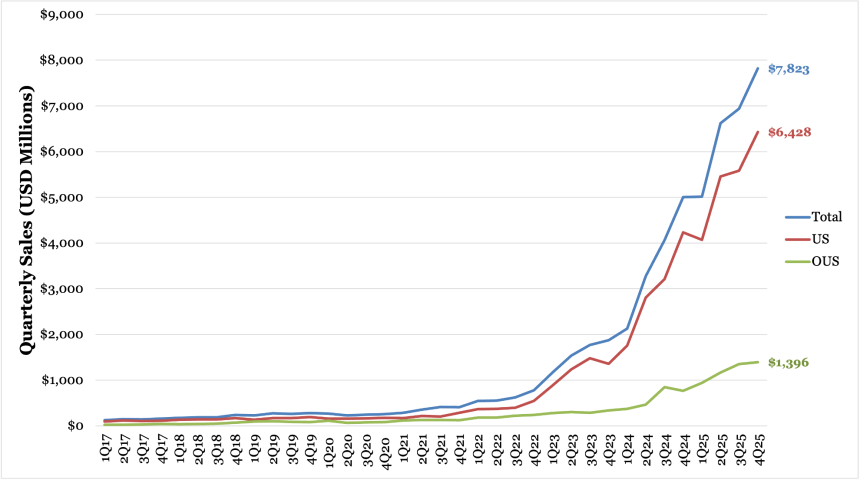
Annual Obesity Medication Geographic Sales (2017 – 2025)
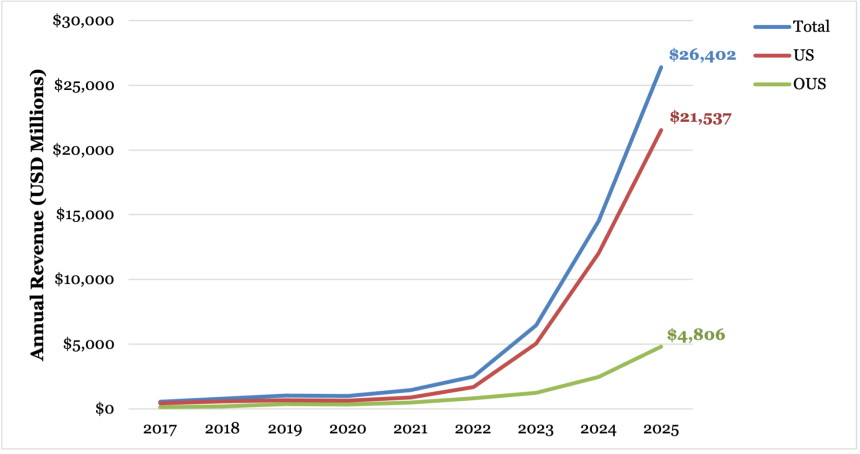
2025 Anti-Obesity Medication Geographic Breakdown
| 2025 US Revenue (Millions) | US YOY Reported Growth | 2025 OUS Revenue (Millions) | OUS YOY Reported Growth | |
| Wegovy | $7,878 | +16% | $4,350 | +163% |
| Saxenda | $41 | -79% | $456 | -44% |
| Zepbound | $13,485 | +174% | $59 | N/A |
| Contrave (est.) | $98 | N/A | N/A | -- |
| Qsymia (est.) | $36 | N/A | N/A | -- |
| Total (est.) | $21,537 | +79% | $4,806 | +95% |
Glucagon
In 4Q25, ready-to-use glucagon revenue totaled $73 million, up 11% from 4Q24 and down 9% sequentially. Sales in 2025 were $282 million, up 16% from the previous year. People with diabetes on insulin, sulfonylureas, and meglitinides are at risk of severe hypoglycemia. The ADA Standards of Care recommend that glucagon – preferably ready-to-use formulations – be prescribed for all individuals taking insulin and that family, caregivers, and school personnel are trained to administer it in acute hypoglycemic emergencies.
- Sales for Amphastar’s intranasal glucagon Baqsimi totaled $47 million in 4Q24, up 12% from 4Q24 and down 13% sequentially. For 2025, Baqsimi sales totaled $185 million, up 46%. Management attributed growth to an increase in unit volumes and greater marketing efforts in the US through its strategic co-promotion agreement with MannKind. In 2026, the company will prioritize increasing prescription volume over price through continued sales and marketing investments. As background, since 1Q25, Amphastar has had full control of Baqsimi from Lilly in all countries.
- Revenue for Xeris’ ready-to-use injectable Gvoke totaled $25 million in 4Q25, up 6% from 4Q24 and down 2% sequentially. In 2025, sales totaled $94 million, up 14% from 2024. Management attributed strong growth to net pricing and patient demand.
- Separately, intravenous glucagon Gvoke VialDx contributed to “other product sales” of $652,000 – in addition to royalty revenue of ~$8.8 million from partnerships. Gvoke VialDx was approved by the FDA in March 2025 as a diagnostic aid to inhibit GI motility during radiologic exams.
- While Zealand stopped reporting revenue for Zegalogue in 3Q22, we estimate that Zegalogue brought in about $500,000 in 4Q25, consistent with revenue and market share estimates from recent quarters.
Ready-to-Use Glucagon Sales (3Q19 – 4Q25)
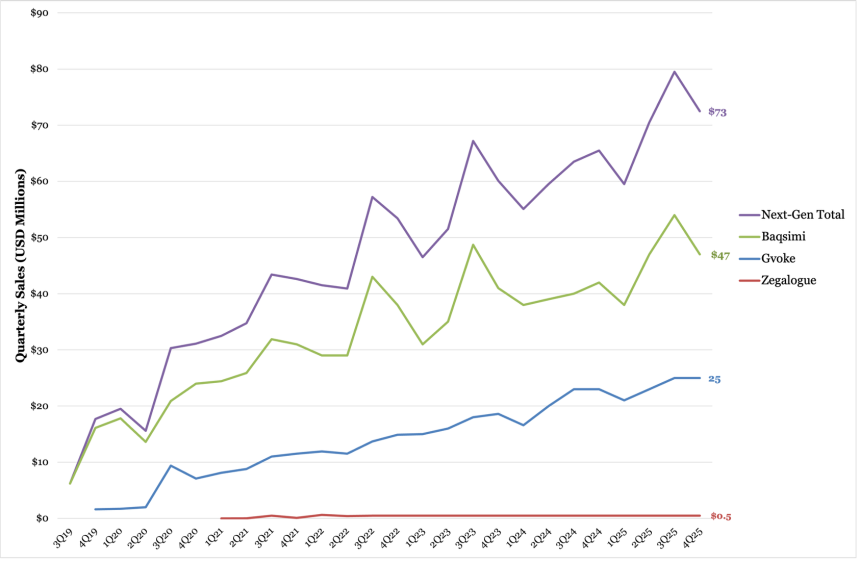
4Q25 Ready-to-Use Glucagon Sales
| 4Q25 Revenue (millions) | Growth | Sequential Growth | Share of Ready-to-Use Market (by revenue) | |
| Baqsimi | $47 | +12% | -13% | 65% |
| Gvoke | $25 | +6% | -2% | 34% |
| Zegalogue | ~$0.5 | -- | -- | <1% |
| Total | $73 | +11% | -9% | -- |
2025 Ready-to-Use Glucagon Sales
| 2025 Revenue (millions) | Growth | Share of Ready-to-Use Market (by revenue) | |
| Baqsimi | $185 | +46% | 67% |
| Gvoke | $94 | +14% | 33% |
| Zegalogue | ~$2 | -- | <1% |
| Total | $281 | +15% | -- |
PCSK9 Inhibitors
In 4Q25, the PCSK9 inhibitor market totaled $1.4 billion, up 42% from 4Q24 and up 9% sequentially. In the US, sales totaled $753 million, up 53% from 4Q24 and up 15% sequentially. The OUS market totaled $678 million, up 31% from 4Q24 and up 2% sequentially.
- Amgen’s Repatha (evolocumab) captured 61% of the market (up from 60% in 3Q25), with the revenue of $870 million, up 44% from 4Q24 and up 10% sequentially. US sales totaled $517 million, up 64% from 4Q24 and up 17% sequentially. OUS sales totaled $353 million, up 21% from 4Q24 and flat sequentially. Sales were driven by 31% volume growth, 8% higher net selling price, and higher inventory levels, per the company. In 2025, Repatha totaled $3.0 billion in sales, up 36% from 2024. The quarter was primarily driven by volume growth.
- Results from the landmark VESALIUS-CV trial (n=12,257) were presented at AHA 2025 and found that PCSK9 inhibitor Repatha (evolocumab) lowered LDL-c by 55% compared to placebo at Week 48 in people with diabetes and/or atherosclerosis. Evolocumab also lowered the risk of all-cause mortality by 20% and MACE by 25%. Specifically, in people with diabetes but not atherosclerosis, evolocumab led to 29% reduction in MACE. This finding supports low LDL-c goals (<55 mg/dL) in people with diabetes or early-stage atherosclerosis, changing the treatment paradigm.
- In the pipeline, the ongoing phase 4 EVOLVE-MI study (n=6,017) investigates Repatha administered within 10 days of acute MI to reduce the risk of CV events. The trial is expected to complete in May 2027.
- On pricing, Repatha is available through AmgenNow, the company’s new direct-to-patient program in the US, as well as on the TrumpRx platform. The therapy is priced at $239/month and is Amgen’s first offering on the platform. The price is nearly 60% below the current US list price, although management has previously said that over 95% of American patients have coverage for Repatha and pay less than $50/month out of pocket.
- Novartis’s infusion-based Leqvio (inclisiran) captured 23% of the market in 4Q25 (flat from 3Q25). Sales totaled $335 million in 4Q25, up 46% from 4Q24 and up 9% sequentially. US sales totaled $164 million, and OUS sales totaled $171 million. In 2025, Leqvio sales totaled $1.2 billion, up 57% from 2024, solidifying Leqvio’s position as a key long-term growth driver.
- In the literature, a study from November 2025 found that Leqvio had high adherence rates and consistent LDL-c-lowering effects over one year in US outpatient clinics. Data presented at AHA 2025 further demonstrated efficacy and safety in a real-world ASCVD population with post-acute coronary syndrome patients (V-INCEPTION; n=400) and LDL-c reduction regardless of background therapy (V-DIFFERENCE; n=1,776).
- In the pipeline, VICTORION-1-PREVENT trial (n=14,013) is evaluating primary prevention of cardiovascular events, and is expected to complete in April 2029. The ORION-4 (n=16,124) and VICTORION-2-PREVENT (n=17,004) trials are assessing Leqvio for secondary prevention of CV events in people with established CVD, with completion expected in 2026 and 2027, respectively.
- Sales for Regeneron and Sanofi’s Praluent (alirocumab) captured 16% of the market, totaling $226 million in 4Q25, up 25% from 4Q24 and 5% sequentially. In the US, sales totaled $72 million for the quarter, up 14% YOY and up 7% sequentially. OUS sales totaled $154 million, up 31% YOY and up 25% sequentially. Full-year global sales totaled $857 million, up 12% from 2024.
- Merck continues to investigate its oral PCSK9 inhibitor enlicitide in multiple phase 3 studies. Our main interest in the program is the CORALreef Outcomes (n=14,550) trial, which assesses cardiovascular outcomes in people with hypercholesterolemia, which is common in people with diabetes. The trials are expected to be completed in November 2029. As background, in the CORALreef Lipids trial (n=2,912), enlicitide decanoate significantly lowered LDL-c by 56% at Week 24 compared to placebo in adults with or at-risk for atherosclerotic cardiovascular disease.
PCSK9 Inhibitor Sales (1Q16 – 4Q25)
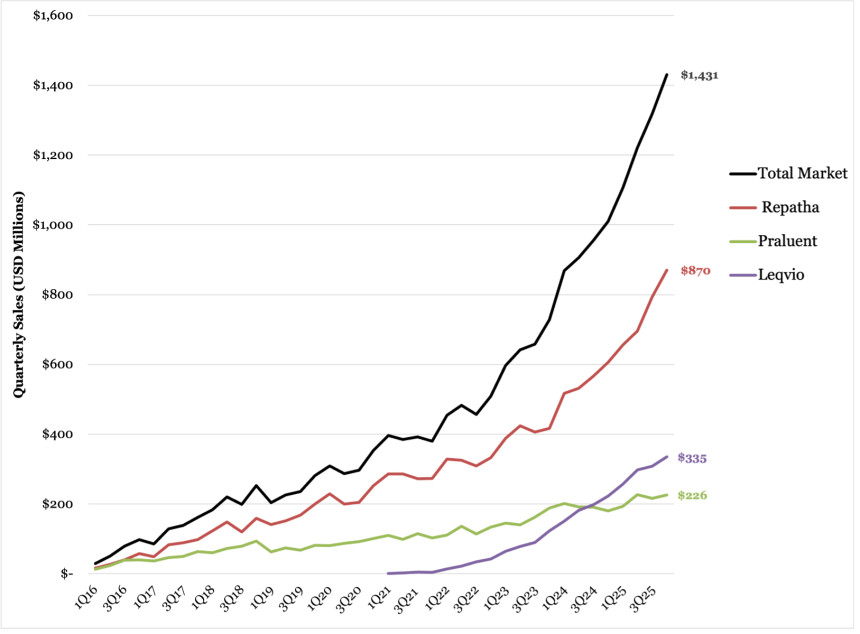
4Q25 PCSK9 Inhibitor Sales
| Revenue (Millions) | YOY Growth | Sequential Growth | Share of Market | |
| Repatha | $870 | +44% | +10% | 61% |
| Praluent | $226 | +25% | +5% | 16% |
| Leqvio | $335 | +46% | +9% | 23% |
| Total | $1,431 | +42% | +9% | -- |
4Q25 PCSK9 Inhibitor Geographic Breakdown
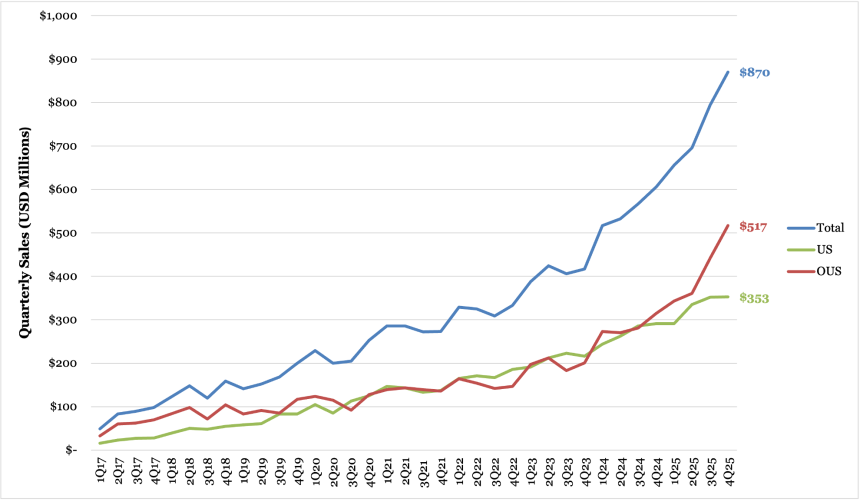
4Q25 PCSK9 Inhibitor Geographic Breakdown
| 4Q25 US Revenue (Millions) | US YOY Growth | US Sequential Growth | 4Q25 OUS Revenue (Millions) | OUS YOY Growth | OUS Sequential Growth | |
| Repatha | $517 | +64% | +17% | $353 | +21% | flat |
| Praluent | $72 | +14% | +7% | $54 | +31% | +25% |
| Leqvio | $164 | +41% | +12% | $171 | +60% | +6% |
| Total | $655 | +51% | +16% | $663 | +27% | +1% |
PCSK9 Inhibitor market share (1Q16 – 4Q25)
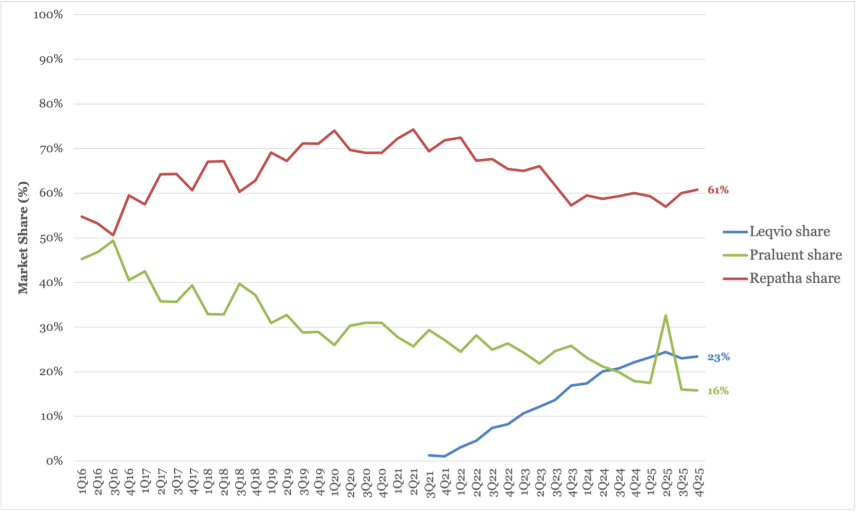
[1] Note that Ryzodeg, which is 70/30 insulin degludec and insulin aspart, divides its sales in our model as 70% in the next-generation basal segment and 30% in the next-generation rapid-acting segment.
[1] As of 1Q25, Roche no longer reports standalone Diabetes Care sales after merging this business into the Near Patient Care segment within the Diagnostics division last year.
[1] All graph data is current through 4Q25. Due to space constraints, the x-axis does not label every quarter; the most recent datapoint may not be explicitly marked on the horizontal axis.